

Butyrate Drink: What to Look For (and What the Research Actually Shows) 2026
I've spent an embarrassing amount of my life smelling butyrate.
I've opened jars of raw butyrate powder in a lab, taken it full in the face, and thought "there is no way anyone is drinking this." That reaction is the entire reason the butyrate supplement aisle looks the way it does.
Search "butyrate supplement" and you'll get capsules. Rows and rows of them. Search "butyrate drink" and you get almost nothing, which is strange for an ingredient this well studied.
The gap comes down to chemistry, and most brands solved that chemistry by giving up and putting it in a pill.
A butyrate drink is an oral supplement that delivers butyrate (a short-chain fatty acid your gut bacteria normally make) in a powder or liquid you mix with water instead of a capsule. Butyrate is the primary energy source for the cells lining your colon and supports gut barrier function. Most butyrate products are capsules because butyric acid has a strong, unpleasant odor.
The format question is settled here. For everything else, our butyrate supplement guide covers what butyrate does and which form absorbs best.
Key takeaways
- Butyrate feeds your colon cells and supports gut barrier function.
- Butyric acid's smell is why the category is almost entirely capsules.
- The GLP-1 connection is real in mice, unproven in humans. Be skeptical.
- Delivery form matters more than most labels admit.
- Prebiotic fiber feeds your own butyrate-producing bacteria alongside any supplement.
Why does your gut care about butyrate at all?
Butyrate is a short-chain fatty acid. Your gut bacteria make it by fermenting fiber you can't digest yourself, mostly down in the colon, mostly from stuff like resistant starch and inulin.
Then something unusual happens. Instead of shipping that butyrate off into your bloodstream like most nutrients, the cells lining your colon (colonocytes) eat most of it on the spot. Butyrate is their preferred fuel. It's estimated to cover the majority of their daily energy needs.
That local consumption has a downstream effect that I think is genuinely elegant. When colonocytes burn butyrate, they chew through oxygen. That keeps the gut lining low in oxygen, which stabilizes a protein called HIF-1a, which in turn helps maintain barrier function. Kelly and colleagues mapped this out in 2015 using cell cultures and mice.2 Animal and cell work, so hold it loosely, but the mechanism is coherent.
The flip side showed up in a 2016 Cell paper. Desai and colleagues fed gnotobiotic mice a fiber-free diet and watched their gut bacteria start eating the mucus layer instead, because that's the only carbohydrate left on the menu.8 Again, mice. But it's a vivid picture of what happens when the fermentation supply runs dry.
So butyrate is real, it matters, and your body already has a system for making it. Which raises an obvious question about supplements.
Your gut already makes butyrate. The interesting question is whether swallowing more of it does anything your colon wasn't already handling.
If your body makes it, why supplement it?
This is the honest tension in the whole category, and I'd rather put it on the table than hide it.
Butyrate made by your bacteria has a delivery problem in reverse. Colonocytes absorb most of it. Whatever slips past gets sent to the liver, where a large share is cleared on the first pass. Very little of your own butyrate ever reaches general circulation. Your colon gets fed. The rest of you mostly doesn't.
Oral butyrate has the opposite problem. Swallow butyrate and a lot of it gets absorbed high in the GI tract, in the stomach and small intestine, long before it reaches the colon where the fermentation normally happens. A 2025 rat study in Langmuir put it plainly, noting that oral tributyrin is "challenging due to its unpleasant odor, rapid metabolism, and fast absorption within the upper gastrointestinal tract."6
Two mirror-image problems. Endogenous butyrate barely leaves the colon. Supplemental butyrate barely reaches it.
That's why the smart version of this conversation is about delivery, and why I get itchy when a brand implies their capsule is bathing your entire colon in butyrate. The pharmacokinetics don't support that confidence.
Why is almost every butyrate supplement a capsule?
Because butyric acid smells like vomit.
I'm not being crude for effect. Butyric acid is literally one of the compounds responsible for the smell of rancid butter and, yes, vomit. Its name comes from the Greek for butter. It's the same molecule doing the work in both places.
The literature says so flatly. A 2026 Scientific Reports paper opens by noting that direct butyric acid supplementation "is not feasible because of its unpleasant taste and odor," which is why researchers reach for microencapsulated versions instead.1
Read it as a business decision and the whole category snaps into focus. Capsules are a workaround. Gelatin is a wall between your nose and the ingredient.
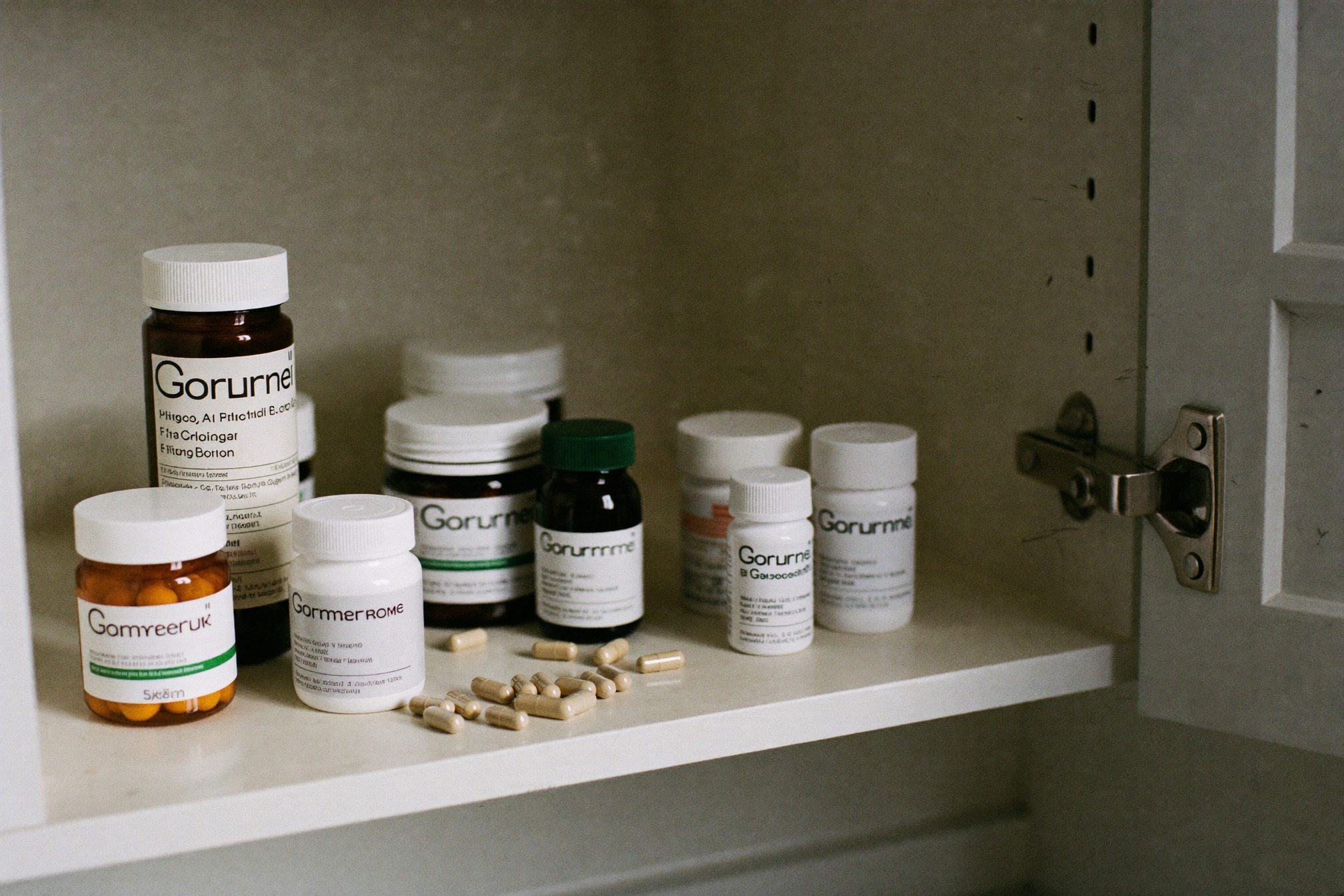
Which works, mostly, until you open the bottle. Anyone who's kept butyrate capsules in a bathroom cabinet knows the smell finds a way out. I've read a lot of Reddit threads on this. "Smells like a dog fart" is a direct quote and it comes up more than once.
The capsule is the easiest place to hide butyrate. That's the whole reason it won the category.
Which butyrate delivery form should you look for?
Here's where labels start doing gymnastics. Four main forms show up, and each one has a real trade-off.
| Form | What it is | Upside | Honest downside |
|---|---|---|---|
| Sodium butyrate | Butyrate bound to sodium. The classic. | Cheap, widely studied, well characterized. | Smells the strongest. Adds sodium. Absorbed high in the gut. |
| Microencapsulated sodium butyrate | Same salt, wrapped in a fat or polymer matrix. | Tames the odor. Aims release further down the tract. | "Encapsulated" isn't regulated. Coating quality varies wildly. |
| Tributyrin | 3 butyrates attached to a glycerol backbone. | Marketed as protected delivery. Dense per gram. | In a validated GI model it got cleaved in the stomach.7 Still smells. |
| Amino acid butyrate salts (e.g. L-lysine butyrate) | Butyrate paired with an amino acid instead of sodium. | No added sodium. More workable in a drink. Better sensory profile. | Thinnest research base. Zero human RCTs on this exact salt. |
That tributyrin row deserves a beat, because it's the form with the strongest marketing story.
Van Deuren and colleagues ran a human crossover study in 2023 and paired it with a validated model of the GI tract.7 Tributyrin, the "protected" one, was rapidly cleaved in the stomach. The protection story didn't hold where it needed to. When the researchers instead esterified butyrate with long-chain fatty acids, release moved down into the small intestine.
That's a useful finding and an uncomfortable one for anyone selling tributyrin as a colon-targeted delivery vehicle.
I'll say the quiet part about our own choice too. We use L-Lysine Butyrate (BIOMEnd) in Crave Crusher because it's the form we could actually get into cold water without it tasting like a crime. There are zero human randomized controlled trials on L-lysine butyrate specifically. It is not "clinically proven." Anyone telling you otherwise is selling.
Does butyrate actually raise GLP-1?
Short answer: no human study has shown that it does, and I'm not going to pretend otherwise.
Here's the full picture, because it's more interesting than the marketing version.
The excitement started with mouse and cell work. A 2012 Diabetes paper showed short-chain fatty acids stimulate GLP-1 secretion through a receptor called FFAR2, using mice and cell models.3 Knock out the receptor, blunt the GLP-1 response. Tidy. That paper is the origin of roughly every "butyrate boosts GLP-1" claim you've read.
Then a 2018 rat study complicated it. Researchers perfused an isolated rat colon with short-chain fatty acids and measured GLP-1 and PYY directly.4 An FFAR2/FFAR3 agonist produced no effect at all. Their read: butyrate might be acting as fuel for colonocytes rather than flipping a simple receptor switch.
So we have a mouse study saying receptor, a rat study saying probably not the receptor, and no human trial closing the loop.
That's the actual state of the science. Butyrate and GLP-1 are connected in preclinical models through mechanisms researchers are still arguing about. The proposed pathway is plausible. It is not established in people.
We think the mechanism is promising enough to build around. That's a bet, and I'd rather label it as one. If you want the longer version, I wrote a whole post on butyrate and GLP-1 that walks through each study. And if you're new to the hormone itself, start with what GLP-1 actually is.
Broader SCFA biology (barrier function, immune signaling, metabolic crosstalk) is on firmer ground. A 2023 review in Cell Communication and Signaling covers the territory well if you want the deep version.5
What should you look for on a butyrate drink label?
Six things, roughly in order of how much they'd change my mind about buying.
1. Does it name the form? "Butyrate 500mg" tells you nothing. Sodium butyrate, tributyrin, and L-lysine butyrate behave differently. A label that won't specify is hiding something or doesn't know.
2. Does it pair butyrate with prebiotic fiber? This is the one I'd weight heaviest. Supplemental butyrate mostly gets absorbed early. Prebiotic fiber travels to the colon and feeds the bacteria that make butyrate where it counts. Doing one without the other leaves the better half on the table.
3. Does it over-claim? If the label says butyrate is "clinically proven to boost GLP-1," you now know that's mouse data wearing a suit.
4. What's the sodium load? Sodium butyrate carries sodium by definition. Usually fine, worth knowing.
5. Can you actually drink it? Sounds trivial. It isn't. A supplement you dread doesn't get taken, and consistency is the whole ballgame with gut stuff.
6. What else is in there? Butyrate alone is a narrow play. Fiber, something for satiety, something for blood sugar support: those pull in the same direction.
How does Ozzi handle the butyrate problem?
I'll be specific, since that's the point of this whole post.
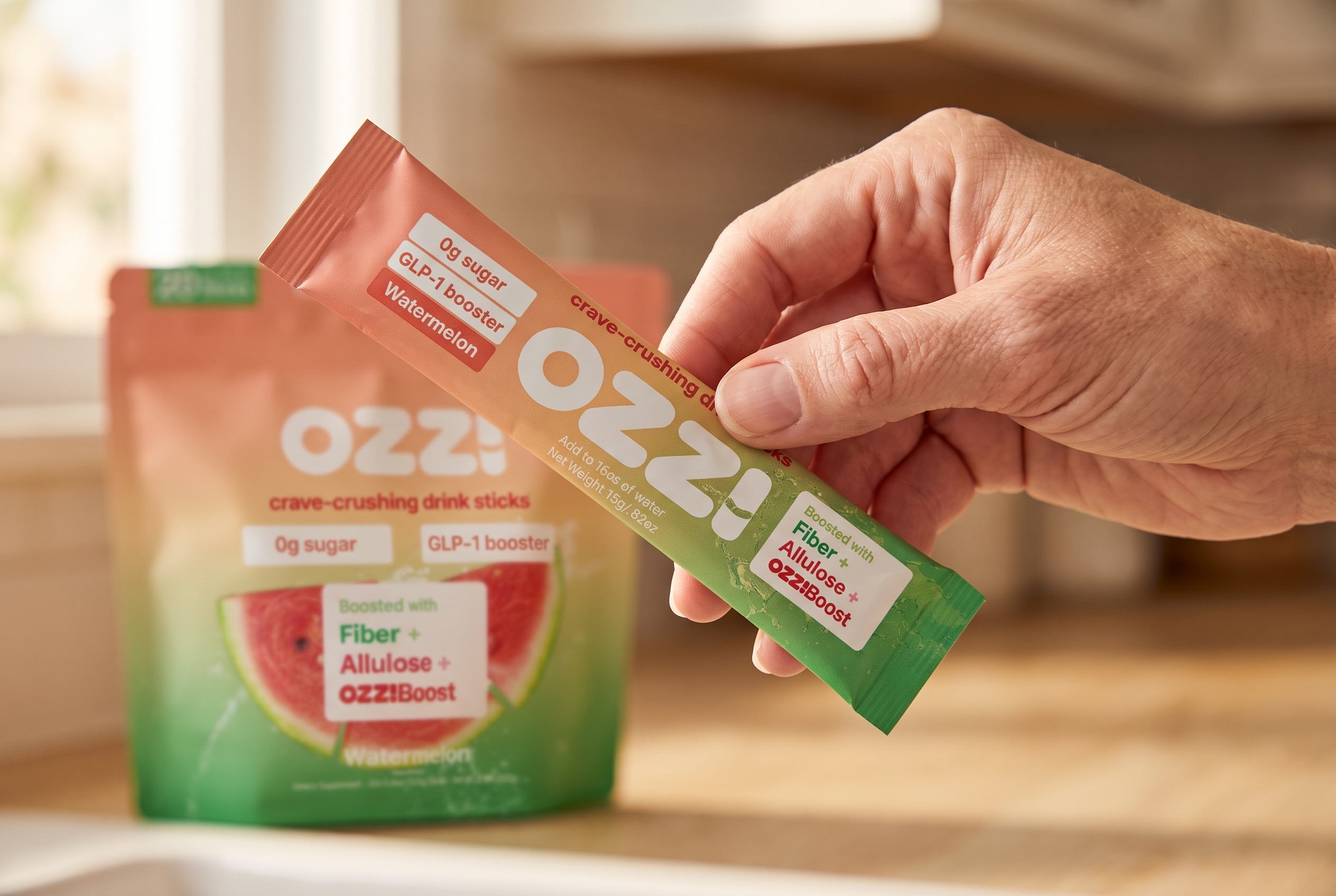
Crave Crusher is a stick pack you dump in cold water. Per serving there's 0.537g of L-Lysine Butyrate (BIOMEnd), 0.5g of chicory root inulin, 0.556g of glucomannan, 8.35g of allulose, 0.15g of African mango extract, and 11mg of chromium polyursolate (Metabolex).
The butyrate and the inulin are a deliberate pair. L-Lysine Butyrate brings butyrate in directly. Chicory root inulin is a prebiotic fiber that feeds butyrate-producing bacteria in your colon, where your own supply gets made. Direct plus prebiotic, working the problem from both ends.
The glucomannan is doing something separate and much less speculative. It's a viscous fiber that absorbs water and expands in your stomach, which supports satiety. That's a physical mechanism, not a hormonal maybe. If you want the fiber comparison, I broke it down in best fiber for appetite control.
Texture and mixability matter more than you'd think when the alternative is a gritty glass of konjac.
Getting butyrate to disappear into a lychee-flavored cold drink took longer than any other part of the formula. Allulose helped. Cold water helped (aroma volatilizes less). Getting the lysine salt right instead of the sodium salt helped most.
No berberine. No caffeine. No stimulants. No artificial sweeteners. Vegan.
Who's actually reaching for this?
Women in their 40s, mostly, who describe the same evening in almost identical words.
The kids are down. The kitchen's clean. And then something switches on around 8pm. About 45% of our customers describe nighttime cravings as their main problem, and the word they reach for is food noise: a running commentary about the pantry that won't shut off.
"The monster comes out at night" is a real customer quote. So is "I feel out of control." So is "I've tried everything." One woman told me she'd been smashing cookies at 10pm for 6 years and had stopped believing anything would touch it.
The gut angle matters here because appetite signaling doesn't start in your head. It starts in your gut, and I've written more about that connection in gut health and GLP-1.
What I won't tell you is that butyrate fixes night cravings. No study shows that. What I'll tell you is that we built a formula around a mechanism we find compelling, made it drinkable, and let people judge for themselves.
How do you take a butyrate drink?
Cold water. Always cold. Warm water pushes more aroma into the air, and with butyrate you want it staying in the glass.
Once a day, and pick a time you'll actually stick to. Most of our customers drink it late afternoon or early evening, ahead of the window where things usually go sideways.
Start slower if you're fiber-sensitive. Glucomannan and inulin are both fermentable, and if your gut isn't used to that, day 3 can be gassy. That settles for most people within a week or two. Drink real water alongside it, not just the 8oz the stick goes in. More on that in GLP-1 bloating and constipation relief.
Give it 2 weeks before you judge. Gut adaptation isn't fast, and anything that promises a next-day transformation is describing caffeine.
Butyrate drink FAQ
What is a butyrate drink?
A butyrate drink delivers butyrate, a short-chain fatty acid your gut bacteria make from fiber, in a powder or liquid you mix with water instead of a capsule. Butyrate is the primary energy source for the cells lining your colon and supports gut barrier function.
Is a butyrate drink better than butyrate capsules?
Neither form has been shown superior for absorption in humans. The practical difference is compliance. Capsules exist mainly to contain butyric acid's odor, and a drink you enjoy tends to get taken more consistently than a bottle you'd rather not open.
Why does butyrate smell so bad?
Butyric acid is one of the compounds behind the smell of rancid butter. The odor is intrinsic to the molecule. Peer-reviewed literature describes direct butyric acid supplementation as not feasible specifically because of its taste and odor.1
Does oral butyrate reach the colon?
Much of it doesn't. Oral butyrate is largely absorbed in the upper GI tract before reaching the colon.6 This is why pairing a butyrate supplement with prebiotic fiber makes sense: the fiber travels to the colon and feeds bacteria that produce butyrate there.
Does butyrate increase GLP-1?
No human study has shown that butyrate raises GLP-1. The connection comes from mouse and cell research proposing an FFAR2 receptor mechanism,3 and a rat study later found no effect from an FFAR2/FFAR3 agonist, suggesting butyrate may act as colonocyte fuel instead.4 Treat it as a proposed mechanism.
Is L-lysine butyrate clinically proven?
No. There are no human randomized controlled trials on L-lysine butyrate specifically. It's chosen for formulation reasons (no added sodium, better sensory profile in a drink), not because of its own trial record.
Is tributyrin better than sodium butyrate?
Not clearly. Tributyrin is marketed as protected delivery, but in a validated GI model it was rapidly cleaved in the stomach.7 Esterifying butyrate with long-chain fatty acids moved release into the small intestine instead.7
Can I just eat fiber instead?
Fiber is the foundation, honestly. Your bacteria make butyrate from fermentable fiber, and in gnotobiotic mice a fiber-free diet pushed gut bacteria to degrade the mucus layer.8 A butyrate supplement sits alongside fiber, not in place of it.
Does butyrate cause bloating?
Butyrate itself usually doesn't. The prebiotic fiber often packaged with it can, especially in the first week, because your bacteria are fermenting something new. Starting with a half serving generally smooths it out.
How long until a butyrate drink does anything?
Give it at least 2 weeks of daily use. Gut adaptation is slow and unglamorous. Anything promising overnight results is probably selling you a stimulant.
A butyrate drink you'll actually finish
Crave Crusher puts L-Lysine Butyrate, prebiotic inulin, and glucomannan into a cold-water stick pack. No capsules to open, no smell to brace for, no berberine, no stimulants. Try it for 14 days straight. If it doesn't work, we'll refund your first bag.
References
- Effect of microencapsulated sodium butyrate on abdominal symptoms and carbohydrate metabolism in patients with type 2 diabetes. Sci Rep. 2026. PMID: 41974937. doi:10.1038/s41598-026-47309-9
- Kelly CJ, et al. Crosstalk between Microbiota-Derived Short-Chain Fatty Acids and Intestinal Epithelial HIF Augments Tissue Barrier Function. Cell Host Microbe. 2015. (Cell culture and rodent study.) PMID: 25865369. doi:10.1016/j.chom.2015.03.005
- Tolhurst G, et al. Short-chain fatty acids stimulate glucagon-like peptide-1 secretion via the G-protein-coupled receptor FFAR2. Diabetes. 2012. (Mouse and cell study, not human.) PMID: 22190648. doi:10.2337/db11-1019
- Christiansen CB, et al. The impact of short-chain fatty acids on GLP-1 and PYY secretion from the isolated perfused rat colon. Am J Physiol Gastrointest Liver Physiol. 2018. (Rat study.) PMID: 29494208. doi:10.1152/ajpgi.00346.2017
- Short-chain fatty acids in diseases. Cell Commun Signal. 2023. (Review.) PMID: 37596634. doi:10.1186/s12964-023-01219-9
- Oral delivery of tributyrin. Langmuir. 2025. (Rat study.) PMID: 40695562. doi:10.1021/acs.langmuir.5c02226
- van Deuren T, et al. Butyrate and hexanoate-enriched triglycerides increase postprandrial systemic butyrate and hexanoate in men with overweight/obesity. Front Nutr. 2023. (Human crossover, n=12, plus validated GI model.) PMID: 36687671. doi:10.3389/fnut.2022.1066950
- Desai MS, et al. A Dietary Fiber-Deprived Gut Microbiota Degrades the Colonic Mucus Barrier and Enhances Pathogen Susceptibility. Cell. 2016. (Gnotobiotic mouse study.) PMID: 27863247. doi:10.1016/j.cell.2016.10.043
These statements have not been evaluated by the Food and Drug Administration. This product is not intended to diagnose, treat, cure, or prevent any disease.
