

Butyrate Smell and Taste, Explained: Why It's Funky and What Helps (2026)
Butyrate smells bad because free butyric acid is a tiny four-carbon molecule that evaporates readily and binds olfactory receptors at extremely low concentrations. Published human testing puts the odor detection threshold near 0.26 parts per billion, so trace amounts are enough to register as rancid, cheesy, or sour.
The smell is one chapter of a bigger story. Our butyrate supplement guide covers the benefits, the forms, and the absorption data in one place.
Key takeaways
- Free butyric acid is detectable near 0.26 parts per billion.
- Salt forms hold butyrate in place and cut volatility.
- Roughly 10 to 15 percent of people notice it strongly.
- Most of what you "taste" is actually retronasal smell.
- A faint funk doesn't mean the product spoiled.
Every butyrate supplement company gets the same email. Some version of "why does this smell like parmesan that lost a fight."
I'd rather explain it than pretend it isn't a thing. The chemistry is actually kind of interesting, and once you know what's happening you can tell the difference between a normal trace odor and a product that's genuinely off.
Here's the whole picture, including what Ozzi does about it and where we still have work to do.
Why does butyrate smell so bad?
Butyric acid is a four-carbon short-chain fatty acid. Small molecule, low molecular weight, and it evaporates at room temperature without much encouragement.
That's half the story. The other half is your nose.
Cometto-Muñiz and Abraham measured concentration-detection curves for a family of carboxylic acids in young, healthy, normal-smelling adults. Butyric acid came in with an odor detection threshold around 0.26 parts per billion, and the authors noted that thresholds in their sample ran lower than what older literature had reported.1
0.26 ppb is a rounding error of a concentration. For comparison, that's the kind of number where a quantity you could not weigh on a kitchen scale fills a room.
So the intensity comes from sensitivity, not quantity. Human olfaction is tuned to catch butyric acid at almost nothing, which is why a trace reads as overwhelming.
There's a reason for that tuning. Butyric acid is a signature of fermentation and spoilage. It's in aged cheese, in rancid butter (the name comes from butyrum, Latin for butter), and in vomit. A nose that catches it early was useful.
Your nose is doing exactly the job it evolved to do: catching fermentation early.
Which receptors actually pick it up?
Short-chain fatty acids converge on a small set of human olfactory receptors, notably OR51E1 and OR51E2.
In 2023 a team published a cryo-EM structure of active human OR51E2 bound to propionate, a three-carbon cousin of butyrate. The odorant sits in a tight, occluded pocket, and mutating that pocket shifted which chain lengths the receptor would accept.2
The practical takeaway: these receptors are shape-picky in a way that makes short fatty acids very hard to sneak past. OR51E1 responds to butyric acid specifically. It's not a receptor you can talk out of noticing.

What does butyrate actually taste like?
Mostly it tastes like it smells, and that's not a coincidence.
Flavor is largely olfaction. When you drink something, volatiles travel up the back of your throat to the same olfactory receptors your nostrils use. That's retronasal smell, and a 2018 review in Critical Reviews in Food Science and Nutrition walks through how orthonasal (sniffing) and retronasal (eating) perception differ in intensity and neural processing even for identical molecules.3
Which is why people describe butyrate as an aftertaste. The volatiles are still working after you swallow.
On top of the smell component, butyrate sources carry real taste attributes. Tributyrin in particular is documented as strongly bitter with cheesy and fecal aroma notes, which is exactly why food scientists keep trying to encapsulate it.4
Descriptors people actually use: sour milk, parmesan rind, gym bag, wet dog, feet. Nobody's imagining it.
Why do some people smell it way more than others?
Because odor perception is genuinely genetically variable, and the differences are bigger than most people assume.
The cleanest human example is OR7D4 and androstenone. A 2007 Nature paper showed that two common coding variants in OR7D4 impair receptor function, and people carrying them rated androstenone as less intense and less unpleasant than people with the functional version.5 Same molecule, same room, different experience.
That turned out to be a pattern rather than a curiosity. A 2019 PNAS study screened variation across the human olfactory receptor repertoire and found that common genetic differences shifted perceived intensity and pleasantness for a broad range of odors.6
Nobody has published an OR7D4-style variant map for butyric acid specifically. So I'll be honest about the limit of the evidence: the general principle is well established in humans, the butyrate-specific mapping isn't done yet.
Our working estimate from customer feedback is that roughly 10 to 15 percent of people notice butyrate strongly even when everyone else in the room notices nothing. If you're in that group, you're not being dramatic. You're carrying a more sensitive version of a receptor.

Do the different butyrate forms smell different?
Yes, and the differences are large. This is the single biggest factor in whether a butyrate product is pleasant to take.
The core principle: free butyric acid is what escapes into the air. Anything that keeps butyrate chemically bound or physically wrapped keeps it out of your nose.
| Form | Odor profile | Why |
|---|---|---|
| Free butyric acid | Severe | Nothing holding it down. Volatile at room temperature. |
| Sodium butyrate (uncoated) | Strong | Salt form helps, but it's hygroscopic and releases free acid readily. |
| Tributyrin | Moderate, plus bitter | Esterified, so less free acid, but documented cheesy and bitter attributes. |
| Amino-acid butyrate salts | Low | Ionic pairing suppresses vapor pressure of free butyric acid. |
| Encapsulated or coated | Lowest | Physical barrier between the molecule and the air. |
If you want the full breakdown of how the forms compare on more than odor, I wrote a longer piece on sodium butyrate vs tributyrin.
How do supplement makers cut the smell?
Four levers, roughly in order of how much they help.
1. Pick a bound form. Salt pairing is the cheapest and most effective single move. When butyrate is ionically held by a counterion, the equilibrium amount of free butyric acid drops, and the vapor pressure drops with it.
2. Encapsulate it. This is a real research area. A 2020 Journal of Food Science study spray-dried tributyrin into gamma-cyclodextrin and got full retention of the tributyrin at a 1:2 molar ratio, with butyrate still released during in vitro fermentation using piglet ileal and colonic contents.7 Note the species: that fermentation work was piglet material in a lab, not a human study.
An earlier study from the same group used sensory R-index testing to show that wall material and drying method measurably changed how detectable microencapsulated tributyrin was in a food matrix.8 Encapsulation performance shows up on a trained sensory panel, so you can measure whether it actually worked.
3. Cover it with competing aroma. Flavor houses stack high-impact aroma compounds in the same perceptual bandwidth. Vanilla, cocoa, dark berry, citrus, and trigeminal cooling from mint all pull attention away from the funk.
The catch: cover systems get calibrated to the median nose. A cover that works for 85 percent of people can still fail for the sensitive cohort, because they're detecting a signal the panel average never registered.
4. Control moisture in the package. Water is what dissociates salts and frees butyric acid. Desiccant-lined packaging pulls residual moisture out of the powder after sealing, which keeps the free-acid level from drifting upward on the shelf.
Masking a smell for the average person and masking it for the person actually complaining are two different engineering problems.
What does Ozzi do about it?
Ozzi uses 500mg of L-Lysine Butyrate per stick, which is butyrate ionically paired with the amino acid lysine. Bound butyrate, not free acid.
The stick packs are lined with a moisture-scavenging layer that pulls residual water out of the powder after sealing, which matters because allulose (8g per stick, the largest ingredient by weight) is hygroscopic.
And Ozzi is a cold-water drink. Volatility drops with temperature, so the in-glass experience is milder than the dry-pack experience. Ice water genuinely helps here.
Where we're still working: a trace amount of free butyric acid accumulates in any L-Lysine Butyrate system, even a dry one. Most people never notice it. The sensitive 10 to 15 percent can, both when they open the stick and in the glass afterward.
We're pushing on that with tighter supplier specs for incoming free-acid levels and deeper cover work aimed at the sensitive cohort rather than the median. I'd rather tell you that than claim we solved it.
Does the smell mean it's gone bad?
Usually no. A faint tang at the moment you tear the stick open is the expected baseline for any butyrate product.
What would actually concern me:
- The powder has clumped into a solid brick (moisture got in)
- The smell got noticeably stronger over weeks of storage
- Visible discoloration or wetness inside the pack
- The pack was stored somewhere hot, like a car in summer
Heat and humidity are the two things that turn a trace odor into a real one. Store sticks in a cool, dry cabinet and skip the bathroom.
If something looks or smells clearly wrong, email us. That's a manufacturing question, not a chemistry question.
Is the smell worth putting up with?
That depends on what you want butyrate for, and I want to be careful here.
What's well established: butyrate is the primary energy source for the cells lining your colon. Human colonocytes derive the bulk of their oxidative energy from butyrate, and this has been reviewed extensively.9,10 That's the claim I'm comfortable making.
What isn't established: whether oral butyrate raises GLP-1 in humans. The appetite mechanism people cite comes from rodent and cell studies. A human trial that successfully raised circulating butyrate measured GLP-1 as a named secondary outcome and found no change.
So the honest framing is that butyrate has a solid gut-cell rationale and a preclinical appetite hypothesis. I go deeper on that split in butyrate and GLP-1 and in the broader butyrate forms breakdown.
If you'd rather build butyrate through food, the dietary fiber route works and smells like nothing. It's slower and less controlled, but it's a real option.
Frequently asked questions
Why does my butyrate supplement smell like vomit?
Butyric acid is one of the main odor compounds in vomit, so the association is chemically accurate. Trace free butyric acid escaping the powder is enough to trigger it, since humans detect it near 0.26 parts per billion.
Does the smell mean the product is working?
No. Smell intensity tracks how much free butyric acid escaped the matrix, not how much butyrate reaches your gut. A well-encapsulated product can smell like almost nothing and still deliver.
Will the smell go away if I keep taking it?
Often yes, through habituation. Olfactory adaptation reduces perceived intensity of a repeated odor. Some people report the funk fading within a week or two.
Does cold water actually help?
Yes. Vapor pressure drops as temperature drops, so fewer volatiles reach your nose. Ice-cold water makes a noticeable difference with cold-mix butyrate powders.
Can I mix butyrate with juice or a smoothie to hide the taste?
You can, and competing aromas do help. Citrus and berry work well. Check whether your product is formulated for cold water first, since some powders don't disperse in thick liquids.
Do butyrate capsules smell less than powders?
At the moment of opening, yes, because the capsule shell is a physical barrier. Some people report butyrate burps afterward, which is the same molecule arriving retronasally.
Is a butyrate smell a sign of a low-quality product?
Not on its own. It usually reflects the form used and the packaging. A strong smell that grows over time in storage is a different matter and worth flagging to the company.
Why can't I smell it when my partner says it's awful?
Genetic variation in olfactory receptors. Human studies have shown common receptor variants that shift both perceived intensity and pleasantness of specific odors, so two people really can get different signals from the same glass.
Does holding your nose while drinking work?
Partly. It blocks orthonasal smell at the moment of drinking, but retronasal volatiles still reach the receptors when you exhale afterward. Cold water plus a strong flavor tends to work better.
Does Ozzi smell like butyrate?
Faintly, for some people. L-Lysine Butyrate is a bound form and the pack is moisture-controlled, so most customers report a watermelon drink and nothing else. A sensitive minority notices a trace, mostly right when the stick is opened.
Butyrate that goes down like a watermelon drink
Ozzi Crave Crusher puts 500mg of bound L-Lysine Butyrate, 8g of allulose, and 500mg of glucomannan into one cold-water stick. Mix it with 16oz of ice water.
Try it for 14 days straight. If it doesn't work, we'll refund your first bag.
Where to go next
If you're evaluating butyrate products, start with the butyrate drink format comparison and the forms breakdown.
For the gut context, gut health and GLP-1 covers how the microbiome ties into appetite, and leaky gut and inflammation separates the real barrier science from the marketing.
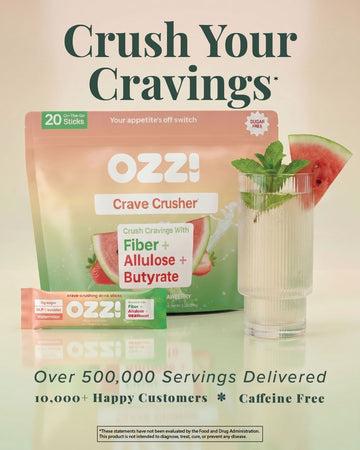
Butyrate you can actually drink
Ozzi Crave Crusher
500mg of BIOMEnd L-lysine butyrate per stick, the form rated most palatable of three in a 2025 human trial, alongside allulose, konjac fiber, chromium and African mango. No capsules, no caffeine, and no butyric acid smell.
See what's in it →References
- Cometto-Muñiz JE, Abraham MH. Structure-activity relationships on the odor detectability of homologous carboxylic acids by humans. Exp Brain Res. 2010;207(1-2):75-84. doi:10.1007/s00221-010-2430-0 (human)
- Billesbølle CB, de March CA, van der Velden WJC, et al. Structural basis of odorant recognition by a human odorant receptor. Nature. 2023;615(7953):742-749. doi:10.1038/s41586-023-05798-y (human receptor, structural/in vitro)
- Goldberg EM, Wang K, Goldberg J, Aliani M. Factors affecting the ortho- and retronasal perception of flavors: A review. Crit Rev Food Sci Nutr. 2018;58(6):913-923. doi:10.1080/10408398.2016.1231167 (human, review)
- Donovan SM, Wang M, et al. Volatile retention and morphological properties of microencapsulated tributyrin varied by wall material and drying method. J Food Sci. 2016;81(9):S2237-S2242. doi:10.1111/1750-3841.13415 (food science, sensory panel)
- Keller A, Zhuang H, Chi Q, Vosshall LB, Matsunami H. Genetic variation in a human odorant receptor alters odour perception. Nature. 2007;449(7161):468-472. doi:10.1038/nature06162 (human)
- Trimmer C, Keller A, Murphy NR, et al. Genetic variation across the human olfactory receptor repertoire alters odor perception. Proc Natl Acad Sci USA. 2019;116(19):9475-9480. doi:10.1073/pnas.1804106115 (human)
- Shi H, Wang M, Donovan SM, Lee SY, et al. Encapsulation of tributyrin by gamma-cyclodextrin: complexation, spray drying, and in vitro fermentation. J Food Sci. 2020;85(10):3167-3174. doi:10.1111/1750-3841.15440 (in vitro, piglet ileal and colonic contents)
- Hamer HM, Jonkers D, Venema K, Vanhoutvin S, Troost FJ, Brummer RJ. Review article: the role of butyrate on colonic function. Aliment Pharmacol Ther. 2008;27(2):104-119. doi:10.1111/j.1365-2036.2007.03562.x (review, human and preclinical)
- Xiong RG, Zhou DD, Wu SX, et al. Health benefits and side effects of short-chain fatty acids. Cell Commun Signal. 2023;21(1):212. doi:10.1186/s12964-023-01219-9 (review, human and preclinical)
- Roediger WEW. Role of anaerobic bacteria in the metabolic welfare of the colonic mucosa in man. Gut. 1980;21(9):793-798. doi:10.1136/gut.21.9.793 (human tissue)
These statements have not been evaluated by the Food and Drug Administration. This product is not intended to diagnose, treat, cure, or prevent any disease. This article is for general education and is not medical advice.
