

How to Increase Butyrate Naturally: Food, Fiber, and What the Research Really Shows (2026)
To increase butyrate naturally, feed your gut bacteria fermentable fiber. The strongest food levers are resistant starch (cooked-and-cooled potatoes, rice, and oats, plus green bananas and legumes) and prebiotic fibers like inulin from chicory, onions, and garlic. Eat 30 or more different plants a week, add fermented foods, and move most days. Ramp fiber up slowly.
Food first is the right instinct. If you're weighing a supplement too, our butyrate supplements guide shows what the human data actually supports.
Key takeaways
- Butyrate is made by gut bacteria fermenting fiber, not eaten directly.
- Resistant starch and inulin are the two most-studied fuel sources.
- Plant variety matters more than any single "superfood."
- Human trials show modest butyrate gains over weeks, not days.
- Ramp fiber slowly or you'll trade cravings for bloating.
Butyrate is having a moment. It's on supplement labels, in gut-health threads, and in my inbox almost daily. Most of the questions boil down to one thing: how do I actually get more of it?
Here's the honest version. Your colon cells run on butyrate. It's their preferred fuel. And the cleanest way to make more of it is to feed the bacteria that produce it, then get out of the way.
I'll walk through what works, what the human research really shows, and where the hype outruns the evidence. I sell a product with butyrate in it, so I'll flag my bias when it's relevant and keep the claims tight.
What is butyrate, and why does your gut want more of it?
Butyrate is a short-chain fatty acid. Your gut bacteria produce it when they ferment certain fibers in your colon.
It's the primary energy source for the cells lining your colon. Those cells prefer butyrate over glucose, which is unusual in human biology. When butyrate is around, the gut lining has fuel to do its job.
Research also connects butyrate-producing bacteria to broader markers of metabolic health. In an 8-week randomized trial on a Mediterranean diet, participants who improved their diet showed more microbial genes tied to butyrate metabolism, alongside better insulin sensitivity, and that happened independently of how many calories they ate (gut health and appetite are tightly linked). According to PubMed, that's Meslier and colleagues in Gut, 2020.

How do you actually increase butyrate naturally?
Six levers, roughly in order of how much evidence backs them. None of them is exotic.
1. Resistant starch. This is starch that skips digestion in the small intestine and reaches the colon intact, where butyrate-producing microbes ferment it. You make it at home by cooking and then cooling starchy foods: potatoes, rice, pasta, oats. The cooling step matters. Green (unripe) bananas, cooked-and-cooled legumes, and lentils are natural sources too.
2. Prebiotic fibers like inulin. Inulin, FOS, and GOS selectively feed bacteria that seed butyrate production, especially Bifidobacterium. Chicory root is the densest source. Onions, garlic, leeks, asparagus, and slightly-underripe bananas carry it too. Inulin is one of the fibers in Ozzi, and it's the one with the deepest human research behind it for feeding butyrate-producing bacteria.
3. Plant variety. Different bacteria eat different fibers. The people with the most diverse, resilient microbiomes tend to eat the widest range of plants. A common target is 30 or more different plant foods a week, counting herbs, spices, nuts, and seeds.
4. Fermented foods. Sauerkraut, kimchi, kefir, and live yogurt add microbial traffic and, in some studies, nudge diversity up. They're a supporting player, not the main event.
5. Polyphenols. The plant compounds in berries, cocoa, green tea, olive oil, and coffee act as prebiotic-like fuel and are associated with more butyrate-producing bacteria such as Faecalibacterium prausnitzii.
6. Movement. Exercise shows up in the gut literature as an independent factor. Lower physical function tends to track with fewer butyrate-producing bacteria in humans, though the causal arrow is still fuzzy. Walking counts.
Butyrate fuel sources, side by side
| Fuel source | Best everyday foods | What human research suggests |
|---|---|---|
| Resistant starch | Cooked-and-cooled potatoes, rice, oats; green bananas; lentils | Shifts butyrate-producing bacteria up; lowers post-meal glucose in some trials |
| Inulin / FOS | Chicory root, onions, garlic, leeks, asparagus | Reliably increases Bifidobacterium and diversity in RCTs |
| Combined fibers | Inulin plus resistant starch together | Raised fasting plasma butyrate in lean men in one crossover trial |
| Polyphenols | Berries, cocoa, green tea, olive oil, coffee | Associated with more butyrate producers; mostly observational |
| Fermented foods | Kimchi, sauerkraut, kefir, live yogurt | Can raise microbial diversity; butyrate effect less direct |
You're not buying butyrate. You're hiring the bacteria that make it, then paying them in fiber.
What does the human research actually show?
This is where I want to be careful, because a lot of butyrate content leans on mouse studies and presents them as settled human fact.
According to PubMed, here's the human picture. In a 21-day randomized crossover trial, a high-SCFA diet built from resistant starch, inulin, and apple cider vinegar raised plasma butyrate in healthy adults compared to a matched low-SCFA diet. That's Gill and colleagues in the American Journal of Clinical Nutrition, 2023. Real people, real diet, measurable bump.
In a separate crossover trial, combining long-chain inulin with resistant starch raised fasting plasma butyrate in lean men, along with higher PYY (a fullness hormone) and lower post-meal glucose. That's Canfora and colleagues in Gut Microbes, 2022.
Now the honest wrinkle. Not every fiber study moves butyrate. When researchers added one potato side dish per day, butyrate-producing bacteria went up but fecal butyrate itself didn't budge (DeMartino and colleagues, Nutrients, 2022). Resistant starch from wheat lowered post-meal glucose without a significant fecal butyrate change (Hughes and colleagues, Nutrients, 2021).
The pattern: fiber consistently shifts the bacteria that make butyrate. Whether measured butyrate rises depends on the fiber, the dose, and the person's existing microbiome.
Does more butyrate mean more GLP-1?
Short answer: in humans, we can't say that yet, and I won't pretend otherwise.
The proposed mechanism comes from cell and rodent studies. In those models, butyrate can stimulate L-cells in the gut lining to release GLP-1, the same hormone the injectables mimic. That's the mechanistic story, and it's genuinely interesting.
But the human evidence hasn't confirmed it. In one double-blind randomized trial, a supplement that successfully raised circulating butyrate in men with overweight did not change GLP-1 or other metabolic markers (van Deuren and colleagues, Frontiers in Nutrition, 2023). GLP-1 was a named secondary outcome, and it didn't move.
So when you see "butyrate boosts GLP-1" stated flatly, treat it as a preclinical hypothesis, not a proven human result. Butyrate feeding your colon cells and supporting gut barrier function is well supported. Butyrate raising your GLP-1 like a drug is not.

What has the research actually studied in patients?
A quick note on the studies you'll see cited around butyrate, so you can read them correctly.
Some of the more dramatic findings come from clinical populations under medical care: children with obesity, adults with metabolic disease, patients being managed for specific conditions. In one 6-month trial, inulin increased gut diversity and butyrate-producing bacteria in children with obesity (Visuthranukul and colleagues, International Journal of Obesity, 2024).
Those results are useful signals. They're also not the same as "this will do X for a healthy adult buying fiber at the store." Participants were patients, doses were controlled, and outcomes were medical. Read them as evidence the mechanism is plausible, not as a promise for your Tuesday.
Fiber consistently changes the bacteria. Whether your butyrate number rises depends on the fiber, the dose, and your gut.
What's a simple daily plan to raise butyrate?
You don't need a spreadsheet. You need a few habits that stack.
Morning: oats or a cooked-and-cooled starch, plus a piece of fruit. If you make rice or potatoes, cook extra and chill it for later. Reheating is fine; the resistant starch mostly survives.
Meals: put a legume on the plate most days. Lentils, chickpeas, black beans. Add onion, garlic, or leek to whatever you're cooking for the inulin.
Snacks: a slightly-green banana, a handful of nuts, some berries with a square of dark chocolate. You're chasing plant variety, so rotate.
Daily: a fermented food if you tolerate it, and a walk. Small, repeatable, boring. That's the point.
One warning worth its own line: ramp up slowly. Going from low fiber to high fiber overnight is how you get bloated and quit by Thursday. Add one lever a week and drink water.

Where does a supplement like Ozzi fit?
Food first. Always. If you're eating a wide range of plants and plenty of fermentable fiber, you're doing the most important work already.
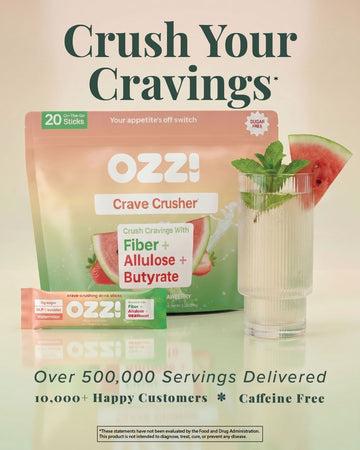
A supplement can fill gaps on busy days. Ozzi's Crave Crusher includes chicory root inulin, which is a prebiotic fiber that feeds butyrate-producing bacteria, plus L-Lysine Butyrate, a form of butyrate itself. The idea is prebiotic fuel plus a direct source in one stick you mix into water.
I'll stay honest about the ceiling. There are no human RCTs on that specific butyrate ingredient, and butyrate's link to GLP-1 in people is still a hypothesis. What inulin does for butyrate-producing bacteria is the better-supported part. If you want the deeper breakdown, I wrote a full roundup of the best butyrate supplements and a piece on what to look for in a butyrate drink.
Feed your gut, quiet the cravings
Ozzi Crave Crusher pairs prebiotic inulin with a direct butyrate ingredient and 8g of allulose, in a 5-calorie watermelon stick you drink before the 9pm pantry run. Try it for 14 days straight. If it doesn't work, we'll refund your first bag.
Frequently asked questions
What food has the most butyrate?
Butter and some cheeses contain small amounts of butyrate directly, but the amount is tiny compared to what your gut makes from fiber. The better question is which foods feed butyrate production: resistant starch and inulin-rich plants lead the list.
How long does it take to increase butyrate?
Think weeks, not days. The human trials that showed changes ran 3 weeks to 6 months. Your microbiome adjusts gradually, so consistency beats intensity.
Is it better to eat butyrate or make it?
Making it in your colon delivers it right where your colon cells use it. Oral butyrate supplements can raise blood butyrate in trials, but they haven't shown the downstream metabolic changes people hope for. Fiber remains the foundation.
Does resistant starch really work if I reheat the food?
Mostly yes. Cooking then cooling creates resistant starch, and reheating retains a good portion of it. Cook a batch of rice or potatoes, chill it, and use it through the week.
Can I just take an inulin supplement?
You can, and inulin reliably feeds Bifidobacterium in trials. Start with a small dose. Inulin is famous for causing gas if you go too fast, so ramp over a couple of weeks.
Does butyrate raise GLP-1?
In cell and rodent studies, butyrate can stimulate GLP-1 release. In humans it hasn't been confirmed, and one trial that raised circulating butyrate saw no GLP-1 change. Treat the GLP-1 claim as a hypothesis for now.
Will more butyrate help me lose weight?
There's no good human evidence that butyrate alone drives weight loss. The habits that raise butyrate (more fiber, more plants, more movement) support appetite and metabolic health broadly, which is the more defensible reason to do them.
How much fiber should I aim for?
Most adults do well working toward 25 to 30g of total fiber a day from varied sources. Increase slowly and drink water, or your gut will complain.
Are fermented foods enough on their own?
They help with diversity, but they're not a strong direct butyrate lever. Pair them with fermentable fiber for the bigger effect.
Can I overdo it?
Yes, mostly in the form of bloating and discomfort if you spike fiber too fast. There's no need to megadose. Steady, varied intake wins.
Butyrate you can actually drink
Ozzi Crave Crusher
500mg of BIOMEnd L-lysine butyrate per stick, the form rated most palatable of three in a 2025 human trial, alongside allulose, konjac fiber, chromium and African mango. No capsules, no caffeine, and no butyric acid smell.
See what's in it →References
- Gill PA, et al. A randomized dietary intervention to increase colonic and peripheral blood SCFAs modulates the blood B- and T-cell compartments in healthy humans. Am J Clin Nutr. 2023. (Human RCT) DOI
- Canfora EE, et al. Fiber mixture-specific effect on distal colonic fermentation and metabolic health in lean but not in prediabetic men. Gut Microbes. 2022. (Human RCT) DOI
- Hughes RL, et al. Resistant Starch Type 2 from Wheat Reduces Postprandial Glycemic Response with Concurrent Alterations in Gut Microbiota Composition. Nutrients. 2021. (Human RCT) DOI
- DeMartino P, et al. Additional Resistant Starch from One Potato Side Dish per Day Alters the Gut Microbiota but Not Fecal Short-Chain Fatty Acid Concentrations. Nutrients. 2022. (Human RCT) DOI
- Meslier V, et al. Mediterranean diet intervention in overweight and obese subjects lowers plasma cholesterol and causes changes in the gut microbiome and metabolome independently of energy intake. Gut. 2020. (Human RCT) DOI
- Visuthranukul C, et al. Enhancing gut microbiota and microbial function with inulin supplementation in children with obesity. Int J Obes. 2024. (Human RCT, clinical population) DOI
- van Deuren T, et al. Butyrate and hexanoate-enriched triglycerides increase postprandial systemic butyrate and hexanoate in men with overweight/obesity. Front Nutr. 2023. (Human RCT; no GLP-1 change) DOI
- Jackson PPJ, et al. Oligofructose, 2'fucosyllactose and beta-glucan in combination induce specific changes in microbial composition and short-chain fatty acid production. J Appl Microbiol. 2023. (In-vitro batch culture) DOI
- Ticinesi A, et al. Gut Microbiota, Muscle Mass and Function in Aging: A Focus on Physical Frailty and Sarcopenia. Nutrients. 2019. (Review; human and rodent evidence) DOI
Research summarized here was retrieved from PubMed. This article is educational and not medical advice. Ozzi is a dietary supplement and is not intended to diagnose, treat, cure, or prevent any disease.
