

Butyrate and GLP-1: How a Gut Fatty Acid Quietly Controls Appetite (2026)
Butyrate is a short-chain fatty acid produced when gut bacteria ferment dietary fiber. It activates receptors on intestinal L-cells (FFAR2 and FFAR3) that trigger GLP-1 secretion, the satiety hormone that signals fullness to the brain. More butyrate generally means stronger natural GLP-1 signaling.
This post answers one question. For everything else butyrate does and doesn't do, see our butyrate benefits and forms guide.
Most people have never heard of butyrate. It might be the most underrated molecule in the whole GLP-1 conversation.
It's a tiny fatty acid your gut bacteria churn out when you feed them fiber. And it happens to flip on the same hormone that the weight-loss shots are built around.
This is the mechanism I got obsessed with when I built Ozzi. Let me walk through what butyrate is, how it talks to your GLP-1 system, and how to actually get more of it.
What is butyrate?
Butyrate is a short-chain fatty acid, or SCFA. It's one of three main SCFAs your gut bacteria produce, alongside acetate and propionate.
Your microbiome makes it by fermenting fiber you can't digest yourself. The fiber reaches your colon intact, the bacteria feast, and butyrate is one of the byproducts.
It's the primary fuel source for the cells lining your colon. Beyond that, it supports your gut barrier and plays a surprising role in appetite signaling.
If you want the broader gut picture, our guide to GLP-1 sets up the hormone side. This post zooms in on the fatty acid that helps trigger it.
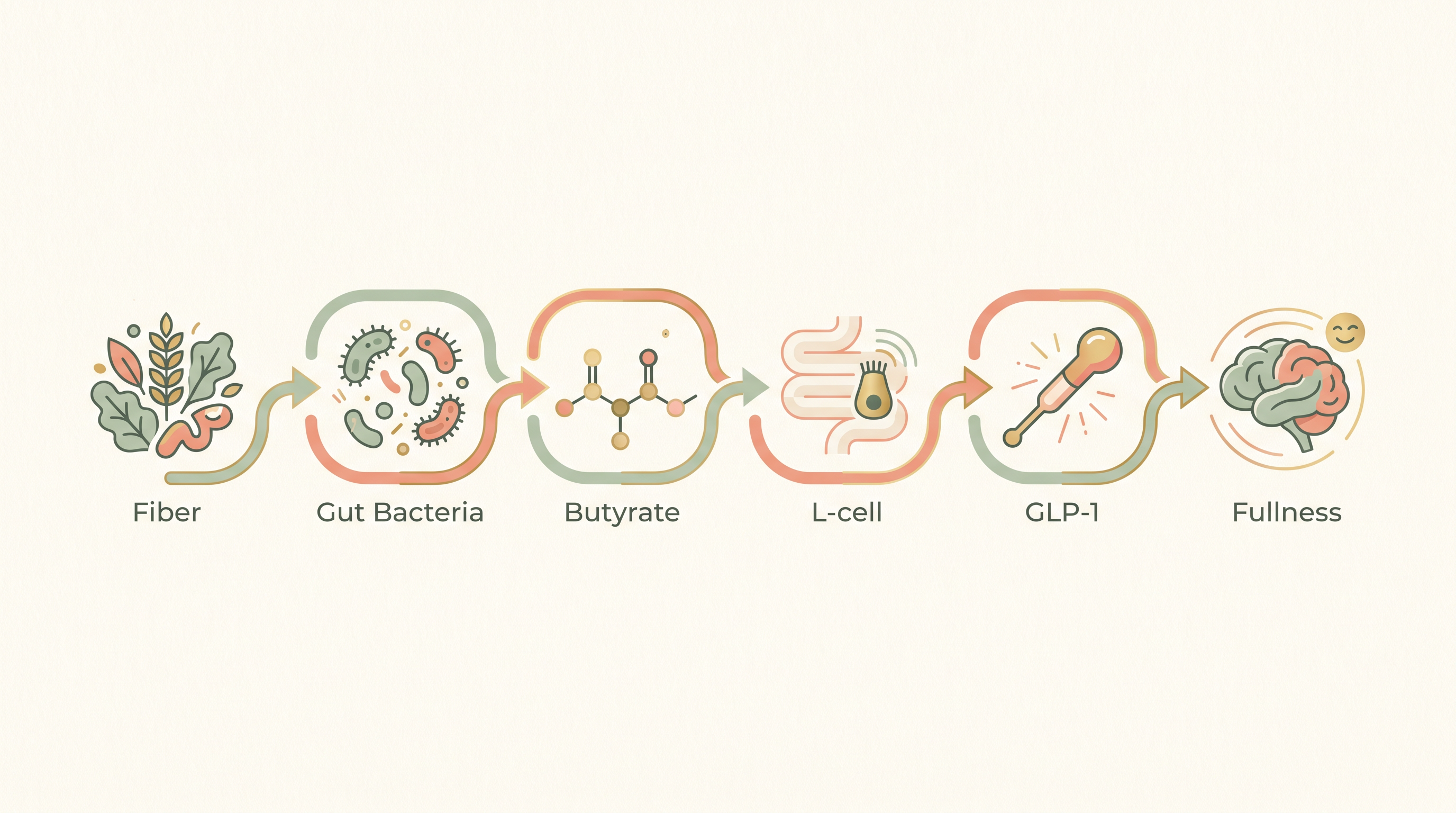
How does butyrate trigger GLP-1?
Here's the chain of events, step by step.
Your gut wall is dotted with specialized cells called L-cells. These are the factories that make and release GLP-1.
L-cells carry receptors called FFAR2 and FFAR3 (also known as GPR43 and GPR41). Short-chain fatty acids like butyrate are the keys that fit these locks.
When butyrate binds, it raises calcium inside the L-cell, and that calcium signal triggers GLP-1 release. This was mapped cleanly in a landmark 2012 study showing SCFAs stimulate GLP-1 through FFAR2.
Researchers confirmed the loop in reverse too. Mice missing these receptors had blunted SCFA-triggered GLP-1 and worse glucose tolerance.
A separate study showed a probiotic that boosts butyrate production led to more GLP-1 and better metabolic markers. The butyrate-GLP-1 link keeps holding up.
Butyrate is the key. Your L-cells are the lock. GLP-1 is what comes out when they meet.
Why does GLP-1 matter for cravings?
GLP-1 is a satiety hormone. When it's flowing, your brain gets a clear signal that you're full and satisfied.
It also slows how fast your stomach empties, so food sticks around longer and you feel fuller for longer.
This is exactly why the GLP-1 drugs are so effective at quieting what people call food noise. They flood the system with a long-acting version of the hormone.
Your own butyrate-driven GLP-1 won't hit drug-level intensity. But it's the same lever, and nudging it naturally is a real strategy. We break that down in how to stop food noise naturally.
Key takeaways
- Butyrate is a fatty acid gut bacteria make from fiber.
- It activates FFAR2 and FFAR3 receptors on L-cells.
- That triggers GLP-1, the same hormone as Ozempic.
- Fiber, prebiotics, and direct butyrate all raise levels.
- Natural GLP-1 is gentler than drugs, but it's the same pathway.
How do you get more butyrate?
There are three routes, and the best approach uses more than one.
1. Eat more fermentable fiber. Your bacteria need raw material. Foods like oats, beans, onions, garlic, asparagus, and slightly green bananas all feed butyrate production.
2. Take prebiotics. Prebiotic fibers like inulin are concentrated fuel for the bacteria that make butyrate. This is the slow-build route, but it compounds.
3. Take a direct source. You can supply butyrate directly. L-Lysine Butyrate binds butyrate to an amino acid for a more stable, less smelly form than older sodium butyrate.
Here's the honest catch with route one and two: it depends on your microbiome. If your gut bacteria are out of balance, you'll make less butyrate from the same fiber.
That's the case for combining a direct source with prebiotic fuel. You get butyrate now, plus you're building the system that makes it later.
Which butyrate sources actually work?
Here's a plain comparison of the three approaches, what each does, and the trade-offs.
| Source | How it raises butyrate | Trade-off |
|---|---|---|
| Fermentable fiber | Feeds bacteria to make it | Depends on your microbiome |
| Prebiotic inulin | Concentrated bacterial fuel | Slow build, possible early gas |
| L-Lysine Butyrate | Supplies butyrate directly | Form and dose matter |
The smart move is stacking the direct source with prebiotic fiber. That's exactly how I built the Ozzi formula.
Is there a butyrate smell problem?
Yes, and I'll be straight about it. Raw butyric acid smells rough, somewhere between parmesan and gym socks.
That's why the form matters. Binding butyrate to L-lysine makes it far more stable and palatable than older sodium butyrate capsules that can repeat on you.
Getting this right was one of the harder parts of formulating a drink people actually want to finish. Taste is not a side detail when you're asking someone to do this daily.
How does Ozzi use butyrate?
Ozzi Crave Crusher includes L-Lysine Butyrate as a direct butyrate source, plus chicory root inulin to feed your own butyrate production.
That's the dual approach: butyrate now from the supplement, plus prebiotic fuel so your microbiome makes more on its own over time.
It sits alongside allulose and glucomannan, which hit the GLP-1 and satiety levers from other angles. See the allulose guide and our konjac glucomannan breakdown for those.
It's caffeine-free, vegan, and 0g sugar. The goal is to support your own GLP-1, not override it.
Feed your own GLP-1
Crave Crusher pairs direct L-Lysine Butyrate with prebiotic inulin and allulose in one cold glass of water. Use it for 10 days straight. If you don't feel a difference, we'll refund your first bag.
For how a 500mg butyrate dose fits into a full formula, see our natural GLP-1 support drink.
Frequently asked questions
What is butyrate in simple terms?
It's a short-chain fatty acid your gut bacteria make from fiber. It fuels your colon cells and helps trigger the GLP-1 satiety hormone.
Does butyrate really increase GLP-1?
In lab and animal studies, yes. Butyrate activates FFAR2 and FFAR3 receptors on intestinal L-cells, which release GLP-1. Human research is still developing.
Is butyrate the same as Ozempic?
No. Ozempic is a potent long-acting GLP-1 drug. Butyrate gently supports your own natural GLP-1. Same pathway, very different intensity.
What foods are highest in butyrate fuel?
Oats, beans, lentils, onions, garlic, asparagus, and slightly underripe bananas all feed butyrate-producing bacteria.
Should I take a butyrate supplement?
It can help, especially if your fiber intake or microbiome is low. A stable form like L-Lysine Butyrate is easier to tolerate than sodium butyrate.
Why does butyrate smell bad?
Raw butyric acid has a strong cheesy odor. Binding it to L-lysine makes it more stable and far more palatable.
How long until butyrate affects appetite?
It's a gradual, gut-level process. Most people think in terms of a few weeks of consistency, not instant results.
Can I get butyrate from diet alone?
Often yes, if your microbiome is healthy and your fiber intake is high. A direct source plus prebiotics helps when it isn't.
Is butyrate safe?
Butyrate is produced naturally in your gut every day and is well tolerated by most people. Check with your doctor if you have a medical condition.
This article is for educational purposes and isn't medical advice. Ozzi is a dietary supplement and isn't intended to diagnose, treat, cure, or prevent any disease. Talk to your doctor before starting a new supplement, especially if you have a health condition or take medication.
References
- Tolhurst G, et al. Short-chain fatty acids stimulate GLP-1 secretion via the G-protein-coupled receptor FFAR2. Diabetes. 2012. PMID 22190648
- Yadav H, et al. Beneficial metabolic effects of a probiotic via butyrate-induced GLP-1 hormone secretion. J Biol Chem. 2013. PMID 23836895
- Christiansen CB, et al. The impact of short-chain fatty acids on GLP-1 and PYY secretion from the isolated perfused rat colon. 2018. PMID 29494208
- Review: short-chain fatty acid receptors and their contribution to GLP-1 release. 2014. PMID 24458110
- Iwasaki Y, et al. Secretion of GLP-1 but not GIP is potently stimulated by luminal D-allulose in rats. 2018. PMID 29402406
- Review on GLP-1, food noise, and reward circuits, 2025. PMC12770913
