

Konjac Root for Weight Loss: 2026 Guide to Glucomannan, GLP-1, and Safety
Konjac root contains glucomannan, a fiber that absorbs up to 50 times its weight in water. It forms a gel in your stomach, slows gastric emptying, and triggers GLP-1 release through gut microbiota fermentation. Clinical trials at 3 to 5g daily for 12+ weeks show modest weight loss of 2 to 3 kg.
Key takeaways
- Konjac glucomannan is one of the most viscous fibers ever studied.
- 2026 RCT: 3g/day cut weight 2.39 kg in 12 weeks with a calorie deficit.
- It boosts GLP-1 indirectly through gut fermentation and SCFAs.
- Doses above 5g/day cause bloating, gas, and bowel changes.
- Capsules carry a real choking risk if taken without enough water.
What is konjac root and how does it work for weight loss?
Konjac root, also called Amorphophallus konjac, is a tuber from Southeast Asia. The active fiber inside it is called glucomannan. It's one of the most viscous water-soluble fibers anyone has ever measured.
You swallow it. It hits stomach acid. It pulls in water and swells into a thick, slow-moving gel. That gel does three things at once.
First, it makes your stomach feel physically full. Second, it slows how fast food empties out of the stomach, so you stay full longer. Third, it travels into the colon undigested, where gut bacteria ferment it into short-chain fatty acids. Those fatty acids, especially propionate, signal the L-cells in your gut to release more GLP-1.
That last part matters. GLP-1 is the same hormone Ozempic copies. The food noise quiets. The next-meal cravings shrink.
Does konjac root actually cause weight loss?
Short answer: yes, modestly, when you stack it with a calorie deficit.
A 2026 triple-blind, placebo-controlled RCT tested 3g of glucomannan per day for 12 weeks against placebo in 40 adults on a personalized hypocaloric diet. The glucomannan group lost 2.39 kg of body weight, 0.83 kg/m² of BMI, and 2.70 cm of waist on average. They also saw drops in LDL cholesterol and inflammation markers.
A broader 2025 systematic review pooled 10 RCTs from 2014 to 2024. At doses of 5g or more per day for at least 12 weeks, participants lost an average of 3.18 kg of weight and 1.49 kg/m² of BMI. Waist dropped 2.11 cm.
That's not Ozempic territory. But it's real, repeatable data.
Konjac won't melt 20 pounds off you. It quiets cravings just enough to make a diet stick.
How does konjac compare to other GLP-1 fibers?
Not all soluble fibers behave the same way. Viscosity is what drives the satiety signal, and konjac has the highest viscosity of the common dietary fibers.
Here's how the major options stack up:
| Fiber | Effective dose | GLP-1 effect | Trade-off |
|---|---|---|---|
| Konjac glucomannan | 3 to 5g/day | Moderate, via SCFA | Choking risk, bloating |
| Psyllium husk | 5 to 10g/day | Mild | Gritty texture |
| Beta-glucan (oat) | 3 to 6g/day | Mild to moderate | Calories from carbs |
| Allulose | 5 to 10g/serving | Direct GLP-1 trigger | Mild GI at high dose |
Konjac wins on raw viscosity. Allulose wins on direct hormone signaling. The two fibers do different jobs and most well-designed formulas pair viscous fiber with a GLP-1 trigger ingredient, not one or the other.
What's the best dose of konjac root for weight loss?
Most studies that showed real weight loss used 3 to 5 grams per day, split into two or three doses, taken 30 to 60 minutes before meals.
Lower doses don't reach the viscosity threshold needed to slow gastric emptying. Higher doses, above 5g, cause GI side effects in about a third of users. After 3g/day for 12 weeks, a meaningful number of participants reported abdominal discomfort, diarrhea, or constipation.
The dose ramp matters as much as the dose itself. Start at 1g/day for a week. Go to 2g/day for a week. Then settle at 3 to 4g/day. Your gut needs the runway.
Is konjac root safe? The choking warning you should know
This is the part most blog posts skip. The FDA has an import alert on konjac candies after multiple choking deaths in children and older adults. Health Canada issued a separate advisory on konjac in tablet, capsule, and powder form.
The issue is mechanical. Glucomannan absorbs water that fast. If it hits a dry throat or esophagus and starts swelling before it reaches your stomach, it can lodge there and block the airway.
The fix is simple. Take konjac with at least 8 ounces of water. Powders pre-mixed in a full glass of water and consumed immediately are safer than capsules. People with swallowing problems or esophageal narrowing shouldn't take dry konjac products at all.
A fiber that absorbs 50 times its weight in water isn't a casual supplement. It demands respect at the dosing stage.
Does konjac actually boost GLP-1 like Ozempic?
It's an indirect boost, not a direct one.
Ozempic and Wegovy are semaglutide. They flood your bloodstream with a synthetic GLP-1 analog that doesn't break down quickly. They hit GLP-1 receptors in your brain and gut for days at a time.
Konjac doesn't do that. It feeds bacteria in your large intestine. Those bacteria ferment glucomannan into short-chain fatty acids like propionate and butyrate. Those fatty acids bind to receptors on L-cells, which then secrete GLP-1 into your bloodstream.
The amount of GLP-1 you get from konjac is small compared to an injection. But the effect is real and stacks with the mechanical satiety from gastric emptying. For people who want to increase GLP-1 naturally without a needle, it's one of several tools that works.
Konjac vs Ozzi: how does this stack up?
Ozzi doesn't use konjac. Here's why.
We wanted something you could feel within 30 minutes. Konjac's strength is delayed gastric emptying and gut fermentation, which both take hours. We also wanted no choking warning attached to a daily product. And we wanted a formula that worked for women who'd told us they couldn't keep choking down chalky fiber drinks.
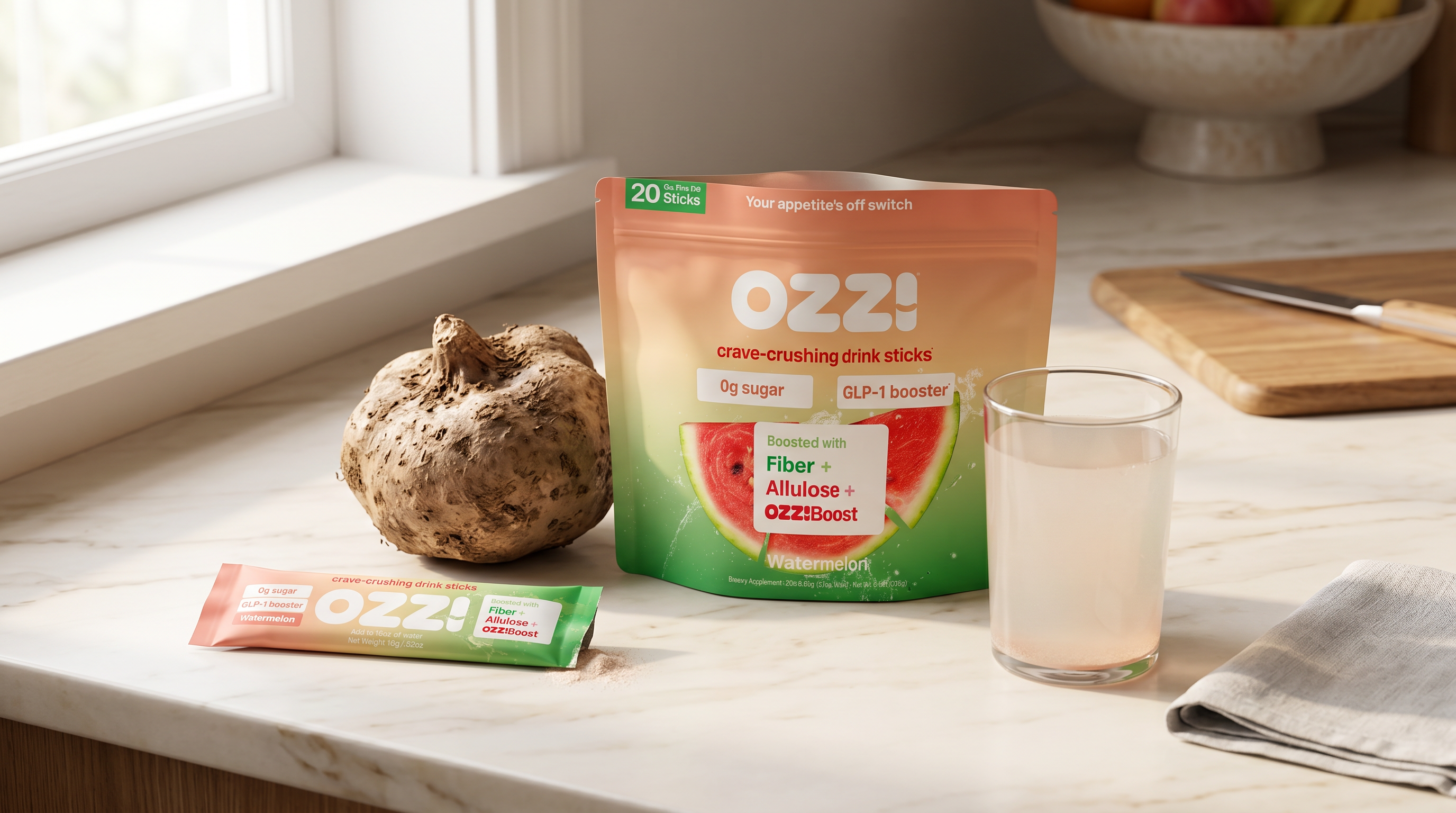
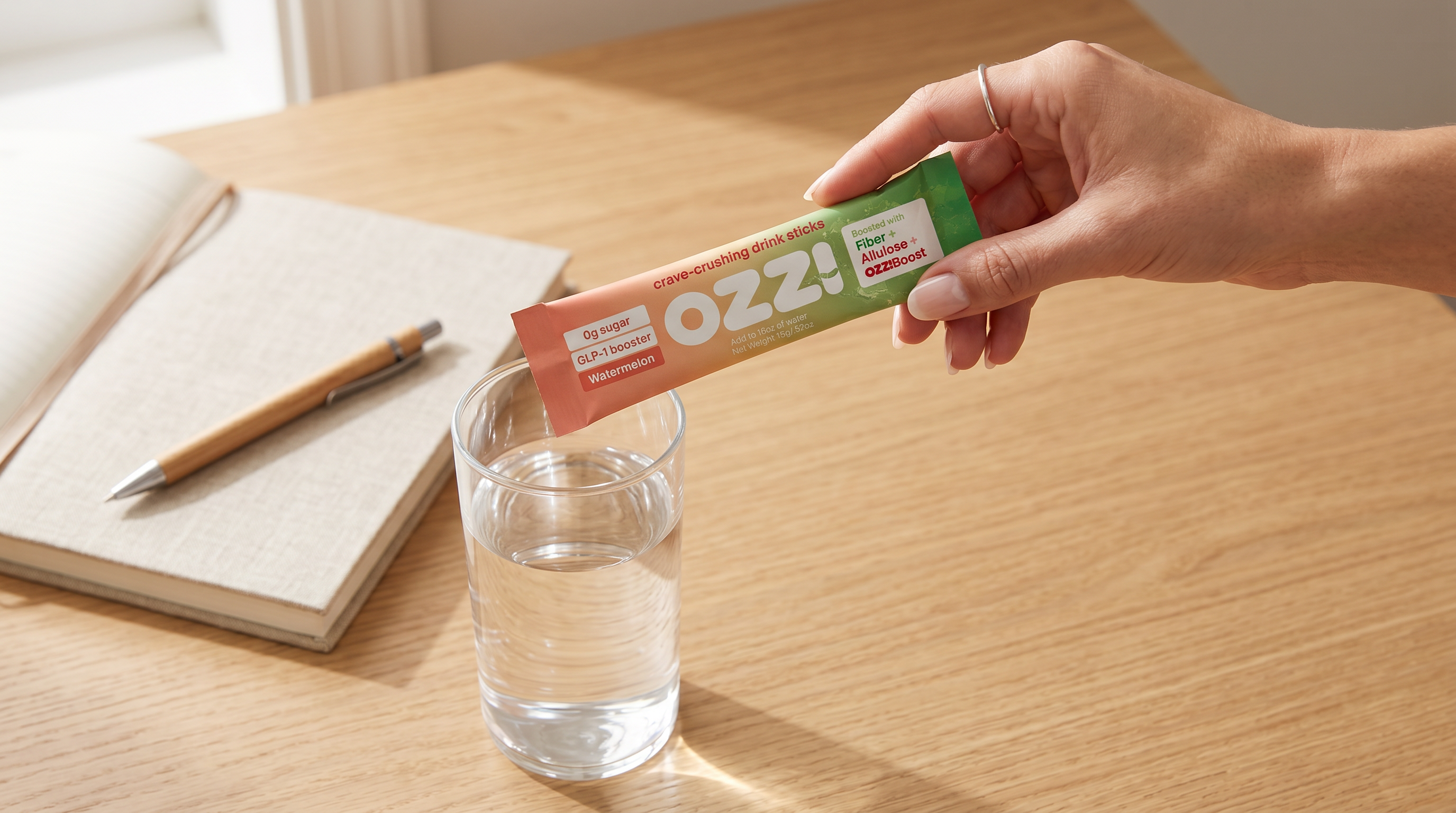
Ozzi's Crave Crusher stack uses allulose to trigger GLP-1 directly and a smaller fiber blend for backup satiety. It's a watermelon stick that stirs into 16 oz of cold water in 5 seconds. No gel. No grit. No 8-ounce warning.
If your goal is the absolute cheapest fiber-based intervention, plain konjac powder wins on dollars per gram. If your goal is something you'll actually take every day for 90 days, the format matters.

Who should and shouldn't try konjac?
Konjac glucomannan makes sense if you're already on a calorie deficit, you tolerate fiber well, and you want a cheap, well-studied add-on. It's also a fair option if cholesterol is part of the picture, since the meta-analyses show real LDL drops.
It's a bad call if you have any swallowing difficulty, a history of GERD or esophageal narrowing, are on diabetes medication without monitoring (glucomannan can lower blood sugar), or take oral medications that need consistent absorption. Glucomannan can blunt drug absorption when taken at the same time.
For how konjac compares with psyllium and the other gel-forming fibers, and what the pooled trials found, see do fiber supplements work for weight loss.
Frequently asked questions
How long does konjac take to work for weight loss?
Satiety effects kick in within 30 to 60 minutes of a dose. Weight changes show up in clinical trials at the 8 to 12 week mark, not earlier.
Can I take konjac with Ozempic or Mounjaro?
Talk to your prescriber. Konjac can lower blood sugar and slow drug absorption. If you take it, separate from oral medications by at least 2 hours.
What does konjac taste like?
Pure glucomannan powder is nearly tasteless but turns gel-like in seconds in water. Capsules avoid the texture issue but carry more choking risk.
Is konjac the same as shirataki noodles?
Yes. Shirataki noodles and konjac jelly are both made from the same root. Eating shirataki gives you a much smaller glucomannan dose than a concentrated supplement.
Does konjac cause diarrhea?
It can, especially above 5g/day or if you start at a high dose. Ramp up slowly. Most GI side effects fade within 2 weeks of steady dosing.
Can I take konjac while pregnant?
No. There isn't enough safety data on glucomannan during pregnancy or breastfeeding. Skip it.
What's the cheapest way to buy konjac?
Bulk glucomannan powder is the cheapest format per gram. Capsules cost more per dose. Watch for products that mix konjac with stimulants, which adds risk for no real benefit.
Does konjac work for night cravings?
It can dampen evening hunger if you dose it 30 minutes before dinner. For the night monster cravings that hit at 9 p.m., a faster-acting GLP-1 trigger tends to work better.
The verdict
Konjac root is a legit weight-loss tool, just a modest one. 2 to 3 kg over 12 weeks on top of a calorie deficit. It works because it's the most viscous fiber we know of, and because gut bacteria ferment it into compounds that boost GLP-1.
The trade-offs are real. Bloating above 5g/day. A choking risk that's not a marketing scare but a documented FDA concern. And a format that most people abandon after a few weeks.
If you want a daily routine you'll actually stick with, look at how Ozzi stacks ingredients to hit the same GLP-1 pathway without the gel-in-throat problem. Either way, the goal is the same: quieter food noise, smaller portions, sustainable weight loss.
Try the GLP-1 booster designed to skip the choking warning
Ozzi Crave Crusher uses allulose and a smart fiber blend to trigger GLP-1 in 30 minutes, no gel-in-throat risk. First bag is backed by our 10-day feel-the-difference guarantee.
Related reads
- What is GLP-1? The complete guide
- How to increase GLP-1 naturally
- Allulose supplement guide 2026
- Best supplements to curb sugar cravings
- Natural alternatives to Ozempic
- Best OTC GLP-1 supplement
- Konjac Glucomannan Improves Body Composition and Reduced Blood Cholesterol, Inflammation, and Cardiovascular Risk in Adults with Excess Weight: A Triple-Blind, Placebo-Controlled Randomized Clinical Trial. medRxiv 2026. Link
- Konjac glucomannan as an emerging nutritional strategy for obesity control via gut microbiota and metabolic regulation. Discover Food 2025. Link
- Effects of glucomannan supplementation on weight loss in overweight and obese adults: A systematic review and meta-analysis of randomized controlled trials. Link
- Konjac mannan oligosaccharides as a sustainer of fasting-associated gut adaptations. medRxiv 2025. Link
- A systematic review and meta-analysis of randomized controlled trials of the effect of konjac glucomannan on LDL cholesterol. American Journal of Clinical Nutrition. Link
- Appetite control and gastrointestinal hormonal behavior following whey protein plus glucomannan. PMC 3851799. Link
- Re-evaluation of konjac gum and konjac glucomannan as food additives. EFSA Journal. Link
- Reflections on the discovery of GLP-1 as a satiety hormone. PMC 11230893. Link
