

Does Butyrate Help You Lose Weight? An Honest Look at the Evidence (2026)
If you've been reading about gut health, you've probably run into butyrate. It shows up in podcasts, supplement labels, and a lot of confident claims about weight loss.
So let me give you the honest version. I sell a drink stick that contains butyrate, and I still think most of the weight-loss hype around it is ahead of the science.
Does butyrate help you lose weight? In rodent studies, oral butyrate consistently supports body-weight control and better metabolism. In humans, the research is early and results are mixed, with some small trials showing benefit and others showing none. Butyrate supports gut and metabolic health. It's not a proven weight-loss drug.
Weight is one claim in a crowded field. Our complete butyrate supplement guide grades all of them by species and study design.
Key takeaways
- Butyrate is the primary energy source for your colon cells.
- Animal studies on weight control are strong and consistent.
- Human weight-loss evidence is early, small, and mixed.
- The GLP-1 link is shown in mice, not proven in people.
- Fiber-rich food is the most reliable way to raise it.
What is butyrate, and what does it actually do?
Butyrate is a short-chain fatty acid. Your gut bacteria produce it when they ferment certain fibers in your large intestine.
Its main job is local. Butyrate is the primary energy source for the cells lining your colon, supplying roughly 70% of the energy those cells use (a finding established in human colon tissue) [1].
That's the part everyone agrees on. Butyrate feeds your gut lining and supports gut barrier function. Where things get fuzzy is the jump from "healthy colon cells" to "you lose weight."
Most of your butyrate comes from fiber you eat, not from a pill. Foods like oats, beans, onions, garlic, and slightly-cooled cooked potatoes feed the bacteria that make it. I wrote a full breakdown in how to increase butyrate naturally.

What does the animal research show?
This is where butyrate looks impressive. In rodents, the story is remarkably consistent.
A 2022 review in Obesity Reviews pulled the animal data together and concluded that oral butyrate, given various ways, positively affects fat-tissue metabolism, energy use, inflammation, insulin sensitivity, and body-weight control in animals [2].
In practice, that means mice fed a high-fat diet plus butyrate tend to gain less weight and handle glucose better than mice on the high-fat diet alone. The effect is real and repeatable in that setting.
The butyrate weight-loss story is strong in mice. The trick is that you're not a mouse.
Here's the catch. Mice get doses, delivery methods, and diets that don't map cleanly onto a human drinking a supplement. A mouse on a controlled high-fat lab diet is a very different system from a person living a normal life.
So the animal work is genuinely promising. It's also the reason to stay skeptical, because promising rodent findings often shrink or vanish when researchers finally test them in people.
What does the human research actually show?
Thinner and messier than the headlines suggest.
A 2025 semi-systematic review in Frontiers in Nutrition looked specifically at butyrate and glycemic control across both animals and humans. The animal evidence was strong. The human evidence was limited and inconsistent, with trials differing in dose, form, and who was studied [3].
That pattern (big in animals, unclear in humans) runs through most of the butyrate literature. Some small human trials report metabolic improvements. Others report little to nothing.
One human randomized trial in people with obesity gave sodium butyrate alongside a weight-loss diet and tracked metabolic markers. It reported some improvements in blood lipids and fasting blood sugar, but it did not show a clear butyrate-specific edge on every outcome measured [4].
The honest summary: butyrate might help metabolic health in people at the margins, but no one has shown it reliably melts off body weight in humans the way the marketing implies.
| Claim about butyrate | Evidence level | Where it's shown |
|---|---|---|
| Fuels colon cells, supports gut lining | Strong | Human tissue [1] |
| Supports body-weight control | Strong in animals, unclear in people | Rodent [2], mixed human [3] |
| Improves insulin sensitivity, blood sugar | Promising, inconsistent in humans | Rodent [2], mixed human [3][4] |
| Raises GLP-1 (your fullness hormone) | Preclinical only | Mice and cells; not shown in humans [5] |
Does butyrate raise GLP-1 the way Ozempic does?
No. And this is where a lot of supplement copy gets dishonest, including copy I've had to fix on my own brand.
The theory goes like this. Cells in your gut called L-cells release GLP-1, the hormone that tells your brain you're full. In mouse and cell studies, butyrate can nudge those L-cells to release more GLP-1 [5]. That's the proposed mechanism, and it's a good one.
The problem is that it's been shown in mice and in a dish, not in people. When human trials have raised circulating butyrate and then measured GLP-1 as an outcome, the GLP-1 needle basically didn't move.
Butyrate nudging GLP-1 is a mouse finding. Anyone selling it as a human fact is getting ahead of the data.
So if a product tells you butyrate "boosts your GLP-1" like a natural Ozempic, that's a claim the human evidence doesn't support yet. The right framing is that butyrate supports the gut environment where GLP-1 gets produced. For the bigger picture on that hormone, see what is GLP-1 and butyrate and GLP-1.
What has the research actually studied?
Worth being precise here, because the details change how much the findings apply to you.
Most human butyrate trials are small. They often run for a few weeks to a few months, use supplemental sodium butyrate or calcium butyrate, and enroll specific groups: people with obesity, metabolic syndrome, or type 2 diabetes, usually under medical supervision as part of the study [3][4]. Some of the more encouraging results come from those clinical populations, not from healthy people looking to drop a few pounds.
That matters for two reasons. A benefit seen in someone with type 2 diabetes under a doctor's care may not transfer to a healthy adult. And a supplement dose used in a trial is a research tool, not a promise about a drink stick.
The forms also differ. Sodium butyrate, tributyrin, and the L-lysine-bound form all behave a little differently in the body. I compared two of them in sodium butyrate vs tributyrin.
So how do you actually get more butyrate?
Food first. It's cheaper, better studied, and it works with your biology instead of around it.
Your gut bacteria make butyrate from fermentable fiber. Feed them and they produce more of it on their own. The reliable sources are prebiotic fibers like inulin from chicory root, plus resistant starch from cooked-and-cooled potatoes, rice, and legumes.
Chicory root inulin is a prebiotic fiber that feeds butyrate-producing bacteria, which is one reason it shows up in a lot of gut-health formulas. For which fibers do what, I broke it down in best fiber for appetite control and inulin and appetite.

A direct butyrate supplement can add to that. Just keep your expectations calibrated to the human evidence, which is early. For the full rundown, see the best butyrate supplement for weight loss and how it all ties into gut health and GLP-1.
Who might actually get something out of butyrate?
If you want a realistic read, here's who I'd expect to notice the most.
People whose diets are low in fiber have gut bacteria that make less butyrate to begin with. Feeding those bacteria, through fiber or a supplement that includes prebiotic fiber, gives the most room to move. Someone already eating 30-plus grams of fiber a day has less headroom.
People working on metabolic health are the group with the most supportive human data, even if it's early and mostly from clinical trials [3][4]. That's blood sugar and lipid markers, not a number on the scale.
And people who care about gut comfort and regularity have the cleanest rationale, since fueling the colon lining is butyrate's best-established job [1].
Butyrate is a supporting actor. It's a good one. It's just not the lead.
Who probably shouldn't bother? Anyone hoping a butyrate capsule alone replaces diet, sleep, protein, and movement. That's not how any single ingredient works, and butyrate is no exception.
The honest bottom line
Does butyrate help you lose weight? The fair answer is "it might help the machinery, but it won't do the work for you."
In animals, the weight and metabolic benefits are strong and consistent [2]. In humans, the evidence is early, the trials are small, and the biggest wins show up in metabolic markers rather than dramatic weight loss [3][4]. The GLP-1 story that makes butyrate sound like a natural Ozempic lives in mice and cells, not people [5].
That's why I put butyrate in Ozzi as one ingredient among several, paired with the prebiotic fiber that feeds your own butyrate production, rather than selling it as a miracle on its own. It supports the system. The satiety and craving side gets handled by the fiber and allulose doing their separate jobs, which you can read about in the butyrate supplement comparison.
Butyrate plus the fiber that feeds it
Ozzi's Crave Crusher pairs butyrate with chicory root inulin, a prebiotic fiber, plus allulose and glucomannan for cravings. It supports natural GLP-1 production, no caffeine, 5 calories, mixed into water. Try it for 14 days straight. If it doesn't work, we'll refund your first bag.
Frequently asked questions
Does butyrate directly burn fat?
No. In animals it shifts energy metabolism in ways that support weight control, but there's no good human evidence that butyrate burns fat on its own [2][3].
Will a butyrate supplement make me lose weight?
On its own, probably not much. Human trials are small and mixed, and the strongest results come from clinical groups under medical care [3][4]. Treat it as gut and metabolic support, not a weight-loss drug.
Is butyrate a natural Ozempic?
No. Ozempic is a GLP-1 medication with large human trials behind it. Butyrate's GLP-1 link is shown in mice and cells, not in people [5].
How long until butyrate does anything?
Human trials usually run weeks to months. Any gut or metabolic effects build slowly, not overnight.
Is it better to eat fiber or take a butyrate pill?
Food first. Fermentable fiber feeds the bacteria that make butyrate naturally, and it's far better studied for appetite and metabolic health.
Does butyrate help with cravings?
Indirectly, at best. It supports the gut environment tied to appetite hormones, but cravings are driven by many things. The fiber and satiety ingredients in a formula tend to do more of that heavy lifting.
Are there side effects?
Butyrate is generally well tolerated. Some people notice mild digestive changes at first, and the raw ingredient has a famously strong smell. More on that soon in a dedicated post.
How much butyrate does Ozzi contain?
Each stick has 500mg of butyrate as L-Lysine Butyrate, plus 500mg of chicory root inulin to feed your own butyrate-making bacteria. We don't claim it's a clinically proven weight-loss dose, because that human proof doesn't exist yet.
Does butyrate raise blood sugar?
No, it doesn't raise blood sugar, and some research suggests it may support blood sugar control, though human results are inconsistent [3][4].
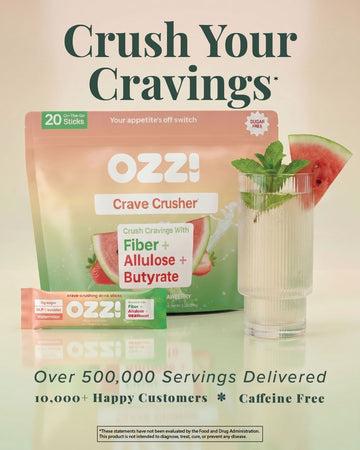
Butyrate you can actually drink
Ozzi Crave Crusher
500mg of BIOMEnd L-lysine butyrate per stick, the form rated most palatable of three in a 2025 human trial, alongside allulose, konjac fiber, chromium and African mango. No capsules, no caffeine, and no butyric acid smell.
See what's in it →References
- Frontiers in Nutrition. The impact of butyrate on glycemic control in animals and humans: a comprehensive semi-systemic review. 2025. DOI: 10.3389/fnut.2025.1603490
- van Deuren T, Blaak EE, Canfora EE. Butyrate to combat obesity and obesity-associated metabolic disorders: current status and future implications for therapeutic use. Obesity Reviews. 2022;23(10):e13498. DOI: 10.1111/obr.13498
- Frontiers in Nutrition. Protective role of butyrate in obesity and diabetes: new insights. 2022. DOI: 10.3389/fnut.2022.1067647
- European Journal of Clinical Nutrition. Expression of PGC-1a, PPAR-a and UCP1 genes, metabolic and anthropometric factors in response to sodium butyrate supplementation in patients with obesity: a triple-blind, randomized placebo-controlled clinical trial. 2024. DOI: 10.1038/s41430-024-01512-x
- Frontiers in Nutrition. Butyrate and hexanoate-enriched triglycerides increase postprandial systemic butyrate and hexanoate in men with overweight/obesity: a double-blind placebo-controlled randomized crossover trial. 2022. DOI: 10.3389/fnut.2022.1066950
This article is for education, not medical advice. Ozzi is a dietary supplement. It is not intended to diagnose, treat, cure, or prevent any disease. Talk to your doctor before changing your routine, especially if you take medication or have a health condition.
