

Tributyrin vs Lysine Butyrate: Which Butyrate Form Actually Works? (2026)
Lysine butyrate is a fast-dissolving butyrate salt that reaches peak blood concentration at 20 minutes. Tributyrin is a glycerol-bound precursor that must be cleaved by lipase, reaching a peak roughly 5x lower at 51.5 minutes. Lysine butyrate targets systemic delivery; tributyrin targets the distal colon.
If you've shopped butyrate supplements, you've noticed the labels don't agree with each other. One says sodium butyrate. One says tributyrin. One says lysine butyrate. A couple say calcium magnesium butyrate.
They all claim to deliver butyrate. They're all telling the truth. They're just doing completely different things with it.
This is the practical comparison, built around the one trial that put three of them head to head in the same people.
What are the butyrate forms, chemically?
Butyric acid by itself is an oily, volatile liquid with a famously rancid smell. It can't go in a capsule or a stick pack as-is. So it gets bound to a partner molecule, and that partner is the entire difference between products.
There are two strategies.
Salts pair butyric acid with a positively charged partner. They're ionic, which means they come apart in water almost immediately. Sodium butyrate, calcium butyrate, magnesium butyrate, and lysine butyrate are all salts.
Esters chemically bond butyric acid to a backbone molecule. Tributyrin is three butyric acid molecules attached to glycerol. It's not a salt, it's a precursor, and it stays intact in water. Your digestive enzymes have to cut it apart before any butyrate is released.
A salt falls apart the moment it's wet. An ester waits for an enzyme. That single difference sets everything else.
Which butyrate form absorbs best?
Until 2025, nobody had run the direct comparison. Then a team published a randomized, single-blinded, three-arm crossover trial that gave 10 healthy men all three forms in random order, at least a week apart, each dose matched to 786 mg of butyric acid, with blood drawn at six timepoints over 3.5 hours.1
Results:
| Measure | Lysine butyrate | Sodium butyrate | Tributyrin |
|---|---|---|---|
| Peak blood level (Cmax) | 4.53 µg/mL | 2.51 µg/mL | 0.91 µg/mL |
| Time to peak (Tmax) | 20.0 min | 22.5 min | 51.5 min |
| Total exposure (AUC₀₋₂₁₀) | 189 | 144 | 108 |
Both salts significantly outperformed tributyrin on all three measures. Lysine butyrate hit roughly 5x the peak concentration of tributyrin (p=0.007) and got there 31 minutes sooner (p=0.004).
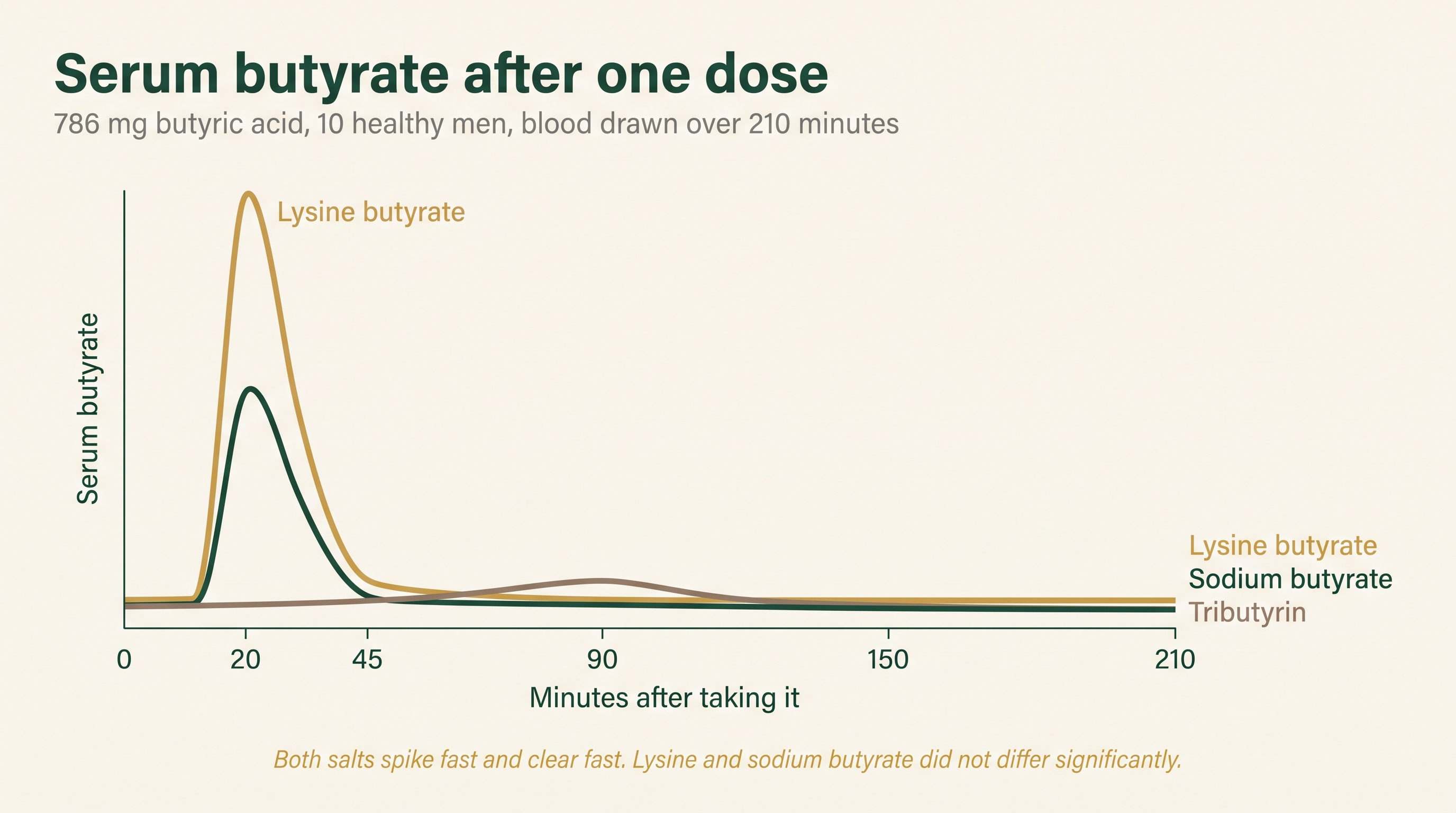
The two salts did not significantly differ from each other. Lysine butyrate's raw numbers are higher, but the p-values were 0.340 and 0.660, and the standard deviations were larger than the means because a handful of participants were unusually strong responders. Treat the salts as comparable on absorption. We broke this down in more detail in the lysine butyrate guide.
So why doesn't everyone just use sodium butyrate?
Because of the sodium.
The trial authors name this as a practical problem: even a small amount of sodium butyrate delivers a meaningful sodium load, which they note "can be problematic for individuals at risk for hypertension, those who are following a low sodium diet, and/or those at high risk of cardiovascular disease."
For an occasional capsule that might not matter. For something you take every day, it adds up, and the people most drawn to gut supplements skew older and more likely to be watching sodium already.
The second problem is the smell. Sodium butyrate is notorious for it. The same paper reports that organoleptic testing rated lysine butyrate as the most palatable of the forms tested, with "a far more pleasant smell and taste than every other product." Anyone who has opened a bottle of sodium butyrate capsules in a quiet room knows why this is not a trivial point. More on the chemistry of that in why butyrate smells.
Sodium butyrate is the most-studied form and it works. It just carries baggage that the newer salts don't.
Then is tributyrin just a worse product?
No, and this is the part most comparison articles get wrong.
Tributyrin's low blood levels are not a bug. They're the intended behavior. Because it survives the stomach and needs enzymatic cleavage, more of it travels further down the digestive tract before releasing butyrate. The trial authors say so directly: the low plasma appearance "suggests that it may have reached the large intestines."
That matters because the large intestine is where most of your gut bacteria live, and where butyrate does its best-established work. Butyrate is the preferred fuel for the cells lining your colon, which burn it in favor of glucose.2 Delivering it there is a legitimate goal.
Animal work supports the idea that distal butyrate release can support intestinal barrier function and reduce colitis severity.3 Human tributyrin data is thinner and mostly comes from oncology dose-finding studies at pharmaceutical doses.4
So the honest framing is a trade, not a ranking:
- Salts get butyrate into circulation fast, where it can reach tissues beyond the gut. Less of it reaches the colon.
- Tributyrin gets more butyrate deeper into the gut. Very little of it shows up in your blood.
We covered the older salt-versus-ester question in sodium butyrate vs tributyrin.
Where do calcium and magnesium butyrate fit?
They weren't in the trial, so anything specific would be guessing.
Mechanistically they're salts, so they should behave roughly like sodium butyrate: dissolve quickly, absorb high in the gut, appear in blood fast. The mineral partner changes the payload rather than the release pattern, so magnesium butyrate gives you magnesium instead of sodium, which some people will consider a feature.
What they don't have is head-to-head human data. If a brand tells you their calcium magnesium blend outperforms other salts, ask which study. As of now there isn't one.
Which butyrate form should you pick?
Depends entirely on what you're after.
| If you want... | Best fit | Why |
|---|---|---|
| Butyrate in your bloodstream, fast | Lysine or sodium butyrate | Both peak around 20 minutes |
| Delivery deep into the colon | Tributyrin | Delayed enzymatic release |
| To take it daily, long term | Lysine butyrate | No sodium load to accumulate |
| To not gag opening the bottle | Lysine butyrate | Rated most palatable in testing |
| The longest research history | Sodium butyrate | Decades of studies behind it |
| To mix it into a drink | Lysine butyrate | Highly soluble, tasteless in formula |
We went with lysine butyrate. Ozzi is a drink you're meant to have every day, so solubility, smell, and no sodium accumulation weren't nice-to-haves, they decided the formula. The full reasoning is in why we picked BIOMEnd, and the broader shopping guide is in the best butyrate supplement.
What none of these forms have been shown to do
Worth saying plainly, because the form debate distracts from a bigger caveat.
Choosing between delivery vehicles only matters if the cargo does something. And for several of butyrate's most-marketed benefits, the human evidence isn't there yet regardless of which form you buy.
The appetite findings come from mice, where oral butyrate reduced food intake through a vagus-nerve pathway.5 The insulin sensitivity findings are also mice.6 The GLP-1 mechanism was mapped in mouse colonic cultures and knockout animals.7 When a human trial raised circulating butyrate and measured GLP-1 as a named secondary outcome, GLP-1 did not move.8
What is solid in humans: butyrate fuels colon cells,2 and short-chain fatty acids infused into the human colon raised fat oxidation, energy expenditure, and PYY in a randomized crossover trial.9
So pick your form on absorption, smell, and sodium. Just don't expect the form choice to deliver a benefit that hasn't been demonstrated in people yet. More in butyrate and GLP-1.
Key takeaways
- Salts dissolve fast. Esters wait for enzymes.
- Both salts beat tributyrin on blood levels, significantly.
- Lysine and sodium butyrate performed comparably on absorption.
- Tributyrin's low blood signal is its design, not a defect.
- Calcium and magnesium butyrate have no head-to-head data.
Frequently asked questions
Is tributyrin better than sodium butyrate?
Not for blood levels. In the head-to-head trial, sodium butyrate produced roughly 2.8x the peak concentration and reached it more than twice as fast. Tributyrin's advantage is that more of it likely survives to the large intestine.
Which butyrate form is most bioavailable?
The two salts, lysine butyrate and sodium butyrate, both significantly outperformed tributyrin. Between the two salts there was no statistically significant difference.
Does tributyrin have less smell than sodium butyrate?
The organoleptic testing described in the trial rated lysine butyrate as the most palatable and best smelling of the three. Tributyrin was not rated best on that measure.
Can I take butyrate and fiber together?
Yes, and it's arguably the more sensible approach. Butyrate supplements deliver the finished compound. Prebiotic fiber feeds the bacteria that make it themselves. They're not redundant. See inulin and appetite.
How much butyrate is in a typical supplement?
It varies widely, and comparing labels is harder than it looks because some list the salt weight and some list the butyric acid content. Ozzi delivers 500mg of L-Lysine Butyrate per stick.
Is butyrate the same as beta-hydroxybutyrate?
No, and this trips up a lot of people. Beta-hydroxybutyrate is a ketone body used in keto supplements. Butyrate is a short-chain fatty acid made by gut bacteria. Different molecules, different purposes.
Do butyrate supplements cause side effects?
In the comparison trial all three forms were well tolerated with no adverse events reported across 10 participants over 3.5 hours. That's a short window and a small group. Sodium forms carry the additional sodium load consideration.
Should I take butyrate with food?
The trial dosed participants fasted after 10 hours, so the fast absorption numbers reflect fasted conditions. Tributyrin depends on lipase, which is more active around a meal, so food may matter more for the ester than the salts.
Is lysine butyrate vegan?
The lysine butyrate in Ozzi is, and so is the rest of the formula. Check individual products, since capsule shells vary.
Butyrate you can actually drink daily
Ozzi Crave Crusher uses 500mg of BIOMEnd L-Lysine Butyrate, the form rated most palatable and carrying no sodium load, plus 500mg of chicory root inulin to feed your own butyrate producers.
Try it for 14 days straight. If it doesn't work, we'll refund your first bag.
References
- La Monica MB, Kirby T, Hartshorn SL, Gustat A, Grdic J, Sandrock J. A Pharmacokinetic Comparison of Three Butyrate Products. Journal of Exercise and Nutrition. 2025;8(1):4. Human randomized crossover trial, n=10. NCT06700785. Full text (open access)
- Donohoe DR, Garge N, Zhang X, et al. The Microbiome and Butyrate Regulate Energy Metabolism and Autophagy in the Mammalian Colon. Cell Metabolism. 2011;13(5):517-526. https://doi.org/10.1016/j.cmet.2011.02.018
- Wang R, Cao S, Bashir MEH, et al. Treatment of peanut allergy and colitis in mice via the intestinal release of butyrate from polymeric micelles. Nature Biomedical Engineering. 2023;7(1):38-55. Mouse. https://doi.org/10.1038/s41551-022-00972-5
- Edelman MJ, Bauer K, Khanwani S, et al. Clinical and pharmacologic study of tributyrin: an oral butyrate prodrug. Cancer Chemotherapy and Pharmacology. 2003;51(5):439-444. Human, cancer patients under medical care. https://doi.org/10.1007/s00280-003-0580-5
- Li Z, Yi CX, Katiraei S, et al. Butyrate reduces appetite and activates brown adipose tissue via the gut-brain neural circuit. Gut. 2018;67(7):1269-1279. Mouse. https://doi.org/10.1136/gutjnl-2017-314050
- Gao Z, Yin J, Zhang J, et al. Butyrate Improves Insulin Sensitivity and Increases Energy Expenditure in Mice. Diabetes. 2009;58(7):1509-1517. Mouse. https://doi.org/10.2337/db08-1637
- Tolhurst G, Heffron H, Lam YS, et al. Short-chain fatty acids stimulate glucagon-like peptide-1 secretion via the G-protein-coupled receptor FFAR2. Diabetes. 2012;61(2):364-371. Mouse and cell culture. https://doi.org/10.2337/db11-1019
- van Deuren T, Smolders L, Hartog A, et al. Butyrate and hexanoate-enriched triglycerides increase postprandial systemic butyrate and hexanoate in men with overweight/obesity: A double-blind placebo-controlled randomized crossover trial. Frontiers in Nutrition. 2023;9:1066950. Human RCT. https://doi.org/10.3389/fnut.2022.1066950
- Canfora EE, van der Beek CM, Jocken JWE, et al. Colonic infusions of short-chain fatty acid mixtures promote energy metabolism in overweight/obese men: a randomized crossover trial. Scientific Reports. 2017;7(1):2360. Human RCT. https://doi.org/10.1038/s41598-017-02546-x
- Guilloteau P, Martin L, Eeckhaut V, Ducatelle R, Zabielski R, Van Immerseel F. From the gut to the peripheral tissues: the multiple effects of butyrate. Nutrition Research Reviews. 2010;23(2):366-384. Review. https://doi.org/10.1017/S0954422410000247
- Egorin MJ, Yuan ZM, Sentz DL, Plaisance K, Eiseman JL. Plasma pharmacokinetics of butyrate after intravenous administration of sodium butyrate or oral administration of tributyrin or sodium butyrate to mice and rats. Cancer Chemotherapy and Pharmacology. 1999;43(6):445-453. Mouse and rat. https://doi.org/10.1007/s002800050922
Peer-reviewed sources retrieved via PubMed. General information, not medical advice. Talk to your doctor before starting any supplement.
