

Lysine Butyrate (BIOMEnd): Why We Chose It Over Every Other Form (2026)
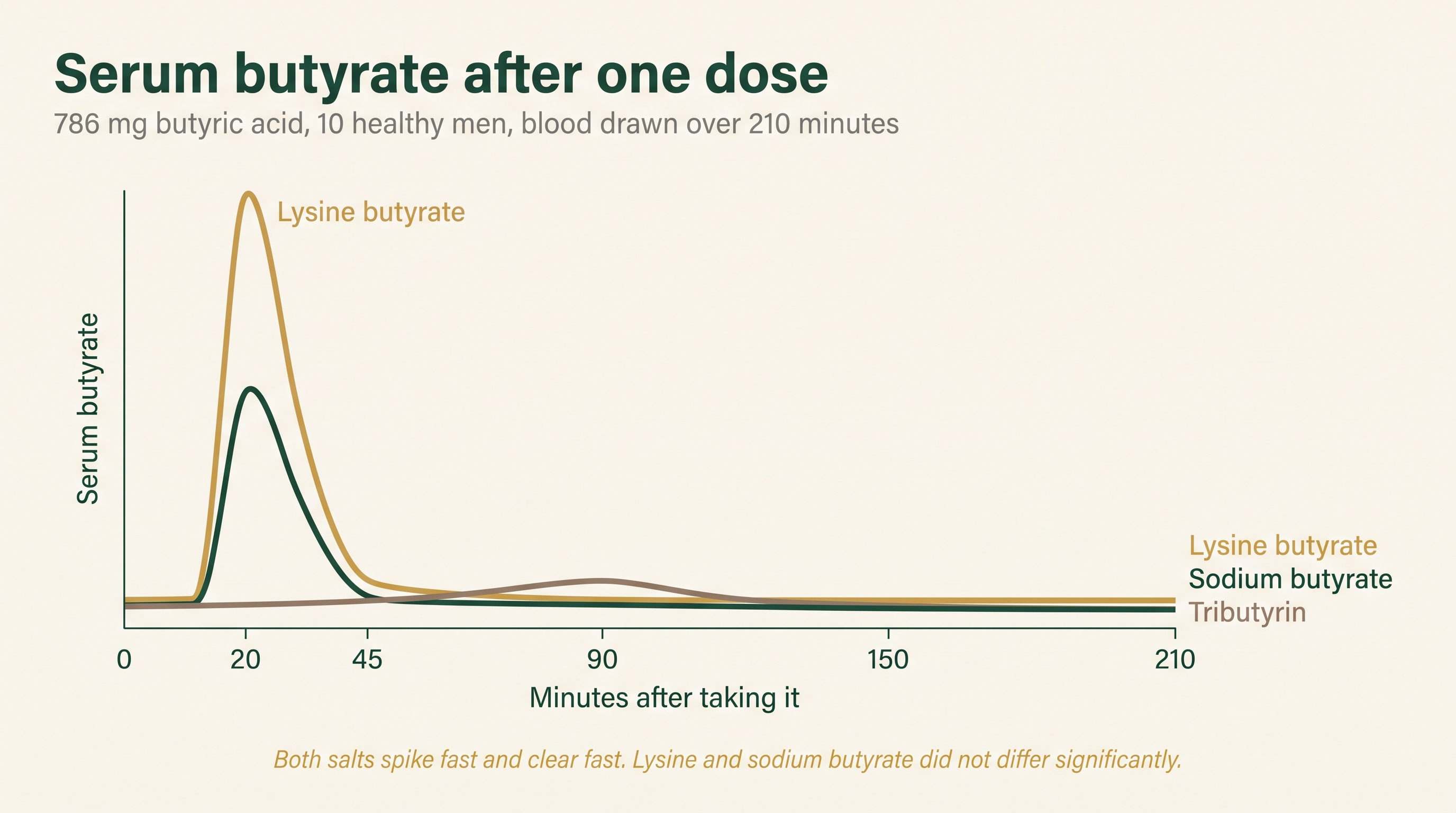
Lysine butyrate is a butyrate salt formed with the amino acid L-lysine. In a 2025 randomized crossover trial in 10 healthy men, it produced a peak serum butyrate of 4.53 µg/mL at 20 minutes, compared with 0.91 µg/mL at 51.5 minutes for tributyrin. It delivers no sodium and is rated the most palatable butyrate form.
This post is the deep dive on one form. For the whole picture in one place, benefits, forms, smell, and the GLP-1 question, start with our complete guide to butyrate supplements.
Every butyrate supplement on the shelf claims to deliver butyrate. Almost none of them tell you how much actually reaches your blood, or when.
That gap matters, because the forms are not interchangeable. They're chemically different molecules that behave differently the moment you swallow them.
In January 2025 a research team finally ran the comparison nobody had run: three commercial butyrate products, same dose of butyric acid, same people, blood drawn at six timepoints. I've read that paper more times than is probably healthy, and this post is the honest version of what's in it, including the part that doesn't flatter the form we use.
What is lysine butyrate?
Butyric acid on its own is an oily liquid that smells like vomit. That's not a figure of speech, it's the same compound responsible for the smell. Nobody is putting raw butyric acid in a drink stick.
So manufacturers bind it to something. What you bind it to defines the product.
- Sodium butyrate: butyric acid paired with sodium. The oldest and most studied form. Dissociates quickly in water.
- Calcium or magnesium butyrate: same idea, different mineral partner.
- Tributyrin: three butyric acid molecules esterified onto a glycerol backbone. A precursor, not a salt. Your enzymes have to cut it apart before any butyrate is released.
- Lysine butyrate: butyric acid paired with L-lysine, an essential amino acid. Sold as BIOMEnd, and this is what we use.
Lysine butyrate is the newest of the four, launched commercially in 2024. It's an ionic compound, so it dissociates in water the same way sodium butyrate does, but the counter-ion you swallow is an amino acid rather than a mineral.
What did the head-to-head trial actually find?
The study is A Pharmacokinetic Comparison of Three Butyrate Products, published in the Journal of Exercise and Nutrition in January 2025 and registered on ClinicalTrials.gov as NCT06700785.1
The design is better than most supplement research you'll encounter:
- Randomized, single-blinded, three-arm crossover. Every participant took all three products, in randomized order, at least 7 days apart. Each person is their own control.
- 10 healthy men, ages 25 to 45, screened with full bloodwork, arriving after a 10-hour fast.
- 786 mg of butyric acid delivered by each product, so the comparison is dose-matched.
- Serum butyrate measured by GC-MS at baseline, 20, 45, 90, 150, and 210 minutes.
Here are the numbers.
| Measure | Lysine butyrate (BIOMEnd) | Sodium butyrate | Tributyrin |
|---|---|---|---|
| Peak concentration (Cmax) | 4.53 µg/mL | 2.51 µg/mL | 0.91 µg/mL |
| Time to peak (Tmax) | 20.0 min | 22.5 min | 51.5 min |
| Total exposure (AUC₀₋₂₁₀) | 189 | 144 | 108 |
| Sodium delivered | None | Meaningful | None |
Against tributyrin, lysine butyrate won on every measure, and the gaps were statistically significant. Roughly 5x the peak concentration (p=0.007), 1.75x the total exposure (p=0.023), and peak reached at 20 minutes instead of 51.5 (p=0.004). Those are large effect sizes, not statistical hairsplitting.
20 minutes to peak, every single participant. The Tmax standard deviation for lysine butyrate was zero.
Where the data doesn't say what the marketing says
Now the part most brands would leave out.
Lysine butyrate did not statistically beat sodium butyrate. The raw numbers favor it, 4.53 against 2.51 on peak concentration, but the p-values were 0.340 for Cmax, 0.660 for total exposure, and above 0.999 for time to peak. In plain terms, the two forms performed comparably and the difference between them could be noise.
Why the huge raw gap with no statistical win? Look at the standard deviations. Lysine butyrate's peak was 4.53 ± 7.56 µg/mL. The variation is bigger than the average. The authors flag exactly this: a few participants were "hyper responders" whose blood butyrate spiked far above everyone else's, which drags the mean up without moving the whole group.
So if you see anyone claim BIOMEnd delivers more circulating butyrate than sodium butyrate, that claim is running ahead of this trial. It delivers comparably. That's the honest read, and it's the read we use.
One more caveat while we're here: this was 10 participants, all men, a single dose, tracked for 3.5 hours. The authors call it a pilot, and it is one. It tells you how the forms absorb. It doesn't tell you what that absorption does for your health over months.
So why did we pick it over sodium butyrate?
Because absorption was never the only thing on the scorecard, and on a tie you decide with everything else.
1. Sodium. This is the big one for a daily drink. The trial authors put it bluntly: even a small amount of sodium butyrate "provides a high sodium intake which can be problematic for individuals at risk for hypertension, those who are following a low sodium diet, and/or those at high risk of cardiovascular disease." Ozzi is designed to be taken every single day, often by women in their 40s and 50s who are already watching sodium. Lysine butyrate delivers the same butyrate with none of it.
2. Smell and taste. The same paper reports that organoleptic testing "rated LysB as the most palatable and provided a far more pleasant smell and taste than every other product." If you've ever opened a bottle of sodium butyrate capsules, you know why this decides products. A supplement you can't stand to open is a supplement you stop taking. We wrote more about this in why butyrate smells the way it does.
3. The carrier is doing something, not nothing. Sodium is inert cargo. L-lysine is an essential amino acid, and it's also one of the substrates your gut bacteria use to make butyrate in the first place. The trial authors call this out as a possible formulation advantage beyond plasma appearance, while being careful to label it speculative. It's not a proven benefit. It is a better thing to be carrying around than sodium.
Three reasons, and only one of them needs a p-value.
Is tributyrin just worse, then?
No, and I don't think it's fair to frame it that way.
Tributyrin is built to do a different job. Because it has to be cleaved by lipase before releasing butyrate, more of it survives the upper gut and travels further down. The trial authors say this directly: the low plasma appearance for tributyrin "suggests that it may have reached the large intestines."
If your goal is delivering butyrate deep into the colon, that delayed release is a feature. Animal work suggests distal delivery may support intestinal barrier function and reduce colitis severity.2
The catch is that it's a genuinely different strategy with a different evidence base, most of it preclinical or from cancer patient studies at pharmaceutical doses.3 We wrote the full comparison in sodium butyrate vs tributyrin.
We chose the systemic route. That's a formulation opinion, not a verdict on anyone else's.
What does butyrate actually do once it's in you?
This is where I have to be careful, because the gap between what butyrate does in a mouse and what it's been shown to do in a person is enormous, and most supplement copy pretends it isn't.
What's solid: butyrate is the primary energy source for the cells lining your colon. Those cells preferentially burn it over glucose.4 It also acts as a histone deacetylase inhibitor, which is a real and well-characterized mechanism.5
What's human but indirect: when researchers infused short-chain fatty acid mixtures directly into the colons of 12 overweight men, fat oxidation and energy expenditure went up, and PYY went up.6 Real human data. Also delivered by rectal infusion, which is not what happens when you drink a stick.
What's mouse: the appetite story. Oral butyrate reduced food intake in mice, suppressed activity in appetite-driving hypothalamic neurons, and activated brown fat. Cutting the vagus nerve abolished the effect entirely, which is elegant work.7 It's also mice. Same for the insulin sensitivity findings.8
What is not established in humans at all: that butyrate raises your GLP-1. The mechanism was mapped in mouse colonic cultures and knockout mice via the FFAR2 receptor.9 When a human trial actually raised circulating butyrate with a butyrate-enriched triglyceride and measured GLP-1 as a named secondary outcome, GLP-1 did not change.10
We sell a GLP-1 support product and I'm telling you the butyrate-to-GLP-1 link is a proposed mechanism, not a human finding. If that costs us a sale to someone who wanted a bigger promise, fine. The full version is in butyrate and GLP-1.
A better delivery vehicle for a mechanism still being mapped is still a better delivery vehicle. It just isn't a cure.
What has the research actually studied?
Worth laying out plainly, because the citation trail behind butyrate marketing is mostly rodents and patients.
| Claim you'll see | Where it comes from | Honest status |
|---|---|---|
| Lysine butyrate absorbs faster than tributyrin | Human crossover trial, n=101 | Supported. Small but well-designed. |
| Lysine butyrate beats sodium butyrate on absorption | Same trial1 | Not supported. No significant difference. |
| Butyrate fuels colon cells | Established cell biology4 | Solid. |
| Butyrate reduces appetite | Mice, oral gavage7 | Rodent only. |
| Butyrate raises GLP-1 | Mouse cultures and knockouts9 | Not shown in humans. One human trial found no change.10 |
| Butyrate improves insulin sensitivity | Mice on high-fat diet8 | Rodent only. |
Note the second row. That's us marking our own homework down, on the exact ingredient we're selling.
Also worth stating outright: there are zero clinical outcome trials on lysine butyrate. Nobody has run a study where people took BIOMEnd for 12 weeks and researchers measured whether anything about their health changed. The pharmacokinetic trial tells you the delivery works. It doesn't tell you what the delivery buys you.
How much lysine butyrate is in Ozzi?
500mg of L-Lysine Butyrate as BIOMEnd per stick, alongside 500mg of chicory root inulin.
Those two are deliberately paired. The butyrate is a postbiotic, meaning it's the finished compound your bacteria would otherwise have to make. The inulin is a prebiotic fiber that feeds the Bifidobacterium populations that produce butyrate on their own. One is the delivery, the other is the supply line. More on that in inulin and appetite and how postbiotics differ from probiotics.
The rest of the stick is 8g allulose, 500mg glucomannan, 150mg African mango, and 11mg chromium. No caffeine, no stimulants, no berberine, vegan. Full detail on the Crave Crusher page and in our butyrate forms breakdown.
Key takeaways
- Lysine butyrate peaked at 20 minutes in every participant.
- It beat tributyrin roughly 5x on peak blood concentration.
- It tied sodium butyrate on absorption, and carries no sodium.
- Organoleptic testing rated it the most palatable butyrate form.
- No clinical outcome trials exist on it yet.
Frequently asked questions
What is BIOMEnd?
BIOMEnd is the branded trade name for L-lysine butyrate, a butyrate ingredient supplied by NutraShure that launched commercially in 2024. It's butyric acid paired with the essential amino acid L-lysine rather than with sodium or a glycerol backbone.
Is lysine butyrate better than sodium butyrate?
On absorption, the head-to-head trial found no significant difference between them. On everything else, lysine butyrate has the edge: no sodium load, better smell and taste, and an amino acid carrier instead of a mineral one. That's why we use it.
Is lysine butyrate better than tributyrin?
For getting butyrate into circulation quickly, yes, and significantly so. Roughly 5x the peak concentration and peak reached 31 minutes sooner. Tributyrin is built for delayed release further down the gut, which is a different goal.
Does lysine butyrate still smell bad?
Far less. The published organoleptic comparison rated it the most palatable of the butyrate forms tested. It's not odorless, and anyone claiming a butyrate product has zero smell is overselling.
How much butyrate should I take?
There's no established optimal dose, and we deliberately don't quote the milligram amounts used in clinical trials, because those studies were run in patient populations at doses well above what's in a daily supplement. Ozzi delivers 500mg per stick.
Does butyrate help with cravings?
In mice, oral butyrate reduced food intake through a vagus-nerve pathway, and cutting that nerve abolished the effect. That work hasn't been replicated in humans. Butyrate is the primary energy source for the cells lining your colon, and that part is solid.
Is lysine butyrate safe?
In the trial, all three butyrate products were well tolerated with no adverse events and no impact on vital signs across 10 participants. That's a small sample over a short window. Talk to your doctor before starting any supplement, especially if you take medication.
Why does the lysine part matter?
Lysine is an essential amino acid and also one of the substrates gut bacteria use in butyrate production. The trial authors raise this as a possible formulation advantage while explicitly calling it speculative. Treat it as a reason to prefer the carrier, not as a proven benefit.
Can I get enough butyrate from food?
You don't eat butyrate directly in any meaningful amount. Your gut bacteria make it when they ferment fiber, which is why fiber intake matters more than any single food. We cover the food routes in how to increase butyrate naturally.
Is butyrate a probiotic?
No. Probiotics are live bacteria. Butyrate is a postbiotic, the finished metabolic compound those bacteria produce. You're skipping a step rather than adding organisms.
The butyrate we'd want to take ourselves
Every Ozzi stick has 500mg of BIOMEnd L-Lysine Butyrate plus 500mg of chicory root inulin. One stick in 16oz of cold water. No sodium load, no caffeine, vegan.
Try it for 14 days straight. If it doesn't work, we'll refund your first bag.
References
- La Monica MB, Kirby T, Hartshorn SL, Gustat A, Grdic J, Sandrock J. A Pharmacokinetic Comparison of Three Butyrate Products. Journal of Exercise and Nutrition. 2025;8(1):4. Human randomized crossover trial, n=10. NCT06700785. Funded in part by the American Institute of Gastrointestinal Health. Full text (open access)
- Wang R, Cao S, Bashir MEH, et al. Treatment of peanut allergy and colitis in mice via the intestinal release of butyrate from polymeric micelles. Nature Biomedical Engineering. 2023;7(1):38-55. Mouse. https://doi.org/10.1038/s41551-022-00972-5
- Edelman MJ, Bauer K, Khanwani S, et al. Clinical and pharmacologic study of tributyrin: an oral butyrate prodrug. Cancer Chemotherapy and Pharmacology. 2003;51(5):439-444. Human, cancer patients under treatment. https://doi.org/10.1007/s00280-003-0580-5
- Donohoe DR, Garge N, Zhang X, et al. The Microbiome and Butyrate Regulate Energy Metabolism and Autophagy in the Mammalian Colon. Cell Metabolism. 2011;13(5):517-526. https://doi.org/10.1016/j.cmet.2011.02.018
- Davie JR. Inhibition of Histone Deacetylase Activity by Butyrate. The Journal of Nutrition. 2003;133(7):2485S-2493S. https://doi.org/10.1093/jn/133.7.2485S
- Canfora EE, van der Beek CM, Jocken JWE, et al. Colonic infusions of short-chain fatty acid mixtures promote energy metabolism in overweight/obese men: a randomized crossover trial. Scientific Reports. 2017;7(1):2360. Human RCT, colonic infusion. https://doi.org/10.1038/s41598-017-02546-x
- Li Z, Yi CX, Katiraei S, et al. Butyrate reduces appetite and activates brown adipose tissue via the gut-brain neural circuit. Gut. 2018;67(7):1269-1279. Mouse. https://doi.org/10.1136/gutjnl-2017-314050
- Gao Z, Yin J, Zhang J, et al. Butyrate Improves Insulin Sensitivity and Increases Energy Expenditure in Mice. Diabetes. 2009;58(7):1509-1517. Mouse. https://doi.org/10.2337/db08-1637
- Tolhurst G, Heffron H, Lam YS, et al. Short-chain fatty acids stimulate glucagon-like peptide-1 secretion via the G-protein-coupled receptor FFAR2. Diabetes. 2012;61(2):364-371. Mouse and cell culture. https://doi.org/10.2337/db11-1019
- van Deuren T, Smolders L, Hartog A, et al. Butyrate and hexanoate-enriched triglycerides increase postprandial systemic butyrate and hexanoate in men with overweight/obesity: A double-blind placebo-controlled randomized crossover trial. Frontiers in Nutrition. 2023;9:1066950. Human RCT. GLP-1 was a secondary outcome and did not change. https://doi.org/10.3389/fnut.2022.1066950
- Guilloteau P, Martin L, Eeckhaut V, Ducatelle R, Zabielski R, Van Immerseel F. From the gut to the peripheral tissues: the multiple effects of butyrate. Nutrition Research Reviews. 2010;23(2):366-384. Review. https://doi.org/10.1017/S0954422410000247
- Recharla N, Geesala R, Shi XZ. Gut Microbial Metabolite Butyrate and Its Therapeutic Role in Inflammatory Bowel Disease: A Literature Review. Nutrients. 2023;15(10):2275. Review. https://doi.org/10.3390/nu15102275
Peer-reviewed sources retrieved via PubMed. This article is general information, not medical advice. Ozzi is a dietary supplement, not a medication. Talk to your doctor before starting anything new.
