

Best Fiber for Appetite Control in 2026: Which Types Actually Curb Hunger
The best fibers for appetite control are viscous soluble fibers (glucomannan, beta-glucan, psyllium) that thicken in the gut and slow digestion, plus fermentable prebiotic fibers (like resistant starch) that gut bacteria turn into short-chain fatty acids, which trigger your body's own GLP-1 and PYY fullness hormones.
Key takeaways
- Viscous soluble fiber slows the stomach and curbs hunger.
- Fermentable fiber feeds bacteria that boost GLP-1.
- Insoluble fiber helps digestion, less so appetite.
- Glucomannan is the thickest, most satiating fiber.
- Combining viscous and fermentable fiber works best.
Everyone says 'eat more fiber.' Almost nobody tells you which kind actually quiets hunger.
Here's the thing: a bran muffin and a scoop of glucomannan are both 'fiber,' but they do completely different things to your appetite. One barely registers. The other can make you feel full on half a meal.
So let's sort it out. By the end, you'll know which fibers fight cravings, which ones don't, and how to use them so the 'food noise' finally settles down.
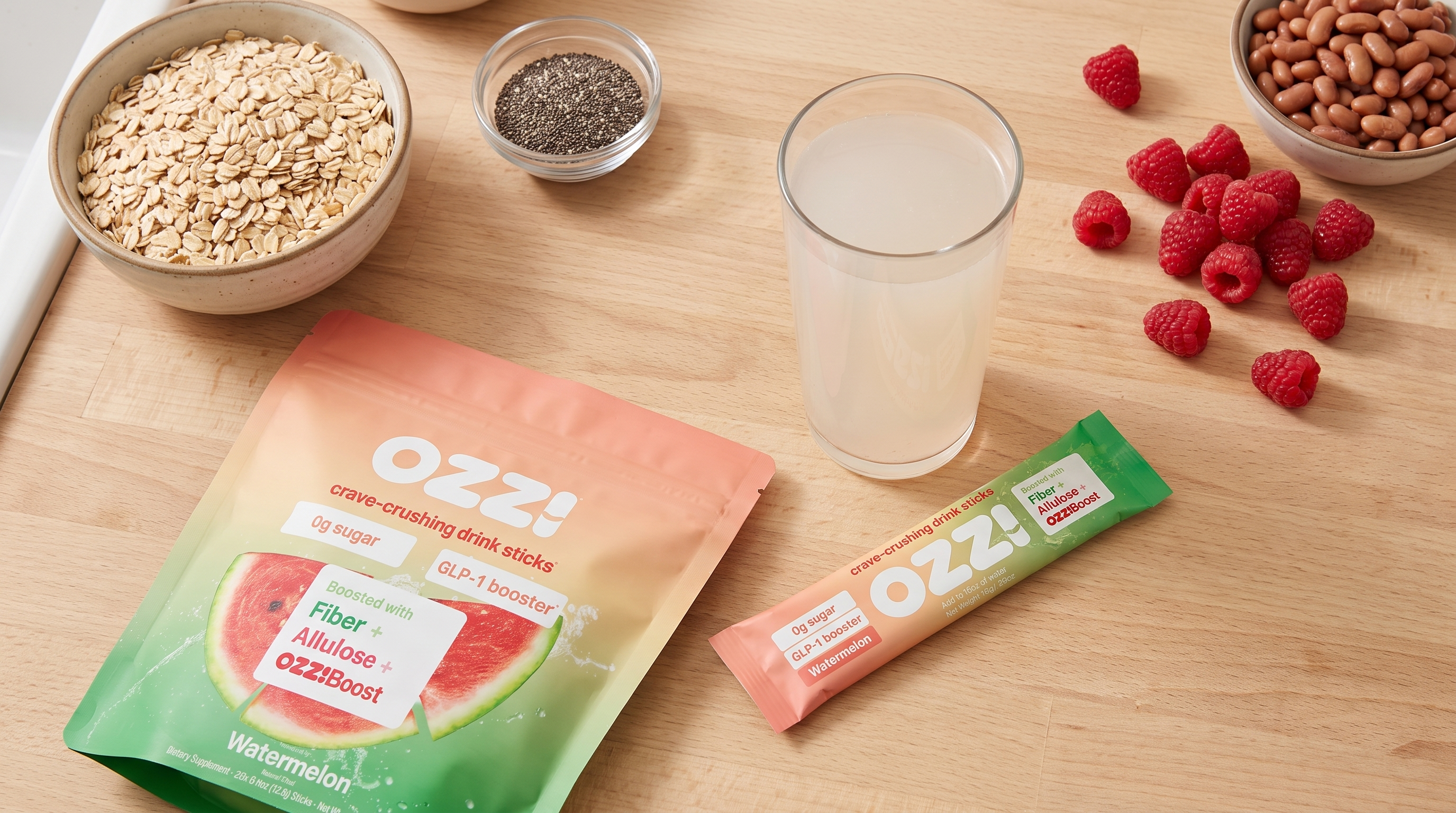
What kinds of fiber actually control appetite?
Viscous soluble fiber like glucomannan, beta-glucan and psyllium is the heavyweight for fullness, fermentable prebiotic fiber like resistant starch gets eaten by your gut bacteria, and insoluble fiber like wheat bran mostly adds bulk and is weak for appetite. Fiber isn't one thing. For appetite, three properties matter: viscosity (how thick it gets in water), fermentability (whether gut bacteria eat it), and solubility.
That breaks down into three practical groups.
Viscous soluble fiber dissolves and turns gel-like. Think glucomannan, beta-glucan (from oats and barley), psyllium, and guar gum. This is the heavyweight for fullness.
Fermentable prebiotic fiber gets eaten by your gut bacteria. Think resistant starch and fructooligosaccharides. This is the heavyweight for hormones.
Insoluble fiber mostly adds bulk and keeps things moving. Think wheat bran and vegetable skins. Great for digestion, weak for appetite.
A bran muffin and a scoop of glucomannan are both 'fiber.' Only one of them fights your cravings.
Why does viscous soluble fiber make you feel full?
Viscous fiber works by physics: it absorbs water and forms a thick gel in your stomach, which takes up space and slows how fast food leaves.
That slower gastric emptying means nutrients hit your bloodstream gradually, so you feel full sooner and stay full longer. A review of human studies found that the most consistent appetite reductions came from viscous fibers like alginate, guar gum, and oat fiber, not from low-viscosity fibers (Salleh et al., 2022).
The thicker the gel, the stronger the effect. That's why glucomannan, the most viscous fiber commonly used, tops the list. We go deep on it in our konjac root weight loss guide.
A 2022 meta-analysis in the American Journal of Clinical Nutrition found that isolated soluble fiber supplements produced modest but significant reductions in body weight in adults with overweight and obesity (Thompson et al., 2022).
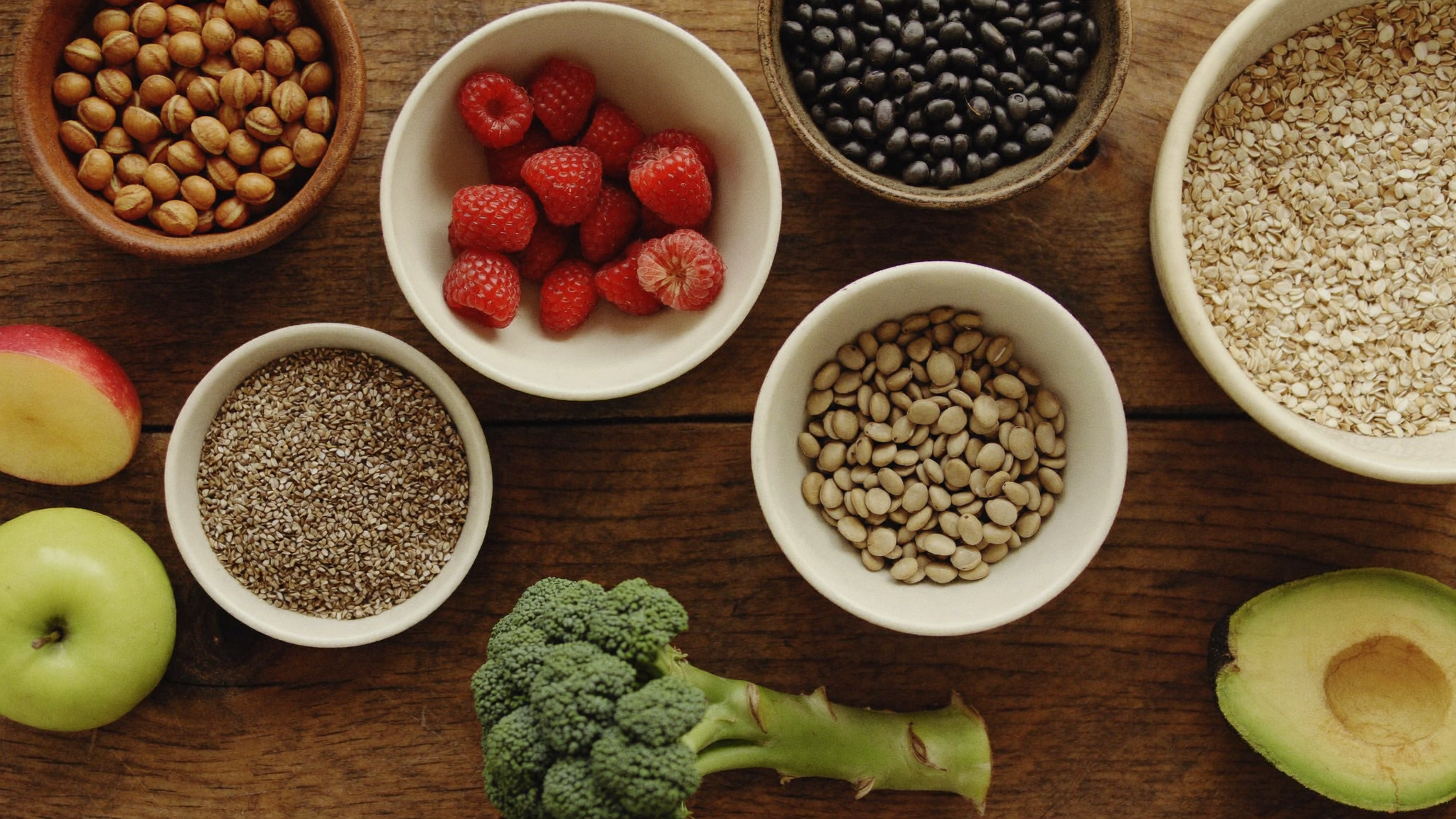
How does fermentable fiber boost GLP-1?
Fermentable fiber plays a different game. It doesn't thicken much, so it won't fill your stomach. Instead, it feeds the bacteria in your colon.
When those bacteria ferment fiber, they produce short-chain fatty acids (SCFAs) like butyrate, propionate, and acetate. SCFAs are signals.
They tell the L-cells in your gut to release GLP-1 and PYY, the same satiety hormones the weight-loss drugs target. More on that chain in our piece on gut health and GLP-1.
A landmark trial delivering propionate straight to the colon found it reduced energy intake and prevented weight gain over 24 weeks in overweight adults (Chambers et al., 2015).
Newer work backs the loop. A 2026 pilot study of a synbiotic (fiber plus probiotics) reported reduced body fat and increased GLP-1 secretion (Synbiotic pilot, 2026). And a June 2026 review argued targeted fiber may improve the durability of GLP-1 drug results (Dietary fiber and GLP-1 RAs review, 2026).
A prebiotic fiber raised gut hormones and steadied post-meal glucose in a randomized crossover study (Prebiotic fiber and gut hormones, 2024). Our prebiotic fiber and appetite guide breaks it down further.
Which fiber is best for appetite control? Ranked
Here's an honest ranking for appetite specifically, not general health. Every fiber here has a role, but they're not equal at fighting hunger.
| Fiber | Type | Appetite effect |
|---|---|---|
| Glucomannan (konjac) | Viscous soluble | Strongest. Highest viscosity, real fullness. |
| Beta-glucan (oat, barley) | Viscous soluble | Strong. Slows emptying, steadies glucose. |
| Psyllium | Viscous soluble | Solid. Gels well, good between meals. |
| Prebiotic fiber | Fermentable prebiotic | Indirect. Feeds gut, boosts GLP-1. |
| Resistant starch | Fermentable prebiotic | Indirect. SCFA production, modest fullness. |
| Wheat bran | Insoluble | Weak. Great for regularity, not hunger. |
A comparative randomized trial of four fiber supplements during calorie restriction found differences between fiber types on weight and metabolic markers, which is the whole point: type matters more than total grams (Reimer et al., 2023).
For appetite, the type of fiber matters far more than the number on the label.
How much fiber do you need to curb hunger?
Most adults eat about 15g of fiber a day. The general target is 25g to 38g, and most people fall short.
For appetite specifically, dose and timing beat raw totals. A few grams of viscous fiber taken with water before a meal can blunt hunger more than a giant bowl of bran at breakfast.
The catch: ramp up slowly and drink plenty of water. Add fiber too fast and you'll trade cravings for bloating and gas. Your gut needs a couple of weeks to adjust.
Viscous fibers especially need water to do their job. A dry fiber pill without enough liquid can't form the gel that creates fullness.
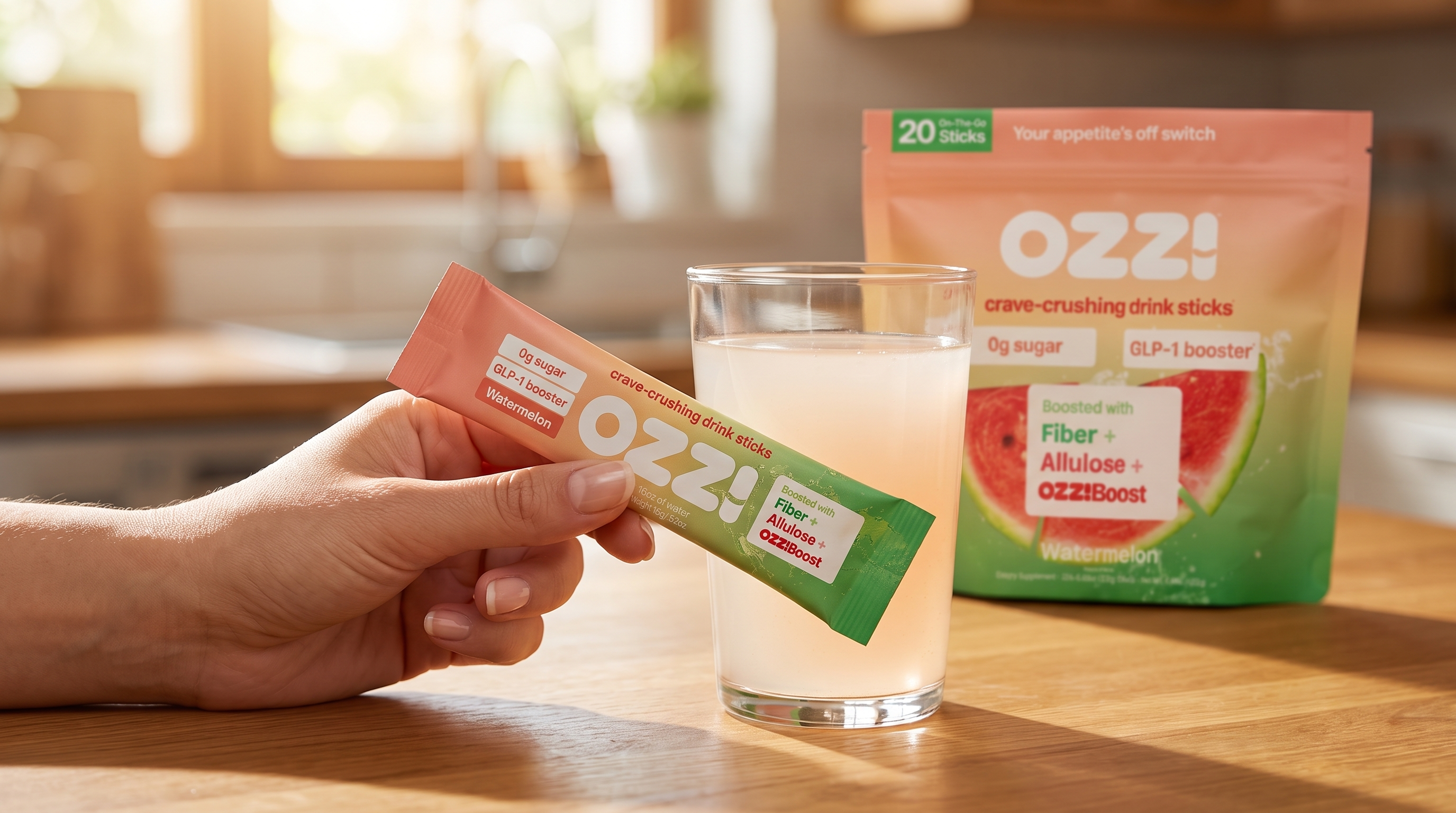
How does Ozzi use fiber for appetite control?
Ozzi's Crave Crusher uses glucomannan, the thickest, most satiating fiber, so a glass before a craving creates real physical fullness.
It uses L-Lysine Butyrate to deliver butyrate directly. That supports your own GLP-1, which is the chain we cover in butyrate and GLP-1 and how to increase GLP-1 naturally.
You mix one watermelon stick into 16oz of cold water, which solves the water problem automatically. No caffeine, so it's fine at night when cravings usually peak.
It's not magic, and I won't pretend a fiber drink matches a prescription. See how it fits the wider category in our natural GLP-1 booster guide and our take on stopping food noise naturally.
Fiber that actually fights cravings
Ozzi pairs viscous glucomannan with butyrate in one watermelon stick. 14-Day Ozzi Challenge: Take it for 14 straight days. If your cravings and food noise aren't quieter, we'll refund your first bag.
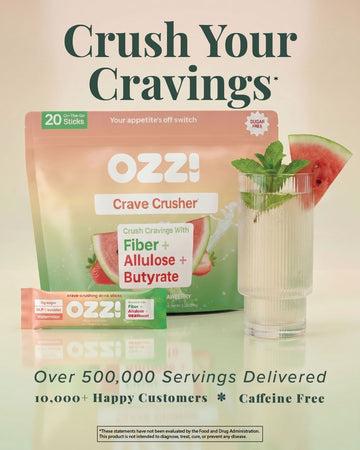
Six actives, no stimulants
Ozzi Crave Crusher
Konjac fiber for physical fullness, 8g of allulose for the sweet craving, plus butyrate, chromium, ursolic acid and African mango. No caffeine and no stimulants, so there is no cutoff time on when you can drink it.
See what's in it →One more question worth answering separately: do fiber supplements actually move the scale? We went through the trial numbers in do fiber supplements work for weight loss, and the honest answer is about 1.8 pounds.
Frequently asked questions
What is the single best fiber for appetite?
Glucomannan from konjac root. It's the most viscous common fiber, so it creates the strongest physical fullness when taken with water before eating.
Is soluble or insoluble fiber better for hunger?
Soluble, specifically the viscous kind. Insoluble fiber helps digestion and regularity but does little for appetite or fullness.
Does fiber really boost GLP-1?
Fiber does support GLP-1, but indirectly. Fermentable fibers feed gut bacteria that make short-chain fatty acids, which trigger your own GLP-1 and PYY release.
How fast does fiber curb cravings?
Viscous fiber can blunt hunger within a meal or two. Gut and hormone benefits from fermentable fiber build over a few weeks of consistency.
Can too much fiber backfire?
Too much fiber can backfire: adding fiber too fast causes bloating, gas, and discomfort. Ramp up slowly over a couple of weeks and drink plenty of water.
Is fiber as good as Ozempic for appetite?
Fiber is not as good as Ozempic for appetite. GLP-1 drugs are far more potent, often 10 to 15% body weight loss. Fiber produces modest, natural effects without a prescription or injection.
Does fiber from food work as well as supplements?
Whole foods give you a healthy mix, but it's hard to get enough viscous fiber from food alone. Supplements let you target the appetite-active types.
When should I take fiber for appetite?
Before meals or before a known craving window, mixed in water. The pre-load lets it gel and signal fullness before you start eating.
Will fiber help with night cravings?
Fiber can help with night cravings. A viscous fiber drink in the evening creates fullness without caffeine, which is why Ozzi works for the nighttime pattern many people struggle with.
This article is for educational purposes and isn't medical advice. Ozzi is a dietary supplement and isn't intended to diagnose, treat, cure, or prevent any disease. Talk to your doctor before starting a new supplement.
References
- Salleh SN, et al. The effect of extracted and isolated fibers on appetite and energy intake: A comprehensive review of human intervention studies. Appetite. 2022. https://www.sciencedirect.com/science/article/abs/pii/S0195666322004317
- Thompson SV, et al. Effects of isolated soluble fiber supplementation on body weight, glycemia, and insulinemia in adults with overweight and obesity: a systematic review and meta-analysis. Am J Clin Nutr. 2022. https://ajcn.nutrition.org/article/S0002-9165%2822%2902702-2/fulltext
- Chambers ES, et al. Effects of targeted delivery of propionate to the human colon on appetite regulation, body weight maintenance and adiposity in overweight adults. Gut. 2015. https://www.ncbi.nlm.nih.gov/pmc/articles/PMC4680171/
- Synbiotic supplement reduces body fat and increases GLP-1 secretion: a pilot clinical study. J Funct Foods. 2026. https://www.sciencedirect.com/science/article/pii/S1756464626000216
- Dietary Fiber and GLP-1 Receptor Agonists in Obesity Management: Converging Mechanisms and Strategies for Durable Weight Control. 2026. https://www.sciencedirect.com/science/article/pii/S216183132600061X
- Inulin effect on gut hormone release and appetite perception: a randomized crossover study. 2024. https://www.ncbi.nlm.nih.gov/pmc/articles/PMC10918168/
- Reimer RA, et al. Effects of Four Different Dietary Fibre Supplements on Weight Loss and Lipid and Glucose Serum Profiles during Energy Restriction. Nutrients. 2023. https://pmc.ncbi.nlm.nih.gov/articles/PMC10253086/
- Unravelling the Effects of Soluble Dietary Fibre Supplementation on Energy Intake and Perceived Satiety: Systematic Review and Meta-Analysis. Nutrients. 2019. https://pmc.ncbi.nlm.nih.gov/articles/PMC6352252/
