

Leaky Gut and Inflammation: What's Real, What's Marketing, and What Actually Helps (2026)
Leaky Gut and Inflammation: What's Real, What's Marketing, and What Actually Helps (2026)
Key takeaways
- Intestinal permeability is real and measurable. It changes with exercise, NSAIDs, alcohol, and disease.
- "Leaky gut syndrome" is not a recognized medical diagnosis, and there's no validated test for it (Mayo's 2024 review says exactly that).
- Commercial zonulin ELISAs don't appear to detect zonulin. Two independent groups showed this, one with the concept's originator as a co-author.
- Increased permeability can precede disease in at least one high-risk population. Genuinely interesting, and still an association rather than a mechanism.
- The butyrate barrier story is beautiful and lives almost entirely in rodents and cell culture.
- Prebiotics have the best human meta-analytic data for lowering an inflammation proxy. A proxy is not a symptom.
Is leaky gut real?
Yes. Intestinal permeability is a real, measurable property of the gut lining, and researchers quantify it in humans using sugar probe tests. What isn't real is "leaky gut syndrome" as a catch-all diagnosis. A 2024 review from Mayo Clinic gastroenterologists states plainly that it is not "currently accepted as a formal medical diagnosis" and that "no validated test currently exists to make this diagnosis."
Both of those things are true at once, and that's the whole problem.
Your gut lining is selectively permeable by design. It lets water, nutrients, and ions through while keeping most bacteria and bacterial debris out. When that selectivity slips, researchers call it increased intestinal permeability. It's a measurable number, not a metaphor.
The marketing version stretches that physiology into a universal explanation: your gut is leaking, that's why you're tired, that's why you're inflamed, that's why the scale won't move, and here's a 90-day protocol and a $189 test kit.
Mark Camilleri's 2019 review in Gut has the sentence that should end most of those funnels: "Whereas inflammatory or ulcerating intestinal diseases result in leaky gut, no such disease can be cured by simply normalising intestinal barrier function." The direction of the arrow is genuinely unsettled.
"Whereas inflammatory or ulcerating intestinal diseases result in leaky gut, no such disease can be cured by simply normalising intestinal barrier function." (Camilleri, Gut, 2019)
The Mayo review goes further on the cost of the fantasy. Patients get led toward "expensive, unnecessary tests and unproven, sometimes dangerous treatments." I've read enough Reddit threads from women who spent four figures on protocols and elimination diets to know that sentence isn't hypothetical.
What actually is the gut barrier?
"Leaky gut" makes people picture a garden hose with holes in it. The real thing is layered, and each layer fails differently.
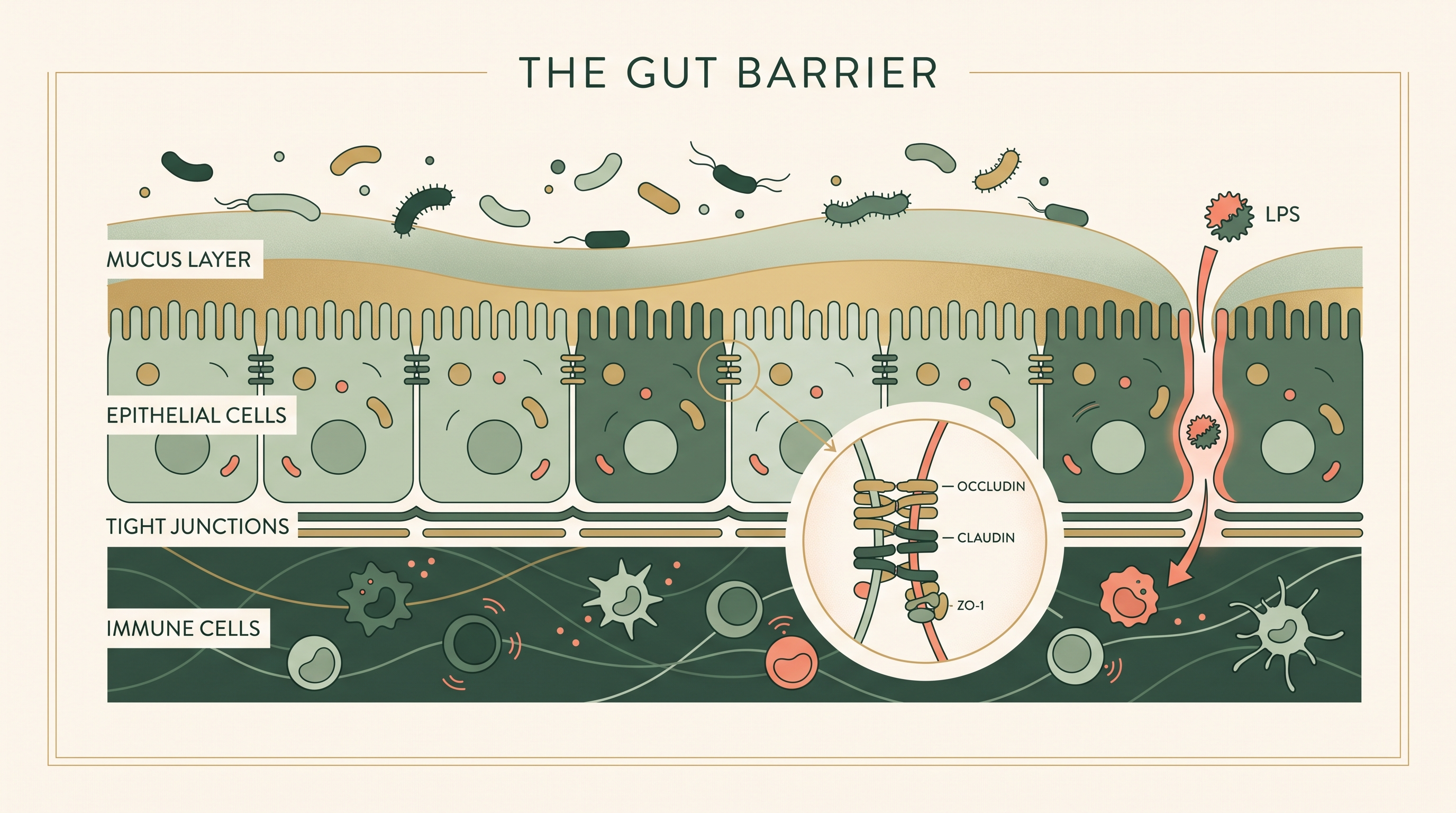
The mucus layer. In your colon, two layers of gel. The outer one is where bacteria live. The inner one is supposed to stay basically sterile.
The epithelium. A single layer of cells, one cell thick, covering a surface area roughly the size of a studio apartment. These cells turn over every few days, and the colonocytes there run on butyrate as their preferred fuel.
The tight junctions. Protein complexes that stitch neighboring cells together and control what slips between them: occludin, the claudin family, zonula occludens-1 (ZO-1). Claudins are the interesting ones because some seal and some form actual pores. "Tight" is relative.
The immune layer. A dense population of immune cells that sample what comes through and decide whether to react. Most of the time they decide not to, which is its own remarkable trick.
When permeability increases, it's usually the paracellular route (between cells, through the tight junctions) that opens up. That's what the sugar tests measure.
Now for the part that gets skipped. Odenwald and Turner reviewed the barrier as a drug target in Nature Reviews Gastroenterology & Hepatology and concluded that "most current clinical data are correlative, making it difficult to separate cause from effect." There is still no FDA-approved agent that targets the epithelial barrier. Pharma has looked at this hard and it hasn't landed.
If drug developers with nine-figure budgets can't confidently move this endpoint and prove it matters, be suspicious of a powder that promises to.
What the research has actually studied (and in whom)
This section is fenced off on purpose. Everything below comes from studies in patients with diagnosed disease or people at genetic high risk, under medical care. It's the strongest evidence in the field, and it says nothing about what any supplement does, including mine.
The best study in the space is Turpin et al., Gastroenterology, 2020. They followed 1,420 healthy first-degree relatives of Crohn's patients, measured intestinal permeability with a lactulose:mannitol ratio, and waited.
An abnormal permeability result was associated with later development of Crohn's disease, hazard ratio 3.03 (95% CI 1.64 to 5.63). It still held when permeability was measured more than 3 years before diagnosis (HR 1.62).
That's temporal precedence, which is rare and valuable. Permeability changed first, disease came later. It's the best argument that a leaky barrier isn't purely downstream wreckage.
Read the fine print with me. One disease. One genetically high-risk population. An association, not a demonstrated mechanism. Subclinical inflammation predating diagnosis could plausibly drive both. None of it means a permeability test predicts anything in a healthy 44-year-old with bloating.
The other established piece is metabolic endotoxemia. Lipopolysaccharide (LPS), a fragment of gram-negative bacterial cell walls, crosses the barrier, binds TLR4, and triggers cytokine release and low-grade systemic inflammation. A 2021 Frontiers in Immunology review describes the pathway well.
The part gut marketing amputates: the loop runs both ways. Obesity, type 2 diabetes, and fatty liver disease also cause increased permeability. Anyone drawing a clean one-way arrow from your gut to your waistline is selling you a diagram, not a finding.
Can you test for leaky gut?
Researchers can measure permeability. You, at home, mostly cannot buy a meaningful version of that.
The research standard is a dual sugar test. You drink a solution of two sugars, typically lactulose and mannitol (or lactulose and rhamnose), then collect urine for a set window. Lactulose is the bigger molecule and gets through mainly when the paracellular route opens; mannitol is small and passes readily. The ratio is your readout, with the second sugar as an internal control.
It's a research tool, sensitive to what you ate, whether you took ibuprofen, whether you exercised that morning, collection timing, and lab methodology. Reference ranges vary between labs, and Camilleri's review is blunt about the variability.
What an abnormal result means for a person without a diagnosed intestinal disease remains unestablished. There's no threshold that says "treat this."
The zonulin problem
This is the part I'd want to read if I'd already paid for a test.
In 2011, Alessio Fasano published a major review in Physiological Reviews proposing zonulin as a physiological regulator of intestinal tight junctions, identified as pre-haptoglobin 2. One measurable protein that reports on barrier state. A blood-drawable biomarker for leaky gut.
Commercial ELISA kits followed. Then direct-to-consumer testing companies. Then practitioner panels. An entire consumer gut-testing category got built on this one analyte.
Then people checked the assay.
In 2018, Scheffler and colleagues published a validation study in Frontiers in Endocrinology across 376 samples. The widely used commercial ELISA did not detect the precursor of haptoglobin 2. It recognized properdin instead. Fasano, who originated the zonulin concept, is a co-author on that paper.
In 2019, Ajamian and colleagues replicated the problem independently in PLoS One, under a title that does the work for me: "Serum zonulin as a marker of intestinal mucosal barrier function: May not be what it seems." The detected antigen included haptoglobin and complement C3. Their recommendation: "We advise the greater scientific and medical community to exercise caution."
In 2021, Massier and colleagues published in Gut under the title "Blurring the picture in leaky gut research," concluding that commercial ELISAs measure "concentrations of unknown proteins."
Two independent groups, one including the concept's originator, showed the commercial zonulin ELISA doesn't detect zonulin. The tests kept selling anyway.
Sit with the implication. Properdin and complement C3 are components of the complement system, part of innate immunity. If your "zonulin" test is partly reading those, an elevated result may be an inflammation readout rather than a permeability readout. Your number could go up for reasons that have nothing to do with your tight junctions.
The honest answer for anyone holding a zonulin result: the assay behind that number has failed independent validation twice, and the field has known since 2018. Whatever you paid, you did not buy a permeability measurement.
This costs me nothing to say, because I don't sell tests. I'm saying it because I've watched people build a year of dietary anxiety on a number that may have been measuring an unknown protein.
What actually increases intestinal permeability?
Here's where the science gets weirdly fun, because the real answers have no product attached.
Strenuous exercise. The cleanest human demonstration in the field. In a 2022 Beneficial Microbes study of 126 people, 1 hour of treadmill running increased the lactulose/rhamnose ratio by roughly 100% (p=0.0001). Researchers use it deliberately as a model, because it works that reliably.
Blood shunts away from the gut toward working muscle, core temperature climbs, and permeability rises. It's transient and reversible. If anyone quotes this at you as evidence that exercise is damaging your gut, close the tab.
NSAIDs. Ibuprofen, naproxen, aspirin. Well documented as increasing small intestinal permeability. The fix is obvious: don't take them casually, especially not habitually before workouts.
Alcohol. Also well documented, dose-dependent, consistent across the literature.
Now the null result, the most useful thing in this section.
A 2024 human crossover trial in International Journal of Molecular Sciences put 15 participants through 2 weeks of a high-fat diet versus 2 weeks of high-carbohydrate. The clean marketing story says the high-fat arm should have blown open the tight junctions and flooded the blood with LPS.
It produced no tight-junction differences. Postprandial endotoxemia stayed low and unchanged. The authors' phrasing: "the healthy gut can adapt."
The tidy diet-to-endotoxemia narrative that anchors a thousand gut-health funnels doesn't reproduce in healthy people over 2 weeks. Small study, sure. But it's human, it's a crossover design, and it's a null this category almost never cites.
Your barrier is dynamic. It opens and closes all day, and in healthy people it's more resilient than the internet implies.
How does butyrate fit in?
Butyrate is a short-chain fatty acid produced when gut bacteria ferment fiber in your colon. Butyrate is the primary energy source for the cells lining your colon, which is a plain physiological fact and my favorite one in this whole area.
The mechanistic story is genuinely elegant. Kelly et al. published it in Cell Host & Microbe in 2015, and I want to be exact about what kind of study it was: rodents and cell culture. Not humans.
Here's the chain. Colonocytes burn butyrate through beta-oxidation, which consumes oxygen. That oxygen consumption keeps the gut lumen hypoxic. Low oxygen stabilizes a transcription factor called HIF-1a. HIF-1a then turns on genes involved in barrier function.
The controls are what sell it. The effect disappeared in HIF-null cells, and after antibiotics wiped out the microbiota, butyrate restored HIF. That's about as tight as mechanistic work gets.
The experiment has never been run end to end in a person: butyrate in, colonocyte oxygen consumption traced to HIF stabilization to barrier gene expression to a clinical outcome. The mouse chain is complete. The human chain is missing.
Same discipline applies to the fiber story. Desai et al. published in Cell in 2016 that a fiber-deprived microbiota starts degrading the colonic mucus layer, eroding the barrier and increasing pathogen susceptibility. Gorgeous experiment, done in gnotobiotic mice colonized with a synthetic 14-member bacterial community.
It's the single most over-claimed paper in gut marketing. You've seen it cited as "fiber prevents leaky gut." It shows no such thing. It's a hypothesis generated in germ-free mice carrying 14 species, a long way from a human gut carrying hundreds.
I sell butyrate. I'd love to tell you the human data is there. It isn't. The longer version is in butyrate and GLP-1 and gut health and GLP-1.
While I'm here: any GLP-1 signaling from butyrate is preclinical. Rodents and cells. I won't pretend otherwise.
What does the evidence say actually helps?
Grades below are mine, based on the human evidence, not on what would be convenient for me.
| Intervention | Best human evidence | Honest grade |
|---|---|---|
| Prebiotics / fermentable fiber | 2025 meta-analysis: LPS reduced, SMD -0.88 (95% CI -1.28 to -0.47), 16 RCTs, n=792, high certainty. Caveat: I²=85.7%, and LPS is a proxy. | B. Strongest thing here, on a surrogate endpoint. |
| Probiotics | 2024 review, 26 studies: 11 of 12 animal studies positive. Human trials "inconsistent, with half reporting reductions in serum LPS and half reporting no differences." | C. The translation gap, quantified. |
| Avoiding habitual NSAIDs | Consistent human evidence that NSAIDs increase small intestinal permeability. | A-. Talk to your doctor if you take them for a reason. |
| Moderating alcohol | Well-documented, dose-dependent effect in humans. | A-. Boring. Works. |
| Polyphenol supplements | Thin. Trials are small and several use zonulin ELISA as the primary outcome. | D. Broken outcome measure. |
| "Gut repair" protocols, L-glutamine stacks, collagen powders | No FDA-approved agent targets the epithelial barrier. Barrier clinical data remain largely correlative. | F for the marketing. Incomplete for the science. |
| Zonulin testing | Failed independent assay validation twice. ELISAs may measure "unknown proteins." | F. Don't buy it. |
The prebiotic row is worth staring at. That meta-analysis, published in Pharmacological Research in 2025, pooled 16 RCTs and earned a high-certainty rating. It's a real result, with an I² of 85.7%, meaning the trials disagreed with each other a lot.
The endpoint is circulating LPS, a marker. Lowering a marker isn't the same as feeling better, and I'm not going to blur those two.
Chicory root inulin is a prebiotic fiber that feeds butyrate-producing bacteria. That's a structure/function statement I can defend at the sentence level. More in inulin and prebiotic fiber and the best fiber for appetite control.
Where Ozzi fits
Short section, because honesty requires it to be short.
Ozzi Crave Crusher is a cold-water drink stick built for food noise, night cravings, and the out-of-control feeling that brings most people here. Appetite is the job.
Two ingredients are relevant here. It contains L-lysine butyrate as a source of butyrate, and butyrate is the primary energy source for the cells lining your colon. It contains chicory root inulin, a prebiotic fiber that feeds butyrate-producing bacteria. Both support gut barrier function and digestive health.
That's the whole claim. Ozzi is not a leaky gut intervention. It isn't tested as one and it isn't sold as one, and given what the barrier literature looks like, there's no product I'd call one.
The other ingredients aren't in this conversation. Glucomannan's lane is viscosity and satiety, covered in konjac root. Allulose is a sweetener. Neither has gut barrier evidence and I'm not going to invent some.
If fiber is new to you, ramp slowly; bloating and gas are common early on. See bloating and constipation relief.
A fiber and butyrate drink, sold honestly
Ozzi Crave Crusher is a cold-water stick with chicory root inulin and L-lysine butyrate. No stimulants. Vegan. Built for food noise and night cravings.
Try it for 14 days straight. If it doesn't work, we'll refund your first bag.
FAQ
Is leaky gut a real diagnosis?
Intestinal permeability is real and measurable. "Leaky gut syndrome" as a diagnosis is not recognized. A 2024 review by Mayo Clinic gastroenterologists says it is not "currently accepted as a formal medical diagnosis" and that "no validated test currently exists to make this diagnosis."
How do I fix leaky gut?
There's no validated protocol, because there's no validated diagnosis to fix. The defensible moves are removing known causes (habitual NSAIDs, heavy alcohol) and eating fermentable fiber. Persistent GI symptoms deserve a gastroenterologist.
Should I get a zonulin test?
No. The commercial ELISAs failed independent validation in 2018 and 2019, appearing to detect properdin, haptoglobin, and complement C3 rather than zonulin. A 2021 paper in Gut concluded they measure "concentrations of unknown proteins."
I already paid for a zonulin test. What does my result mean?
Probably not what you were told. Since the assay appears to pick up complement components, an elevated result may reflect inflammation rather than permeability. That's frustrating, and it's not your fault for buying it.
What actually increases intestinal permeability?
In humans: strenuous exercise (1 hour of treadmill running roughly doubled the lactulose/rhamnose ratio in a 126-person study), NSAIDs, and alcohol. Notably, 2 weeks of a high-fat diet did nothing to tight junctions in a healthy human crossover trial.
Does butyrate fix the gut lining?
The mechanism (butyrate to colonocyte oxygen consumption to HIF-1a to barrier genes) is worked out in rodents and cell culture, and has never been shown end to end in humans. Butyrate is the primary energy source for colonocytes. The rest is a hypothesis.
Does fiber prevent leaky gut?
The famous 2016 study showing fiber deprivation causing mucus degradation was done in gnotobiotic mice with 14 bacterial species. It's a mechanistic hypothesis, not a human finding. Human prebiotic trials show reductions in circulating LPS, a marker rather than a symptom.
Is Ozzi a treatment for leaky gut?
No. Ozzi is a drink stick for appetite and cravings. It contains a butyrate source and a prebiotic fiber, and those support gut barrier function and digestive health. It isn't a leaky gut intervention.
References
- Camilleri M. Leaky gut: mechanisms, measurement and clinical implications in humans. Gut. 2019;68(8):1516-1526. PMID: 31076401. doi:10.1136/gutjnl-2019-318427
- Leaky Gut Syndrome: Myths and Management. Gastroenterol Hepatol (N Y). 2024. PMID: 39193076. PMC11345991
- Odenwald MA, Turner JR. The intestinal epithelial barrier: a therapeutic target? Nat Rev Gastroenterol Hepatol. 2017;14(1):9-21. PMID: 27848962. doi:10.1038/nrgastro.2016.169
- Turpin W, Lee SH, Raygoza Garay JA, et al. Increased Intestinal Permeability Is Associated With Later Development of Crohn's Disease. Gastroenterology. 2020;159(6):2092-2100.e5. PMID: 32791132. doi:10.1053/j.gastro.2020.08.005
- Safety of Bif195, employing a human exercise-induced intestinal permeability model. Benef Microbes. 2022. PMID: 35866597. doi:10.3920/BM2021.0173
- Scheffler L, Crane A, Heyne H, et al. Widely Used Commercial ELISA Does Not Detect Precursor of Haptoglobin2, but Recognizes Properdin as a Potential Second Member of the Zonulin Family. Front Endocrinol (Lausanne). 2018;9:22. PMID: 29459849. doi:10.3389/fendo.2018.00022
- Ajamian M, Steer D, Rosella G, Gibson PR. Serum zonulin as a marker of intestinal mucosal barrier function: May not be what it seems. PLoS One. 2019;14(1):e0210728. PMID: 30640940. doi:10.1371/journal.pone.0210728
- Massier L, Chakaroun R, Kovacs P, Heiker JT. Blurring the picture in leaky gut research: how shortcomings of zonulin as a biomarker mislead the field of intestinal permeability. Gut. 2021;70(9):1801-1802. PMID: 33037053. doi:10.1136/gutjnl-2020-323026
- Fasano A. Zonulin and its regulation of intestinal barrier function: the biological door to inflammation, autoimmunity, and cancer. Physiol Rev. 2011;91(1):151-175. PMID: 21248165. doi:10.1152/physrev.00003.2008
- Kelly CJ, Zheng L, Campbell EL, et al. Crosstalk between Microbiota-Derived Short-Chain Fatty Acids and Intestinal Epithelial HIF Augments Tissue Barrier Function. Cell Host Microbe. 2015;17(5):662-671. PMID: 25865369. doi:10.1016/j.chom.2015.03.005
- Desai MS, Seekatz AM, Koropatkin NM, et al. A Dietary Fiber-Deprived Gut Microbiota Degrades the Colonic Mucus Barrier and Enhances Pathogen Susceptibility. Cell. 2016;167(5):1339-1353.e21. PMID: 27863247. doi:10.1016/j.cell.2016.10.043
- Role of Metabolic Endotoxemia in Systemic Inflammation and Potential Interventions. Front Immunol. 2021;11:594150. PMID: 33505393. doi:10.3389/fimmu.2020.594150
- Intestinal Ketogenesis and Permeability. Int J Mol Sci. 2024;25(12):6555. PMID: 38928261. doi:10.3390/ijms25126555
- DiMattia Z, et al. Effect of Probiotic Supplementation on Intestinal Permeability in Overweight and Obesity: A Systematic Review of Randomized Controlled Trials and Animal Studies. Adv Nutr. 2024;15(1):100162. PMID: 38072119.
- Ghorbani Z, et al. Reinforcing gut integrity: A systematic review and meta-analysis of clinical trials assessing probiotics, synbiotics, and prebiotics on intestinal permeability markers. Pharmacol Res. 2025;216:107780. PMID: 40378939. doi:10.1016/j.phrs.2025.107780
