

GLP-1 Bloating and Constipation: How to Get Relief (2026)
If you started a GLP-1 and your stomach feels like a balloon by 3pm, you're not imagining it.
Bloating and constipation are two of the most common complaints people report on semaglutide and tirzepatide. They're annoying, they're uncomfortable, and they make you wonder if the medication is even worth it.
Here's the reassuring part: most of it is manageable. The mechanism is well understood, and the fixes are boring in the best way.
GLP-1 medications cause bloating and constipation because they slow gastric emptying and gut motility. Food sits longer, stool moves slower, and gas builds up. Relief usually comes from steady hydration, gradual soluble fiber, daily movement, magnesium, and smaller, lower-fat meals.
Key takeaways
- GLP-1 drugs slow the gut on purpose, which drives bloating and constipation.
- Symptoms peak when you start and after each dose increase.
- Hydration plus gradual soluble fiber is the highest-leverage fix.
- Magnesium, walking, and smaller meals all help transit time.
- Gentle fiber and butyrate support the gut without a prescription.
Why do GLP-1 drugs cause bloating and constipation?
GLP-1 receptor agonists work partly by slowing down your digestion. That's a feature, not a bug. Slower gastric emptying keeps you full longer, which is exactly why the drugs curb appetite so well.
The trade-off is that everything downstream slows too.
Food lingers in the stomach. The small intestine moves at a crawl. Stool spends more time in the colon, where extra water gets pulled out of it, so it turns hard and dry. Gas from normal fermentation has more time to build up. That's your bloating and that's your constipation, in one tidy loop.
A 2025 network meta-analysis found that semaglutide and liraglutide carried a higher constipation risk than some other agents, while tirzepatide topped the charts for nausea and diarrhea. Different drugs, slightly different gut personalities, same underlying cause.
Slower digestion is how the drug works. The bloating is the same machinery running in the background.
Delayed gastric emptying is the star of the show here. A 2024 clinical review in the Journal of Clinical Endocrinology tied it directly to the retained stomach contents and fullness that patients describe, and flagged that in rare cases the slowdown can be significant enough to matter before procedures like endoscopy.
When does the bloating usually hit?
Timing is predictable. Symptoms are worst in two windows: the first few weeks after you start, and the week or two after every dose increase.
That's not a coincidence. Your gut is adjusting to a stronger brake each time the dose goes up.
The clinical consensus is that most GI side effects are temporary and fade as your body adapts, which is also why slow, gradual dose escalation is the number one recommendation for reducing them. If your prescriber is rushing your titration, that's worth a conversation.
How do you fix GLP-1 constipation without derailing progress?
The fixes stack. No single one is magic, but together they work fast for most people. A 2025 joint advisory from the American College of Lifestyle Medicine, the American Society for Nutrition, and two obesity groups laid out the priorities, and they're refreshingly simple.
1. Drink more water than feels necessary
Hydration is the foundation. Fiber without water is a traffic jam, not a solution. When you're eating less on a GLP-1, you're also drinking less by accident, so you have to be deliberate about it.
2. Add soluble fiber slowly
Adults should aim for 25 to 35 grams of fiber a day, ideally a mix of soluble and insoluble. The keyword is slowly. Dumping 30 grams on a slowed gut overnight makes bloating worse, not better.
Soluble fiber like inulin and glucomannan pulls water into the stool and feeds the bacteria that keep things moving. A 2025 double-blind, placebo-controlled trial found that 12 grams of daily chicory inulin improved stool frequency and abdominal symptoms in adults with functional constipation, and it notably improved quality of life too.
3. Move your body daily
A walk after meals is one of the most underrated tools for gut motility. It doesn't have to be a workout. Ten minutes counts.
4. Consider magnesium
When diet isn't enough, the consensus guidance suggests magnesium, titrated to keep bowel movements regular. Magnesium oxide and citrate draw water into the intestine. Magnesium glycinate is gentler and better if you're just correcting a deficiency. Skip it if you have kidney issues without checking with your doctor first.
5. Shrink your meals and your fat load
Big, high-fat meals slow gastric emptying even further. On a GLP-1, that's the last thing your stomach needs. Smaller, more frequent meals sit easier.
What does the research say about fiber for gut transit?
The evidence for soluble fiber is stronger than most people assume. Here's a quick look at what recent trials found.
| Approach | What the research shows | Best for |
|---|---|---|
| Chicory inulin | 12g daily improved stool frequency and abdominal symptoms in a 2025 RCT | Gentle daily regularity |
| Glucomannan (konjac) | Viscous fiber that holds water and adds bulk; needs plenty of fluid | Fullness plus softer stool |
| Psyllium | Bulk-forming, traps water and softens stool per clinical guidance | Reliable bulk |
| Magnesium (osmotic) | Draws water into the gut; titrate to effect | When fiber isn't enough |
One caveat worth naming: viscous fibers like glucomannan need water to work. Take them dry, or without enough fluid, and they can make bloating worse. This is the exact opposite of what you want, so hydrate.
Where does gut health fit into all of this?
Constipation on a GLP-1 isn't only about transit speed. Your gut bacteria matter too.
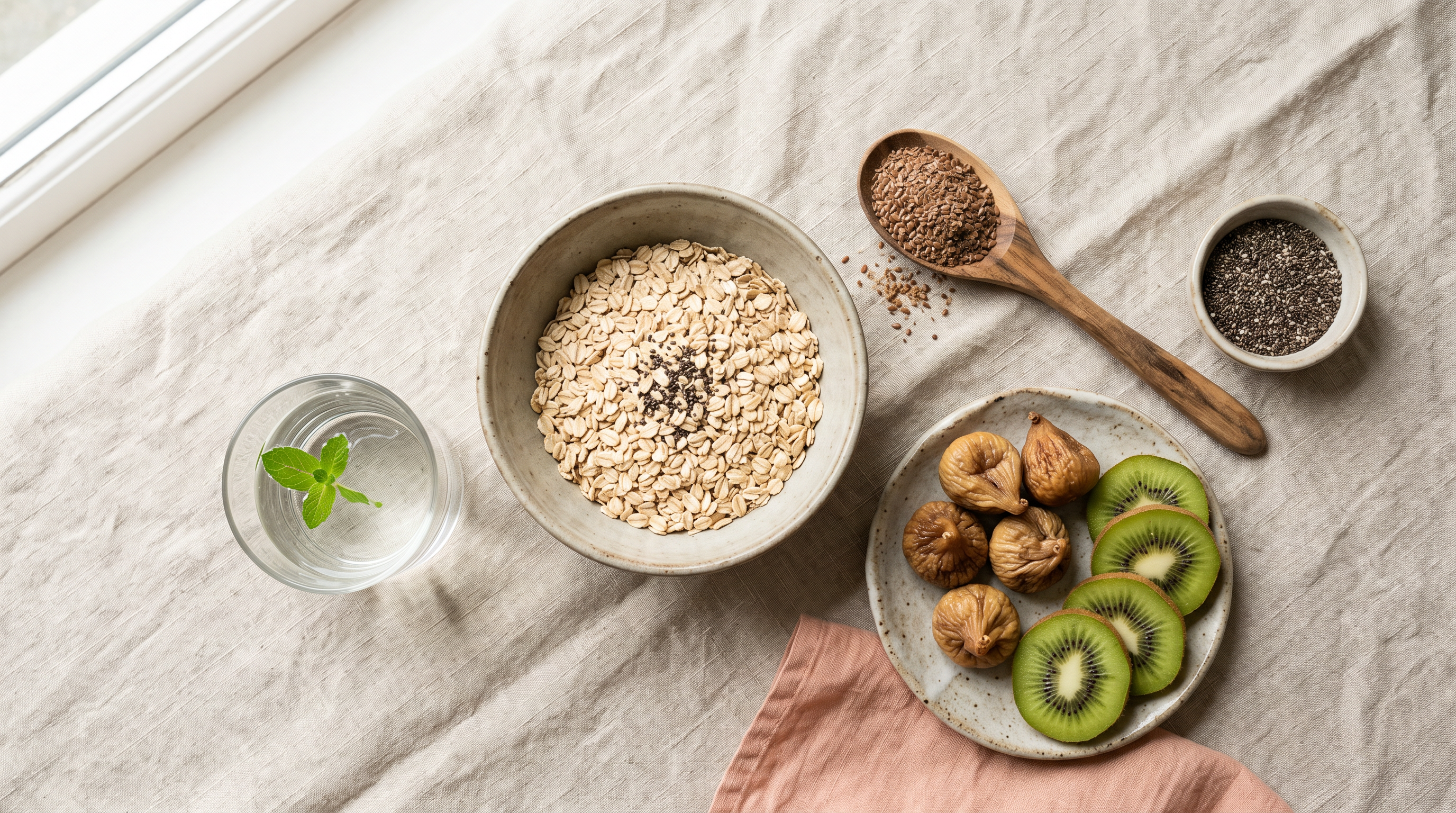
Beneficial bacteria ferment soluble fiber into short-chain fatty acids, and one of them, butyrate, is a big deal for the gut lining and for motility. Inulin is a prebiotic, which means it feeds the bacteria that make butyrate. That's part of why fiber helps beyond just adding bulk.
If you want the deeper mechanism, I wrote about it in butyrate and GLP-1 and gut health and GLP-1. The short version: a well-fed microbiome is a calmer, more regular gut.
Feeding your gut bacteria the right fiber does two jobs at once: it softens stool and it quiets appetite.
Can you get GLP-1 benefits without the gut side effects?
This is the question I hear most from people who quit their prescription or never started one. They want the appetite control. They don't want the bloating, the constipation, or the nausea.
It's a fair ask, and it's exactly why I built Ozzi.
Ozzi is a drink stick that supports your body's own GLP-1 production instead of injecting a drug. It uses chicory inulin and L-Lysine Butyrate to support the gut-to-GLP-1 pathway, plus glucomannan for fullness and allulose to handle sweet cravings.
Because it works through gentle, food-based fiber rather than a strong pharmacological brake on your gut, the side effect profile is very different. You're supporting motility with prebiotics, not slowing it to a crawl. That said, any time you add fiber, ramp up slowly and drink water. Same rules apply.
If you're weaning off a drug, our GLP-1 quitting protocol and the natural alternative guide walk through the transition. And if you want the full ingredient rundown, the best fiber for appetite control post compares the options honestly.
Appetite control without the gut turmoil
Ozzi supports your natural GLP-1 with gentle, prebiotic fiber. Zero caffeine, no prescription, no injection. Try it for 14 days straight, and if it doesn't work for you, we'll refund your first bag.
When should you actually call your doctor?
Most bloating and constipation on a GLP-1 is a nuisance, not an emergency. But some signs warrant a call.
Severe, persistent abdominal pain, vomiting that won't stop, a hard and distended belly, no bowel movement for several days despite the fixes above, or any sign of a possible obstruction. Those aren't things to tough out. When in doubt, ask your prescriber.
I'm a founder, not a doctor, so treat this as a starting map, not medical advice for your specific case.
Frequently asked questions
How long does GLP-1 bloating last?
For most people it's worst in the first few weeks and after each dose increase, then eases as the body adapts. If it never settles, talk to your prescriber about your titration pace.
Does drinking more water really help constipation on Ozempic?
Yes. Slower digestion pulls extra water out of stool, so replacing it matters. Water is also what makes fiber work instead of backfire.
What fiber is best for GLP-1 constipation?
Soluble fiber like inulin, glucomannan, and psyllium tends to help most. A 2025 trial found 12g of daily inulin improved stool frequency in adults with functional constipation. Add it slowly.
Can fiber make bloating worse?
It can, if you add too much too fast or don't drink enough water. Ramp up over a couple of weeks and hydrate, and the bloating usually settles.
Should I take magnesium for GLP-1 constipation?
Expert guidance supports magnesium, titrated to keep you regular, when diet isn't enough. Magnesium oxide and citrate are more laxative; glycinate is gentler. Check with your doctor if you have kidney concerns.
Why is my constipation worse after a dose increase?
Each dose bump strengthens the brake on your gut. Symptoms tend to spike for a week or two, then improve as you adapt.
Does Ozzi cause constipation?
Ozzi uses gentle prebiotic and viscous fiber to support motility rather than slow it pharmacologically. As with any fiber, start with less and drink water. Most people tolerate it well.
Can I use Ozzi instead of my GLP-1 drug?
Ozzi isn't a drug and doesn't replace a prescription your doctor has you on. Many people use it to support natural GLP-1 or to bridge after they stop the medication. Talk to your doctor about your plan.
References
- Comparative gastrointestinal adverse effects of GLP-1 receptor agonists and multi-target analogs in type 2 diabetes: a Bayesian network meta-analysis. 2025. https://www.ncbi.nlm.nih.gov/pmc/articles/PMC12491879/
- Gastrointestinal adverse events associated with GLP-1 RA in non-diabetic patients with overweight or obesity: a systematic review and network meta-analysis. Int J Obes. 2025. https://www.nature.com/articles/s41366-025-01859-6
- Clinical Consequences of Delayed Gastric Emptying With GLP-1 Receptor Agonists and Tirzepatide. 2024. https://pmc.ncbi.nlm.nih.gov/articles/PMC11651700/
- Nutritional Priorities to Support GLP-1 Therapy for Obesity: A Joint Advisory. 2025. https://pmc.ncbi.nlm.nih.gov/articles/PMC12125019/
- Nutritional and lifestyle supportive care recommendations for management of obesity with GLP-1-based therapies: an expert consensus statement. 2025. https://www.ncbi.nlm.nih.gov/pmc/articles/PMC12768930/
- Inulin-induced improvements on bowel habit and gut microbiota in adults with functional constipation: a randomized, double-blind, placebo-controlled study. BMC Gastroenterol. 2025. https://link.springer.com/article/10.1186/s12876-025-04409-6
- A randomized trial of inulin for bowel symptoms, depression and quality of life in constipation-predominant IBS. Sci Rep. 2025. https://www.nature.com/articles/s41598-025-16321-w
- Comparative Safety of GLP-1 Receptor Agonists Across Gastrointestinal, Renal and Pancreatic Systems. 2025. https://www.ncbi.nlm.nih.gov/pmc/articles/PMC12845133/
