

What Is Food Noise? The Science Behind Constant Food Thoughts (2026)
Key takeaways
- Food noise is unwanted, persistent thoughts about food, separate from real hunger.
- Roughly 57% of people with obesity report experiencing it.
- It lives in the brain's reward circuit, driven by dopamine and cues.
- GLP-1 cut "constant food thoughts" from 62% to 16% in one 2025 study.
- You can dial it down with sleep, protein, fiber, and GLP-1 support.
You ate dinner an hour ago. You're not hungry. And yet your brain keeps circling back to the kitchen, the pantry, the leftover cookies on the counter.
That's food noise. And if you've ever felt it, you already know it has almost nothing to do with being hungry.
Food noise is the persistent, intrusive preoccupation with food and eating that exists separately from physical hunger. It's the mental loop that keeps thinking about food even when your body doesn't need it, and it's tied to the brain's reward system rather than a lack of self-control.
The term used to live in online forums and Reddit threads. Now it's in peer-reviewed journals. A 2025 expert panel published in Nature gave it a formal definition: persistent thoughts about food that the person experiences as unwanted or distressing (Hayashi et al., 2025).
So no, you didn't make it up. Researchers are studying the exact thing you feel at 9pm.
What is food noise, exactly?
Food noise is the running commentary in your head about what to eat, when to eat, and how soon you can eat again. It shows up uninvited and it doesn't switch off when you're full.
The clearest research definition comes from a 2025 expert consensus: food noise is "persistent thoughts about food that are perceived by the individual as being unwanted and/or dysphoric" (Hayashi et al., 2025).
Earlier work framed it as heightened food cue reactivity, meaning your brain reacts strongly to the sight, smell, or even the memory of food (Hall et al., 2023). A bakery window, a TV ad, a coworker's lunch. The cue fires, and the loop starts.
It's common. More than half of people living with overweight or obesity report experiencing food noise, with surveys putting the figure around 57% (Hall et al., 2023).
Our own customers describe it better than any journal. One wrote, "Food noise is the worst. Trying to solve my always-hungry problem." Another said, "I'm not even hungry but the urge to eat is so overwhelming that I do it anyway."
What does food noise actually feel like?
It's not one thing. It shows up differently depending on the person and the time of day.
Some people feel it as a steady hum, a background thought about snacks that never fully goes away. Others feel it hit hard at a specific hour, usually after dinner.
Common signs people describe:
- Thinking about your next meal while still eating the current one.
- Mentally scanning the kitchen even when you're full.
- Eating because the urge is loud, not because your stomach is empty.
- Feeling like the volume turns up at night, after a day of eating well.
That last one is the big one. One customer put it perfectly: "I can be stellar all day long, but the monster comes out at night."
"I'm not even hungry, but the urge to eat is so overwhelming that I do it anyway."
Is food noise the same thing as hunger?
No. And this is the distinction that changes everything.
Real hunger is homeostatic. It's your body asking for energy. It builds gradually, almost any food will satisfy it, and it quiets down once you've eaten.
Food noise is hedonic. It's your brain's reward system asking for a specific payoff, usually triggered by a cue, stress, or habit rather than an empty stomach. It can fire when you're completely full, and a salad rarely shuts it up. It wants the cookie. If sugar is your specific trigger, our roundup of the best supplements to curb sugar cravings goes deeper.
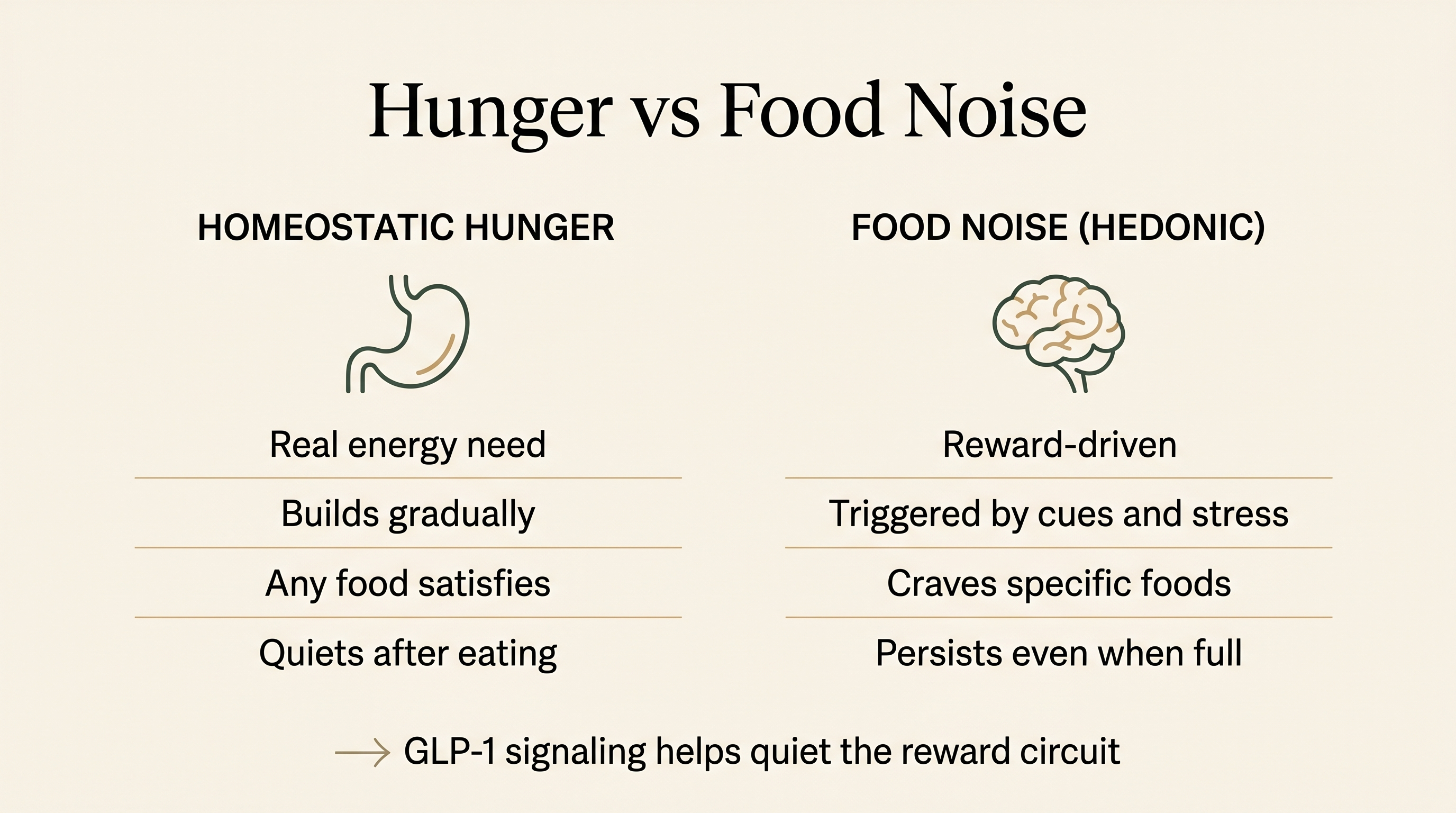
Here's a simple way to tell them apart at home. Ask yourself: would an apple sound good right now? If yes, that's probably hunger. If only the ice cream will do, that's the reward circuit talking.
| Signal | Real hunger | Food noise |
|---|---|---|
| Source | Body's energy need | Brain's reward circuit |
| Onset | Builds slowly | Sudden, cue-triggered |
| What satisfies it | Almost any food | A specific food, often sweet |
| After eating | Goes away | Can keep going |
What causes food noise in the brain?
Food noise has biological roots in brain chemistry, hunger hormones, and the stress response. It's not a character flaw.
The main player is the reward circuit. Food cues trigger dopamine signaling in regions like the ventral tegmental area and the nucleus accumbens, the same areas involved in motivation and wanting (Hsu et al., 2025). Ultra-processed foods, engineered to be hyper-rewarding, train that circuit to fire harder over time.
Hormones set the volume. When satiety hormones like GLP-1 run low, or when leptin signaling gets blunted, the brain has a harder time registering "enough." Stress and poor sleep make it worse by raising cortisol and ramping up reward sensitivity.
So food noise is really a conversation between your gut, your hormones, and your reward circuit. When that conversation gets noisy, the thoughts get loud.

Why does food noise get louder at night?
This is the question I hear most. People tell me they eat clean all day, then something flips after dinner.
A few things stack up at once. Your reward sensitivity tends to rise later in the day, so the same cookie that did nothing at 2pm feels magnetic at 9pm. Decision fatigue is real too. After a full day of choices, the part of your brain that says "no" is running on fumes.
Habit loops pile on top. If you've eaten in front of the TV every night for years, the couch itself becomes a cue. Your brain learned the pattern, and it fires whether or not you're hungry.
Sleep matters more than people think. Short sleep raises ghrelin (the hunger hormone) and dials up reward responses to food the next day. So a late night can hand you louder food noise tomorrow.
This is exactly what our customers describe. "After dinner snacking is sabotaging me." "I binge eat in the evenings all the way up to bedtime, I'm not hungry, I know this." The pattern is so consistent it almost feels designed.
It isn't a moral failing. It's biology following a schedule.
Why do GLP-1 drugs quiet food noise?
This is the part that put "food noise" on the map. People on Ozempic and Wegovy started saying the same thing: the constant thoughts about food just went quiet.
The data backs it up. A 2025 study presented at the European Association for the Study of Diabetes surveyed 550 people on semaglutide. Before treatment, 62% reported constant thoughts about food throughout the day. After treatment, that dropped to 16% (EASD, 2025).
Why? GLP-1 receptors sit right inside the brain's reward and appetite regions, including the VTA, nucleus accumbens, hypothalamus, and amygdala (Hsu et al., 2025). When GLP-1 signaling goes up, it appears to dampen the dopamine response to food cues, which turns down the wanting (Reddy et al., 2026).
A 2026 systematic review of brain imaging studies found that GLP-1 receptor agonists tend to reduce brain reactivity to food cues in appetite and reward regions, though the effect can vary between people (Reddy et al., 2026). Newer work also suggests these drugs may rewire activity in the brain's default mode network, the system tied to self-referential, ruminating thought (Patel et al., 2026).
When GLP-1 goes up, the brain stops shouting about food. That's the whole story in one line.
Can you reduce food noise without the shot?
For a lot of people, yes, at least partly. The shot isn't the only way to raise GLP-1 naturally, and food noise responds to more than one lever. If you're weighing options, our guide to natural alternatives to Ozempic breaks down what has real evidence.
Start with the basics that move GLP-1 and reward sensitivity:
- Protein first. Higher-protein meals raise satiety hormones and blunt the urge to graze later.
- Fiber, especially fermentable fiber. Your gut bacteria turn it into short-chain fatty acids, which stimulate GLP-1.
- Sleep. One bad night cranks up reward sensitivity and makes cues harder to resist.
- Stress regulation. Lower cortisol, quieter reward circuit.
The fiber point is where the gut comes in. When gut bacteria ferment fiber, they produce butyrate and other short-chain fatty acids. Those bind to receptors on intestinal L-cells (FFAR2 and FFAR3) and trigger GLP-1 release (Tolhurst et al., 2012; Psichas et al., 2015). It's the body's own GLP-1 button, pressed from the inside.
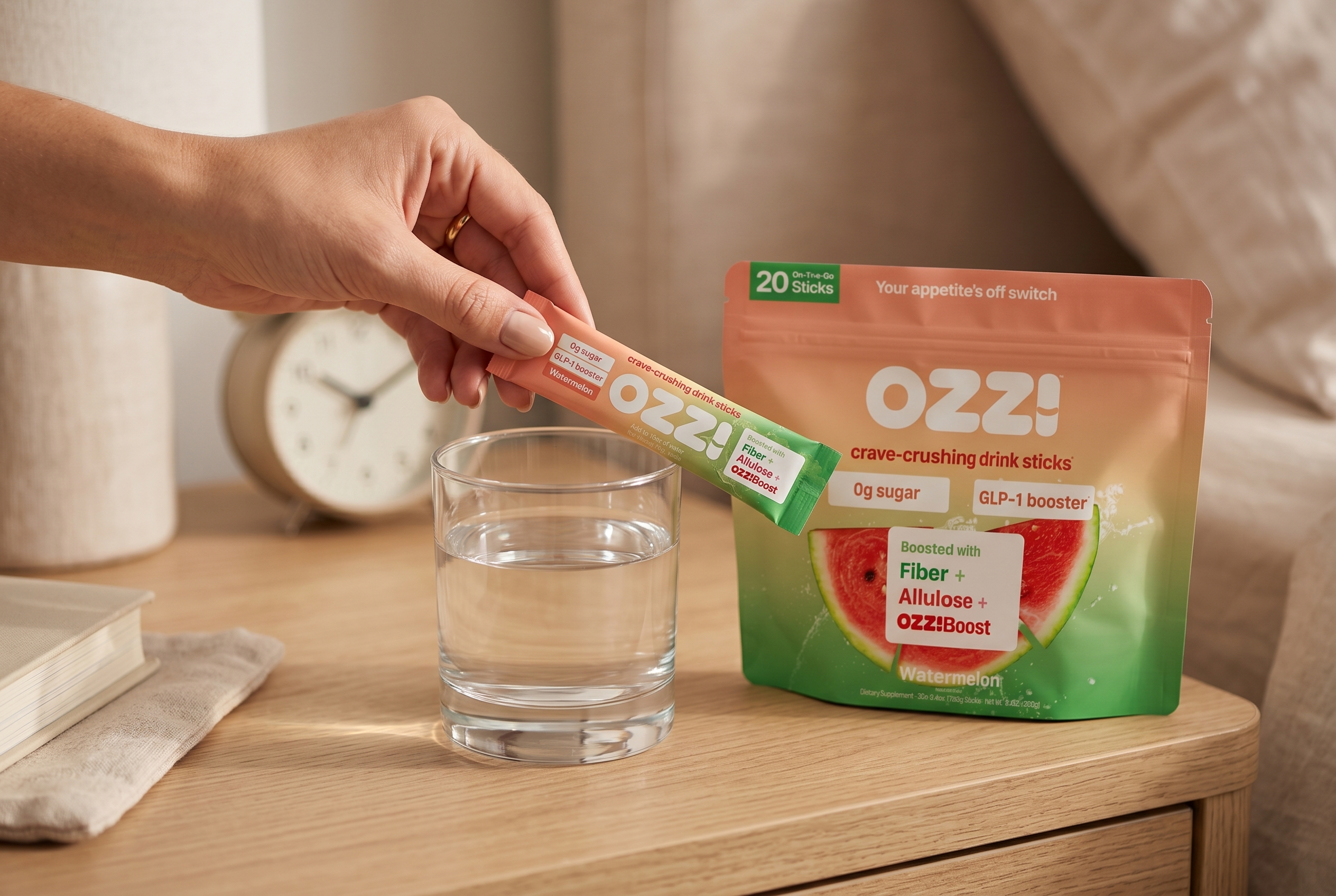
That's the logic behind Ozzi. Crave Crusher pairs L-Lysine Butyrate (a direct source of butyrate) with chicory root inulin (prebiotic fuel for your bacteria to make more), plus allulose and glucomannan for fullness without a blood sugar spike. The goal is to support your natural GLP-1 pathway instead of injecting the hormone.
It won't match a prescription drug milligram for milligram, and I'd never claim it does. But for the food-noise crowd who can't or won't do the shot, supporting GLP-1 naturally is a real lever. For the full playbook, see our guide on how to stop food noise naturally.
When should you worry about food noise?
Food noise on its own isn't a medical diagnosis. Lots of people deal with it and manage fine.
But if the thoughts feel truly relentless, drive frequent binge episodes, or come with real distress, it's worth talking to a doctor or a registered dietitian. Persistent intrusive food thoughts can overlap with binge eating disorder, and that deserves proper support, not a supplement.
If you've come off a GLP-1 drug and the noise came roaring back, you're not imagining it either. Appetite rebound after stopping is common, and it's worth a plan. We cover that in our GLP-1 quitting protocol.
Turn down the volume
Ozzi Crave Crusher supports your natural GLP-1 pathway with butyrate, prebiotic fiber, and allulose. No caffeine, no shot. Use it for 10 days straight. If you don't feel a difference, we'll refund your first bag.
Frequently asked questions
Is food noise a real medical term?
It started as everyday language, but it's now used in research. A 2025 expert panel in Nature published a formal definition describing it as unwanted, persistent thoughts about food (Hayashi et al., 2025).
How common is food noise?
Surveys suggest around 57% of people living with overweight or obesity experience it (Hall et al., 2023). It's far more common than most people assume.
What's the difference between food noise and hunger?
Hunger is your body's energy signal and fades after you eat. Food noise comes from the brain's reward circuit, gets triggered by cues, and can keep going even when you're full.
Why does food noise get worse at night?
Reward sensitivity rises later in the day, willpower runs low after decision fatigue, and habit loops kick in. Most people report their loudest food noise after dinner.
Do GLP-1 drugs really stop food noise?
For many people, yes. In one 2025 study, "constant food thoughts" dropped from 62% to 16% on semaglutide (EASD, 2025). GLP-1 appears to quiet the brain's reward response to food cues.
Can you reduce food noise naturally?
Often, partly. Protein, fermentable fiber, better sleep, and lower stress all help. Fermentable fiber feeds gut bacteria that produce butyrate, which stimulates your own GLP-1 (Tolhurst et al., 2012).
Does Ozzi get rid of food noise?
Ozzi supports your natural GLP-1 pathway, which is one of the levers behind food noise. It's not a drug and won't match a prescription, but many customers say their night cravings quiet down.
When should I see a doctor about food noise?
If the thoughts feel relentless, drive frequent bingeing, or cause real distress, talk to a doctor or dietitian. It can overlap with binge eating disorder, which needs proper care.
- Hayashi D, et al. Toward a consensus definition of "food noise." Nature (expert panel). 2025. PubMed
- Hall KD, et al. What Is Food Noise? A Conceptual Model of Food Cue Reactivity. Nutrients. 2023. PMC10674813
- European Association for the Study of Diabetes (EASD). Survey of 550 patients on semaglutide and food noise. 2025. Conference report
- Hsu TM, et al. GLP-1 receptor agonist semaglutide reduces appetite while increasing dopamine reward signaling. 2025. PMC12244221
- Reddy S, et al. Do GLP-1 Receptor Agonists Alter Brain Responses to Reward-Related Cues? A Systematic Review. 2026. PMC12889473
- Patel A, et al. Quieting "Food Noise": How GLP-1s and Mindfulness Rewire the Default Mode Network and Reward Circuits. 2026. PMC12770913
- Tolhurst G, et al. Short-chain fatty acids stimulate glucagon-like peptide-1 secretion via the G-protein-coupled receptor FFAR2. Diabetes. 2012. PubMed
- Psichas A, et al. The short chain fatty acid propionate stimulates GLP-1 and PYY secretion via FFAR2 in rodents. 2015. PMC4356745
- Xiong RG, et al. Short-Chain Fatty Acids and Human Health: From Metabolic Pathways to Current Therapeutic Implications. Life. 2024. MDPI
