

Menopause and the Gut Microbiome: What Actually Changes (2026)
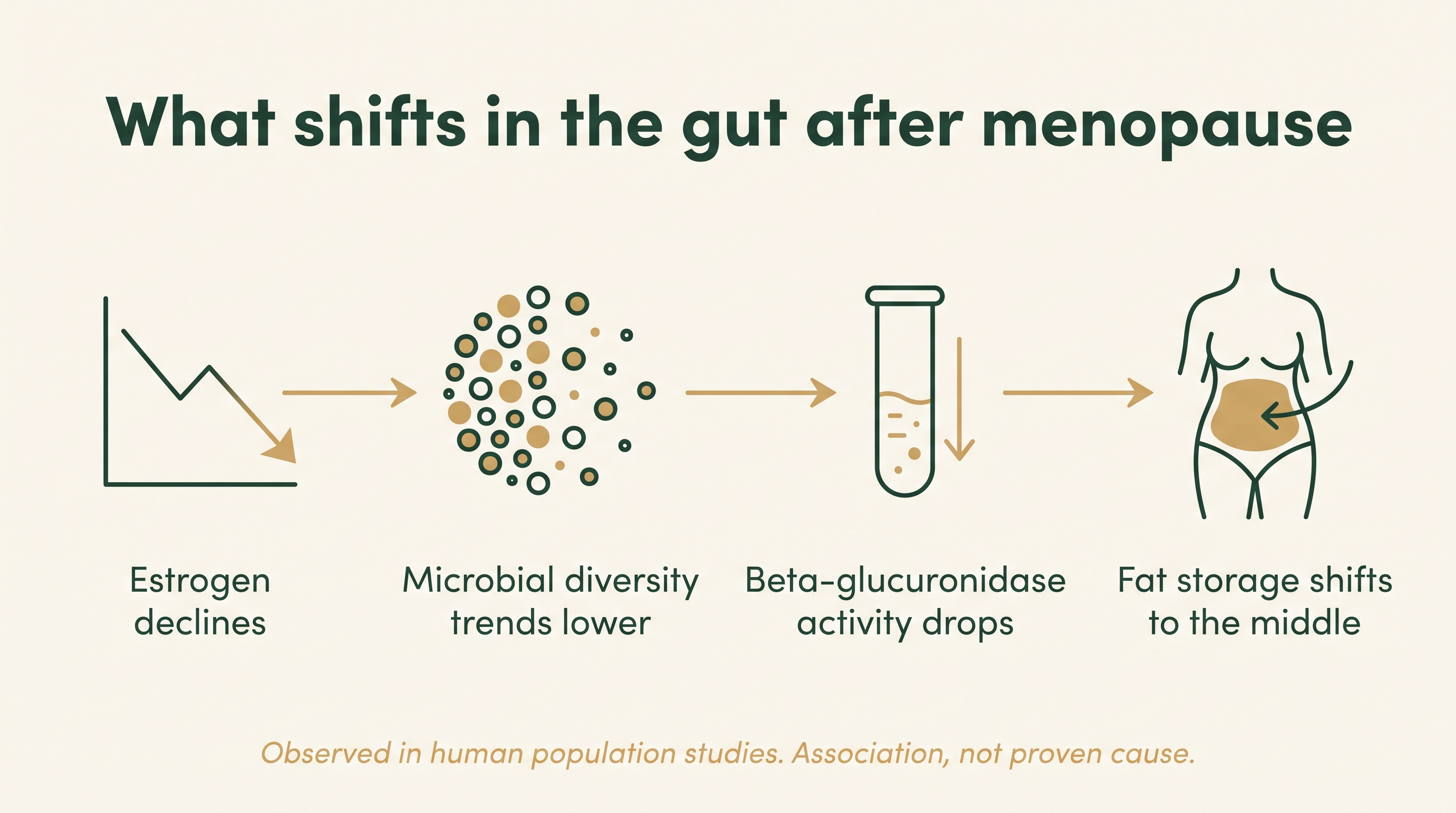
After menopause, the gut microbiome trends toward lower diversity and a composition closer to the male pattern. Activity of microbial beta-glucuronidase, the enzyme that recycles estrogen back into circulation, decreases. These changes are associated with higher cardiometabolic risk, though causation has not been established in humans.
Something changes around menopause that most women notice before any lab test catches it.
The same food sits heavier. Bloating shows up on days it never used to. Weight collects around the middle instead of the hips. And the evening cravings get louder, even when nothing about the day changed.
Estrogen gets the blame for all of it, which is fair as far as it goes. But there's a second system involved, and it's one the research has only started mapping properly in the last 5 years: the roughly 100 trillion bacteria living in your gut.
Here's what the human data actually shows, what it doesn't, and where the honest line sits.
What actually happens to the gut microbiome during menopause?
The largest human study on this comes from the Hispanic Community Health Study/Study of Latinos. Researchers ran shotgun metagenomic sequencing on stool from 2,300 people: 295 premenopausal women, 1,027 postmenopausal women, and 978 men.1
Three findings stood out.
First, postmenopausal women trended toward lower gut microbiome diversity than premenopausal women, after adjusting for age and behavioral factors. Diversity is a rough proxy for resilience. Fewer species generally means a less adaptable system.
Second, and this is the part that surprised the researchers: the postmenopausal gut microbiome looked more similar to the male gut microbiome than the premenopausal one did. Specific species shifted. Some went up, including Prevotella marshii and Sutterella wadsworthensis. Others went down, including Akkermansia muciniphila and several Escherichia species.
Third, activity of microbial beta-glucuronidase decreased after menopause. That enzyme matters more than its name suggests, and it gets its own section below.
Those microbiome differences correlated with worse cardiometabolic profiles in postmenopausal women. Correlated. Not caused. The study design can't separate the two, and the authors say so directly.
The postmenopausal gut starts to look statistically more like a man's gut. Nobody fully knows what that means yet.
What is the estrobolome, and does the evidence hold up?
The "estrobolome" is the set of gut bacterial genes that metabolize estrogen. It's the reason gut health and hormones get talked about in the same breath.
The mechanism is real and well described. Your liver packages used estrogen with a glucuronide tag and ships it to the gut for disposal. Certain gut bacteria produce beta-glucuronidase, an enzyme that snips that tag off. The freed estrogen can then get reabsorbed into the bloodstream instead of leaving the body.2
So the bacteria in your gut have a hand in how much estrogen actually stays in circulation. In a body that's already producing less of it, that's not a small detail.
This is where the wellness internet usually stops. Here's the part it skips.
A study of 164 healthy postmenopausal women measured fecal microbiome diversity against urinary estrogen metabolites. Diversity did associate with several estrogen metabolism ratios. But the Firmicutes-to-Bacteroidetes ratio, the single number most often sold as a "gut health score," showed no association with any estrogen measure.3
And in a 1,000-person Estonian cohort looking at a different estrogen-driven condition, estrobolome-associated enzyme sequences showed no significant differences between groups after correction for multiple testing.4
The estrobolome is a genuine biological pathway. It is not yet a reliable predictor of anything you can act on at home. Both things are true.
Why does menopause weight land around the middle?
Estrogen influences where the body stores fat. When it drops, storage shifts from hips and thighs toward the abdomen, including the visceral fat packed around the organs.
The gut appears to be part of that story. A cross-sectional study of 56 postmenopausal women with obesity found that visceral fat and waist circumference had a significant impact on the metabolic potential of the microbiome, meaning the functional genes the bacteria carried, not just which species were present.5
The same study found microbial diversity was inversely correlated with lipopolysaccharide, a bacterial cell-wall fragment that drives low-grade inflammation when it crosses the gut lining. Lower diversity, higher LPS. We covered that pathway in detail in metabolic endotoxemia and gut inflammation.
Worth being precise here: this was 56 women, cross-sectional, with no matched control group. The authors call for better-controlled studies before anyone draws causal arrows. That's the honest read.
Does any of this explain the cravings?

Partly, and only partly.
Estrogen has direct effects on appetite signaling in the brain, which is a separate mechanism we walk through in estrogen and appetite. That pathway doesn't need the microbiome to explain anything.
The gut angle is more indirect. Gut bacteria ferment fiber into short-chain fatty acids, and one of those, butyrate, is the main fuel source for the cells lining your colon. Short-chain fatty acids are also part of the signaling traffic along the gut-brain axis.
Here's where I want to be careful, because this is the exact spot where supplement marketing usually oversells.
The idea that butyrate stimulates GLP-1 release from intestinal L-cells comes from mouse and cell-culture work. It has not been demonstrated in humans. A human trial that successfully raised circulating butyrate measured GLP-1 as a named secondary outcome and found no change. Anyone telling you butyrate raises your GLP-1 is describing a rodent, not you. We laid out that evidence honestly in butyrate and GLP-1.
What holds up better: fiber intake, satiety, and blood sugar stability are well-studied in humans, and all three get harder to maintain when insulin sensitivity drops after menopause. That's covered in hormonal hunger versus real hunger.
Your cravings aren't really a willpower problem, they're a hormone problem. Menopause just turns the volume up.
What has the research actually studied?
Most of what gets quoted about menopause and the microbiome comes from a small number of study types, each with real limits. Here's the honest inventory.
| Finding | Evidence type | How much weight it carries |
|---|---|---|
| Diversity trends lower after menopause | Human, 2,300 participants, cross-sectional1 | Strong for the association. Silent on cause. |
| Beta-glucuronidase recycles estrogen | Human mechanism, review-level2 | Mechanism is solid. Clinical meaning unclear. |
| Firmicutes/Bacteroidetes ratio predicts estrogen status | Human, 164 women3 | Not supported. No association found. |
| Probiotic maintains serum estradiol | Human RCT, exploratory, manufacturer-funded6 | Interesting. Needs independent replication. |
| Gut bacteria drive postmenopausal bone loss | Mouse models, with limited human sampling7 | Preclinical. Do not read as human fact. |
| Soy isoflavones protect bone via microbiome | Ovariectomized mice on high-fat diet8 | Rodent only. Hypothesis-generating. |
Two of the six rows above are mouse studies. That ratio is roughly what the whole field looks like right now, which is exactly why species labels belong on every claim.
One note on the probiotic trial: an exploratory randomized, double-blind, placebo-controlled study in healthy peri- and postmenopausal women found serum estradiol held steady in the probiotic group over 12 weeks while it dropped in the placebo group.6 That's a real result. It was also run by the companies that make the strain, in a small exploratory design, and it hasn't been independently replicated. Participants in that trial were healthy volunteers, not patients under treatment.
What can you actually change?
You can't put estrogen back with food. Anyone selling you that is selling you something.
What you can influence is the input the bacteria depend on. A 2025 review of the menopause microbiome landed on the same conclusion: dietary fiber and prebiotic intake are the most consistently supported levers, and the evidence for specific probiotic strains remains thin.9
Four things worth doing, in rough order of evidence quality:
- Eat more fiber, from more sources. Diversity of plant fiber tracks with diversity of bacteria. 30 different plants a week beats 30 grams from one source.
- Add prebiotic fiber specifically. Inulin from chicory root feeds Bifidobacterium, which produces butyrate. We go deeper in inulin and appetite.
- Protect protein and muscle. Not a microbiome move, but the single biggest lever on metabolic rate after 50.
- Stabilize blood sugar. Insulin sensitivity falls with estrogen. Steadier glucose means fewer of the crash-driven cravings covered in menopause weight gain and cravings.
Notice what's missing from that list: a gut test, a probiotic protocol, and a "reset." None of those have the evidence to earn a spot.
Where does Ozzi fit into this?
Straight answer: Ozzi is a fiber and postbiotic drink stick, not a menopause treatment. No supplement replaces estrogen, and nothing in our formula has been tested in a menopause-specific trial.
What it does contain, per stick:
- 500mg chicory root inulin, a prebiotic fiber that feeds butyrate-producing bacteria.
- 500mg L-Lysine Butyrate, a postbiotic form of butyrate. Butyrate is the primary energy source for the cells lining your colon.
- 500mg glucomannan from konjac root, a viscous fiber that expands with water and supports satiety.
- 8g allulose, a rare sugar that tastes sweet without spiking blood glucose the way sucrose does.
- 11mg chromium as Metabolex, which supports blood sugar control.
That's a fiber-forward stack aimed at satiety and gut support. It sits alongside the four levers above rather than replacing them. Full breakdown lives on the Crave Crusher page, and the wider mechanism is covered in gut health and GLP-1 and what GLP-1 actually is.
Key takeaways
- Postmenopausal gut diversity trends lower in human studies.
- Beta-glucuronidase activity drops, reducing estrogen recycling.
- The Firmicutes/Bacteroidetes ratio predicts nothing useful here.
- Most bone and barrier findings come from mice, not women.
- Fiber variety is the best-supported lever you control.
Frequently asked questions
Does menopause change your gut bacteria?
Human population data says yes. In a study of 2,300 people, postmenopausal women showed lower microbial diversity and a composition closer to the male pattern than premenopausal women did. Whether menopause causes those shifts or simply travels with them has not been settled.
What is the estrobolome?
It's the collection of gut bacterial genes involved in estrogen metabolism. The key player is beta-glucuronidase, an enzyme that frees estrogen from its disposal tag so it can be reabsorbed rather than excreted.
Can a probiotic raise my estrogen?
One small exploratory trial found serum estradiol held steadier in a probiotic group than in placebo over 12 weeks. It was funded by the strain's manufacturer and hasn't been independently replicated. Treat it as a lead, not a conclusion.
Is bloating during menopause caused by the microbiome?
Possibly, though it's rarely just one thing. Slowed gut motility, shifting bacteria, and changes in how you tolerate certain fibers all overlap in this window. If bloating is new, persistent, or painful, that's a conversation for your doctor.
Will fixing my gut stop menopause weight gain?
No. Fat redistribution after menopause is driven mainly by falling estrogen and declining muscle mass. Gut health looks like a contributing factor, not the lever that reverses it.
Should I get a microbiome test?
Consumer gut tests currently can't tell you anything actionable about menopause. The one metric they lean on hardest, the Firmicutes-to-Bacteroidetes ratio, showed no association with any estrogen measure in a study of 164 postmenopausal women.
Does butyrate help with menopause cravings?
Butyrate is the primary energy source for colon cells and supports gut barrier function. The proposed link between butyrate and GLP-1 release comes from mouse and cell studies, and has not been shown in humans. We don't claim otherwise.
How long does it take to shift the gut microbiome with diet?
Composition starts changing within days of a real dietary shift, but stable change tracks with sustained habits over weeks to months. Diversity responds to variety more than to any single food.
Does HRT affect the gut microbiome?
It's an active research question. Since estrogen and gut bacteria influence each other in both directions, hormone therapy plausibly affects composition, but the human evidence isn't strong enough yet to make claims about it.
Fiber first, when the evening cravings get loud
Ozzi Crave Crusher is a daily stick with 500mg prebiotic inulin, 500mg postbiotic butyrate, and 500mg glucomannan. Mix it in 16oz of cold water.
Try it for 14 days straight. If it doesn't work, we'll refund your first bag.
References
- Peters BA, et al. Menopause Is Associated with an Altered Gut Microbiome and Estrobolome, with Implications for Adverse Cardiometabolic Risk in the Hispanic Community Health Study/Study of Latinos. mSystems. 2022;7(3):e0027322. Human. https://doi.org/10.1128/msystems.00273-22
- Hu S, et al. Gut microbial beta-glucuronidase: a vital regulator in female estrogen metabolism. Gut Microbes. 2023;15(1):2236749. Human, review. https://doi.org/10.1080/19490976.2023.2236749
- Yaghjyan L, et al. Associations of gut microbiome with endogenous estrogen levels in healthy postmenopausal women. Cancer Causes Control. 2023;34(10):873-881. Human. https://doi.org/10.1007/s10552-023-01728-5
- Pérez-Prieto I, et al. Gut microbiome in endometriosis: a cohort study on 1000 individuals. BMC Medicine. 2024;22(1):294. Human. https://doi.org/10.1186/s12916-024-03503-y
- Łoniewski I, et al. Analysis of correlations between gut microbiota, stool short chain fatty acids, calprotectin and cardiometabolic risk factors in postmenopausal women with obesity: a cross-sectional study. Journal of Translational Medicine. 2022;20(1):585. Human. https://doi.org/10.1186/s12967-022-03801-0
- Honda S, et al. Supplementation with a Probiotic Formula Having β-Glucuronidase Activity Modulates Serum Estrogen Levels in Healthy Peri- and Postmenopausal Women. Journal of Medicinal Food. 2024;27(8):720-727. Human RCT, manufacturer-funded. https://doi.org/10.1089/jmf.2023.k.0320
- Sapra L, et al. Bacillus coagulans ameliorates inflammatory bone loss in post-menopausal osteoporosis via modulating the "Gut-Immune-Bone" axis. Gut Microbes. 2025;17(1):2492378. Mouse, with limited human sampling. https://doi.org/10.1080/19490976.2025.2492378
- Jin S, et al. Genistein supplementation alleviates bone damage by regulating gut microbiota composition and metabolism in obesity and estrogen decline. Food & Function. 2025;16(19):7900-7918. Rodent. https://doi.org/10.1039/d5fo02537k
- Liaquat M, et al. The gut microbiota in menopause: Is there a role for prebiotic and probiotic solutions? Post Reproductive Health. 2025;31(2):105-114. Human, review. https://doi.org/10.1177/20533691251340491
- Siddiqui R, et al. The Gut Microbiome and Female Health. Biology (Basel). 2022;11(11):1683. Human, review. https://doi.org/10.3390/biology11111683
Research summarized here was retrieved via PubMed. This article is general information, not medical advice. Talk to your doctor about menopause symptoms, hormone therapy, and any supplement you're considering.
