

Estrogen and Appetite: Why Hunger Changes With Your Hormones (2026)
By Brandon, founder of Ozzi
TL;DR: Estrogen is one of your body's appetite brakes. When it is high you eat less, and when it falls you eat more. That explains the hunger before your period and much of the hunger in perimenopause. You can't eat your way to more estrogen, but you can support the other fullness signals.
What does estrogen do to appetite?
A 2012 review in Maturitas put it plainly: estrogen inhibits food intake, whereas progesterone and testosterone may stimulate appetite (Hirschberg 2012).
Most of the detail on how comes from animal research. In rats, estradiol makes meals smaller by strengthening the fullness signals the gut sends after eating (Butera 2010; Asarian and Geary 2013). The human evidence is the eating pattern across the cycle and across menopause, which lines up with those findings.
How does estrogen make you feel full?
Estrogen makes you feel full through at least four routes: it turns up your gut's fullness hormones, makes your brain listen to leptin and acts in the brain's appetite center, all three best shown in animals, and it helps manage blood sugar, which has good human support.
1. It turns up your gut's fullness hormones
When you eat, your gut releases hormones like CCK and GLP-1 that tell your brain the meal is working. In rats without ovaries, giving estradiol made the body's own GLP-1 and CCK significantly better at ending a meal (Asarian 2012).
2. It makes your brain listen to leptin
Leptin is the hormone your fat cells use to report how much energy you have stored. In rats, higher estrogen made the brain more sensitive to leptin's appetite-lowering signal (Clegg 2006).
3. It acts in the brain's appetite center
Estrogen receptors sit in the hypothalamus, the part of the brain that balances food intake against energy burned. Estrogen acting there helps control food intake, energy expenditure and where fat is stored (Mauvais-Jarvis 2013).
4. It helps manage blood sugar
Estrogens support insulin sensitivity in muscle, liver and fat tissue, and estrogen deficiency promotes metabolic dysfunction (Mauvais-Jarvis 2013).
| Signal | What estrogen does | Evidence |
|---|---|---|
| CCK and GLP-1 | Makes these fullness hormones more effective | Rats |
| Leptin | Makes the brain more sensitive to it | Rats; a small human association study |
| Eating pattern | Intake is lowest when estrogen is highest | Humans, 19 studies |
What do progesterone and testosterone do?
The same review that calls estrogen an appetite inhibitor says progesterone and testosterone may stimulate appetite (Hirschberg 2012).
In the second half of your cycle estrogen is still present, but progesterone is high. The brake and the accelerator are both pressed, and the accelerator wins.
How does appetite change across the menstrual cycle?
Food intake follows your hormones through the month. It is lowest around ovulation, when estrogen peaks, and highest in the luteal phase, the two weeks before your period, when progesterone is high.
A pooled analysis of 19 studies found an average difference of about 1.0 MJ a day, roughly 240 calories, and more than 2.5 MJ a day in some women (Buffenstein 1995).
So the week before your period is not a willpower problem. We cover what to do about it in how to stop period cravings, with food ideas in healthy snacks for period cravings.
What happens to appetite in perimenopause and menopause?
In perimenopause estrogen stops following a tidy monthly pattern. It swings, then trends down. The brake that used to come back every month becomes unreliable, and many women notice hunger and cravings at times they never had them before.
The best long-term data comes from a four-year study that followed 156 women through the menopausal transition (Lovejoy 2008). Three findings matter here:
- Women who reached menopause gained body fat and visceral fat. Women who stayed premenopausal did not gain visceral fat.
- Energy burned during sleep fell about 8% in the women who became postmenopausal, compared with about 5% in those who did not.
- Food intake was highest 3 to 4 years before menopause, not after it.
The hungry years are the perimenopause years. By the time periods stop, intake has often come back down, but the body is burning less.
For the full picture, read perimenopause cravings and appetite changes, menopause cravings and weight gain and menopause sugar cravings.
Is it all estrogen?
Hunger and cravings are not all estrogen: sleep, habit and stress count too.
Sleep is its own lever. In healthy young men, two short nights raised hunger by 24% (Spiegel 2004). Perimenopause disrupts sleep, so some of what gets blamed on estrogen is tiredness.
Habit and stress count too. When researchers compared women before and after menopause, chocolate cravings were only 13.4% less common afterward, far less than a purely hormonal explanation would predict (Hormes and Rozin 2009).

What helps when estrogen is not helping?
You cannot eat your way to higher estrogen, and hormone therapy is a conversation for your doctor. What you can do is lean on the other fullness signals your body has. Estrogen was amplifying them. They still work without it.
- Protein at every meal. In healthy women, a Greek yogurt snack with 24 g of protein held off the next meal for 178 minutes, against 124 minutes with no snack (Douglas 2013).
- Fiber, with water. It slows digestion and adds stretch, which is the fullness signal that never depended on hormones.
- Plan for the evening. Cravings in both the luteal phase and perimenopause tend to land after dinner.

Which ingredients support the fullness signals estrogen used to help?
Estrogen worked on fullness hormones, leptin and blood sugar. Each of those has ingredients with research behind them. None of these raises estrogen, and none has been tested as a replacement for it.
Fullness hormones: allulose and butyrate
In a double-blind crossover trial of 18 healthy adults, 25 g of allulose caused a significant release of CCK, GLP-1 and PYY compared with water (Teysseire 2022).
Butyrate, the compound gut bacteria make from fiber, stimulates GLP-1 release from gut cells in mouse and cell studies (Tolhurst 2012). Human confirmation is pending.
Blood sugar: allulose, chromium and konjac
Allulose taken with a carbohydrate load lowered the rise in blood glucose and insulin in healthy adults (Iida 2008). Chromium picolinate reduced food intake, hunger and fat cravings in 42 overweight women who craved carbohydrates (Anton 2008). Konjac glucomannan lowered fasting blood glucose across 14 trials (Sood 2008).
Leptin: African mango
In a 10-week trial of 102 overweight adults, African mango extract improved leptin along with weight and waist size (Ngondi 2009). A later review judged the trials too few and too weak to call it proven (Onakpoya 2013), so we treat it as a supporting ingredient.
Ozzi is a cravings product, not a hormone product. It does not raise estrogen, and it does not treat menopause or PMS. If the change started in your 40s, start with perimenopause craving control. The research on each ingredient is in what's inside Ozzi and supplements for period cravings.
Two ways to take Ozzi
The drink
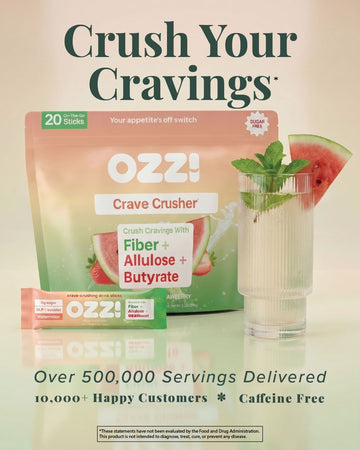
Ozzi Crave Crusher
8g allulose, 500mg konjac glucomannan, 500mg BIOMEnd L-lysine butyrate, chromium, ursolic acid and 150mg African mango in one daily stick. Sweet, caffeine-free, and made for after dinner.
See the drink →
The capsules
Ozzi Capsules
OEA, BIOMEnd butyrate and konjac fiber in a capsule. No caffeine, no flavor to choose, nothing to mix. Take with a full glass of water.
See the capsules →
When should you talk to your doctor?
Talk to your doctor if your appetite changed suddenly, if you are gaining or losing weight without explanation, if your periods have become very irregular before your mid-40s, or if hunger arrived alongside a new medication. Questions about hormone therapy belong there too. Appetite is one small part of that decision.
Other topics you may enjoy
More on hormones and cravings
Frequently asked questions
Does menopause increase appetite?
Appetite tends to rise in perimenopause more than after menopause. In a four-year study, food intake was highest 3 to 4 years before menopause. After menopause the bigger change was a drop in energy burned, especially during sleep.
Can taking estrogen make you hungrier or less hungry?
Estrogen is generally linked with lower appetite, but hormone therapy affects women differently and often includes progesterone. If your appetite changed after starting or stopping a hormone medication, talk to the doctor who prescribed it.
References
- Hirschberg AL. Sex hormones, appetite and eating behaviour in women. Maturitas. 2012. PMID 22281161
- Butera PC. Estradiol and the control of food intake. Physiol Behav. 2010. PMID 19555704
- Asarian L, Geary N. Sex differences in the physiology of eating. Am J Physiol Regul Integr Comp Physiol. 2013. PMID 23904103
- Asarian L et al. Estradiol increases body weight loss and gut-peptide satiation after Roux-en-Y gastric bypass in ovariectomized rats. Gastroenterology. 2012. PMID 22609384
- Clegg DJ et al. Gonadal hormones determine sensitivity to central leptin and insulin. Diabetes. 2006. PMID 16567519
- Krishnan S et al. Estradiol, SHBG and leptin interplay with food craving and intake across the menstrual cycle. Physiol Behav. 2016. PMID 27527001
- Mauvais-Jarvis F et al. The role of estrogens in control of energy balance and glucose homeostasis. Endocr Rev. 2013. PMID 23460719
- Buffenstein R et al. Food intake and the menstrual cycle: a retrospective analysis. Physiol Behav. 1995. PMID 8623004
- Brennan IM et al. Effects of the phases of the menstrual cycle on gastric emptying, glycemia, plasma GLP-1 and insulin, and energy intake in healthy lean women. Am J Physiol Gastrointest Liver Physiol. 2009. PMID 19556358
- Dye L, Blundell JE. Menstrual cycle and appetite control: implications for weight regulation. Hum Reprod. 1997. PMID 9221991
- Lovejoy JC et al. Increased visceral fat and decreased energy expenditure during the menopausal transition. Int J Obes. 2008. PMID 18332882
- Spiegel K et al. Brief communication: sleep curtailment in healthy young men is associated with decreased leptin levels, elevated ghrelin levels, and increased hunger and appetite. Ann Intern Med. 2004. PMID 15583226
- Hormes JM, Rozin P. Perimenstrual chocolate craving. What happens after menopause? Appetite. 2009. PMID 19595725
- Douglas SM et al. Low, moderate, or high protein yogurt snacks on appetite control and subsequent eating in healthy women. Appetite. 2013. PMID 23022602
- Teysseire F et al. The role of D-allulose and erythritol on the activity of the gut sweet taste receptor and gastrointestinal satiation hormone release in humans. J Nutr. 2022. PMID 35135006
- Tolhurst G et al. Short-chain fatty acids stimulate glucagon-like peptide-1 secretion via the G-protein-coupled receptor FFAR2. Diabetes. 2012. PMID 22190648
- Iida T et al. Acute D-psicose administration decreases the glycemic responses to an oral maltodextrin tolerance test in normal adults. J Nutr Sci Vitaminol. 2008. PMID 19155592
- Anton SD et al. Effects of chromium picolinate on food intake and satiety. Diabetes Technol Ther. 2008. PMID 18715218
- Sood N et al. Effect of glucomannan on plasma lipid and glucose concentrations, body weight, and blood pressure: systematic review and meta-analysis. Am J Clin Nutr. 2008. PMID 18842808
- Ngondi JL et al. IGOB131, a novel seed extract of the West African plant Irvingia gabonensis, significantly reduces body weight and improves metabolic parameters in overweight humans. Lipids Health Dis. 2009. PMID 19254366
- Onakpoya I et al. The efficacy of Irvingia gabonensis supplementation in the management of overweight and obesity: a systematic review of randomized controlled trials. J Diet Suppl. 2013. PMID 23419021
