

Perimenopause Appetite Changes: Why You're Suddenly So Hungry (2026)
You used to be able to skip a snack without thinking about it. Now you're standing at the fridge at 9pm wondering why you're starving an hour after dinner.
If that sounds familiar, you're not imagining it, and you're not slipping. Your hormones are rewriting the rules on hunger.
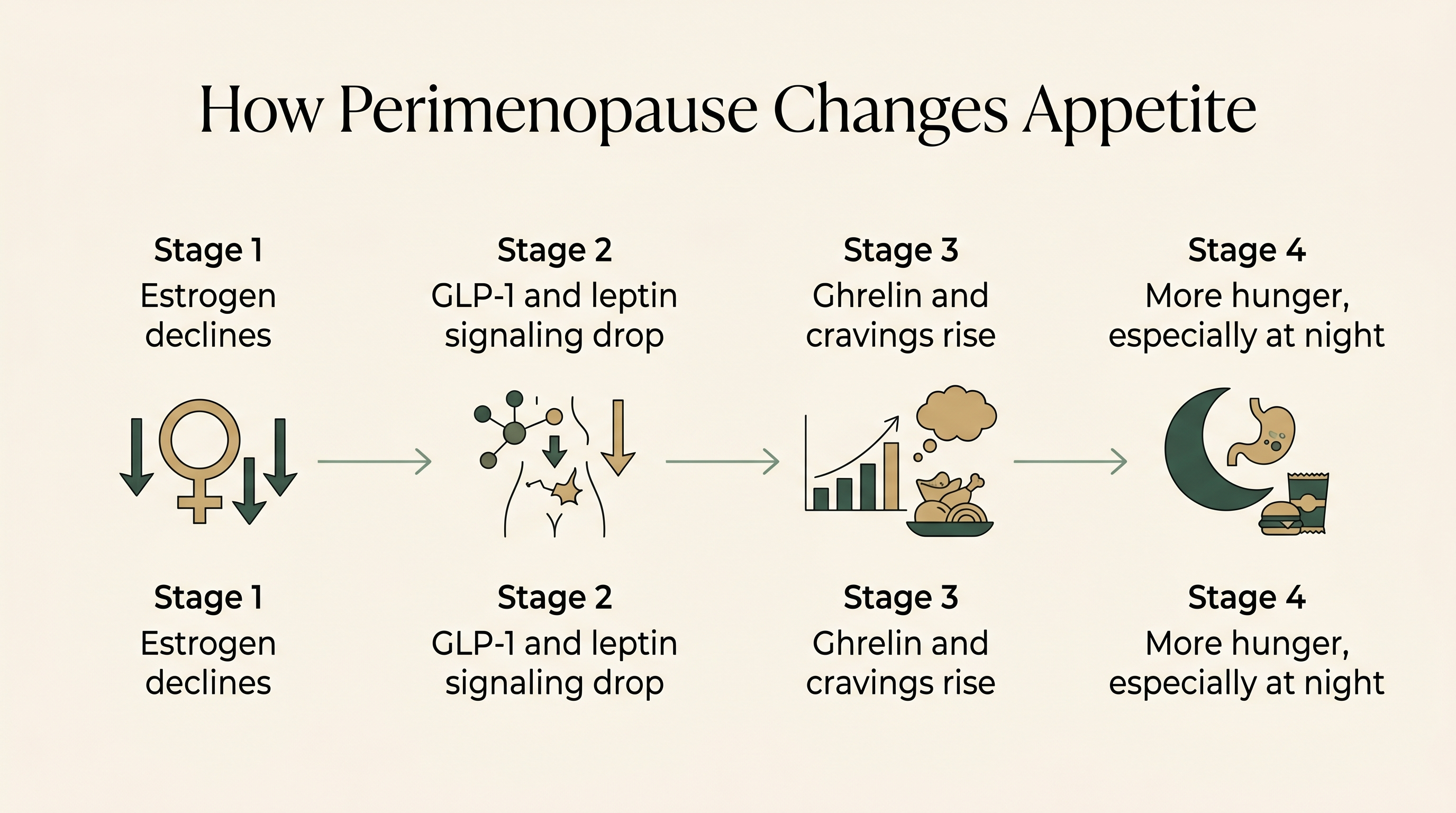
Perimenopause changes appetite because falling estrogen weakens the body's satiety signals (including GLP-1 and leptin) while hunger signals like ghrelin grow louder. Women notice bigger portions, more snacking, and stronger cravings for carbs and sugar, especially in the evening.
Key takeaways
- Falling estrogen disrupts the hunger and fullness hormone balance.
- Estrogen helps drive natural GLP-1, your built-in satiety signal.
- Cravings peak at night when sleep and cortisol go sideways.
- This is a hormone problem, not a willpower problem.
- Protein, fiber, sleep, and gut support can quiet the cravings.
What's actually happening to your appetite in perimenopause?
Perimenopause is the stretch before your final period, and it can run anywhere from a few years to a decade. Estrogen doesn't fall in a clean line. It swings, spikes, and dips, sometimes wildly.
Those swings hit your appetite hard. Estrogen helps dampen hunger, so when it drops, the brakes come off.
A 2025 review in PMC on estrogen and metabolism describes how declining estradiol reshapes appetite control across the menopause transition, changing how the brain reads fullness and hunger signals.
Translation: the same dinner that filled you up at 38 might leave you hunting for cookies at 47.
You'll see it as larger portions, more frequent snacking, and a stronger pull toward carbs and sugar. Researchers studying the perimenopause window call it a period of heightened metabolic sensitivity, when biology and behavior line up to make weight gain easier.
Which hormones drive the new hunger?
Three players matter most: leptin, ghrelin, and GLP-1.
Leptin tells your brain you've had enough. Ghrelin tells you to eat. GLP-1 is the gut hormone that slows digestion and flips your fullness switch after a meal.
Estrogen quietly props up the "stop eating" side of that system. When it falls, leptin signaling gets noisier and less effective, and ghrelin gets a freer hand.
Visceral fat, the deep belly fat that tends to build during this stage, makes it worse. It secretes less leptin than other fat, which further blunts your satiety signal.
Your appetite didn't get weaker. Your fullness signal did.
There's also a blood sugar piece. Lower estrogen reduces how well your cells respond to insulin, so glucose management gets shakier. Shaky blood sugar means more crashes, and crashes feel like cravings.
What role does GLP-1 play in perimenopause appetite?
GLP-1 is the same hormone the famous weight loss shots mimic. Your body makes it naturally every time you eat.
Here's the part that connects to perimenopause: estradiol appears to directly stimulate GLP-1 release from the gut. As one body of research on the GLP-1 satiety system shows, this hormone slows gastric emptying and signals fullness to the brain.
So when estrogen drops, your natural GLP-1 output can drop with it. You lose some of your built-in appetite brake at exactly the moment hunger is climbing.
A 2026 review on GLP-1 medications and menopause symptoms notes that estrogen and GLP-1 signaling overlap, which is part of why some women feel their appetite shift so sharply during this transition.
This is also why "just eat less" advice falls flat. You're being asked to override a hormone system that's actively working against you. For the natural side of this, see our guide on how to increase GLP-1 naturally.
Why do cravings get worse at night during perimenopause?
Almost every woman I talk to says the same thing: the days are fine, the nights are a battle.
Two things stack up after dark. Progesterone, which has a calming, sleep-supporting effect, is also falling in perimenopause. So sleep gets lighter and more broken.
Poor sleep then scrambles ghrelin and leptin the very next day, dialing hunger up and fullness down. A narrative review on late-night eating and sleep ties broken sleep and nighttime cortisol activation to a cycle of evening hunger.
Cortisol is the second piece. Nighttime cortisol spikes are common for women over 40, and high cortisol drives cravings for comfort foods and sugar.
Add the day's stress and decision fatigue, and 9pm becomes the hardest hour. If this is your pattern, our deep dives on how to stop night eating and why you crave sugar at night go further.

Is perimenopause weight gain about willpower or hormones?
It's hormones. Let me say it plainly: you didn't suddenly lose discipline at 45.
The Swiss Perimenopause Study tracked steroid hormone changes across the transition and confirmed how much these shifts vary woman to woman and month to month. Your body genuinely changed underneath you.
That reframe matters because shame makes cravings worse. When you feel like a failure, you reach for comfort, and the cycle tightens.
You're not fighting your character. You're working with new chemistry.
Once you see it as a hormone problem, the playbook gets clearer. You stop trying to white-knuckle through it and start supporting the systems that went quiet. For the broader picture, see menopause weight gain and cravings and weight loss after 35 for women.
How do you calm perimenopause cravings naturally?
You can't put estrogen back with food, but you can support the same downstream signals that estrogen used to manage. Here's where the leverage actually is.
| Strategy | What it targets | Why it helps |
|---|---|---|
| Protein first | Satiety, blood sugar | Slows glucose swings and boosts fullness signals. |
| Soluble fiber | Fullness, gut health | Expands in the stomach and feeds butyrate-making bacteria. |
| Sleep priority | Ghrelin, leptin, cortisol | One bad night raises next-day hunger. |
| Strength training | Insulin sensitivity | Muscle pulls glucose out of the blood, steadying cravings. |
| Evening ritual | Nighttime habit loop | Replaces the automatic 9pm snack reach. |
None of these are magic on their own. Stacked together, they take real pressure off the system. The EMPOWIR randomized trial in midlife women found that a carb-modified approach plus insulin support reduced weight and improved metabolic markers, which lines up with the protein and blood sugar focus above.
Can fiber and gut health help perimenopause appetite?
This is the part that gets overlooked. Your gut bacteria help make butyrate, a short-chain fatty acid that's tied to GLP-1 release from the cells lining your intestine.
So a gut that's well fed with the right fiber can support your natural satiety hormone, the same one that's slipping as estrogen falls.
Soluble and prebiotic fibers like inulin feed those butyrate-producing bacteria. Viscous fibers like glucomannan add physical fullness by expanding in the stomach.
That's exactly the angle I built Ozzi around. More on the gut connection in how to stop food noise naturally.
What does a craving-proof perimenopause day look like?
Knowing the science is one thing. Here's how it cashes out in an ordinary day.
Start with protein at breakfast, not toast or cereal. Thirty grams sets your blood sugar up for the whole morning and blunts the mid-afternoon dip that turns into a craving.
Get light and movement early. A short morning walk anchors your circadian rhythm, which helps the sleep and cortisol problem we talked about. It doesn't have to be intense.
Lift something heavy two or three times a week. Muscle is your best ally here, because it pulls glucose out of the blood and keeps insulin sensitivity higher as estrogen falls.
Eat enough during the day. A lot of nighttime bingeing traces back to under-eating earlier, when women try to "be good" and end up starving by 9pm.
Most night cravings are a debt you ran up earlier in the day.
Then build an evening ritual that isn't food. A drink you actually look forward to, a wind-down routine, lights down by a set time. The goal is to interrupt the automatic reach for the pantry and give your body a fullness cue instead.
None of this requires perfection. It requires removing a few of the triggers that perimenopause stacked against you.
Where does Ozzi fit for perimenopause cravings?
I built Ozzi for the exact problem this article describes: cravings that feel bigger than your willpower, especially at night.
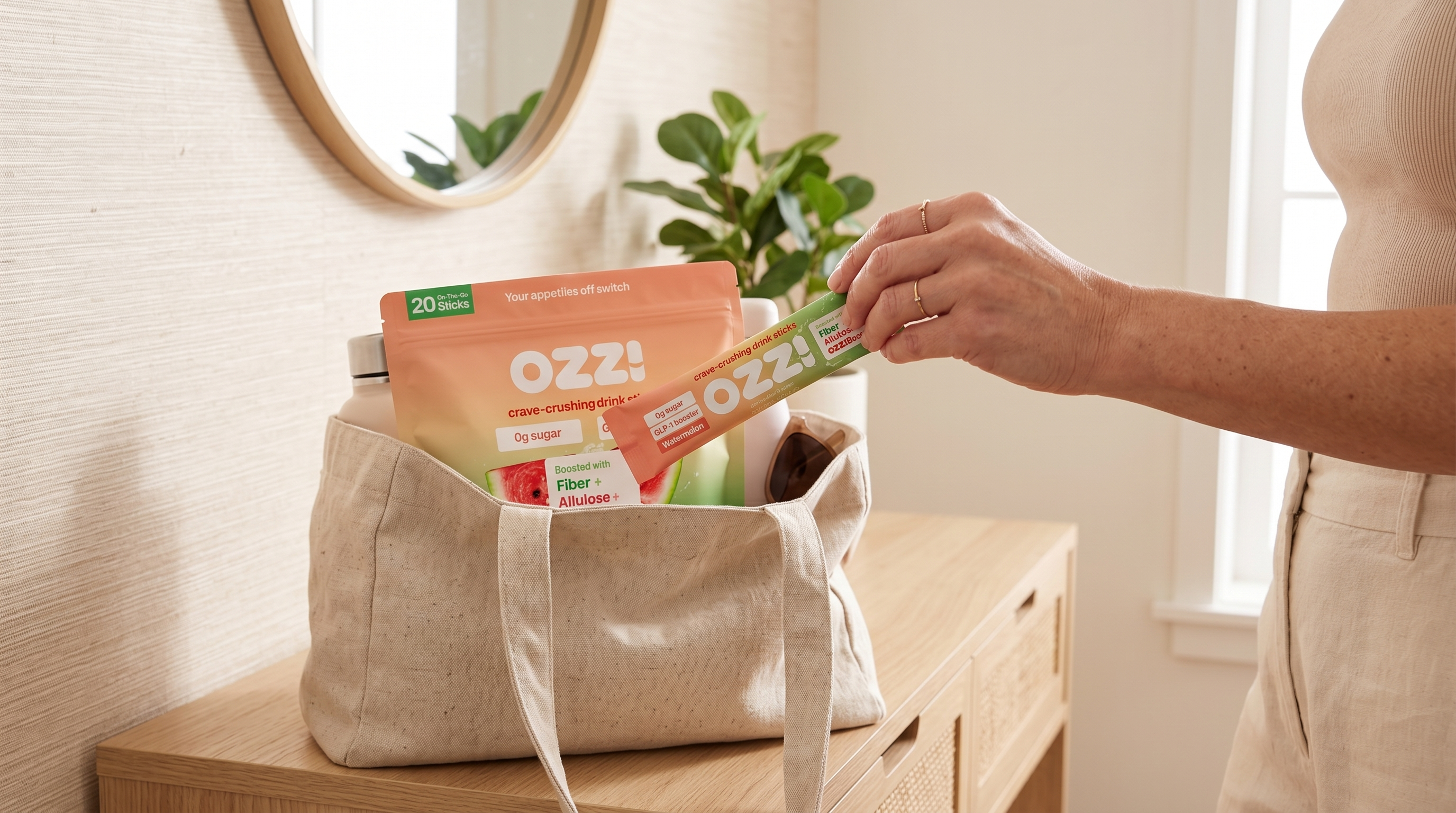
Crave Crusher is a caffeine-free drink stick you mix into cold water. It's designed to support your natural GLP-1 pathway and add real fullness, not to replace hormone therapy or a doctor's plan.
A few ingredients do the heavy lifting. L-Lysine Butyrate delivers butyrate directly, the short-chain fatty acid tied to GLP-1 release. Chicory root inulin feeds your gut bacteria so they make more butyrate on their own.
Glucomannan from konjac root expands in your stomach for physical fullness. Allulose satisfies the sweet pull without spiking blood sugar, which matters more when insulin sensitivity is dropping. You can read the allulose and blood sugar evidence here.
Because there's zero caffeine, you can drink it in the evening, right when the cravings hit hardest. That's the whole point. If you want a wider comparison, see the best appetite suppressant options for women.
Take the 14-day challenge
Perimenopause cravings are a hormone problem, so treat them like one. Try Crave Crusher for 14 days straight. If it doesn't work for you, we'll refund your first bag.
Frequently asked questions
Why am I suddenly hungry all the time in perimenopause?
Falling estrogen weakens your fullness hormones while hunger signals rise. The same meals that used to satisfy you now leave you looking for more, often within an hour or two.
Is perimenopause weight gain inevitable?
No. The hormonal shift makes gain easier, but protein, fiber, sleep, strength training, and steady blood sugar all push back meaningfully. The change isn't a sentence.
Why are my cravings worse at night?
Lighter sleep, falling progesterone, and nighttime cortisol all stack up after dark. Poor sleep then raises hunger the next day, which keeps the cycle going.
Does estrogen affect GLP-1?
Yes. Research suggests estradiol helps stimulate GLP-1 release from the gut. As estrogen falls, your natural GLP-1 output can drop, weakening a key fullness signal.
Are my cravings a willpower problem?
No. They're a hormone problem. Your appetite chemistry genuinely changed, which is why old strategies stop working and self-blame backfires.
What foods help with perimenopause cravings?
Protein at every meal, soluble and prebiotic fiber, and fewer fast carbs that crash your blood sugar. Steady glucose means fewer craving spikes.
Can a supplement actually help?
Supplements that support fullness and your natural GLP-1 pathway can take pressure off. They work best alongside sleep, protein, and movement, not instead of them.
Should I consider hormone therapy or GLP-1 medication?
That's a conversation for your doctor. Both can be appropriate for some women. This article is about the natural, daily-habit side of the problem.
How fast can I expect cravings to ease?
Habit and hormone changes take a little time. Most people give a new routine a couple of weeks before judging it, which is why our challenge runs 14 days.
- Estrogen and Metabolism: Navigating Hormonal Transitions from Perimenopause to Postmenopause. PMC. https://pmc.ncbi.nlm.nih.gov/articles/PMC12431702/
- Perimenopause as an Obesogenic Sensitive Period: Contributions to Elevated Cardiovascular Risk. PMC. https://pmc.ncbi.nlm.nih.gov/articles/PMC12818170/
- Steroid Hormone Secretion Over the Course of the Perimenopause: Findings From the Swiss Perimenopause Study. PMC. https://www.ncbi.nlm.nih.gov/pmc/articles/PMC8712488/
- Neuroendocrine Crosstalk Between Sex and Metabolic Hormones. PMC. https://www.ncbi.nlm.nih.gov/pmc/articles/PMC12872743/
- Reflections on the Discovery of GLP-1 as a Satiety Hormone. PMC. https://www.ncbi.nlm.nih.gov/pmc/articles/PMC11230893/
- GLP-1 Receptor Agonists for Obesity and Symptoms in Menopause: A Review. PMC. https://www.ncbi.nlm.nih.gov/pmc/articles/PMC12908505/
- The Sensory Mechanisms of Nutrient-Induced GLP-1 Secretion. PMC. https://www.ncbi.nlm.nih.gov/pmc/articles/PMC9147592/
- Carbohydrate Modified Diet and Insulin Sensitizers in Midlife Women (EMPOWIR): A Randomized Trial. PMC. https://www.ncbi.nlm.nih.gov/pmc/articles/PMC4178125/
- Late-Night Feeding, Sleep Disturbance, and Cortisol: A Narrative Review. PMC. https://www.ncbi.nlm.nih.gov/pmc/articles/PMC12821527/
This article is for educational purposes and isn't medical advice. Ozzi is a dietary supplement, not a treatment for any condition. Talk to your doctor about perimenopause symptoms, hormone therapy, or GLP-1 medications.
