

How to Stop Night Eating: The 2026 Plan That Actually Works
Key takeaways
- Ghrelin rises in the evening, driving real hunger.
- A tired brain has less impulse control at night.
- Skipping protein and fiber by day fuels night cravings.
- Light, sleep, and routine reset the craving clock.
- A fullness signal at night beats raw willpower.
To stop night eating, work with your biology, not against it. Eat enough protein and fiber during the day, keep a consistent sleep schedule, dim lights in the evening, break the snack-trigger loop with a new routine, and give your body a genuine fullness signal at night instead of relying on willpower.
You're stellar all day long. Clean breakfast, sensible lunch, you've got this.
Then 9pm hits and the monster comes out. You're standing at the pantry, not even hungry, smashing whatever's there. And the next morning you feel terrible about it.
If that's you, you're in the biggest group of people we hear from. Around 45% of our customers say nighttime cravings are their number one problem. You are very much not alone, and you're not broken.
Here's the real reason it happens, and the plan to fix it.
Why do I eat at night when I'm not even hungry?
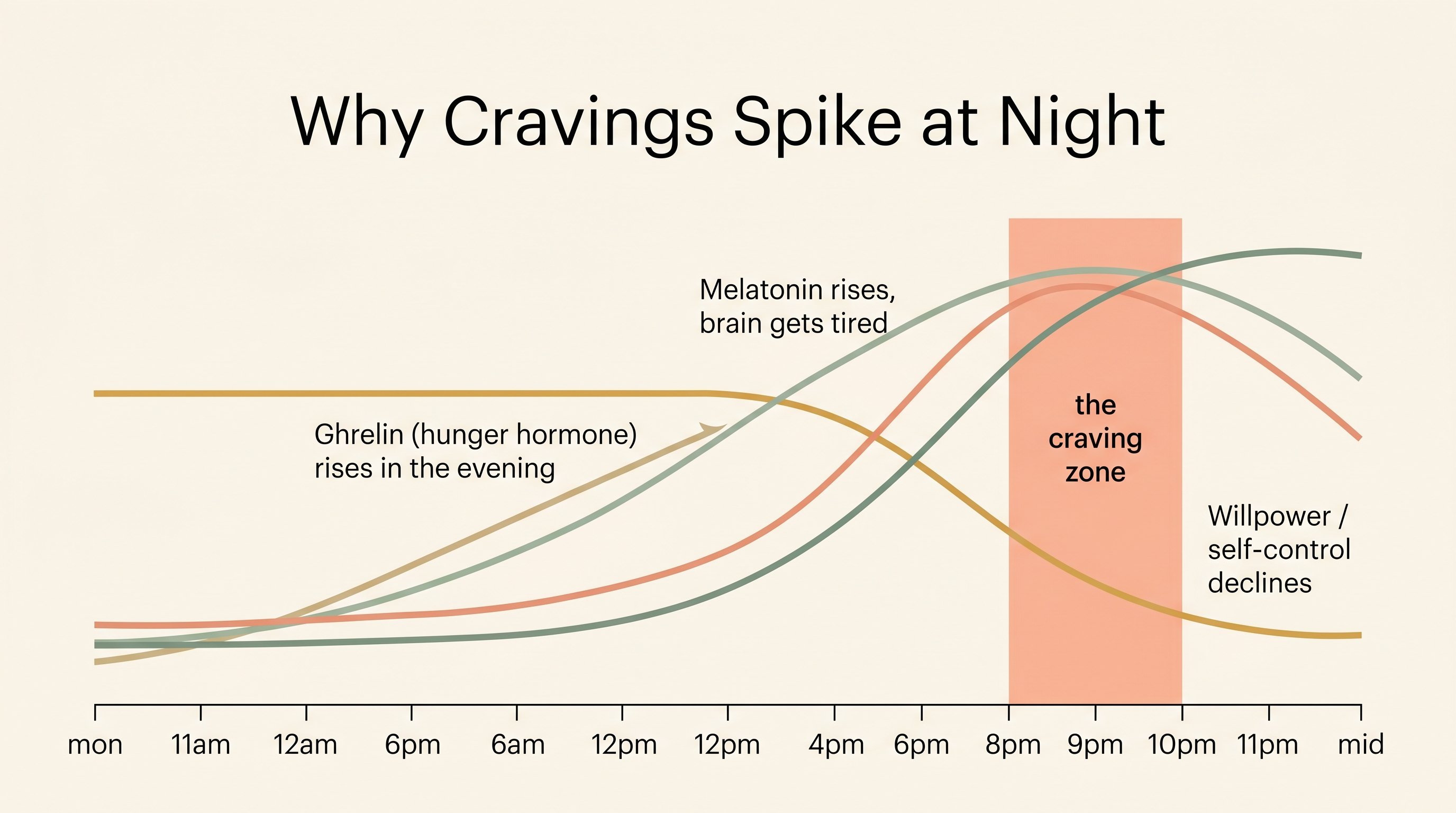
Because at night, three things stack up against you at the exact same time.
First, ghrelin. That's your main hunger hormone, and it follows a daily rhythm. For a lot of people it climbs in the evening (ghrelin and circadian rhythms review, 2025). Real, hormone-driven hunger, not imaginary.
Second, melatonin. As it gets dark, melatonin rises to make you sleepy. So you've got a tired brain and an active appetite fighting in the same body (ghrelin and circadian rhythms review, 2025).
Third, willpower. Self-control is a limited resource, and it drains over the day. By 9pm the part of your brain that says "no thanks" is running on fumes.
You're not failing at night. Your hormones and your brain are ganging up at the worst possible hour.
That's why "just have more discipline" never works. You're trying to out-muscle biology with the one tool that's most depleted right when you need it.
Is night eating actually bad for you?
The timing matters more than people think.
Eating late shifts your metabolism. One line of research found that late-night snacking is tied to higher hunger the next day, lower daytime energy burn, and a worse ghrelin-to-leptin ratio (meaning more hunger signal, less fullness signal).
It also wrecks sleep, which feeds the whole cycle. A carb-heavy late meal can suppress melatonin by 30% to 50%, pushing back when you fall asleep (Hu et al., 2025). Worse sleep then makes ghrelin worse the next night.
And the foods we reach for at night are usually the ultra-processed ones. A 2025 study linked higher ultra-processed food intake and night eating to poorer sleep quality (Sezer et al., 2025).
For some people this becomes a defined pattern called night eating syndrome, where the body's whole clock is shifted. In one study, ghrelin's daily peak was phase-advanced by 5.2 hours in people with the syndrome (Goel et al., 2009). The hunger clock is literally set wrong.
How do I stop eating at night? The 6-part plan
You can't delete ghrelin. But you can lower the pressure and rebuild the signals. Here's what actually moves the needle.
1. Front-load protein and fiber. If you under-eat real food during the day, your body collects the debt at night. Protein at breakfast raises the fullness hormones PYY and GLP-1 and cuts later intake (Smith et al., 2024). Fiber feeds the gut bacteria that support those same signals.
2. Don't skip dinner, and build it right. A dinner with protein, fiber, and some fat keeps blood sugar steady overnight so you're not chasing a crash at 10:30.
3. Fix your light and your bedtime. Dim the lights an hour before bed and keep a consistent sleep schedule. This pulls your melatonin and ghrelin rhythms back into line. Better sleep is one of the most underrated appetite tools there is. A 2025 analysis even tied higher protein and fiber intake to longer, better sleep.
4. Break the trigger loop. Most night eating is a habit hooked to a cue: the couch, the show, the scroll. Change the cue. New evening routine, hands busy, snacks out of sight. You're rewiring a pattern, not just resisting it.
5. Address the real trigger. Sometimes it's not food, it's stress, boredom, or grief. Naming the actual feeling takes a lot of the power out of the snack. We go deeper in how to stop food noise naturally.
6. Give your body a fullness signal. This is the piece willpower can't supply. A glass of water with fiber and a GLP-1-supporting drink at night creates physical and hormonal fullness, so the urge fades instead of winning.
What are the best and worst things to eat at night?
Sometimes you really are hungry at night, and that's fine. What you reach for decides whether you sleep well or set up tomorrow's cravings.
The worst night picks are fast, refined carbs and sugar. They spike blood sugar, then crash it, and a carb-heavy late snack can suppress melatonin by 30% to 50%, pushing back sleep (Hu et al., 2025). Worse sleep then raises tomorrow's ghrelin. It's a trap dressed as a treat.
The better picks lean on protein, fiber, and a little fat. They digest slowly, keep blood sugar steady, and actually support sleep.
| Reach for | Skip |
|---|---|
| Greek yogurt with berries | Ice cream and cookies |
| A small handful of nuts | Chips and crackers |
| A fiber drink in cold water | Sugary cereal or candy |
| Cottage cheese | Soda or juice |
And a 2025 study tied higher protein and fiber intake to longer, better sleep, so a smarter night snack pays you back twice.
What's the fastest way to kill a craving in the moment?
When you're already standing at the pantry, you need something for right now.
| In-the-moment move | Why it works |
|---|---|
| Drink a tall glass of cold water first | Thirst often masquerades as hunger; fills the stomach |
| Wait 15 minutes before deciding | Most impulse cravings fade if you don't act instantly |
| Brush your teeth | Signals the kitchen is closed; changes the taste cue |
| Have a fiber + GLP-1 drink | Creates real fullness instead of fighting the urge raw |
| Leave the room | Breaks the cue-driven habit loop |
Notice the theme. Every one of these gives your body or brain a different signal. None of them is "try harder."
What actually causes night eating in the first place?
The evening hormone stack explains the timing. But why does it tip into a habit for some people and not others? A few root causes show up again and again.
Daytime restriction. If you skip breakfast, eat a sad little lunch, and "save calories" for later, your body collects the debt at night with interest. The hunger you feel at 9pm was partly built at 9am.
Blood sugar swings. Refined-carb meals spike glucose, then drop it, and the crash reads as hunger even when you don't need food. Steadier meals flatten the after-dark crash. We get into this in our sugar cravings guide.
Emotional triggers. Stress, boredom, loneliness, grief. Food is a fast, reliable soother, and evenings are when the day's feelings catch up with you. One customer told us she gained 20 pounds after losing her fiance, all of it night eating. That's not weakness, that's being human.
The habit loop. Cue, routine, reward, repeated until it's automatic. The couch and the show become a trigger your brain links to snacking, no hunger required.
Poor sleep. Short sleep raises ghrelin and lowers leptin the next day, so one bad night sets up the next night's cravings. It's a loop that feeds itself.
This is the same machinery behind general food noise, just concentrated into the evening. And if your nights got worse in your late 30s or 40s, hormones are likely part of it, which is why we built a whole guide on raising GLP-1 naturally.
What does a 7-day night-eating reset look like?
If you want a concrete starting point, here's a week. It's not magic, just the levers above, stacked.
Days 1 to 2: Fix breakfast. Eat 25 to 30 grams of protein within an hour of waking. This alone lowers evening hunger by reducing the daytime deficit.
Days 3 to 4: Build a real dinner. Protein, fiber, and a little fat, no skipping. Add a fiber drink in the evening so fullness has a physical anchor.
Days 5 to 6: Change the cue. Pick a new after-dinner routine. Tea, a walk, a hobby, anything that isn't the pantry-and-screen combo. Put trigger snacks out of sight.
Day 7: Protect sleep. Dim lights an hour before bed, same bedtime, screens down. Better sleep resets ghrelin for the whole next week.
Repeat it. Habits loosen with repetition, not willpower heroics. Most people feel the night pull soften within 2 to 3 weeks.
How does Ozzi help with night cravings specifically?
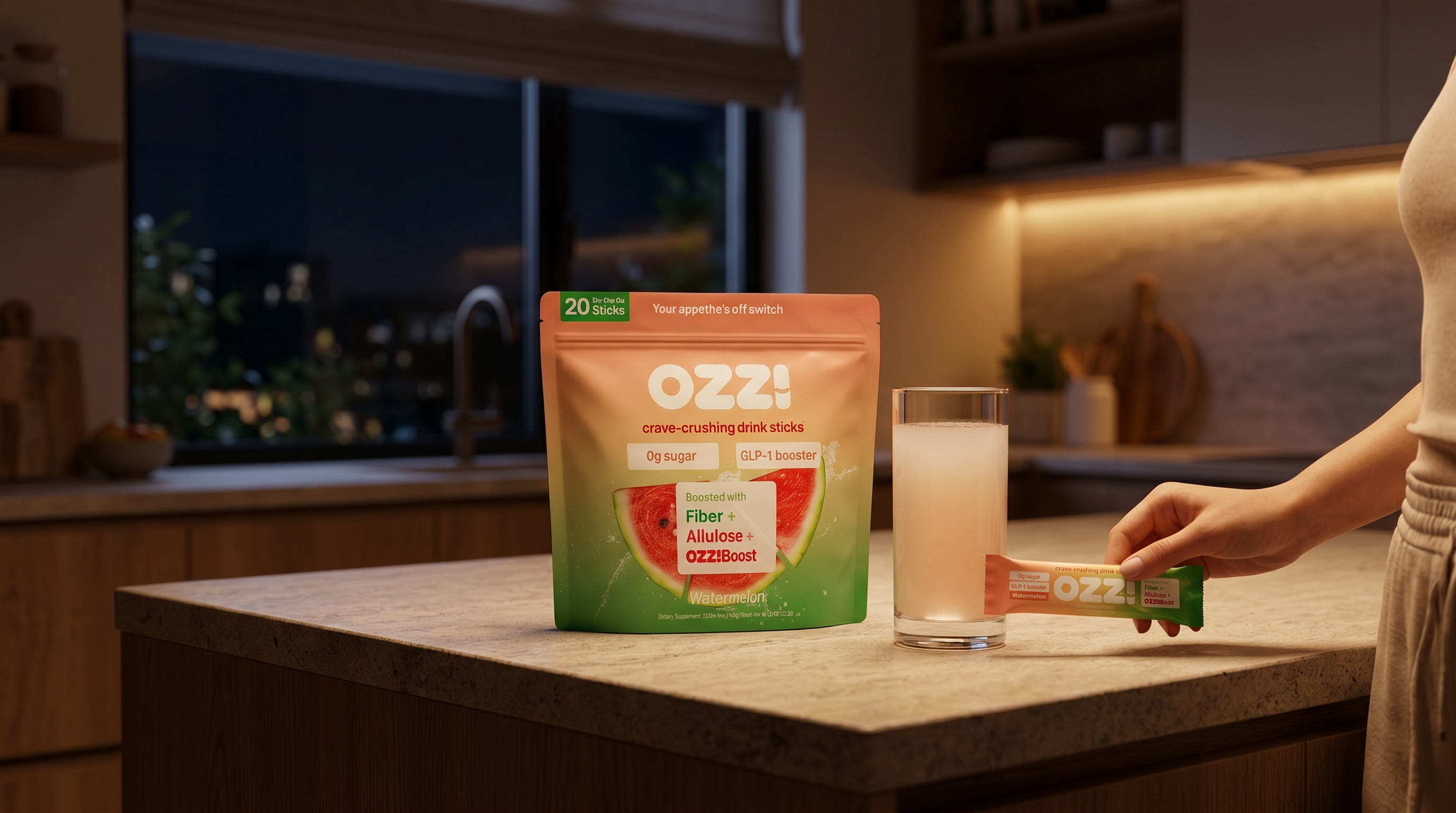
Ozzi was built for exactly this hour. That's the whole reason it exists.
Crave Crusher is a drink stick you mix into cold water at night. It works on the fullness signal from two directions.
Glucomannan fiber expands in your stomach, so there's real physical fullness. And L-Lysine Butyrate plus chicory inulin support your body's own GLP-1, the hormone that turns down appetite. That gut-hormone link is covered in our gut health and GLP-1 guide.
The key detail: it's caffeine-free. No stimulants. You can drink it at 9pm and still sleep, which matters a lot when bad sleep is part of what drives the cravings in the first place.
Instead of white-knuckling past the pantry, you give your body a reason to feel done.
Plenty of our customers tell us the same thing: half a stick in cold water and the night snacking just quiets down. If sugar is your specific villain after dark, pair this with supplements to curb sugar cravings. And if this kicked off in your late 30s or 40s, the hormone-shift angle is in weight loss after 35.
Make 9pm a non-event
Ozzi Crave Crusher gives your body a real fullness signal at night, caffeine-free. Use it for 10 days straight. If you don't feel a difference, we'll refund your first bag.
Evening eating gets harder in December, when the leftovers are on the counter for a week. We wrote a seasonal version of this in how to eat less junk food during the holidays.
Frequently asked questions
Why do I crave sugar specifically at night?
Evening ghrelin and a tired brain push you toward fast energy, and sugar is the fastest. Low daytime protein and blood sugar dips make it sharper. More in our sugar cravings guide.
Is night eating a sign of an eating disorder?
Not always. Occasional night snacking is common. A persistent pattern of large evening intake, morning skipping, and waking to eat may be night eating syndrome, which is worth discussing with a professional.
What should I eat if I'm genuinely hungry at night?
Something with protein and fiber, not pure sugar or refined carbs. Greek yogurt, a small handful of nuts, or a fiber drink keeps blood sugar steady overnight.
Does eating late really cause weight gain?
It's less about the clock and more about total intake, but late eating tends to add calories, raise next-day hunger, and harm sleep, which together make weight harder to manage (Hu et al., 2025).
How long until night cravings actually fade?
Habit loops usually loosen within 2 to 3 weeks of consistent changes. The hormonal and sleep pieces improve on a similar timeline. Consistency beats intensity.
Will drinking water actually help?
Often, yes. Thirst is easily mistaken for hunger, and a full stomach reduces the urge. It's the cheapest first move you've got.
Can I have Ozzi before bed?
Yes. It's caffeine-free and stimulant-free, designed for the evening when cravings peak.
I eat well all day and only lose control at night. What gives?
That's the most common pattern we see. Daytime restriction plus evening ghrelin plus low willpower is a setup, not a personal failing. The 6-part plan above is built for exactly this.
This article is for educational purposes and is not medical advice. Statements about ingredients describe general structure and function and have not been evaluated to diagnose, treat, cure, or prevent any disease. If you think you may have an eating disorder, please talk to a qualified professional.
References
- The intersection between ghrelin, metabolism and circadian rhythms. 2025. Link
- Goel N, et al. Circadian rhythm profiles in women with night eating syndrome. J Biol Rhythms. 2009. Link
- Hu Y, et al. The Effects of Food on Circadian Rhythm: A Comprehensive Review. eFood. 2025. Link
- Sezer et al. Association between ultra-processed food intake, night eating behavior, and sleep quality. 2025. Link
- Smith et al. Effect of dietary protein at breakfast on satiety, PYY, GLP-1, and subsequent food intake. 2024. Link
- Beat the Clock: Assessment of Night Eating Syndrome and Circadian Rhythm in Greek Adults. Link
