

How to Eat Less Junk Food During the Holidays
To eat less junk food during the holidays, eat a protein and fiber based meal before you go to a party, put a plate between you and the food instead of grazing, keep alcohol to the front of the evening, and get your usual sleep. Research shows people eat about 508 more calories a day on an ultra-processed diet even when the food is matched for calories, fat, sugar, salt and fiber, which means the food itself drives the overeating rather than a lack of discipline. Average measured holiday weight gain is 0.37 kg, roughly 0.8 pounds, but it is not lost afterward.
Key takeaways
- Measured holiday gain is about 0.8 pounds, not the 5 everyone repeats.
- It isn't reversed in spring or summer, which is why it accumulates with age.
- Ultra-processed food drove 508 extra calories a day in a controlled inpatient trial.
- Eating before the party beats trying to resist at the party.
- Skipping meals to "save calories" is the single most reliable way to overeat later.
First, the number is wrong, and the truth is more annoying
The "average American gains 5 to 7 pounds over the holidays" line has been repeated for decades. Somebody actually measured it.
Researchers at the National Institutes of Health weighed 195 adults before, during and after the holiday season. The average gain between late September and early January was 0.37 kg. That's 0.8 pounds. Not 5.1
So relax about that part. Now the part that should get your attention.
They kept weighing people. The gain wasn't reversed in spring, and it wasn't reversed in summer. When the same participants came back the following September, the weight was still there. Their conclusion was that this small annual gain "probably contributes to the increase in body weight that frequently occurs during adulthood."1
A pound a year, never given back, is 10 pounds in a decade. That's the real holiday problem. It isn't dramatic and it doesn't need a dramatic response. It needs you to not drift.
A 2025 study in college students found the same shape, 0.74 kg gained across the holiday period, though in that group the gain was mostly lean mass and body fat percentage didn't change.2

Why junk food specifically, and not just "more food"
This is the study that changed how I think about the whole thing.
In 2019, Kevin Hall's team at the NIH admitted 20 adults to a metabolic ward for a month. For two weeks they ate an ultra-processed diet, for the other two weeks a minimally processed one. The two diets were matched for presented calories, energy density, protein, fat, carbohydrate, sugar, sodium and fiber. People could eat as much or as little as they wanted.
On the ultra-processed diet, they ate 508 more calories a day. They gained 0.9 kg in two weeks. On the unprocessed diet, the same people lost 0.9 kg.3
Read the matching list again. Same calories offered. Same sugar. Same salt. Same fiber. The only thing that differed was how processed the food was, and it moved intake by 500 calories a day without anyone deciding to eat more.
That reframes the holidays entirely. You're not failing at willpower in December. You're standing next to a table engineered to be eaten quickly and in volume, for four hours, and the food is winning on its own terms.
Which means the fixes that work are the ones that change your relationship with the table, not the ones that ask you to be tougher.
Eight things that actually work
1. Eat before the party. Not a snack. A real meal with protein and fiber, 60 to 90 minutes ahead. In a controlled trial, a high-protein high-fiber beverage preload reduced hunger and desire to eat, and tended to reduce how much people ate at the following meal.4 Arriving hungry to a room full of ultra-processed food is the whole failure mode.
2. Never skip meals to bank calories. This is the most common holiday strategy and the most reliably counterproductive one. You arrive with low blood sugar and high ghrelin, and the food in front of you is designed for exactly that state. We covered the mechanism in blood sugar spikes and hunger.
3. Use a plate, once. Grazing has no edges. Fill a plate, sit down, eat it, and then be done. The plate is a decision you make while you're still thinking clearly, and it takes the decision away from the version of you who is three drinks in next to the cookies.
4. Put the protein down first. Turkey, ham, shrimp, cheese, nuts. Protein is the most satiating macronutrient by a distance, and what you eat first shapes how much of everything else you want.
5. Stand somewhere else. Proximity does most of the work at a party. If you're within arm's reach of a bowl, you will eat from it without deciding to. Move one room over and the problem mostly disappears.
6. Front-load the alcohol, then stop. Alcohol lowers your blood sugar, lowers your inhibition, and adds calories that don't register as food. Two drinks early in the evening does far less damage than five spread across it. Our post on alcohol and sugar cravings goes into the mechanism.
7. Protect your sleep. Short sleep raises ghrelin and lowers leptin the next day, which means one late night sets up the following day's snacking. Of everything on this list, this is the one people skip and shouldn't.
8. Take the leftovers out of the house. Send them home with guests. The party is one day. Four days of leftover pie on the counter is where the actual calories are.
The 9pm problem gets worse in December
Most people's hardest window isn't the holiday dinner. It's the evening after it, on the couch, with everything still out.
Your fullness hormones run lowest in the evening, and that's true in July as well as December. What changes over the holidays is what's within reach when it happens. If evening eating is your pattern, that's the window worth defending, and we wrote it up properly in how to stop night eating and why you crave sugar at night.
What to do on December 26
Nothing dramatic. Specifically, not a detox, not a juice cleanse, and not a punishing week at the gym to "undo" it.
Go back to your normal eating on the next meal, not the next Monday. The gap between the holiday and the restart is where most of the damage accumulates, because a week of leftovers plus a promise to start in January is two more weeks of drift.
Weigh yourself in early January if you weigh yourself at all. Not to feel bad. To notice the drift while it's still 1 pound rather than finding it at 10.
Where a craving supplement fits, and where it doesn't
Straight answer, and I make one of these so weigh it accordingly.
No supplement is going to beat a table of ultra-processed food. If you take Ozzi and then graze for four hours, you'll eat the same amount. Nothing in a stick pack overrides an environment.
What it can do is take the edge off the specific window where you're not at a party at all, the evening at home when the leftovers are on the counter and you're not really hungry. That's the problem it was built for, and it's caffeine-free specifically so it works at 9pm.
Eat before you go, use a plate, protect your sleep. Those three are free and they matter more than anything you can buy.
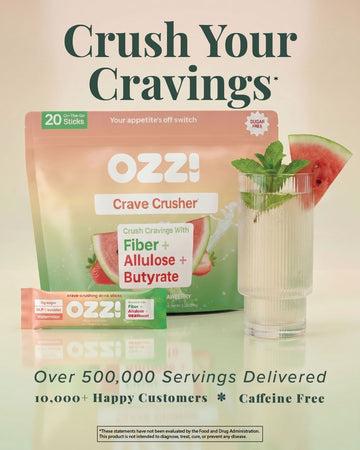
For the evening after, not the party
Ozzi Crave Crusher
A caffeine-free drink stick built for the 9pm window: 8g allulose, 500mg konjac glucomannan, 500mg BIOMEnd L-lysine butyrate, chromium, ursolic acid and 150mg African mango. No stimulants, so there is no cutoff time on when you can drink it.
See what's in it →Frequently asked questions
How much weight do people actually gain over the holidays?
About 0.8 pounds on average, according to a study that weighed 195 adults through the season. The widely repeated 5 to 7 pound figure is not supported. The catch is that the gain isn't lost during the following spring or summer, so it accumulates from year to year.1
Should I skip breakfast before a big holiday dinner?
No. Arriving very hungry is the most reliable way to overeat. A normal meal with protein and fiber beforehand reduces hunger and tends to reduce how much you eat afterward.4
Why do I eat so much more at parties than at home?
Partly the food. In a controlled inpatient trial, people ate 508 more calories a day on an ultra-processed diet than on an unprocessed one, even when both were matched for calories, sugar, salt and fiber.3 Partly the format: grazing over hours has no natural stopping point the way a plated meal does.
Does alcohol make you eat more?
Yes, through several routes at once. It lowers blood sugar, reduces inhibition, and its own calories don't produce fullness. Keeping drinks to the earlier part of the evening limits how long that effect is running.
What should I do the day after overeating?
Return to normal eating at your next meal rather than waiting for Monday or January. Skip the detox or cleanse; there's nothing to flush, and the restriction usually sets up another swing.
Do appetite supplements help during the holidays?
Not against a party. No supplement overrides several hours next to a table of ultra-processed food. Where products like this fit is the quieter evening window at home, and even then they support the effort rather than replace it.
References
- Yanovski JA, Yanovski SZ, Sovik KN, et al. A prospective study of holiday weight gain. N Engl J Med. 2000;342(12):861-867. Prospective observational study, n=195. https://pubmed.ncbi.nlm.nih.gov/10727591/
- Yoo HB, Bigham C, et al. Holiday weight change in a US college student sample: a prospective observational cohort study. Obes Sci Pract. 2025. Prospective cohort. https://pubmed.ncbi.nlm.nih.gov/39790442/
- Hall KD, Ayuketah A, Brychta R, et al. Ultra-processed diets cause excess calorie intake and weight gain: an inpatient randomized controlled trial of ad libitum food intake. Cell Metab. 2019;30(1):67-77.e3. Randomized controlled crossover trial, n=20, inpatient metabolic ward. https://pubmed.ncbi.nlm.nih.gov/31105044/
- Sharafi M, Alamdari N, Wilson M, et al. Effect of a high-protein, high-fiber beverage preload on subjective appetite ratings and subsequent ad libitum energy intake. Curr Dev Nutr. 2018;2(6):nzy022. Randomized crossover trial. https://pubmed.ncbi.nlm.nih.gov/29955731/
- Udroiu IV, Albai A, et al. Persistence of body composition changes observed during the winter holiday period: a three-time-point, one-year study. Medicina (Kaunas). 2026. https://pubmed.ncbi.nlm.nih.gov/41901591/
- Brum JM, Gibb RD, Peters JC, Mattes RD. Satiety effects of psyllium in healthy volunteers. Appetite. 2016;105:27-36. Randomized, double-blind, placebo-controlled crossover trials. Industry-affiliated authors. https://pubmed.ncbi.nlm.nih.gov/27166077/
Peer-reviewed citations retrieved from PubMed. This article is for general education and is not medical advice. These statements have not been evaluated by the Food and Drug Administration. This product is not intended to diagnose, treat, cure, or prevent any disease.
