

Why You Crave Sugar After Quitting Alcohol (And How to Stop) 2026
You crave sugar after quitting alcohol because both hit the same dopamine reward pathway. When the alcohol stops, your brain seeks a similar reward, and sugar delivers it fast. Falling blood sugar and a temporary dip in serotonin add fuel. For most people the cravings peak within 1 to 2 weeks and fade over 4 to 8 weeks.
Key takeaways
- Alcohol and sugar compete for the same dopamine reward pathway.
- Cravings usually peak in the first 2 weeks of sobriety.
- They typically fade over 4 to 8 weeks as your brain rebalances.
- Research suggests eating sweets can trigger later alcohol cravings.
- Steady blood sugar, protein, and fiber blunt the urge fastest.
Why do you crave sugar so badly after quitting alcohol?
You gave up drinking. Good on you. Then, out of nowhere, you're standing at the pantry at 9pm inhaling cookies you didn't even want an hour ago.
That's not weakness. That's your brain rewiring.
Alcohol and sugar both light up the same reward circuit. Drinking triggers a release of dopamine, the feel-good chemical, in a brain region called the nucleus accumbens. Sugar hits that exact same spot.
So when the alcohol disappears, your brain knows a shortcut. It can reach a similar dopamine state with something sweet, because sugar runs on the same wiring alcohol used to.
A 2025 research snapshot from Vanderbilt found that alcohol can reshape the brain's dopamine system for a long time, even during abstinence. Your reward system doesn't reset the day you put the bottle down. It stays primed, looking for its usual hit.
One of our customers put it plainly in a survey: "I gave up alcohol in May and substituted sugar/snacking. I'm finding it difficult to give that up."
She's describing a swap that happens in millions of brains. It has a name in the research world: overlapping dopaminergic reward pathways.
Is it normal to crave sugar when you stop drinking?
Completely normal. It's one of the most common early-sobriety experiences there is.
Three things happen at once, and they stack:
First, the dopamine gap. Your reward pathways used to fire from alcohol. Now they don't, so they hunt for the next fastest source. Sugar wins that race every time.
Second, blood sugar swings. Alcohol carries a lot of calories and affects how your body handles glucose. Take it away and your blood sugar can dip lower than you're used to, which your body reads as "eat something sweet, now."
Third, serotonin drops. Early sobriety often comes with a temporary dip in serotonin, the mood chemical. Sugar gives it a quick nudge, which is why the craving feels emotional, not just physical.
The craving isn't a character flaw. It's a brain looking for a reward it used to get on tap.
Here's what's happening under the hood, and roughly when.
| What's going on | Why it drives sugar cravings | Typical timeline |
|---|---|---|
| Dopamine pathway seeks a new reward | Sugar hits the same circuit alcohol did | Starts days 1 to 3, peaks week 1 to 2 |
| Blood sugar runs lower without alcohol's calories | Dips read as an urgent need for fast fuel | First few weeks |
| Serotonin temporarily falls | Sweets give a quick mood lift | First 2 to 4 weeks |
| Reward system rebalances | Cravings lose their grip | Weeks 4 to 8 |
How long do sugar cravings last after quitting alcohol?
For most people, the worst of it hits in the first 1 to 2 weeks. That's when the dopamine gap is widest and your body is adjusting to running without alcohol.
From there, cravings usually taper over 4 to 8 weeks as your reward system rebalances and your blood sugar settles into a steadier rhythm.
That timeline isn't a promise. Some people feel steady by week 3. Others, especially heavier former drinkers, notice a longer tail. The direction of travel is the same though: it gets easier, not harder.
The trick is not white-knuckling through it. If you leave the craving unmanaged, you're more likely to build a nightly sugar habit that outlasts the sobriety adjustment. That's the trap. If night is your danger zone, our guide on why you crave sugar at night breaks down the evening spike in detail.
Does swapping booze for sugar actually backfire?
It can. And there's data on it.
A 2021 ecological momentary assessment study followed 25 adults in early recovery from alcohol use disorder for 21 days, pinging them 4 times a day about real-time cravings. The finding that surprised people: consuming sweets was linked to later alcohol cravings.
Handing yourself sugar to quiet an alcohol craving is a common recovery tip. This study suggests it might feed the very thing you're trying to quiet, because you're keeping that reward loop active instead of letting it calm down.
A separate line of research on attitudes toward sweet foods found that sweet preference and sugar intake track with cravings for both alcohol and sweets in early recovery. The two urges move together.
Feeding a sugar craving to dodge an alcohol craving can keep both alive.
None of this means sweetness is the enemy forever. It means the goal is to satisfy the sweet signal without the blood sugar spike that keeps the reward loop spinning. That's a very different thing from a fistful of candy.
How do you stop sugar cravings after quitting alcohol?
You don't out-willpower a rewiring brain. You give it what it's actually asking for, in a form that doesn't dig the hole deeper.
Here's what works.
Keep blood sugar steady. Don't skip meals. Big dips are what turn a background craving into a 9pm raid. Eat on a regular rhythm.
Lead with protein and fiber. Protein blunts the crash. Soluble fiber slows how fast sugar hits your blood. Together they keep the floor from dropping out. Our guide to supplements that curb sugar cravings covers the fiber options worth knowing.
Satisfy the sweet signal without the spike. This is the big one. A sweet taste that doesn't jack up your blood sugar can answer the craving without keeping the reward loop lit. Allulose is a rare sugar that tastes sweet but doesn't spike glucose the way table sugar does. More on that below.
Move the reward. A short evening walk, a hot shower, ten minutes outside. You're teaching the reward system it can get a hit somewhere other than the pantry.
Guard the danger hours. For most people it's after dinner. Have your plan ready before the craving shows up. If nighttime eating is your pattern, the how to stop night eating playbook is built for exactly this.
And if the cravings feel less like hunger and more like a mental loop you can't switch off, that's food noise, and it's worth addressing on its own terms.
Can a GLP-1 booster help with post-alcohol sugar cravings?
This is why I built Ozzi. Not for the alcohol side specifically, but the mechanism lines up neatly with the sugar side.
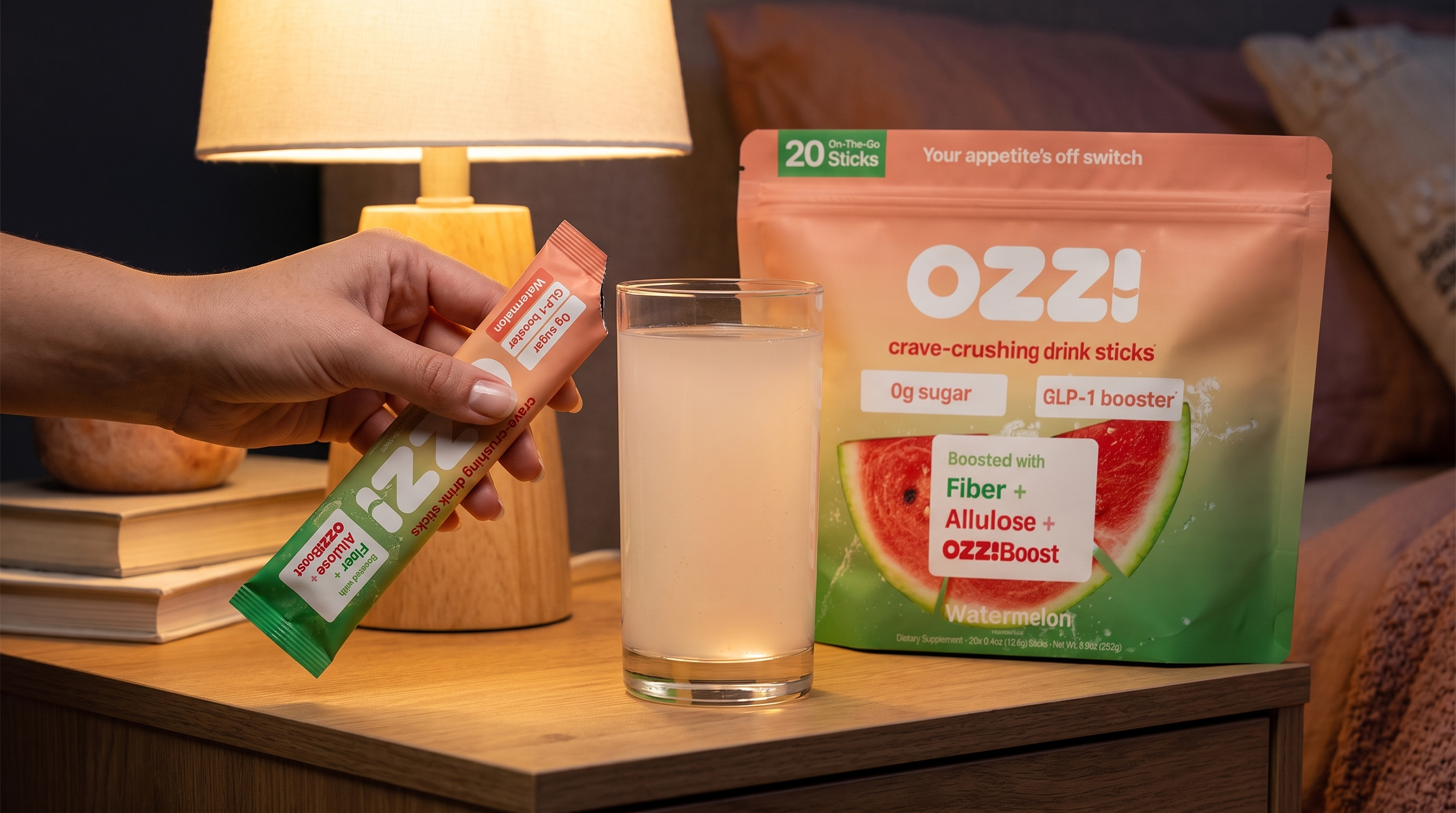
Ozzi Crave Crusher is a watermelon drink stick you mix into cold water. It works on cravings from a few angles at once.
The biggest ingredient by weight is allulose (8.35g per serving). It tastes sweet, so it answers the sweet signal, but it doesn't spike blood glucose or insulin the way sugar does. In animal studies, allulose actually stimulated GLP-1, the same satiety hormone behind drugs like Ozempic, more strongly than glucose or fructose. You can read the deeper breakdown in our allulose supplement guide.
Then there's the GLP-1 support piece. Ozzi includes L-Lysine Butyrate, a short-chain fatty acid that emerging research links to GLP-1 release from cells in your gut, plus chicory root inulin that feeds the bacteria producing more butyrate naturally.
Glucomannan, a soluble konjac fiber, rounds it out. It absorbs water and expands in your stomach for physical fullness, and randomized trials tie it to reduced appetite and slower carb absorption.
So the craving gets hit from three directions: a sweet taste with no sugar spike, GLP-1 support for satiety, and fiber for real fullness. No caffeine, no stimulants, vegan.
It won't do the emotional work of recovery. Nothing in a packet does. But for the specific 9pm "I need something sweet" pull, it's built for the moment.
Frequently asked questions
Why do I crave sugar so much after quitting drinking?
Because alcohol and sugar share the same dopamine reward pathway. When you stop drinking, your brain seeks the same reward and sugar delivers it fastest. Low blood sugar and a temporary serotonin dip add to it.
How long do sugar cravings last after I stop drinking?
They usually peak in the first 1 to 2 weeks and fade over 4 to 8 weeks as your reward system rebalances. Heavier former drinkers may notice a longer tail.
Is craving sugar after quitting alcohol a sign of relapse?
No. It's a normal part of early sobriety. That said, research suggests eating a lot of sweets can trigger later alcohol cravings, so it's worth managing rather than leaning into.
Will I gain weight replacing alcohol with sugar?
You can, if the sugar swap becomes a nightly habit. The fix isn't cutting all sweetness, it's choosing sweet options that don't spike blood sugar and keeping protein and fiber high.
What can I eat instead of sugar when the craving hits?
Protein first, then something with fiber. Greek yogurt, berries, a handful of nuts. A sweet drink made with allulose can answer the craving without the glucose spike.
Does sugar really affect the same brain pathway as alcohol?
Yes. Both increase dopamine in the nucleus accumbens, and heavy intake of either can down-regulate dopamine receptors in a similar way.
Why are my cravings worst at night?
Willpower is lowest in the evening, blood sugar has dropped since your last meal, and old drinking rituals often lived at night. See our guide on night sugar cravings.
Can Ozzi help with sugar cravings after quitting alcohol?
It's designed to. Ozzi uses allulose for a sweet taste without the sugar spike, plus GLP-1-supporting ingredients and fiber for fullness. It's not a treatment for alcohol use disorder, but it targets the sugar craving directly.
Should I just push through the cravings with no sugar at all?
You can, but white-knuckling often backfires into a binge. Satisfying the sweet signal in a smarter form tends to work better than pure restriction.
When should I talk to a professional?
If cravings, mood, or drinking urges feel unmanageable, reach out to a doctor or a recovery support resource. This article is educational, not medical advice.
Answer the sweet craving without the sugar spike
Ozzi Crave Crusher is a watermelon drink stick that hits cravings with allulose, GLP-1 support, and fiber. Try your first bag for 14 days straight. If it doesn't work for you, we'll refund it.
References
- Nguyen LC, et al. Daily associations between alcohol and sweets craving and consumption in early AUD recovery: results from an ecological momentary assessment study. J Subst Abuse Treat. 2021. https://pubmed.ncbi.nlm.nih.gov/34493429/
- Prospective associations between attitudes toward sweet foods, sugar consumption, and cravings for alcohol and sweets in early recovery from alcohol use disorders. PMC. https://pmc.ncbi.nlm.nih.gov/articles/PMC8462793/
- Sweet taste preference as a moderator of links between internalizing symptoms and alcohol craving. PubMed. 2024. https://pubmed.ncbi.nlm.nih.gov/38662513/
- Iwasaki Y, et al. Secretion of GLP-1 but not GIP is potently stimulated by luminal d-allulose (d-psicose) in rats. Biochem Biophys Res Commun. 2018. https://pubmed.ncbi.nlm.nih.gov/29402406/
- Intestinal distension induced by luminal d-allulose promotes GLP-1 secretion in male rats. Endocrinology. 2025. https://academic.oup.com/endo/article/166/2/bqaf002/7959153
- The effects of gelled konjac glucomannan fibre on appetite and energy intake in healthy individuals: a randomised cross-over trial. Br J Nutr. Cambridge Core
- Research snapshot: how alcohol reshapes the brain's dopamine system long after drinking stops. Vanderbilt University. 2025. Vanderbilt Basic Sciences
This article is for education, not medical advice. Ozzi is a dietary supplement and is not intended to diagnose, treat, cure, or prevent any disease, including alcohol use disorder. If you're struggling with drinking or cravings, talk to a qualified professional.
