

Why Do I Crave Sugar at Night? The Science of Evening Cravings (2026)
Sugar cravings spike at night because your circadian clock raises hunger and appetite for sweets to a peak near 8pm, evening insulin sensitivity drops so blood sugar swings more, and poor sleep tips your hunger hormones toward "eat." It's wiring, not a willpower flaw.
Key takeaways
- Your body clock peaks hunger and sweet cravings around 8pm.
- Evening insulin sensitivity can drop, so glucose swings harder at night.
- One bad night of sleep raises ghrelin and lowers leptin.
- Skipping meals and stress both prime the nighttime sugar urge.
- Steady blood sugar and a calmer gut quiet the craving at the source.
You ate clean all day. Salad at lunch, real dinner, no snacking. Then 9pm hits and you're standing at the pantry reaching for cookies you didn't even want an hour ago.
If that's you, you're in good company. One of the most common things our customers tell us is some version of "I'm stellar all day, then the monster comes out at night." It's the single biggest reason people try Ozzi.
Here's the part that should take some weight off your shoulders. The night sugar craving isn't a character flaw. It's a measurable, repeatable pattern baked into your biology. Let's walk through why it happens and what actually helps.
Why do I crave sugar at night and not in the morning?
Because your appetite runs on a clock, and that clock is loudest in the evening.
In a tightly controlled 13-day lab study, researchers at Harvard balanced meals and sleep evenly across each participant's body clock, then tracked hunger. They found a strong internal rhythm: hunger hit its trough around 8am and its peak around 8pm, a swing of about 17%.
The kicker for us: the same rhythm showed up specifically for sweet, salty, and starchy foods. Your craving for sugar isn't random. It's scheduled, and the appointment is for the evening.
Your craving for sugar isn't random. It's scheduled, and the appointment is for the evening.
The researchers think this evolved for a reason. A built-in evening appetite push nudged our ancestors to eat a bigger meal before the long overnight fast of sleep. Useful in a world without refrigerators. Less useful when there's ice cream in the freezer.
One more detail from that work stuck with me. The same study found that calories eaten after 8pm predicted body weight, even after accounting for how much and when people slept. So the evening isn't just when you want to eat more. It's also when those extra bites seem to count for more on the scale.
That's why "just have more self-control at night" is such bad advice. You're being asked to fight a rhythm at the exact hour it's wired to be strongest, on a day when your willpower tank is already low from decision-making since morning.
Is it my willpower or my biology?
Mostly biology. And that reframe matters, because shame makes the cycle worse.
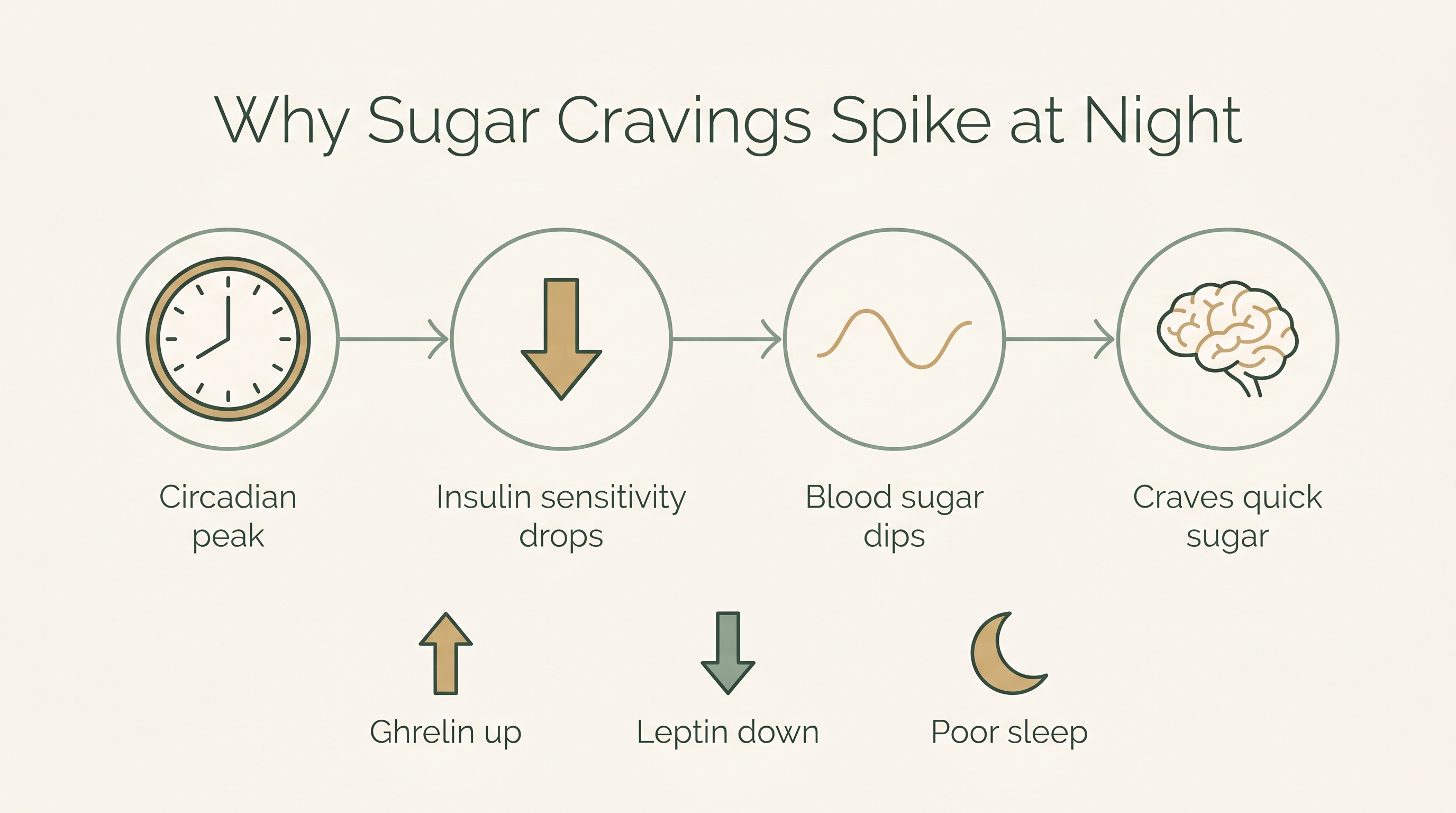
Three systems gang up on you after dark. Your circadian clock raises appetite. Your evening insulin sensitivity drops. And if you're short on sleep, your hunger hormones shift toward "eat more."
Insulin sensitivity is the big one people miss. As the evening goes on, the hormone melatonin starts rising to prep you for sleep. Melatonin quiets the pancreas cells that release insulin, so your body handles carbs less efficiently at night than it does at breakfast.
The practical result: the same snack can send your blood sugar on a bigger up-and-down ride at 10pm than it would at 10am. That dip on the back end of the swing is part of what your brain reads as "go find sugar."
How does bad sleep make sugar cravings worse?
Fast, and more than you'd expect.
Two hormones run your hunger thermostat. Ghrelin tells you to eat. Leptin tells you you're full. Sleep loss pushes ghrelin up and leptin down, which is exactly the wrong combination if you're trying to skip dessert.
It gets more specific. Sleep deprivation doesn't just make you hungrier in general, it steers you toward high-sugar, high-fat food in particular, and it dulls the part of your brain that would normally talk you out of it. You're hungrier and your brakes are softer at the same time.
There's a nasty loop here too. Eating a lot of sugar late tends to fragment your sleep. Worse sleep then drives more cravings the next night. Round and round.
You're hungrier and your brakes are softer at the same time. That's not weakness. That's chemistry.
What else triggers the night sugar urge?
A few everyday things quietly load the gun before evening even arrives.
Under-eating during the day. If you "save calories" by skimping at breakfast and lunch, your body collects the debt at night, often in sugar. Low daytime intake can leave you running on fumes and low on serotonin by evening.
Stress. Chronically high cortisol nudges your body to chase quick energy and messes with blood sugar. A stressful day is a setup for a sugary night.
Habit and cue. If you've eaten sweets on the couch at 9pm for years, the couch and the time of day become the trigger. Plenty of our customers say they're "not even hungry," the urge just shows up on schedule. That's the overlap with food noise, the constant low hum of food thoughts that has nothing to do with real hunger.
The alcohol swap. A real pattern we hear: people quit drinking and their sugar cravings explode. The brain was getting a reward hit from alcohol and goes looking for the nearest replacement. Sugar volunteers.
How do I actually stop craving sugar at night?
You won't out-willpower a hormone. You change the inputs so the craving never gets that loud. Here's what moves the needle, ranked roughly by impact.
| Lever | What to do | Why it works |
|---|---|---|
| Eat enough by day | Protein and fiber at every meal, no skipping lunch | Stops the evening rebound before it starts |
| Protect sleep | 7 to 9 hours, consistent bedtime | Keeps ghrelin and leptin in balance |
| Steady your glucose | Pair carbs with fiber, fat, or protein at dinner | Softens the after-dinner blood sugar swing |
| Break the cue | New evening ritual: tea, a walk, a flavored drink | Replaces the habit loop with a non-sugar one |
| Feed your gut | Prebiotic fiber and fermented foods | Supports the butyrate-to-GLP-1 satiety pathway |
None of these are exotic. The trick is stacking a few so the craving has less to grab onto. For a structured version, our 7-day sugar reset walks through it day by day, and the night eating playbook goes deeper on the evening routine piece.
How long until night cravings actually calm down?
Honest answer: faster than you'd think for the easy wins, slower for the deep habit.
If under-eating during the day was your main driver, fixing that can quiet things in a few days. Your body stops collecting the evening debt, so the rebound shrinks almost right away.
The sleep piece tends to show up within a week or two of consistent nights. Once ghrelin and leptin settle back into rhythm, the desperate edge softens.
The habit loop is the stubborn one. If you've eaten sweets on the couch at 9pm for a decade, that wiring takes a few weeks of repetition to overwrite with a new ritual. Most people who quit alcohol and swapped in sugar tell us the worst of it passes in 3 to 4 weeks, then keeps fading.
The goal isn't to never want something sweet again. It's to get the volume down from a scream to a whisper you can actually choose to ignore.
Where does a GLP-1 booster fit in?
This is the lane Ozzi sits in, so let me be straight about the mechanism instead of hand-waving.
GLP-1 is a gut hormone that tells your brain you're satisfied. It's the same target the prescription shots hit. You can also nudge it up naturally through your gut, and that's where two of Ozzi's ingredients come in.
Butyrate is a short-chain fatty acid your gut bacteria make. In lab studies, short-chain fatty acids including butyrate stimulate the intestinal L-cells that release GLP-1. Ozzi includes a branded butyrate (L-Lysine Butyrate) plus chicory inulin, a prebiotic fiber that feeds the bacteria making even more butyrate on their own. We broke this whole loop down in our butyrate and GLP-1 explainer and the gut health guide.
The other half is the blood sugar story from earlier. Ozzi's biggest ingredient by weight is allulose, a rare sugar that tastes sweet but doesn't spike glucose the way table sugar does. Studies suggest allulose can even blunt the post-meal glucose rise from other carbs. That matters most at night, when your insulin sensitivity is already running low. More on that in our allulose and blood sugar piece.
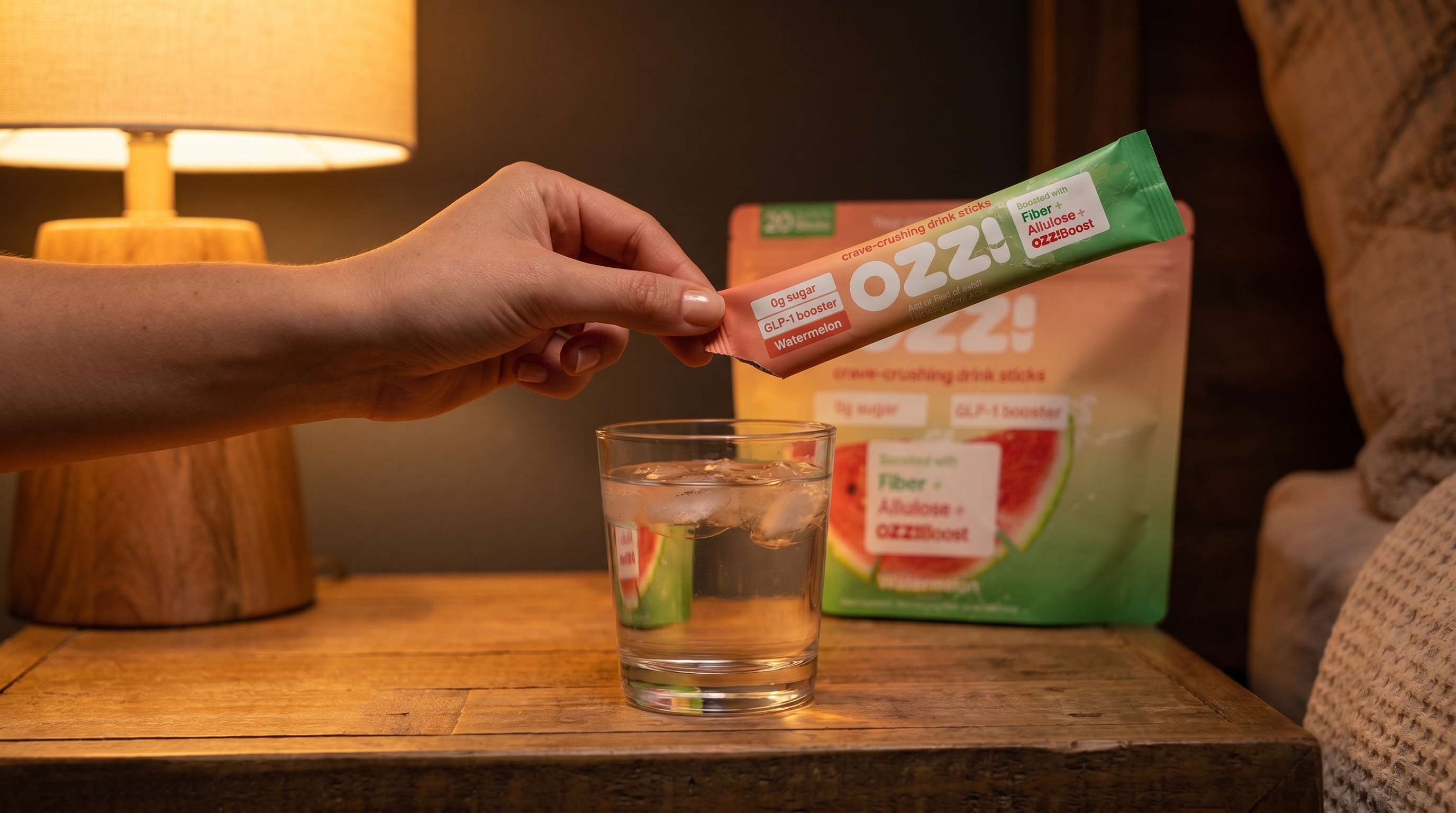
Add glucomannan, a konjac fiber that swells in your stomach for physical fullness, and you've got a drink aimed straight at the evening craving: sweet enough to scratch the itch, built to steady glucose, and designed to support your own GLP-1. No caffeine, so you can have it before bed.
It's not magic, and it's not a drug. It's a way to make the 9pm urge quieter so your daytime effort actually sticks. If you want the bigger ingredient rundown, see how to increase GLP-1 naturally and our guide to supplements for sugar cravings.
Quiet the 9pm craving
Ozzi is a watermelon drink stick built to steady blood sugar and support your own GLP-1, so the night urge stops running the show. Caffeine-free, so you can sip it before bed.
Try it for 14 days straight. If it doesn't work for you, we'll refund your first bag.
Frequently asked questions
Why do I crave sugar at night even when I'm not hungry?
Because the urge is partly habit and hormones, not true hunger. Your evening circadian appetite peak, plus a learned cue (couch, TV, 9pm), can fire the craving even on a full stomach. That overlap is what people call food noise.
Does eating more during the day stop night cravings?
Often, yes. Under-eating at breakfast and lunch sets up an evening rebound. Front-loading protein and fiber earlier keeps blood sugar and hunger hormones steadier, so the night urge is weaker.
Is craving sugar at night a sign of diabetes?
Not on its own. Night cravings are common in people with totally normal blood sugar. That said, frequent intense cravings plus other symptoms are worth a chat with your doctor. This article is education, not medical advice.
Why do I crave sugar at night after quitting alcohol?
Your brain was getting a reward hit from alcohol and looks for a fast replacement. Sugar is the easiest substitute. It usually settles over a few weeks, and steadier blood sugar helps bridge the gap.
Does poor sleep really cause sugar cravings?
Yes. Even one short night raises ghrelin (the hunger hormone), lowers leptin (the fullness hormone), and tilts your brain toward sugary, fatty food. Protecting sleep is one of the highest-impact fixes you've got.
What can I drink instead of eating sugar at night?
A warm herbal tea, sparkling water, or a low-sugar functional drink can break the habit loop. Ozzi was built for exactly this slot: a sweet-tasting, caffeine-free drink stick that won't spike your glucose.
Will a GLP-1 booster stop cravings like Ozempic?
A natural booster works on the same hormone, GLP-1, but more gently and without a prescription. It's support, not a drug. Many people use it specifically for the nighttime window rather than around-the-clock appetite suppression.
Are nighttime sugar cravings hormonal for women?
They can be. Cycle phases, perimenopause, and menopause all shift appetite and blood sugar. We cover that in our menopause cravings guide. The evening circadian peak stacks on top of those shifts.
References
- Scheer FAJL, Morris CJ, Shea SA. The internal circadian clock increases hunger and appetite in the evening independent of food intake and other behaviors. Obesity. 2013. PMC3655529
- Tonon AC, et al. The intersection between ghrelin, metabolism and circadian rhythms. Nat Rev Endocrinol / PMC. 2025. PMC11760189
- Leptin and ghrelin dynamics: their influence on food intake, energy balance, and type 2 diabetes. PMC. 2024. PMC11196531
- Effects of sleep deprivation on blood glucose, food cravings, and affect: an N-of-1 randomized pilot study. PMC. 2020. PMC7151045
- Nightshift work and nighttime eating are associated with higher insulin and leptin levels in hospital nurses. PMC. 2022. PMC9124849
- Tolhurst G, et al. Short-chain fatty acids stimulate glucagon-like peptide-1 secretion via the G-protein-coupled receptor FFAR2. Diabetes. 2012. PMID 22190648
- Yadav H, et al. Beneficial metabolic effects of a probiotic via butyrate-induced GLP-1 hormone secretion. J Biol Chem. 2013. PMC3757173
- Allulose for the attenuation of postprandial blood glucose levels in healthy humans: a systematic review and meta-analysis. PLOS One. 2023. PMC10079081
- Impact of allulose on blood glucose in type 2 diabetes: a meta-analysis of clinical trials. 2024. PMID 39583955
- Evaluation of the action of glucomannan on metabolic parameters and on the sensation of satiation in overweight and obese patients. PubMed. PMID 7796558
This article is for education and isn't medical advice. Ozzi is a dietary supplement and isn't intended to diagnose, treat, cure, or prevent any disease. Talk to your doctor about your individual health.
