

Does Allulose Spike Blood Sugar? What 2026 Research Actually Shows
Allulose does not spike blood sugar or insulin. Your body absorbs it but barely metabolizes it, so it delivers a sweet taste with almost no caloric or glycemic impact. Controlled human studies show allulose actually blunts the glucose rise from a meal.
If you've started reading sweetener labels, you've probably hit 'allulose' and wondered what it actually does to your blood sugar.
It's a fair question. Most things that taste like sugar behave like sugar once they hit your bloodstream.
Allulose is the rare exception. It's the largest ingredient in Ozzi Crave Crusher by weight, so I've spent more hours than I'd like to admit reading the research on it. Here's the honest version.
Key takeaways
- Allulose tastes like sugar with about 1/10th the calories.
- Human trials show it lowers post-meal blood glucose, not raises it.
- The FDA exempts allulose from 'added sugars' on labels.
- Early research links allulose to higher GLP-1 release.
- Ozzi uses 8.35g of allulose per serving.
What is allulose, exactly?
Allulose (also called D-psicose) is a 'rare sugar.' It shows up naturally in tiny amounts in figs, raisins, and maple syrup.
Chemically, it's almost identical to fructose. It's a C-3 epimer, which means one carbon atom is flipped. That tiny flip changes everything about how your body handles it.
It tastes about 70% as sweet as table sugar with a clean finish and no bitter aftertaste. But it carries fewer than 0.4 calories per gram, roughly a tenth of sugar's 4 calories per gram, according to the systematic review by Tani and colleagues published in PLOS One.
Here's the part that matters: your gut absorbs allulose, but your cells can't really burn it for energy. So about 70% of it gets absorbed and then excreted in urine, mostly intact. It goes in, takes a lap, and leaves.
It goes in, takes a lap, and leaves. That's why it tastes like sugar without acting like it.
Does allulose raise blood sugar or insulin?
Short answer: no. And the data here is unusually consistent for a sweetener.
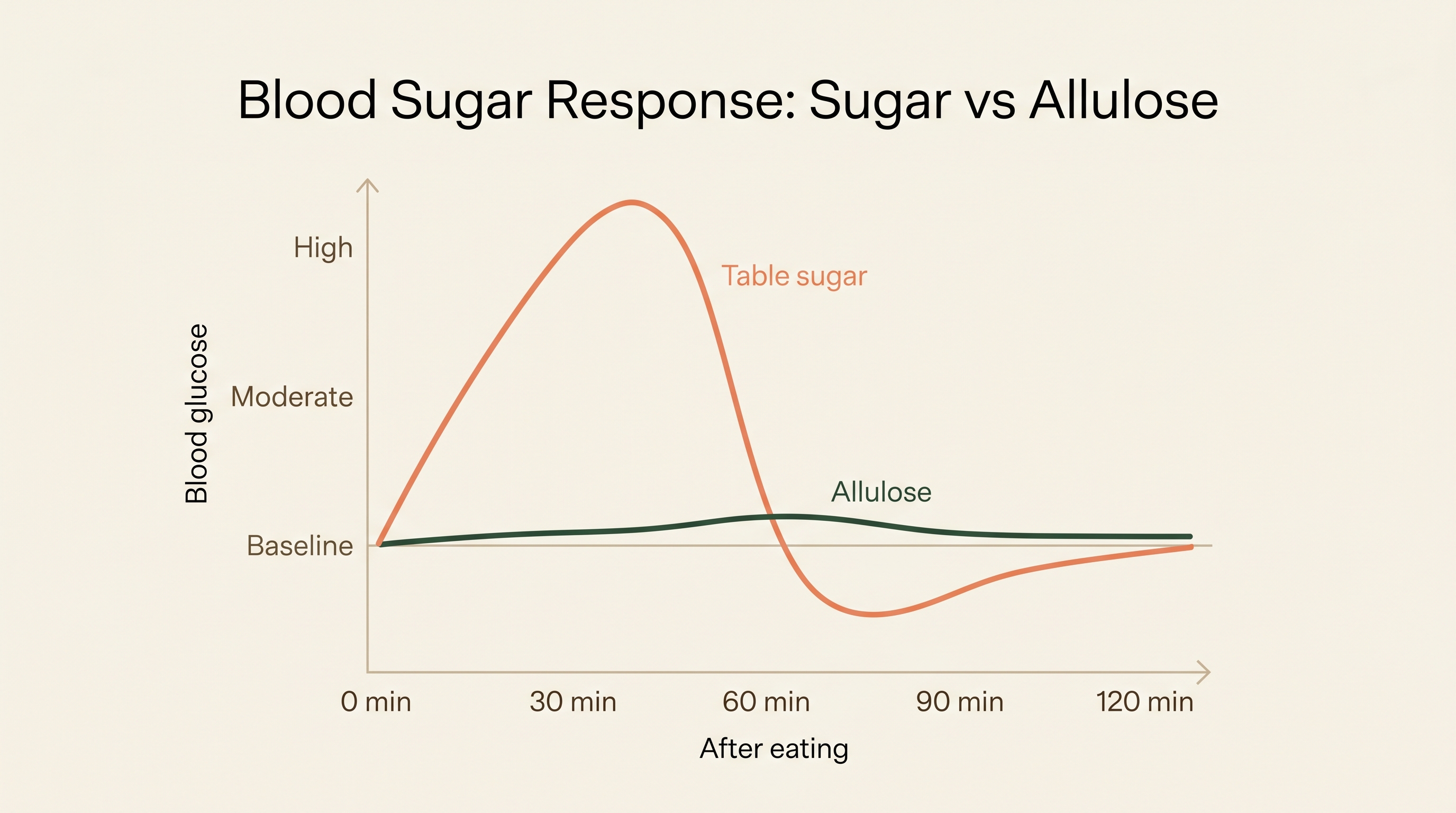
A 2023 systematic review and meta-analysis in PLOS One pooled human trials and found that both 5g and 10g doses of allulose significantly reduced the area under the curve for post-meal blood glucose in healthy adults. Translation: people's blood sugar rose less after eating when allulose was part of the meal.
A separate randomized controlled trial found that adding allulose to sucrose blunted the glucose and insulin response compared to sucrose alone. So it's not just neutral. It can actively soften the spike from other carbs eaten alongside it.
This is the opposite of what regular sugar does. Sugar drives glucose up fast, insulin chases it, and then you crash and reach for more food. Allulose skips that whole loop.
Why does the FDA treat allulose differently?
Because the science forced it to.
In 2019, the FDA ruled that allulose can be excluded from the 'total sugars' and 'added sugars' lines on the Nutrition Facts label. It still counts toward total carbohydrates, but it's separated out from sugars.
The agency made that call specifically because allulose doesn't raise blood glucose or insulin the way regular sugars do, and it provides almost no calories. That's a regulatory body looking at the metabolic data and saying, plainly, this doesn't behave like sugar.
Can allulose actually help your GLP-1?
This is where it gets interesting, and where I'll be careful not to oversell.
GLP-1 is the fullness hormone everyone's talking about thanks to drugs like Ozempic. It tells your brain you've had enough and slows how fast your stomach empties. If you want the background, I wrote a full primer on what GLP-1 is.
In animal studies, oral allulose stimulated GLP-1 secretion more strongly than glucose, fructose, or dextrin. Researchers led by Hayakawa found the effect lasted over two hours and was dose-dependent in rats.
A 2025 study in Endocrinology dug into the mechanism and found that allulose triggers GLP-1 partly through gentle intestinal stretching, a genuinely novel pathway.
Human evidence is still thin. Most human studies have used 5g to 10g doses, and results vary person to person. A new randomized crossover trial is underway to pin down the GLP-1 effect in healthy adults. So I'd call this promising, not proven.
Allulose looks like a sugar to your tongue and a near-nothing to your blood sugar. The GLP-1 angle is the cherry on top.
How does allulose compare to other sweeteners?
Most 'blood sugar friendly' sweeteners fall into a few buckets. Here's how allulose stacks up.
| Sweetener | Blood sugar impact | Tastes like sugar? | Common downside |
|---|---|---|---|
| Allulose | Lowers post-meal glucose | Yes, very close | Gas at very high doses |
| Table sugar | Sharp spike | It is sugar | Spike, crash, cravings |
| Stevia / Reb M | None | Mostly, slight aftertaste | Can taste bitter alone |
| Erythritol | None | Close, cooling effect | Cooling mouthfeel, gas |
In Ozzi we pair allulose with a touch of Reb M (a stevia-derived sweetener). The allulose carries the sugar-like body and the Reb M rounds out the sweetness, so neither has to do the job alone.
How much allulose is in Ozzi, and why?
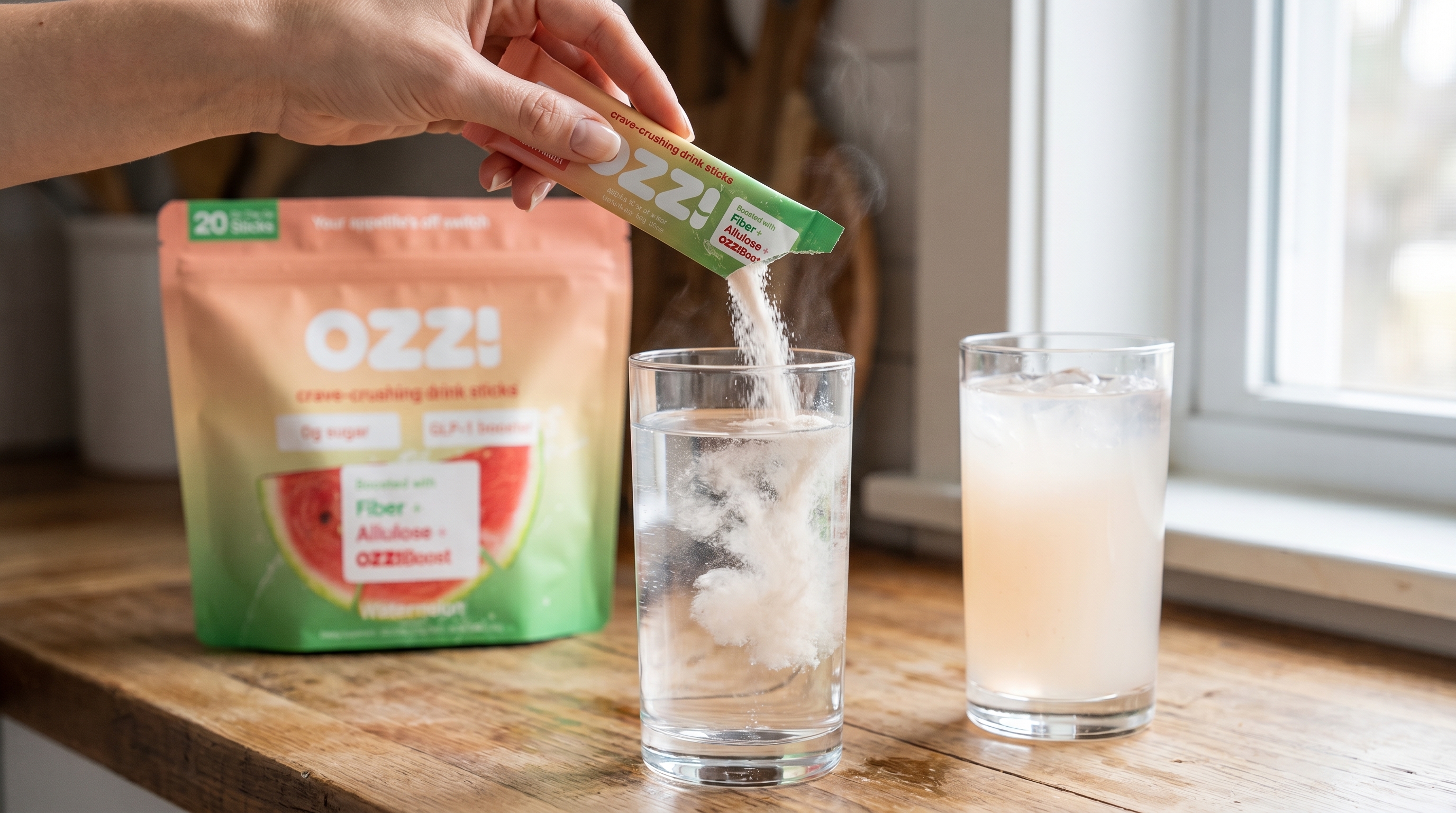
Ozzi Crave Crusher uses 8.35g of allulose per serving, branded as allSWEET. That's the single biggest ingredient by weight in the formula.
The dose isn't random. It lands right in the 5g to 10g window where the human glucose studies showed an effect. Enough to taste sweet, enough to fall inside the researched range, and low enough to stay gentle on your gut.
Allulose is one piece of a stack. It handles the sweet-without-the-spike job while ingredients like L-Lysine Butyrate and chicory inulin work on the GLP-1 side. If you want the deep dive, here's my full allulose supplement guide and how it fits into a GLP-1 booster drink.
Is allulose safe, and are there side effects?
Allulose has GRAS status with the FDA, which is the agency's 'generally recognized as safe' designation.
The main side effect is the same one you'd get from most sugar alternatives: digestive upset if you go overboard. Eat a large pile of it at once and you might get gas or loose stools.
At the doses used in food and in a single Ozzi stick, most people don't notice anything but the sweetness. If you're sensitive, start with half a stick and work up. People managing diabetes should still loop in their doctor before changing anything, since this is general information and not medical advice.
So is allulose worth it for cravings?
If your problem is sweet cravings, especially the kind that hit at night, allulose is one of the few sweeteners that lets you answer the craving without the blood sugar rollercoaster that usually follows.
A lot of Ozzi customers come to us saying the same thing: they're great all day, then the sugar monster shows up after dinner. Allulose is part of why a drink can scratch that itch. For the bigger picture, here's what actually helps curb sugar cravings and how to raise GLP-1 naturally.
Sweet without the spike
Ozzi Crave Crusher uses 8.35g of allulose per stick to satisfy the sweet craving without the sugar crash. Use it for 10 days straight. If you don't feel a difference, we'll refund your first bag.
Frequently asked questions
Does allulose spike blood sugar?
No. Human trials show allulose lowers the post-meal glucose rise rather than raising it. Your body absorbs it but doesn't metabolize it for energy.
Does allulose raise insulin?
No meaningful insulin response. Studies show allulose doesn't trigger the insulin surge that table sugar does, and it can blunt insulin from carbs eaten with it.
Is allulose keto-friendly?
Yes. It has under 0.4 calories per gram, doesn't raise blood glucose, and the FDA lets it be excluded from total and added sugars on labels.
Is allulose safe for people with diabetes?
Research suggests it supports healthy post-meal glucose, but everyone's different. Talk to your doctor before changing your routine. This is general info, not medical advice.
What does allulose taste like?
Very close to table sugar, around 70% as sweet, with a clean finish and no bitter aftertaste. That's its main advantage over stevia alone.
How much allulose is safe per day?
Most people tolerate moderate amounts well. Very large single doses can cause gas or loose stools, so spread it out and start small if you're sensitive.
Does allulose break a fast?
It has negligible calories and doesn't spike insulin, so many people use it during fasting windows. Strict fasters may still prefer to skip all sweeteners.
How much allulose is in Ozzi?
8.35g per serving, the largest ingredient by weight, dosed inside the 5g to 10g range used in the human glucose studies.
Can allulose help with GLP-1?
Animal and early mechanistic studies suggest allulose can stimulate GLP-1 release. Human confirmation is still in progress, so treat it as promising rather than settled.
References
- Tani Y, et al. Allulose for the attenuation of postprandial blood glucose levels in healthy humans: A systematic review and meta-analysis. PLoS One. 2023;18(4):e0281150. https://doi.org/10.1371/journal.pone.0281150
- Hayakawa M, Hira T, et al. Secretion of GLP-1 but not GIP is potently stimulated by luminal d-Allulose (d-Psicose) in rats. Biochem Biophys Res Commun. 2018;496(3):898-903. https://doi.org/10.1016/j.bbrc.2018.01.128
- Intestinal Distension Induced by Luminal D-allulose Promotes GLP-1 Secretion in Male Rats. Endocrinology. 2025;166(2):bqaf002. https://academic.oup.com/endo/article-abstract/166/2/bqaf002/7959153
- Comparison of postprandial glycemic and insulinemic response of allulose when consumed alone or when added to sucrose: A randomized controlled trial. J Funct Foods. 2023. https://www.sciencedirect.com/science/article/pii/S175646462300169X
- A Double-Blind, Randomized Controlled, Acute Feeding Equivalence Trial of Small, Catalytic Doses of Fructose and Allulose on Postprandial Blood Glucose Metabolism in Healthy Participants (FACE Trial). https://www.ncbi.nlm.nih.gov/pmc/articles/PMC6024645/
- Glycemic and cardiometabolic effects of rare sugars allulose and tagatose: a systematic review and meta-analysis of controlled human intervention trials. Am J Clin Nutr. 2026. https://www.sciencedirect.com/science/article/pii/S0002916526001231
These statements have not been evaluated by the Food and Drug Administration. This product is not intended to diagnose, treat, cure, or prevent any disease. Content is for general education and is not medical advice.
