

Blood Sugar Spikes and Hunger: Why the Dip Is What Makes You Snack
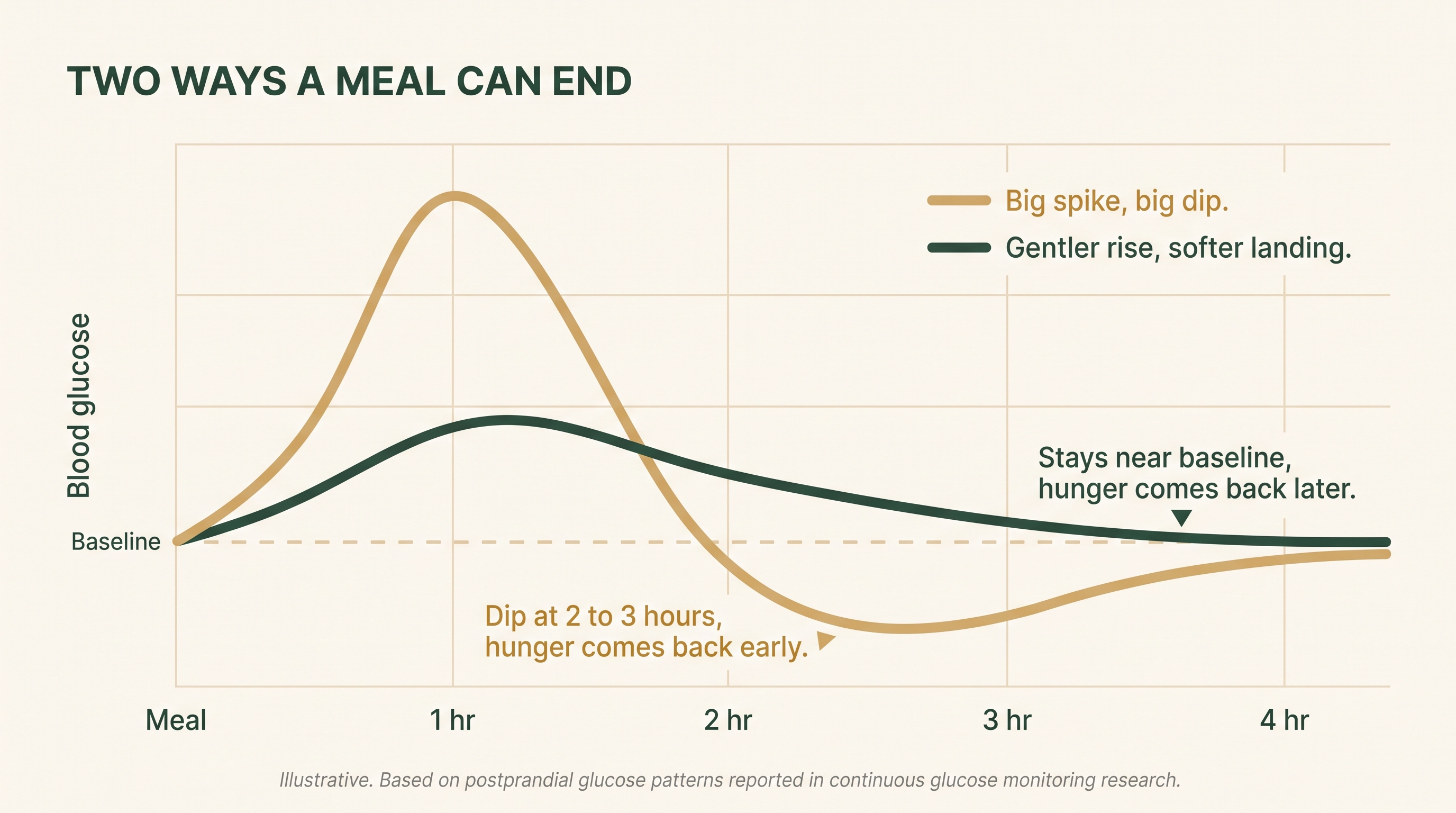
Blood sugar spikes cause hunger indirectly. A large rise triggers a large insulin response, which can overshoot and push glucose below its starting point 2 to 3 hours later. In a study of 1,070 people wearing continuous glucose monitors, that post-meal dip predicted hunger and next-meal calories better than the peak did.
Key takeaways
- The dip predicts hunger better than the peak does.
- Big dippers ate about 80 more calories at the next meal.
- Over 24 hours, that gap widened to roughly 300 calories.
- Meal viscosity and sugar type both change the curve.
- Same meal, different people, very different curves.
You ate lunch. A real lunch. Two hours later you're standing there hunting for something sweet, annoyed at yourself, wondering why you have the appetite of someone who skipped a meal.
That's not a character flaw. It's a glucose curve.
What actually happens to blood sugar after you eat?
A meal with carbohydrate in it raises blood glucose. Your pancreas answers with insulin, which moves that glucose out of the bloodstream and into cells.
That part is normal and healthy. The interesting part is the landing.
Sometimes glucose glides back to where it started and stays there. Sometimes insulin overshoots, and glucose keeps falling past baseline into a trough. Researchers call that a postprandial glycemic dip, and it usually shows up 2 to 3 hours after eating.
Both people ate. Only one of them gets the crash.
Why does a blood sugar dip make you hungry?
Your brain runs almost entirely on glucose and it doesn't like watching the supply drop. A falling glucose signal is one of the oldest hunger cues in the body, older and blunter than anything hormonal.
So the dip reads as an emergency even when you have plenty of stored fuel. You just ate. Your body doesn't care. The direction of travel is what it's watching.
That's why the hunger feels irrational and physical at the same time. Your glucose is falling, and your brain treats that as the more urgent fact.
The dip is why you can eat a full lunch and still want something at 3pm.
How much does a glucose dip actually change what you eat?
This is where the research got specific. A 2021 study in Nature Metabolism tracked 1,070 people across a UK cohort and a US validation cohort. Participants ate 8,624 standardized meals and 71,715 meals of their own choosing, all while wearing continuous glucose monitors (Wyatt et al., 2021).
The researchers compared three things as predictors of appetite: the peak glucose in the first 2 hours, the area under the curve in the first 2 hours, and the dip at 2 to 3 hours.
The dip won.
People with bigger dips reported more hunger at 2 to 3 hours, waited less time before their next meal, ate more at 3 to 4 hours, and ate more across the full 24 hours. The 24-hour association was the strongest one in the paper.
In practical terms, as the authors and subsequent coverage described it, the biggest dippers ate roughly 80 more calories at the next meal and around 300 more over a whole day than the flattest responders. That's a rounding error on one afternoon and about 30 pounds of theoretical calorie surplus across a year.
Two caveats worth stating plainly. These are correlations, not a controlled intervention, and the correlation coefficients were modest (r values in the 0.14 to 0.27 range). Glucose is one input into appetite, not the whole system.
Is the spike the problem, or is it the dip?
Most of the internet has settled on "flatten your spikes." The data points somewhere slightly different.
A tall peak and a deep dip usually travel together, because a big glucose rise pulls a big insulin response behind it. So spike-flattening advice tends to work. It just works for a reason people usually get backwards.
Chasing a perfectly flat line is also the wrong goal. A rise after eating is what a working metabolism looks like. What you're trying to avoid is the overshoot on the way down.
If you want the deeper version of this, we covered the mechanism in the insulin resistance and cravings cycle, and the fixes in how to reverse insulin resistance naturally.
What makes some meals dip harder than others?
Four things move the curve more than anything else.
How fast the carbohydrate digests. Liquid sugar hits faster than intact starch. In a randomized crossover in 13 adults, chickpeas in three different physical forms all produced lower glucose responses and higher reported fullness than mashed potato, and processing the chickpeas into puree or pasta barely changed the result (Hafiz et al., 2022).
How thick the meal is. Viscosity slows gastric emptying. A crossover trial in 22 healthy adults tested breakfasts thickened with konjac glucomannan at three viscosities. As viscosity went up, gastric emptying slowed, hunger and desire to eat went down, and glucose and satiety hormone responses shifted with it (Shang et al., 2020).
What sugar you use. Allulose is a rare sugar the body largely doesn't metabolize for energy. In a randomized, double-blind, placebo-controlled crossover in 30 people without diabetes, adding allulose to a 50g sucrose load produced a dose-dependent reduction in plasma glucose at 30 minutes and reduced both glucose and insulin excursion, with the clearest effects at the 7.5g and 10g doses (Franchi et al., 2021). A separate crossover in 30 Thai volunteers found the same dose-dependent pattern across 2.5g to 10g (Buranapin et al., 2024).
Who you are. The same meal produces meaningfully different curves in different people. Age, body composition, sleep, muscle mass, hormonal phase, and gut microbiome all move it. This is the single most under-reported finding in the CGM literature.
For the hormonal version of that last point, see perimenopause and insulin resistance.
What does the human evidence actually show?
Here's the honest scorecard on the ingredients people reach for when they're trying to stop the 3pm crash.
| Approach | What was tested | Population | Result |
|---|---|---|---|
| Allulose | 2.5g to 10g with 50g sucrose | Human, no diabetes (n=30) | Dose-dependent drop in glucose and insulin excursion |
| Konjac glucomannan | Breakfasts at three viscosities | Human, healthy adults (n=22) | Slower gastric emptying, less hunger and desire to eat |
| Glucomannan + FOS + chromium complex | Single 3g dose with 50g dextrose | Human, healthy adults (n=16) | Lower insulin, more fullness, less hunger at 150 min |
| Low-GI whole food (chickpeas) | Matched-carb meals vs potato | Human, normoglycemic (n=13) | Lower glucose response, higher reported satiety |
| Oat polar lipids | Breakfast, measured through lunch | Human, healthy young adults (n=20) | Lower glucose and insulin after both meals; higher GLP-1 and PYY after lunch |
The 2025 glucomannan trial is the most directly relevant one to the afternoon problem. Sixteen healthy adults took a single 3g dose of a chromium-enriched glucomannan and fructooligosaccharide complex alongside 50g of dextrose. Insulin was lower at 45, 75 and 90 minutes. Fullness was higher and desire to eat lower at 75 minutes. And at 150 minutes, right in the dip window, hunger, desire to eat and food desire scores were all lower than dextrose alone (Ancu et al., 2025).
Two honest notes on that one. It's a small acute study, and it tested a specific 3g complex, not any single ingredient in isolation.

What the research has actually studied in patient populations
Some of the most cited work here was done in people with diagnosed metabolic disease, under medical supervision. It belongs in its own box, because those results don't transfer cleanly to a healthy person trying to get through an afternoon.
A prospective single-blind crossover in patients with type 2 diabetes compared a standard diabetic diet against one containing 8.5g of allulose, using continuous glucose monitoring. The allulose diet improved peak postprandial glucose (Fukunaga et al., 2023). Participants were patients under medical care with an established diagnosis.
A 2022 systematic review and meta-analysis pooled 119 randomized trials of nine add-on nutrients in type 2 diabetes management. Chromium was one of four that significantly improved glycemic markers (Kim et al., 2022). Again, that's a diagnosed patient population already on antidiabetic medication.
Neither of those says anything about treating, curing or preventing disease with a supplement, and neither is a claim Ozzi makes. They're context for why these ingredients get studied at all.
A study in patients under medical care is a reason to be curious, not a promise to a healthy person.
How do you soften the dip without eating less?
Five things with actual human evidence behind them, roughly in order of how much they move the curve.
1. Put protein and fat in front of the carbohydrate. Order changes rate of absorption, and rate of absorption changes the shape of the curve.
2. Add viscosity. Soluble viscous fiber thickens stomach contents and slows emptying. That's the glucomannan mechanism, and it's about texture more than nutrition. More on this in the best fiber for appetite control.
3. Swap the sugar, not the sweetness. Allulose tastes like sugar and behaves very differently in the bloodstream. We broke that down in does allulose spike blood sugar and the allulose supplement guide.
4. Walk for 10 minutes after eating. Muscle takes up glucose without needing much insulin to do it, which blunts the rise and the overshoot that follows.
5. Sleep. One short night measurably worsens next-day glucose handling in controlled studies. It's the least glamorous item on this list and probably the most powerful.
None of this is about restriction. It's about the shape of the line.
Where does Ozzi fit into this?
I built Crave Crusher around the afternoon and evening version of this problem, because that's what 956 post-purchase surveys kept describing. Not "I'm hungry." More like "I ate, and two hours later something else took over."
Three of the seven actives in the stick sit directly on the curve.
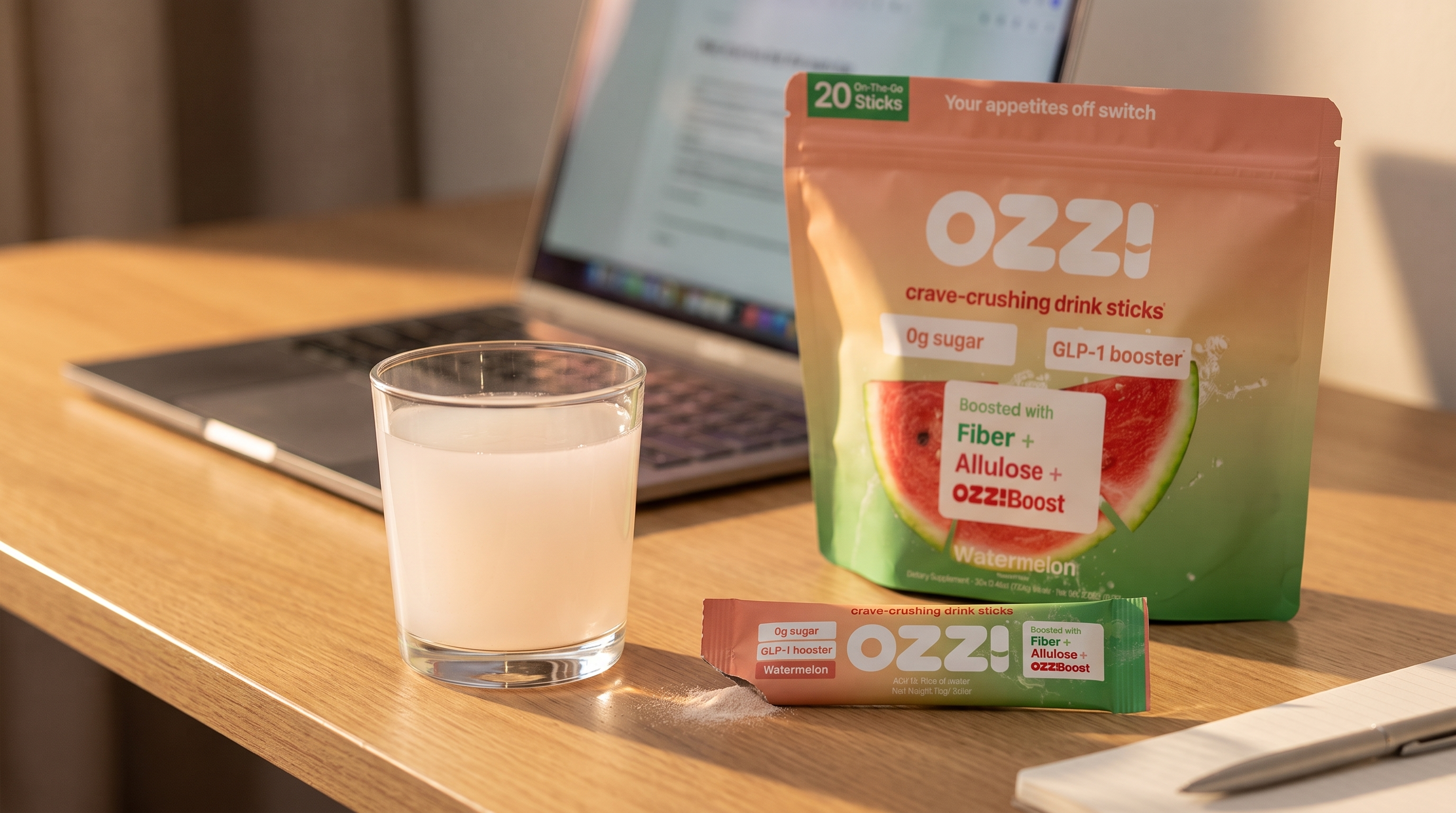
8g allulose carries the sweetness without the glucose load that comes with sucrose. 500mg glucomannan is the viscosity lever, absorbing water in the stomach to support satiety. 11mg chromium polyursolate supports insulin signaling, which is the mineral's best-established role.
The rest of the formula works on a different axis. 500mg chicory root inulin is a prebiotic fiber that feeds butyrate-producing bacteria, and 500mg L-Lysine Butyrate provides butyrate directly. Butyrate is the primary energy source for the cells lining your colon, and it supports gut barrier function. The link between butyrate and GLP-1 secretion has mostly been demonstrated in rodent and cell studies, so treat that as a proposed mechanism rather than a human finding. We go through the whole formula in what GLP-1 actually is and the mineral in chromium for cravings and blood sugar.
One stick in 16oz of cold water. No caffeine, no stimulants.
Should you buy a CGM to figure this out?
Probably not as step one.
A monitor tells you your curve, which is genuinely useful information and often surprising. It also turns eating into a scoreboard, and for anyone with a history of disordered eating that trade is a bad one.
Most people can find their own dippers without hardware. Note what you ate at the meal before every craving you didn't plan. Two weeks of that gets you 80% of the signal.
If the pattern is mostly nighttime, the driver may not be glucose at all. See why you crave sugar at night and what food noise actually is.
Frequently asked questions
Does a blood sugar spike cause cravings directly?
Not directly. The spike sets up the insulin response, and it's the dip below baseline 2 to 3 hours later that tracks with reported hunger and higher next-meal intake in CGM research.
How long after eating does the dip usually happen?
2 to 3 hours in the largest human dataset on this. That timing lines up neatly with the mid-afternoon and post-dinner craving windows most people describe.
Is reactive hypoglycemia the same thing as a glucose dip?
No. Reactive hypoglycemia is a clinical diagnosis involving symptomatic low blood sugar. A postprandial dip is a normal-range fluctuation that can still nudge appetite. If you get shaky, sweaty or lightheaded after meals, talk to a doctor.
Can you have big dips and still be metabolically healthy?
Yes. The Nature Metabolism cohort was made up of healthy participants, and dip size varied widely across them. Being a dipper isn't a diagnosis.
Does allulose raise blood sugar?
Human crossover trials found allulose lowered glucose and insulin excursion when added to a sucrose load, in a dose-dependent way. It's a rare sugar the body largely doesn't metabolize for energy.
Does fiber flatten the curve or just fill you up?
Both, and they're related. Viscous fiber slows gastric emptying, which slows carbohydrate absorption and increases fullness at the same time.
Will Ozzi stop my blood sugar from spiking?
Ozzi supports blood sugar control through several ingredients with human evidence behind them. It isn't a drug, it doesn't treat any condition, and it won't override a meal you'd rather not have eaten.
How fast would I notice a difference?
Most people who report a change describe it in the first 1 to 2 weeks, usually as quieter evenings rather than a dramatic switch. That's why the 14-Day Ozzi Challenge exists.
Can I take Ozzi with a GLP-1 medication?
Ask your prescriber. Ozzi is a supplement, not a substitute for medical advice, and anyone on prescription medication should check first.
Give the afternoon a fair fight
Crave Crusher is one stick in 16oz of cold water. 8g allulose, 500mg glucomannan, 500mg butyrate, 11mg chromium. No caffeine, no stimulants.
Try it for 14 days straight. If it doesn't work, we'll refund your first bag.
References
- Wyatt P, Berry SE, Finlayson G, et al. Postprandial glycaemic dips predict appetite and energy intake in healthy individuals. Nature Metabolism. 2021;3(4):523-529. https://doi.org/10.1038/s42255-021-00383-x
- Ancu O, Mackenzie RWA, Patterson M, et al. Impact of a mineral enriched, fiber complex on glycaemic response and satiation in healthy adults: a double-blind, crossover intervention study. European Journal of Nutrition. 2025;64(5):216. https://doi.org/10.1007/s00394-025-03732-8
- Shang L, Wang Y, Ren Y, et al. Gastric emptying characteristics of konjac glucomannan with different viscosity and its effects on appetite regulation. Food & Function. 2020;11(9):7596-7610. https://doi.org/10.1039/d0fo01104e
- Franchi F, Yaranov DM, Rollini F, et al. Effects of D-allulose on glucose tolerance and insulin response to a standard oral sucrose load: results of a prospective, randomized, crossover study. BMJ Open Diabetes Research & Care. 2021;9(1):e001939. https://doi.org/10.1136/bmjdrc-2020-001939
- Buranapin S, Kosachunhanan N, Waisayanand N, et al. Effects of D-Allulose with Sucrose Beverage on Glucose Tolerance and Insulin Levels among Thai Healthy Volunteers. Journal of Nutritional Science and Vitaminology. 2024;70(3):203-209. https://doi.org/10.3177/jnsv.70.203
- Hafiz MS, Campbell MD, Orsi NM, et al. Impact of food processing on postprandial glycaemic and appetite responses in healthy adults: a randomized, controlled trial. Food & Function. 2022;13(3):1280-1290. https://doi.org/10.1039/d1fo02304g
- Hossain MM, Tovar J, Cloetens L, et al. Oat Polar Lipids Improve Cardiometabolic-Related Markers after Breakfast and a Subsequent Standardized Lunch: A Randomized Crossover Study in Healthy Young Adults. Nutrients. 2021;13(3):988. https://doi.org/10.3390/nu13030988
- Fukunaga K, Yoshimura T, Imachi H, et al. A Pilot Study on the Efficacy of a Diabetic Diet Containing the Rare Sugar D-Allulose in Patients with Type 2 Diabetes Mellitus. Nutrients. 2023;15(12):2802. https://doi.org/10.3390/nu15122802
- Kim Y, Oh YK, Lee J, Kim E. Could nutrient supplements provide additional glycemic control in diabetes management? A systematic review and meta-analysis of randomized controlled trials. Archives of Pharmacal Research. 2022;45(3):185-204. https://doi.org/10.1007/s12272-022-01374-6
These statements have not been evaluated by the Food and Drug Administration. This product is not intended to diagnose, treat, cure or prevent any disease. This article is educational and is not medical advice.
