

How to Reverse Insulin Resistance Naturally: What the Human Evidence Actually Supports (2026)
Insulin resistance can improve substantially with lifestyle change. In randomized human trials, modest weight loss combined with regular exercise improves whole-body insulin sensitivity more than weight loss alone, and short sleep measurably worsens it. Diet, movement, and sleep are the three levers with the best evidence behind them.
Key takeaways
- Losing roughly 7% of body weight moves the needle most
- Exercise adds benefit on top of weight loss alone
- Six hours of sleep measurably raises insulin resistance
- More fiber lowers fasting insulin across dozens of trials
- Isocaloric meal timing tricks did not improve insulin sensitivity
What is insulin resistance, actually?
Insulin is a key. Your cells have locks. Insulin resistance means the locks got stiff, so your pancreas has to push harder on the key to get the same door open.
For a while, that works. Your pancreas makes extra insulin, your blood sugar stays in a normal range, and nothing on a standard lab panel looks alarming. This is the quiet phase, and it can last years.
What you feel during that phase is usually not blood sugar. It's hunger that shows up too early after eating, energy that dips in the afternoon, and cravings that get loud in the evening. We wrote about that specific pattern in more detail in the insulin resistance craving cycle.
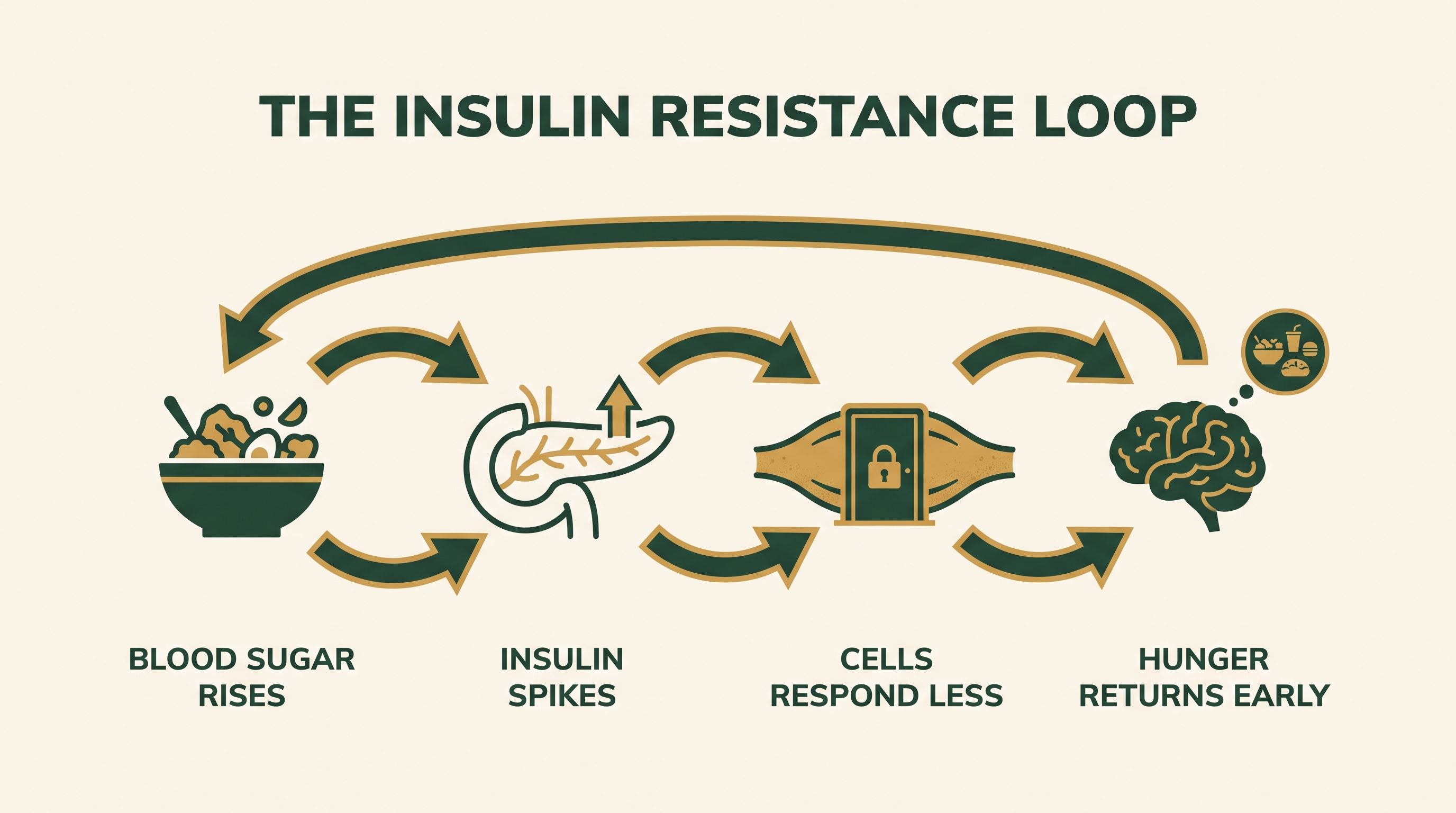
The reason this matters for appetite is that insulin does more than manage blood sugar. It's a storage and signaling hormone that talks to your brain, your fat cells, and your gut. When the signal gets noisy, so does hunger.
Can you actually reverse insulin resistance?
The honest answer is that "reverse" is a marketing word and "improve, sometimes a lot" is the scientific one. But the direction of travel is real, and it's better established here than for most things people sell supplements for.
The reference point is the Diabetes Prevention Program, which randomized 3,234 adults with elevated fasting and post-load glucose to placebo, metformin, or a lifestyle program aimed at 7% weight loss and 150 minutes of activity a week. Over an average of 2.8 years, the lifestyle group cut new diabetes cases by 58%. Metformin cut them by 31%. Behavior beat the drug (Knowler et al., New England Journal of Medicine).
That trial is 24 years old and it still hasn't been beaten by anything you can buy in a bottle. Worth sitting with.
Behavior beat the drug. That result is 24 years old and still standing.
Why does losing body fat help so much?
Fat stored in the liver and around the organs behaves differently from fat under your skin. It's metabolically loud. Shrinking it tends to quiet the insulin signal down.
The cleanest recent demonstration comes from Washington University. Researchers matched two groups of adults with obesity and prediabetes for the exact same 10% weight loss, one through calorie restriction alone and one through calorie restriction plus supervised exercise training. Whole-body insulin sensitivity improved about twice as much in the diet-plus-exercise group (Beals et al., Nature Metabolism, 2023).
Two caveats you should know. The groups were small, 8 people each, so treat the size of the effect as directional rather than precise. And both groups did improve. The exercise group just improved more for the same pounds lost.
The practical read: the scale number is not the whole story. What you do while losing the weight changes the metabolic result.
Does exercise work even without weight loss?
Yes, and this is the part most people underrate. Skeletal muscle is the biggest glucose sink in your body. Contracting it pulls glucose in through a pathway that doesn't depend on insulin at all.
A Spanish trial randomized 139 adults with metabolic syndrome to 16 weeks of supervised high-intensity interval training in the morning, the same training in the afternoon, or no training, with no dietary restriction. Both training groups improved body composition and blood pressure. The morning group reduced insulin resistance by 14% versus 4% in the afternoon group (Morales-Palomo et al., The Journal of Physiology, 2024).
Don't over-read the morning part. It's one trial, the mechanism isn't settled, and training at a time you'll actually keep doing beats training at the theoretically optimal hour you'll quit in three weeks.
The lower-effort version also has data behind it. A crossover trial in middle-aged and older adults tested different patterns of interrupting an 8-hour sitting block with light walking. Breaking up sitting every 30 minutes for 5 minutes was the dose that meaningfully blunted the glucose curve (Duran et al., Medicine & Science in Sports & Exercise, 2023). Small study, 11 people, but it points somewhere useful: frequency matters, not just intensity.
If you're worried about losing muscle while losing weight, which is a legitimate concern, we covered that separately in GLP-1 and muscle loss.
How much does sleep actually matter?
More than almost anyone budgets for. And unlike most nutrition questions, this one has been tested with a proper randomized design.
Columbia researchers took 38 women with normal habitual sleep and randomized them, crossover style, to 6 weeks of adequate sleep and 6 weeks of sleeping 1.5 hours less per night. That's it. No diet change, no exercise change. Fasting insulin and HOMA-IR both rose during the restricted phase, and the effect held after accounting for changes in body fat. It was more pronounced in postmenopausal women (Zuraikat et al., Diabetes Care, 2024).
A separate crossover trial at Pennington used a hyperinsulinemic-euglycemic clamp, the gold standard measurement, in postmenopausal women. Just 4 nights of shortened sleep reduced insulin sensitivity by about 20% at the lower insulin dose (Singh et al., Obesity, 2023). Nine women completed it, so it's small, but the measurement method is the strictest one available.
Four nights. That's a work trip, a sick kid, or one bad week. If you're doing everything else right and sleeping 6 hours, you're fighting your own biology at night.
If you're in perimenopause and this is landing uncomfortably close to home, we went deeper in perimenopause and insulin resistance.
Does fiber help, and does the type matter?
Fiber is the most boring answer in nutrition and one of the few with a genuinely deep evidence base.
An umbrella review pooled 52 meta-analyses covering 47,197 people and found higher dietary fiber intake was associated with lower fasting glucose, lower fasting insulin, and lower HOMA-IR across the board (Fu et al., Frontiers in Nutrition, 2022). Umbrella reviews inherit the flaws of the studies underneath them, so this is a strong signal rather than a precise number. But the direction is consistent across dozens of independent trials.
Type does matter, and the mechanisms split in two directions:
| Fiber type | How it works | Evidence quality in humans |
|---|---|---|
| Viscous (glucomannan, psyllium, beta-glucan) | Thickens stomach contents, slows how fast carbohydrate reaches the bloodstream, adds fullness | Good. Multiple RCTs on satiety and post-meal glucose |
| Fermentable prebiotic (inulin, resistant starch) | Feeds gut bacteria that produce short-chain fatty acids including butyrate | Moderate. Glycemic markers improve in trials; the downstream mechanism is largely preclinical |
| Insoluble (wheat bran, vegetable skins) | Bulk and transit time, minimal direct glucose effect | Good for regularity, weaker for insulin markers |
One honest note on that middle row, because it's the row supplement marketing loves most. Butyrate's effects on appetite hormones have mostly been mapped in rodents and cell studies. A human trial that successfully raised circulating butyrate measured GLP-1 as a secondary outcome and found no change. So treat butyrate and GLP-1 as a proposed mechanism, not a demonstrated human one. We laid out the full picture in our short-chain fatty acids guide.
If you want the practical version of which fibers to actually eat, that's best fiber for appetite control.
What about intermittent fasting and meal timing?
Here's where a popular answer runs into a well-designed trial.
German researchers ran a crossover study in 31 women with overweight or obesity, comparing 2 weeks of early time-restricted eating (8am to 4pm) against 2 weeks of late time-restricted eating (1pm to 9pm), with participants told to keep their usual food quantity and quality. Adherence was excellent, above 96% in both arms.
Insulin sensitivity didn't improve in either arm. Neither did 24-hour glucose, lipids, or inflammatory markers. Circadian clocks shifted, but the cardiometabolic outcomes didn't follow (Peters et al., Science Translational Medicine, 2025).
The narrower reading is the right one here. When people report metabolic benefits from a shorter eating window, the benefit most likely comes from eating less, rather than from the window itself. Two weeks is short and 31 people is not enormous, so this won't be the last word. But it's the most direct test we have of timing separated from calories.
When the eating window shrinks and nothing else changes, the metabolic benefit mostly disappears with it.
What the research has actually studied
Two of the strongest results in this space came from trials in people already diagnosed with type 2 diabetes and under medical care. That's a different population from someone reading this article because their afternoons feel foggy. Their numbers started worse, which usually means more room to move, and they were being monitored by clinicians throughout. Keep that in mind while reading these.
A trial in Manipal, India randomized 160 adults aged 30 to 65 with type 2 diabetes to 12 weeks of structured aerobic, resistance, or combined exercise on top of standard care. HOMA-IR, fasting insulin, fasting glucose, and HbA1c all improved significantly versus the control group (Amaravadi et al., PLOS ONE, 2024).
On the supplement side, a systematic review pooled 119 randomized trials testing nine nutrients added on top of standard diabetes medication. Chromium was one of four that significantly improved glycemic control, showing effects on HbA1c, fasting glucose, and HOMA-IR (Kim et al., Archives of Pharmacal Research, 2022).
Both are real results. Neither tells you what happens in a person without diabetes who isn't on medication and isn't being followed by a clinic. That study is mostly still missing. Our full look at the chromium literature is in chromium for cravings and blood sugar.
What does a realistic 90-day plan look like?
Here's a ranking rather than a protocol, ordered by evidence strength divided by how hard the thing is to actually keep doing.
| Priority | What to do | Why it's ranked here |
|---|---|---|
| 1 | Sleep 7 hours or more, consistently | Randomized trials show 4 nights of short sleep is enough to move the needle the wrong way. Free. Hardest to actually do. |
| 2 | Walk 10 minutes after your largest meal | Muscle contraction pulls glucose in without insulin. Almost zero friction to start. |
| 3 | Add 10g of fiber a day from food first | Deepest evidence base of anything on this list. Go slowly or your gut will complain. |
| 4 | Resistance train twice a week | Builds the tissue that stores glucose. Slower payoff, larger ceiling. |
| 5 | Aim for 5% to 7% body weight loss if you carry extra | The DPP target. Largest single effect, longest timeline. |
| 6 | Consider supplements last | They support the plan. They don't replace items 1 through 5. |
Get your fasting insulin and HbA1c checked before you start and again at 90 days. Fasting glucose alone will miss the early phase entirely, because your pancreas is busy hiding the problem from it.
Where does Ozzi fit into this?
Honestly, at position 6. I'd rather tell you that than pretend a drink outranks sleep.
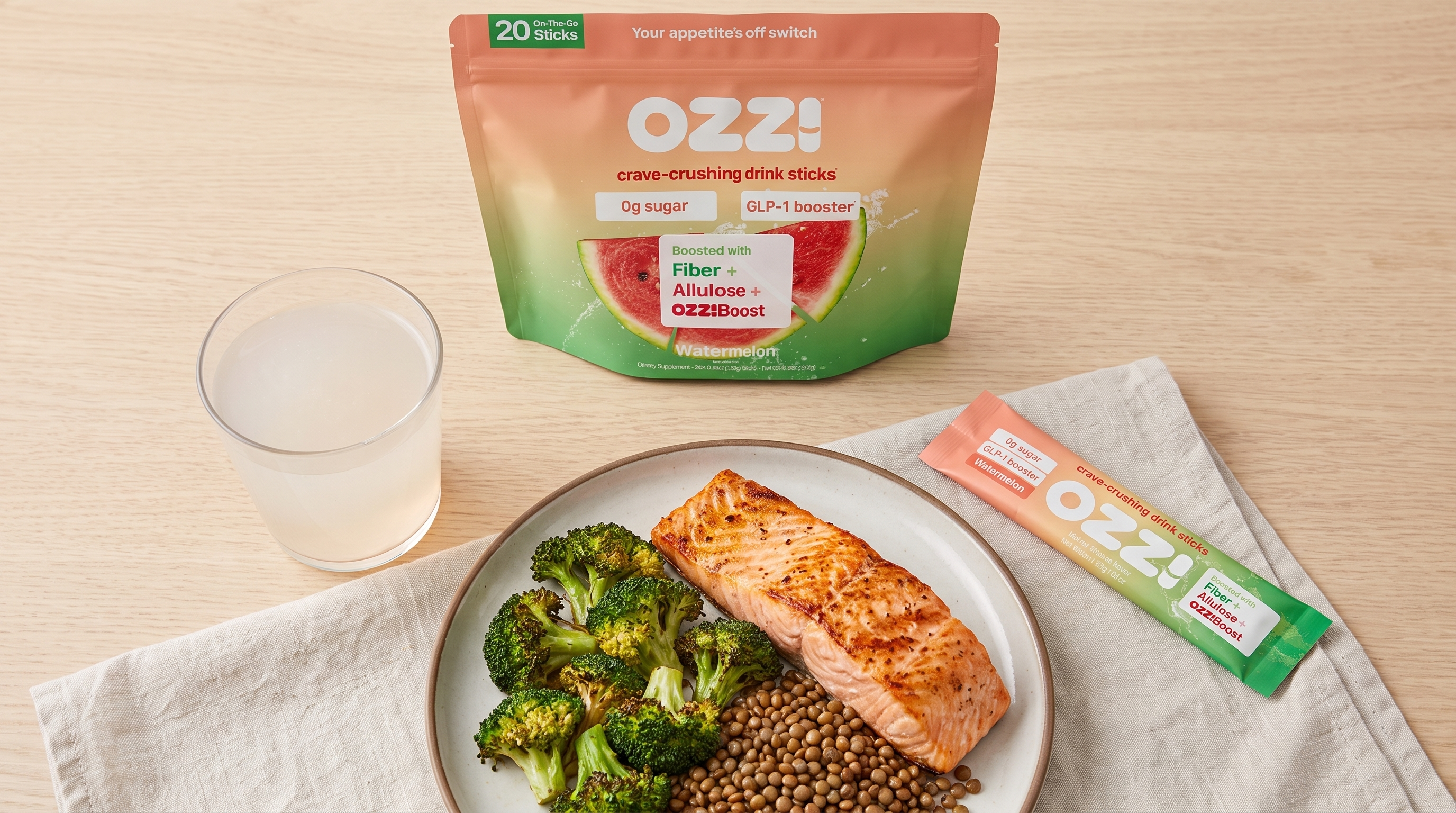
What Crave Crusher actually contains, and what each piece is there to do:
- 8g allulose, a rare sugar that tastes sweet and doesn't raise blood glucose the way table sugar does. See does allulose spike blood sugar.
- 500mg glucomannan from konjac root, a viscous fiber that expands with water and supports fullness. Viscosity and satiety is its whole lane here.
- 500mg chicory root inulin, a prebiotic fiber that feeds butyrate-producing bacteria.
- 500mg L-Lysine Butyrate (BIOMEnd), a postbiotic form of butyrate. Butyrate is the primary energy source for the cells lining your colon.
- 150mg African mango extract and 11mg chromium (Metabolex), which supports blood sugar control.
What Ozzi is not: a treatment for insulin resistance, prediabetes, or diabetes. It supports natural GLP-1 production and blood sugar control. It does not replace medical care, and if your labs are off, that's a conversation with your doctor, not with a drink stick.
Where it earns its place is the 9pm problem. Most people don't fall off a plan at noon. They fall off it after dinner, when the food noise gets loud and the plan feels theoretical. Filling that window is a narrow job, and it's the one we built for. More on that in how to stop food noise naturally.
Handle the 9pm part
Ozzi Crave Crusher is a watermelon drink stick you mix into 16oz of water. 8g allulose, 500mg butyrate, 500mg glucomannan, and 11mg chromium, dosed to support natural GLP-1 production and blood sugar control.
Try it for 14 days straight. If it doesn't work, we'll refund your first bag.
Frequently asked questions
How long does it take to improve insulin resistance?
Some markers move within days. Sleep trials show measurable changes in insulin sensitivity after 4 nights, in both directions. Meaningful, durable change from weight loss and training usually shows up on labs somewhere between 8 and 16 weeks. The Diabetes Prevention Program measured its main result over an average of 2.8 years, so think in seasons, not weeks.
Can insulin resistance be reversed permanently?
It can improve substantially and stay improved, as long as the behaviors that improved it stay in place. When people return to short sleep, low activity, and low fiber, the markers tend to drift back. Nobody has shown a permanent fix that survives going back to the old pattern.
What's the single best exercise for insulin resistance?
The one you'll repeat. Aerobic training, resistance training, and combined training all improved HOMA-IR in the 12-week Manipal trial. Combining both gives you the glucose disposal from cardio plus the muscle mass from lifting, but consistency beats optimization every time.
Do I need to go low carb?
Not necessarily. Nothing in the trials above required it. What most successful approaches share is a calorie deficit if weight loss is the goal, plus more fiber. Low carb is one way to get there. It isn't the only one, and it isn't required by the evidence.
Is fasting glucose enough to tell if I'm insulin resistant?
No. Fasting glucose is often the last thing to move. Ask for fasting insulin alongside it so you can calculate HOMA-IR, and get an HbA1c for the 3-month picture. Plenty of people with normal fasting glucose have markedly elevated fasting insulin.
Does insulin resistance cause cravings, or is it the other way around?
It runs both ways, which is why it feels like a loop. Higher insulin drives glucose into storage, glucose dips faster than expected, and hunger returns before the next meal is due. Eating more refined carbohydrate in response makes the next cycle a little easier to fall into.
Do supplements reverse insulin resistance?
No supplement has been shown to do that on its own in healthy adults. The chromium data is real but comes from trials in people already taking diabetes medication under clinical supervision. Treat supplements as support around the behaviors, not a substitute for them.
Does menopause make insulin resistance worse?
The evidence points that way. In the Columbia sleep trial, the effect of short sleep on HOMA-IR was more pronounced in postmenopausal women than premenopausal women. Falling estrogen also shifts fat storage toward the abdomen, which is the metabolically noisier place to keep it.
Can I improve insulin resistance without losing weight?
Yes, at least partly. The Spanish metabolic syndrome trial ran 16 weeks of training with no dietary restriction and still reduced insulin resistance. Weight loss makes the effect bigger, but training is not conditional on it.
Does allulose affect blood sugar?
Allulose is a rare sugar that is largely not metabolized for energy, and it doesn't raise blood glucose the way sucrose does. It's the reason Ozzi tastes sweet without a sugar load. We went through the human data in does allulose spike blood sugar.
References
- Knowler WC, et al. Reduction in the incidence of type 2 diabetes with lifestyle intervention or metformin. N Engl J Med. 2002;346(6):393-403. https://doi.org/10.1056/NEJMoa012512
- Beals JW, et al. Dietary weight loss-induced improvements in metabolic function are enhanced by exercise in people with obesity and prediabetes. Nat Metab. 2023;5(7):1221-1235. https://doi.org/10.1038/s42255-023-00829-4
- Morales-Palomo F, et al. Efficacy of morning versus afternoon aerobic exercise training on reducing metabolic syndrome components: a randomized controlled trial. J Physiol. 2024;602(23):6463-6477. https://doi.org/10.1113/JP285366
- Zuraikat FM, et al. Chronic insufficient sleep in women impairs insulin sensitivity independent of adiposity changes: results of a randomized trial. Diabetes Care. 2024;47(1):117-125. https://doi.org/10.2337/dc23-1156
- Singh P, et al. Effect of sleep restriction on insulin sensitivity and energy metabolism in postmenopausal women: a randomized crossover trial. Obesity. 2023;31(5):1204-1215. https://doi.org/10.1002/oby.23739
- Fu L, et al. Associations between dietary fiber intake and cardiovascular risk factors: an umbrella review of meta-analyses of randomized controlled trials. Front Nutr. 2022;9:972399. https://doi.org/10.3389/fnut.2022.972399
- Duran AT, et al. Breaking up prolonged sitting to improve cardiometabolic risk: dose-response analysis of a randomized crossover trial. Med Sci Sports Exerc. 2023;55(5):847-855. https://doi.org/10.1249/MSS.0000000000003109
- Peters B, et al. Intended isocaloric time-restricted eating shifts circadian clocks but does not improve cardiometabolic health in women with overweight. Sci Transl Med. 2025;17(822):eadv6787. https://doi.org/10.1126/scitranslmed.adv6787
- Amaravadi SK, et al. Effectiveness of structured exercise program on insulin resistance and quality of life in type 2 diabetes mellitus: a randomized controlled trial. PLOS ONE. 2024;19(5):e0302831. https://doi.org/10.1371/journal.pone.0302831
- Kim Y, et al. Could nutrient supplements provide additional glycemic control in diabetes management? A systematic review and meta-analysis of randomized controlled trials. Arch Pharm Res. 2022;45(3):185-204. https://doi.org/10.1007/s12272-022-01374-6
Related reading: What is GLP-1? · Gut health and GLP-1 · Pre-diabetes and GLP-1 · PCOS cravings and insulin resistance
Peer-reviewed sources retrieved via PubMed. This article is for general information and is not medical advice. These statements have not been evaluated by the Food and Drug Administration. This product is not intended to diagnose, treat, cure or prevent any disease.
