

PCOS Cravings and Insulin Resistance: Why the Hunger Feels Different (2026)
If you have PCOS, you've probably had some version of this conversation. You describe the hunger. Someone suggests you try meal prepping.
The frustrating part is that the hunger really is different, and there's human research showing it. Not a lot of it, and not as much as the internet implies. But enough to say something honest.
PCOS cravings are driven largely by insulin resistance and altered gut-hormone signaling. High insulin levels push cells to take up glucose fast, which can leave you hungry soon after eating. Separately, a 2025 mixed-meal study found women with PCOS had lower GLP-1 and GIP responses and higher food-craving scores than matched controls.
Key takeaways
- PCOS raises odds of disordered eating roughly 1.5 to 3 fold.
- The gap persists at normal body weight, not just obesity.
- A 2025 study found blunted GLP-1 and GIP after meals.
- Insulin resistance affects an estimated 35% to 80% of women with PCOS.
- Chromium evidence is real but modest and genuinely mixed.
Do women with PCOS actually crave food more?
Yes, and this is the single best-supported claim in the whole article.
A 2024 systematic review and meta-analysis in The Journal of Clinical Endocrinology & Metabolism pooled 20 studies covering 28,922 women with PCOS and 258,619 controls. Women with PCOS had higher odds of any eating disorder (OR 1.53). When the analysis was restricted to studies that diagnosed PCOS by the stricter Rotterdam criteria, the odds climbed to 2.88.1
Odds of bulimia nervosa, binge eating disorder, and disordered eating were all elevated. Anorexia nervosa was not. That pattern matters, because it points at appetite dysregulation rather than a general psychiatric difference.
An earlier 2019 meta-analysis in Eating and Weight Disorders found the same direction with a smaller sample: odds of an abnormal eating-disorder score at 3.05, and odds of any eating disorder diagnosis at 3.87.2
The 2024 meta-analysis found higher disordered eating scores in PCOS when stratified by normal weight, not just higher weight.
That last detail is the one I'd underline. The lazy explanation for PCOS cravings is that women with PCOS weigh more on average, and heavier people eat more. The stratified analysis undercuts that. Something about the condition itself is involved.
Worth saying plainly: these are studies of eating-disorder screening scores, not of cravings measured in a lab. A high score on a screening tool is a signal, not a diagnosis. But 28,922 women is a lot of signal.

What does insulin resistance do to appetite?
Insulin resistance means your cells respond sluggishly to insulin, so your pancreas compensates by making more of it. Estimates of how many women with PCOS are insulin resistant range from 35% to 80% depending on the diagnostic criteria and the phenotype studied.
That's an enormous range, and anyone quoting a single tidy number is rounding off real uncertainty.
The appetite consequence works like this. High circulating insulin drives glucose into cells aggressively. Blood sugar can drop faster and further than it otherwise would after a meal. Your brain reads the drop as a fuel emergency and generates hunger, often for fast carbohydrate specifically.
So you eat. Blood sugar spikes. Insulin spikes higher than it would in someone without insulin resistance. Blood sugar falls again. The loop restarts, usually in the late afternoon or evening.
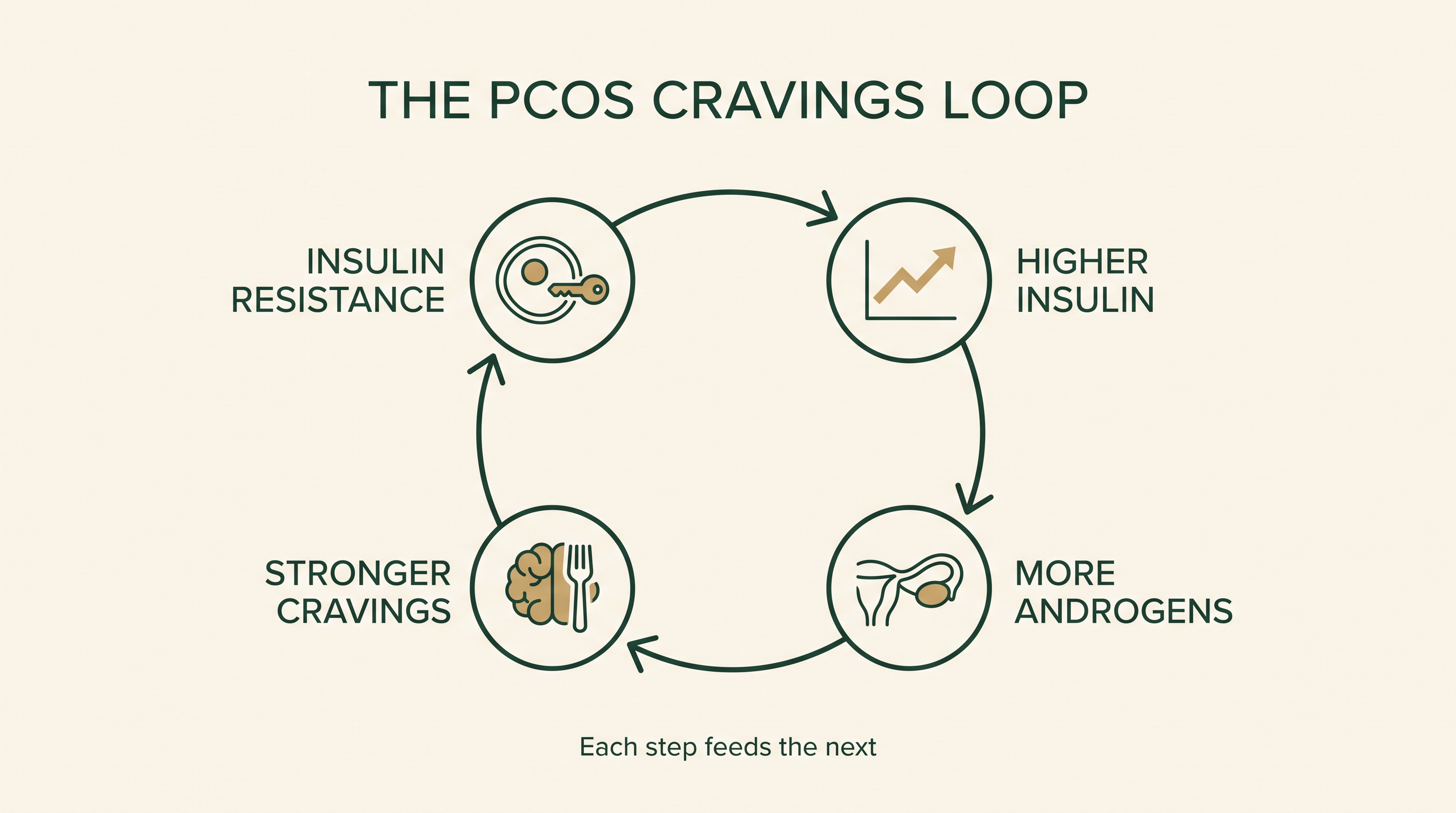
There's a second arm to it. Elevated insulin acts on the ovaries to increase androgen production, and it lowers sex hormone binding globulin so more free testosterone circulates. Higher androgens worsen insulin resistance. Each step feeds the next, which is why researchers describe PCOS as a vicious cycle rather than a linear chain.
If you want the underlying blood-sugar mechanics without the PCOS layer, we covered them in pre-diabetes and GLP-1.
Is GLP-1 lower in women with PCOS?
This is the most interesting recent finding, and it's new enough that most PCOS content hasn't caught up to it.
In July 2025, researchers at Hacettepe University published a cross-sectional study in the European Journal of Endocrinology. They ran a standardized mixed-meal test on 36 women with PCOS and 36 age- and BMI-matched healthy controls, drawing blood at 0, 30, 60, and 120 minutes.3
The BMI matching is the part that makes this study useful. Any difference they found can't be waved away as a weight difference.
| Measure | PCOS group | What it suggests |
|---|---|---|
| Baseline GLP-1 | Reduced (p < .001) | Lower fasting satiety signal |
| GLP-1 area under the curve | Reduced (p = .022) | Blunted response to the meal itself |
| Baseline and AUC GIP | Reduced | The other main incretin is affected too |
| Fasting oxytocin | 1294 vs 1580 pg/mL (p = .024) | A second appetite pathway differs |
| Food Craving Questionnaire | Higher (p < .001) | The subjective experience matches the biology |
Two findings from that table are worth sitting with. First, GLP-1 was lower both at rest and in response to eating. Second, the women in the PCOS group scored higher on a validated craving questionnaire. The lab numbers and the lived experience pointed the same way.
In the control group, early oxytocin changes correlated negatively with hunger and positively with satiety. In the PCOS group, that correlation was absent. The signal was there; the response to it wasn't.
Caveats, because they matter. This is one cross-sectional study of 72 women total. Cross-sectional means it shows an association at a single point in time and can't establish that low GLP-1 causes the cravings. The authors themselves say the shared oxytocin-GLP-1 pathway "warrants further investigation." A 2016 review in Current Pharmaceutical Design summarizing earlier work described PCOS GLP-1 findings as "unaltered or decreased," which is a fair reflection of how inconsistent the older literature was.4
If GLP-1 itself is new to you, start with our explainer on what GLP-1 is and what it does. The mental loop it quiets has its own guide in what food noise actually is.
Does the gut microbiome play a role?
Probably some role. The evidence here is thinner than the wellness internet suggests, and I'd rather say that than oversell it.
A 2024 study in the International Journal of Molecular Sciences compared gut bacteria and short-chain fatty acids in 69 women with PCOS against 18 healthy controls. The PCOS group showed reduced beneficial bacteria and overgrowth of opportunistic species.5 Note the control group: 18 women is small, and that limits how much weight the comparison can carry.
A 2025 cross-sectional study in BMC Endocrine Disorders looked at 54 women split into three groups and found fecal butyrate and propionate markedly reduced in one PCOS subtype versus controls.6 Two honest qualifications. The subtype was defined using Traditional Chinese Medicine categories, which limits how well it generalizes. And in the other PCOS group, most differences versus controls lost significance after adjusting for BMI and age.
Lower butyrate in women with PCOS is an association. Nobody has shown that raising it changes cravings in humans.
That distinction is the whole ballgame, and it's where most gut-health marketing quietly cheats.
Butyrate is a short-chain fatty acid your gut bacteria produce when they ferment fiber, and it's the primary energy source for the cells lining your colon. The idea that butyrate stimulates GLP-1 release comes from rodent and cell studies. That's the proposed mechanism, and it's a reasonable one. It is not a demonstrated human effect, and we don't claim it is. A human trial that successfully raised circulating butyrate measured GLP-1 as a named secondary outcome and found no change.
We wrote both sides of this out in the microbiome and cravings and the gut-brain axis, and the wider appetite picture in gut health and GLP-1.
What has the research actually studied in PCOS populations?
This section covers trials run in women diagnosed with PCOS who were under medical care. It's here for completeness, because these are the studies people find when they search. None of it is a description of what a supplement does, and none of it is medical advice.
A 2025 systematic review and meta-analysis in Diabetes, Obesity and Metabolism pooled 19 randomized controlled trials covering 1,657 women with PCOS, comparing a GLP-1 receptor agonist plus metformin against metformin alone. The combination improved fasting glucose, HbA1c, HOMA-IR, BMI, and several hormone measures. The authors rated the overall certainty of evidence as low, citing risk of bias and high heterogeneity.7
A separate 2023 randomized controlled trial in Nutrients compared a GLP-1 receptor agonist plus a calorie-restricted diet against the diet alone in 68 overweight or obese women with PCOS. There was no significant difference in visceral fat reduction between groups. The authors concluded that dietary intervention remains the first line, with drug therapy as an adjunct.8
I include that second study specifically because it's the less flattering one, and it's the kind of result that tends to vanish from supplement marketing.
These are prescription medications studied in patients under clinical supervision. If you have PCOS and want to explore them, that's a conversation with your doctor, not with a blog.
Which ingredients have human evidence behind them?
Here's where I try to be more useful than the average roundup, which means telling you where the evidence is weak.
| Ingredient | Human evidence | Honest read |
|---|---|---|
| Allulose | Randomized crossover trials in 30 adults each | Strongest of this list for post-meal glucose and insulin. Not studied in PCOS. |
| Chromium | Multiple meta-analyses in PCOS, conflicting | Studied directly in PCOS, but the results disagree with each other. |
| Glucomannan | FDA-recognized structure/function claim for satiety | Works by viscosity and physical fullness. No gut-barrier claim here. |
| Inulin | Prebiotic fiber studies in general populations | Feeds butyrate-producing bacteria. Downstream appetite effect is indirect. |
| Butyrate | Human data on gut measures; GLP-1 link is preclinical | Real compound, real gut role. GLP-1 claims are rodent and cell studies. |
Allulose
Allulose is a rare sugar that tastes close to sucrose but is metabolized differently. In a randomized, double-blind, placebo-controlled crossover study published in BMJ Open Diabetes Research & Care, 30 adults without diabetes took a standard 50g sucrose load alongside escalating allulose doses. Allulose produced a dose-dependent reduction in plasma glucose at 30 minutes, significant at 7.5g and 10g, plus a dose-dependent reduction in insulin excursion.9
A 2024 randomized crossover trial in 30 Thai volunteers found the same dose-dependent pattern for both peak postprandial glucose and peak insulin.10
Two independent groups, two populations, same direction. That's about as good as ingredient evidence gets outside of pharmaceuticals. What it isn't: a study in women with PCOS. Nobody has run that trial.
More detail in our allulose guide and whether allulose spikes blood sugar.
Chromium
Chromium is the one ingredient here studied directly in women with PCOS, and the results genuinely conflict.
A January 2026 meta-analysis in BMC Endocrine Disorders pooled 11 RCTs covering 618 women with PCOS and found significant reductions in fasting glucose, fasting insulin, and HOMA-IR.11 A 2025 meta-analysis of 10 RCTs in 683 women reported reduced fasting insulin and improved insulin sensitivity index.12
But a 2018 meta-analysis in Hormone and Metabolic Research found no significant difference in fasting insulin between chromium and placebo, and no significant difference in insulin sensitivity index. Its authors wrote that the magnitude of effect is small and the clinical relevance uncertain.13
When meta-analyses of overlapping trials reach opposite conclusions, the honest summary is that the effect, if it exists, is small enough that study design decides the answer. We put 11mg of chromium polyursolate in Ozzi because the mechanism is well established and the safety profile is clean, not because I think it's doing the heavy lifting. Longer version in chromium for cravings and blood sugar.
Fiber
Glucomannan is a soluble viscous fiber from konjac root. It absorbs water and expands in the stomach, which promotes satiety through physical fullness. That's its lane, and it has an FDA-recognized structure/function claim for appetite support.
Chicory root inulin is a prebiotic that feeds bacteria which produce short-chain fatty acids including butyrate. Its effect on appetite is indirect and slower. We compared the options in the best fiber for appetite control.
What can you actually do about PCOS cravings?
Nothing on this list is exotic. That's sort of the point.
Eat protein before carbohydrate at every meal. The order changes the glucose curve. If the insulin-resistance loop is what's driving your late-day hunger, flattening the curve earlier in the day does more for your evening than anything you can do at 8pm.
Stop eating on a schedule instead of a feeling. If your hunger signal is unreliable, don't use it as your only input. A lot of women with PCOS undereat during the day and then can't stop at night.
Get screened. The 2023 International PCOS Guideline recommends considering disordered-eating risk in PCOS care regardless of weight, and that recommendation came directly from the 2024 meta-analysis cited above.1 If eating feels out of control, that's a clinical conversation, not a character flaw.
Train, don't just cardio. Resistance training improves insulin sensitivity independently of weight loss. That's one of the few interventions that acts on the actual mechanism.
Sleep. Short sleep worsens insulin sensitivity in healthy people. There's no reason to think PCOS is the exception.
If you're navigating hormonal appetite shifts more broadly, menopause weight gain and cravings covers a different life stage with overlapping mechanics, and how to quiet food noise naturally is the practical companion piece.
Where does Ozzi fit, honestly?
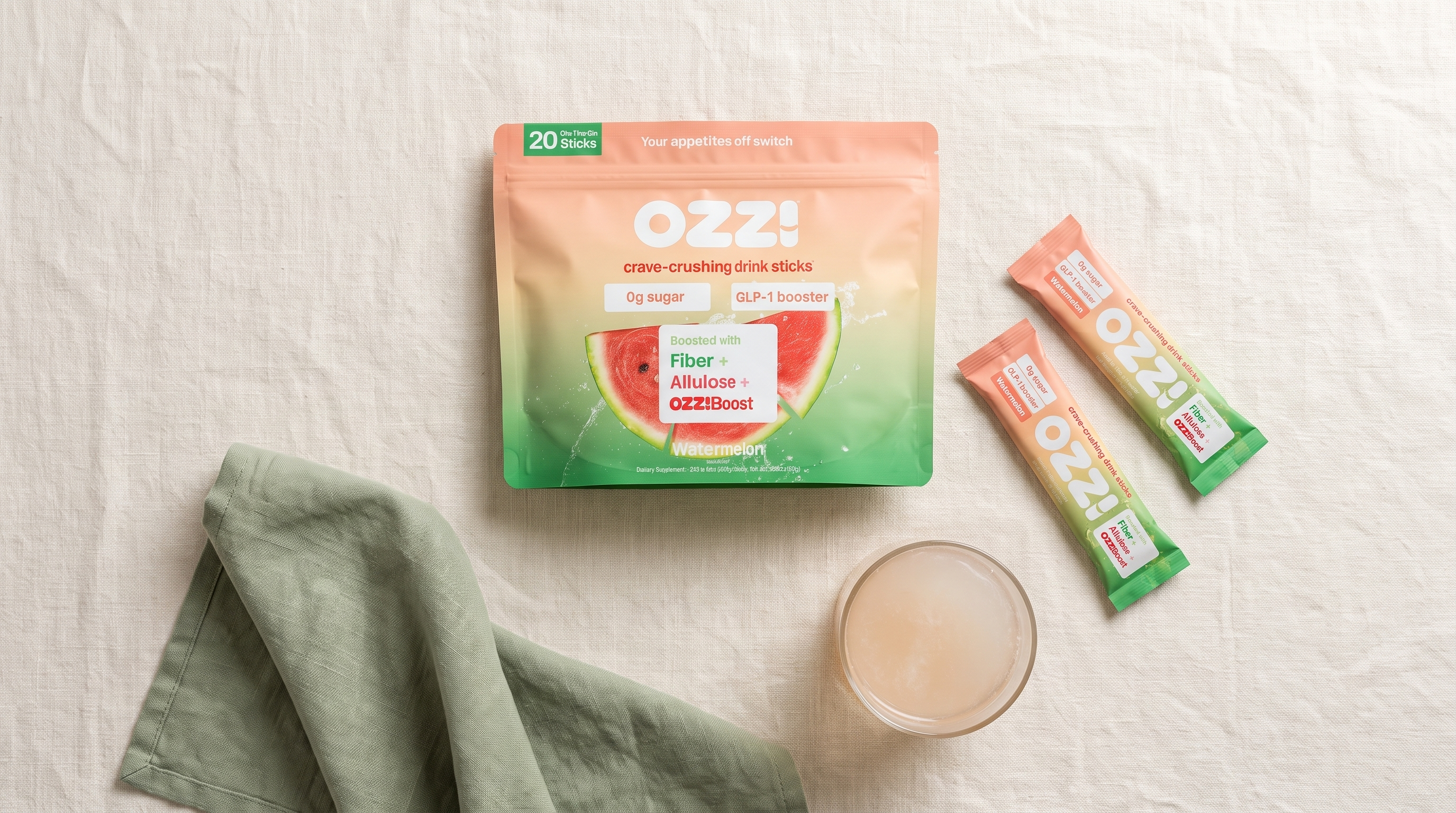
Ozzi is a supplement that supports natural GLP-1 production and blood sugar control. It is not a treatment for PCOS, it doesn't claim to be, and it can't replace a conversation with an endocrinologist.
Nobody has run a clinical trial of Ozzi in women with PCOS. If anyone selling you a supplement implies otherwise, check their citations.
What's in a stick, and why: 8g allulose (the ingredient with the best human data for post-meal glucose and insulin), 500mg glucomannan for viscosity and fullness, 500mg L-Lysine Butyrate and 500mg chicory root inulin for the gut side, 150mg African mango, and 11mg chromium polyursolate.
No caffeine, no stimulants, no berberine, vegan. Full breakdown lives on the product page.
The reason women with PCOS end up on our site is usually simpler than the science: they eat well all day and then the evening happens. If your cravings are structural rather than situational, an 8g allulose stick isn't going to fix your endocrine system. It might make 8pm less loud. That's the honest version of the pitch.
Try it for 14 days and see
Ozzi Crave Crusher supports natural GLP-1 production with 8g of allulose, fiber, and butyrate. Take it for 14 straight days. If your cravings and food noise aren't quieter, we'll refund your first bag.
Frequently asked questions
Why are PCOS cravings worse at night?
The insulin-resistance loop compounds across the day. Each meal that spikes glucose triggers an oversized insulin response and a sharper subsequent drop, so by evening you're often several cycles deep. Undereating during the day makes it worse.
Does insulin resistance cause sugar cravings specifically?
The mechanism points that way. When blood sugar falls quickly, the brain preferentially signals for fast-absorbing carbohydrate. That's a physiological pull toward sugar rather than a preference you chose.
Can you have PCOS cravings at a normal weight?
Yes. The 2024 meta-analysis found higher disordered-eating scores in PCOS when stratified by both normal and higher BMI. Lean PCOS is real and often goes unaddressed.
Do women with PCOS have lower GLP-1?
One 2025 mixed-meal study of 36 women with PCOS and 36 BMI-matched controls found lower baseline and post-meal GLP-1 in the PCOS group. Older literature was less consistent, describing GLP-1 as unaltered or decreased. One study isn't settled science.
Does butyrate raise GLP-1 in people with PCOS?
No human study shows that. The butyrate-to-GLP-1 link comes from rodent and cell research. Butyrate is the primary energy source for colon lining cells and that part is well established, but we don't extend it into a human GLP-1 claim.
Is chromium worth taking for PCOS?
The evidence is split. Two recent meta-analyses found improvements in insulin measures; a 2018 meta-analysis found no significant effect on fasting insulin. If the effect exists it's small. It's cheap and safe at supplemental doses, so it's a reasonable low-stakes addition rather than a strategy.
Will allulose help with PCOS?
Allulose has good human evidence for reducing post-meal glucose and insulin in adults without diabetes. It has not been studied in women with PCOS. The mechanism is relevant to the insulin loop, but that's inference, not evidence.
Does the microbiome cause PCOS cravings?
Studies find differences in gut bacteria and short-chain fatty acids between women with and without PCOS. Those are associations at a point in time. Nobody has shown that changing the microbiome changes cravings in women with PCOS.
Can a supplement replace PCOS treatment?
No. PCOS is a medical diagnosis with real reproductive and metabolic consequences, and it should be managed by a clinician. Supplements sit alongside that, not in place of it.
Further reading. The Nutrition Desk on inositol for PCOS covers what the trials found on cycle and hormone outcomes.
References
- Cooney LG, et al. Increased Prevalence of Binge Eating Disorder and Bulimia Nervosa in Women With Polycystic Ovary Syndrome: A Systematic Review and Meta-Analysis. J Clin Endocrinol Metab. 2024;109(12):3293-3305. https://doi.org/10.1210/clinem/dgae462
- Lee I, et al. Increased odds of disordered eating in polycystic ovary syndrome: a systematic review and meta-analysis. Eat Weight Disord. 2019;24(5):787-797. https://doi.org/10.1007/s40519-018-0533-y
- Gunesli I, et al. Fasting and postprandial oxytocin and incretin dynamics in women with polycystic ovary syndrome and healthy controls. Eur J Endocrinol. 2025;193(2):255-261. https://doi.org/10.1093/ejendo/lvaf154
- Saydam BO, Yildiz BO. Gut-Brain Axis and Metabolism in Polycystic Ovary Syndrome. Curr Pharm Des. 2016;22(36):5572-5587. https://doi.org/10.2174/1381612822666160715143933
- Kukaev E, et al. Impact of Gut Microbiota and SCFAs in the Pathogenesis of PCOS and the Effect of Metformin Therapy. Int J Mol Sci. 2024;25(19):10636. https://doi.org/10.3390/ijms251910636
- Xia XY, et al. Gut microbiota dysbiosis and short-chain fatty acid depletion in phlegm-dampness polycystic ovary syndrome. BMC Endocr Disord. 2025;25(1):255. https://doi.org/10.1186/s12902-025-02076-y
- Ling J, et al. Combined liraglutide and metformin therapy in overweight or obese women with polycystic ovary syndrome: A systematic review and meta-analysis. Diabetes Obes Metab. 2025;27(11):6139-6153. https://doi.org/10.1111/dom.70028
- Zhang Y, et al. Effects of a Dulaglutide plus Calorie-Restricted Diet versus a Calorie-Restricted Diet on Visceral Fat and Metabolic Profiles in Women with Polycystic Ovary Syndrome: A Randomized Controlled Trial. Nutrients. 2023;15(3):556. https://doi.org/10.3390/nu15030556
- Franchi F, et al. Effects of D-allulose on glucose tolerance and insulin response to a standard oral sucrose load: results of a prospective, randomized, crossover study. BMJ Open Diabetes Res Care. 2021;9(1):e001939. https://doi.org/10.1136/bmjdrc-2020-001939
- Buranapin S, et al. Effects of D-Allulose with Sucrose Beverage on Glucose Tolerance and Insulin Levels among Thai Healthy Volunteers. J Nutr Sci Vitaminol. 2024;70(3):203-209. https://doi.org/10.3177/jnsv.70.203
- Ye J, et al. Effectiveness of mineral supplements in reducing insulin resistance in polycystic ovary syndrome: a meta-analysis of randomized controlled trials. BMC Endocr Disord. 2026;26(1). https://doi.org/10.1186/s12902-025-02158-x
- Hamsho M, et al. Therapeutic effects of chromium supplementation on women with polycystic ovarian syndrome: A systematic review and meta-analysis. Endocrinol Diabetes Nutr. 2025;72(8):501578. https://doi.org/10.1016/j.endien.2025.501578
- Heshmati J, et al. The Effects of Supplementation with Chromium on Insulin Resistance Indices in Women with Polycystic Ovarian Syndrome: A Systematic Review and Meta-Analysis of Randomized Clinical Trials. Horm Metab Res. 2018;50(3):193-200. https://doi.org/10.1055/s-0044-101835
- Stefanaki K, et al. Food Cravings and Obesity in Women with Polycystic Ovary Syndrome: Pathophysiological and Therapeutic Considerations. Nutrients. 2024;16(7):1049. https://doi.org/10.3390/nu16071049
- Fukunaga K, et al. A Pilot Study on the Efficacy of a Diabetic Diet Containing the Rare Sugar D-Allulose in Patients with Type 2 Diabetes Mellitus. Nutrients. 2023;15(12):2802. https://doi.org/10.3390/nu15122802
These statements have not been evaluated by the Food and Drug Administration. This product is not intended to diagnose, treat, cure, or prevent any disease. This article is educational and is not medical advice.
