

The Gut-Brain Axis: What It Is and How to Actually Improve It (2026)
I've read a lot of gut-brain content while building Ozzi. Most of it follows the same recipe: quote a mouse study, drop the serotonin stat, sell you a probiotic.
The frustrating part is that the actual science is more interesting than the marketing version. It's just messier, and messy doesn't sell as well.
So this post explains the gut-brain axis properly, labels every mechanism as human or animal, and tells you which popular interventions have weak evidence behind them. Including some that sound like things I should be selling you.
If you're here because the monster comes out at night and you want to know whether your gut is why, there's a real answer, and it's partly yes.
What is the gut-brain axis?
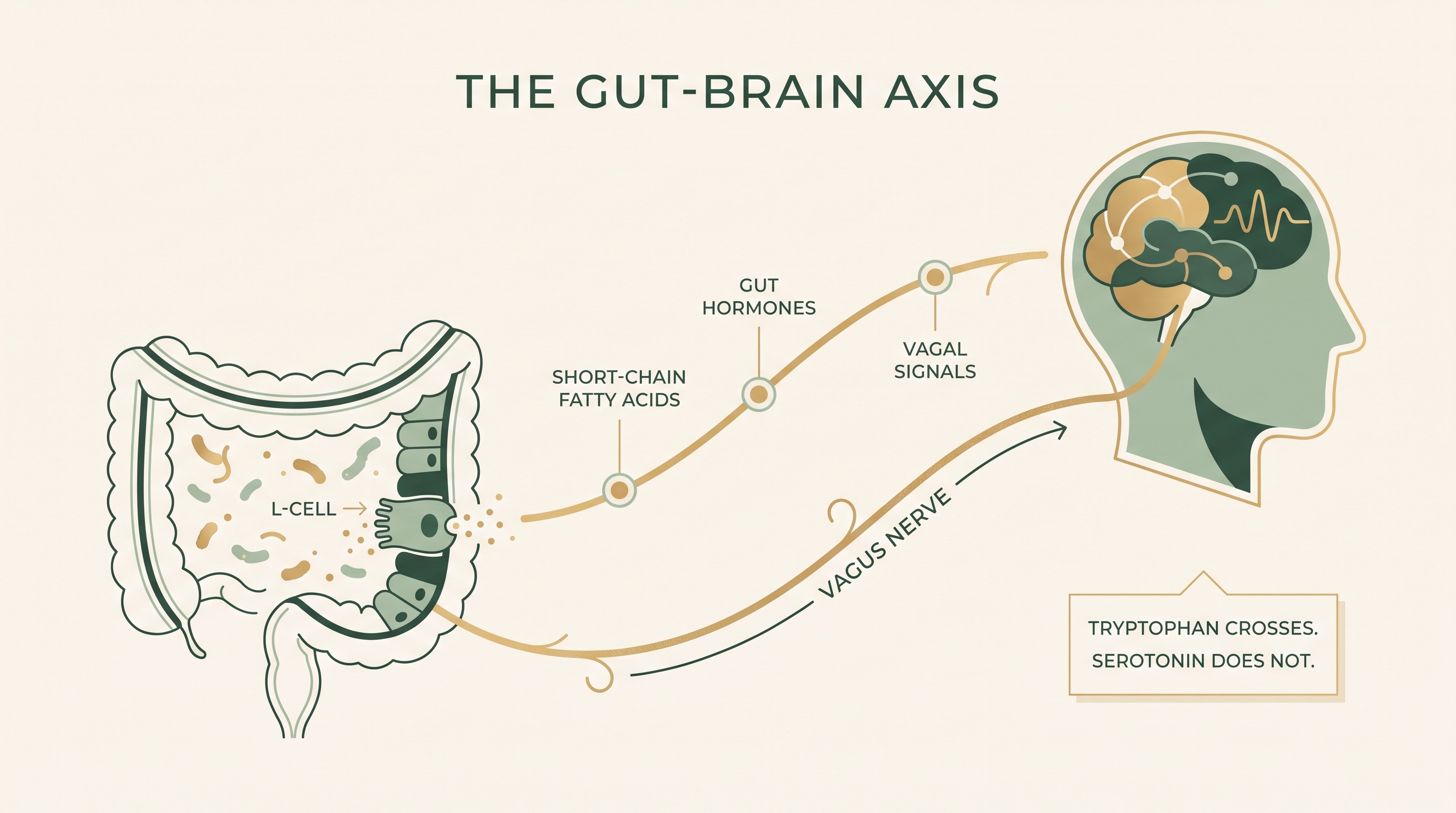
The gut-brain axis is the two-way communication system linking your digestive tract and your central nervous system. It runs on four channels: the vagus nerve (fast electrical signaling), gut hormones like GLP-1 and PYY (slower chemical signaling through the bloodstream), immune and inflammatory messengers, and metabolites produced by your gut bacteria. Your gut microbiome sits on top of all four, shaping the signals your brain receives about hunger, fullness, stress, and reward.
The phrase "gut-brain axis" gets used like it's one thing. It's four systems with different speeds, different currencies, and very different levels of evidence behind them. Some of it is measured in milliseconds; some of it takes weeks.
Lumping them together is how you end up with a wellness industry that thinks kombucha fixes anxiety.
Key takeaways
- Your gut signals your brain through 4 channels: nerves, hormones, immune messengers, and bacterial metabolites.
- The strongest human craving evidence involves short-chain fatty acids in the colon, specifically propionate, changing brain reward activity on fMRI.
- Gut serotonin and brain serotonin are separate pools. Serotonin doesn't cross the blood-brain barrier. What crosses is tryptophan, the raw material.
- Fermented foods have the best human data for shifting the microbiome. Plain fiber underperformed in the same trial.
- Prebiotics failed against placebo on craving in a human RCT. I'm including that even though it's inconvenient for me.
- Almost every dramatic gut-brain claim traces back to a rodent study.
How does your gut actually talk to your brain?
Four channels. Here they are in order of speed.
1. The vagus nerve (milliseconds)
The vagus is the long wandering nerve connecting your gut to your brainstem. Roughly 80% of its fibers run upward, gut to brain, which tells you who's doing most of the talking.
The interesting recent work is on neuropod cells: specialized gut lining cells that form actual synapses onto vagal neurons, transducing a nutrient signal in milliseconds rather than the minutes a hormone would take (Kaelberer et al., Annual Review of Neuroscience, 2020). Your gut has something functionally close to a sense organ in it.
Label that one carefully: the neuropod work is rodent-derived. The cells exist in humans. The millisecond synaptic transduction was characterized in mice. That experiment hasn't been run in a person, for reasons I hope are obvious.
2. Hormones (minutes)
Your gut lining is studded with enteroendocrine cells that release hormones when food shows up. GLP-1 and PYY matter most for appetite. They travel through the blood and act on hunger circuits in the hypothalamus and brainstem.
This is the channel GLP-1 drugs work on, in a much louder way. Full mechanism in what GLP-1 actually is.
3. Immune signaling (hours to weeks)
Your gut houses a majority of your immune tissue. When the gut barrier gets leaky or the microbiome shifts, inflammatory cytokines rise, and those cytokines reach the brain. More below, because there's genuinely good human data.
4. Bacterial metabolites (hours to days)
Your bacteria ferment fiber and produce short-chain fatty acids: acetate, propionate, butyrate. These are the molecules doing most of the work that gets credited to "gut health" generally.
They feed your colon cells, they bind receptors on enteroendocrine cells, and some cross into circulation. This is where the honesty gets hard, so let's do that part properly.
Roughly 80% of vagal fibers run gut to brain. Your gut spends most of its bandwidth filing reports upward.
Does your gut really control your cravings?
Partly. And the best human evidence for it is a study most gut-health content skips, probably because the result is more complicated than the headline anyone wanted.
Researchers at Imperial College built a molecule that carries propionate to the colon and releases it there, which doses the colon directly instead of hoping fiber gets fermented into something useful. Then they ran it in people.
In the first trial, colonic propionate raised postprandial GLP-1 and PYY and cut energy intake at a test meal. Over 24 weeks, in 60 overweight adults, it reduced weight gain and visceral fat (Chambers et al., Gut, 2015). A human RCT with a hard endpoint, which is rare here.
The second one is the one I keep thinking about. Same team, 20 adults, fMRI crossover. They gave people colonic propionate and showed them pictures of high-energy food while scanning their brains.
Propionate reduced BOLD signal in the caudate and nucleus accumbens, the reward areas that light up when you want something. People rated the food as less appealing and ate less afterward (Byrne et al., Am J Clin Nutr, 2016).
So a molecule made in your colon changed how much your brain wanted a cheeseburger. A real finding, in humans, with a mechanism you can see on a scan.
Then the detail that almost never gets reported. The effect was not mediated by changes in plasma PYY, GLP-1, glucose, or insulin. The researchers measured all four. None explained the brain result.
So something other than GLP-1 is carrying that signal: possibly vagal, possibly direct SCFA action, possibly something not yet characterized. The honest answer is that we don't fully know.
I find that more compelling than the tidy version, personally. There's a route from your colon to your food decisions that we've measured but can't yet explain.
The mouse study everyone cites as if it were human
When you read "SCFAs boost GLP-1," the source is usually Tolhurst et al., Diabetes, 2012. Short-chain fatty acids stimulate GLP-1 secretion via the FFAR2 receptor, and knockout mice lose the response.
Excellent study. It's mice and cell culture.
That distinction gets erased constantly. A mechanism that works in a mouse colon and a mechanism that works in your colon are two different claims, and only one of them has been tested. I go deeper in butyrate and GLP-1, including why I won't tell you butyrate raises GLP-1 in humans. No human study shows that.
Same caution on the correlational stuff. A 2023 EBioMedicine study found microbiome differences associated with social cognition and craving in 71 young binge drinkers. Human, yes. Observational, also yes. It shows a pattern; causation is a separate question.
What about serotonin? The 95% myth, corrected
This is the section I wrote this whole post for.
You've seen the stat. "95% of your serotonin is made in your gut." It's on supplement labels, in podcast intros, in about nine million Instagram carousels, always arguing that fixing your gut will fix your mood.
Yes, about 95% of your body's serotonin is made in your gut. It still isn't what's making you happy.
Serotonin cannot cross the blood-brain barrier. This has been settled pharmacology for decades. The molecule is polar, it has no dedicated transporter at the barrier, and it stays where it's made.
Your gut serotonin and your brain serotonin are two separate pools. They never mix. The serotonin your enterochromaffin cells produce is doing gut jobs: gut motility, secretion, platelet function, nausea signaling. It's not floating up to your prefrontal cortex to cheer you up.
Your gut serotonin and your brain serotonin are two different pools that never mix. The 95% stat is true. The story built on it is fiction.
So why does the gut-mood link keep showing up in real research? Because there are two legitimate routes, and both are more interesting than the myth.
Route 1: your microbiome rations the raw material
What does cross the blood-brain barrier is tryptophan, the amino acid your brain uses to build its own serotonin locally. Tryptophan has a transporter. Serotonin doesn't.
Tryptophan has two main fates: the serotonin pathway, or the kynurenine pathway, which produces a completely different set of metabolites.
Your gut bacteria influence that fork. When microbiota push tryptophan toward kynurenine, they are, as O'Mahony and colleagues put it in Behavioural Brain Research (2015), "thereby simultaneously reducing the fraction available for serotonin synthesis."
So the microbiome affects brain serotonin by controlling the supply chain. It's a rationing mechanism.
Fair labeling: that review synthesizes rodent work alongside human observational data. The tryptophan/kynurenine fork is well established in humans. How much your specific bacteria move that dial is not something anyone can currently measure for you, whatever a $200 microbiome test claims.
Route 2: gut serotonin talks to the brain electrically
Gut serotonin does reach your brain, as an impulse rather than a molecule.
Serotonin released in the gut activates 5-HT3 receptors on vagal afferent terminals sitting right there in the gut wall. Those fibers fire. The signal travels up the vagus to the nucleus tractus solitarius in your brainstem, which projects onward to the dorsal raphe and locus coeruleus, regions involved in mood and arousal (Int J Mol Sci review, 2025).
The serotonin molecule stays in your gut. The information gets to your brain anyway, converted into nerve traffic.
That's the actual mechanism: electrical signaling along a nerve. It's a better story because it's the true one, and because it explains what the myth can't (like why gut signals reach the brain in seconds rather than the minutes bloodstream transport would need).
The mechanistic detail here is largely rodent-derived. The anatomy holds in humans; the precise circuit mapping doesn't come from human experiments.
Why the myth survives
Because "95%" is a great number and "the microbiome modulates tryptophan availability upstream of central serotonin synthesis" fits badly on a label.
I get it. But when a brand uses the 95% line to sell you a mood probiotic, they're either not reading the literature or they're counting on you not reading it. Neither is a great look for someone asking for your money.
How does inflammation fit in?
This is the channel with the best human data, and it gets the least attention because it's not sexy.
The LIFE-Adult study looked at roughly 2,600 people with brain imaging and body composition measures. The mediation analysis found that visceral fat affects brain tissue structure, and the pathway runs through systemic low-grade inflammation (Proceedings of the Nutrition Society, 2022).
Visceral fat is metabolically active tissue. It releases inflammatory cytokines, those cytokines act on the brain, and some of what they act on is appetite and reward regulation. So you get a loop: eating patterns drive visceral fat, visceral fat drives inflammation, inflammation nudges the circuits that shape eating patterns.
That's human data, large sample, with a modeled causal pathway, which puts it ahead of most of what gets sold as gut-brain science.
The gut's role is upstream. Barrier integrity and microbial composition influence how much inflammatory signal enters circulation at all. That link is better established in animals, but the human end of the chain (inflammation to brain) is solid.
What actually improves your gut-brain axis?
I graded these on human evidence quality, not on how often they show up in wellness content. A few popular levers do badly, and I've left the bad grades in.
| Intervention | Grade | Best human evidence | The honest caveat |
|---|---|---|---|
| Fermented foods | A- | Stanford randomized trial, 17 weeks. High-fermented-food diet increased microbiota diversity and decreased inflammatory markers. | 18 people per arm. Measured immune markers rather than cravings. No trial has shown it stops you eating crackers at 10pm. |
| Colonic SCFA delivery (propionate) | A- | Two human RCTs: raised GLP-1/PYY, cut energy intake, reduced 24-week weight gain and visceral fat, reduced brain reward response on fMRI. | Used a purpose-built delivery molecule you can't buy. Eating fiber is not the same intervention. |
| Specific probiotic strains | B | L. rhamnosus HA-114 RCT, 152 adults: reduced binge eating, disinhibition, and food cravings during weight loss. | Strain-specific. Did not increase weight or fat loss. This says nothing about "probiotics" as a category. |
| Plain added fiber | C+ | The high-fiber arm of the same Stanford trial missed its primary outcome. Cytokine response score was unchanged. | Fiber is still good for you for other reasons. As a gut-brain lever specifically, it underperformed in the trial designed to test it. |
| "Psychobiotic" whole-diet approach | C | 4-week RCT, 45 adults. Perceived stress fell 32% on the diet vs 17% on control. | The between-group difference was not statistically significant. That 32% number gets quoted constantly without this sentence attached. |
| Prebiotics for craving | D | Inulin RCT, 50 adults with alcohol use disorder. Inulin was no better than placebo on craving, anxiety, or depression. | This is a direct negative result. Prebiotics have a defensible role as fermentation substrate. Craving reduction isn't it. |
| Exercise (for the microbiome specifically) | D | Small human studies show microbiome shifts in athletes. | Confounded by diet, mostly cross-sectional. Exercise is great; the gut-brain case for it is thin. |
| Sleep (for the microbiome specifically) | D/F | Correlational only. Some circadian rodent work. | Sleep affects appetite hormones through a different mechanism. The gut-brain framing here is decoration. |
Notice what happened. The two best-graded interventions are eating fermented food and a research compound you can't purchase. The stuff with the loudest marketing sits at the bottom.
The practical version: eat fermented foods most days, get fiber from actual plants (for general health, not to fix your cravings), sleep, and don't buy anything sold on the serotonin stat. More in gut health and GLP-1 and the best fiber for appetite control.
Where does Ozzi fit into any of this?
Short section, because I'd rather undersell this than join the pile I just spent 2,000 words criticizing.
Ozzi Crave Crusher is a cold-water drink stick. Per serving: allulose (8.35g), glucomannan (0.556g), L-Lysine Butyrate (0.537g), chicory root inulin (0.5g), cyclic dextrin (0.5g), African mango extract (0.15g), chromium polyursolate (11mg). No berberine, caffeine, or stimulants. Vegan.
What I'll say: it's formulated around the fermentation-substrate and viscous-fiber side of gut function, and it's designed to support satiety and help manage food noise. That's structure/function language and I'm sticking to it.
What I won't say: that the butyrate in it raises your GLP-1. No human study shows that. The mechanism is real in mice and in cell studies, and mice aren't you.
I also won't tell you the inulin in Ozzi kills cravings, because a human RCT tested inulin against placebo on craving and inulin lost. It's in there as fermentation substrate. That's the honest job description, and I covered it in inulin, prebiotic fiber, and appetite.
The ingredient I'd point at for the nighttime problem is glucomannan, a viscous fiber that swells with water and slows gastric emptying. That's mechanical, boring, and it doesn't require a gut-brain story to work.
If nighttime is your battleground, why you crave sugar at night and how to quiet food noise naturally are more useful to you than anything on this page.
Test it on yourself for 14 days
All I'll promise you is a fair test. Try it for 14 days straight. If it doesn't work, we'll refund your first bag.
Gut-brain axis FAQ
Is 95% of your serotonin really in your gut?
Yes, roughly. About 95% of the body's serotonin is produced by enterochromaffin cells in the gut. That serotonin can't cross the blood-brain barrier, so it doesn't affect your mood directly. It handles gut motility, secretion, and platelet function. Your brain manufactures its own serotonin from tryptophan.
So how does the gut affect brain serotonin at all?
Two ways. Your microbiome influences how much tryptophan (the precursor, which does cross the blood-brain barrier) gets diverted down the kynurenine pathway instead of the serotonin pathway, which changes the raw material available for brain serotonin synthesis. And gut serotonin activates vagal nerve fibers locally, sending an electrical signal to the brainstem. The molecule stays put; the information travels.
Can improving my gut health stop my night cravings?
Honestly, I don't know, and neither does anyone selling you a confident yes. The best human evidence (colonic propionate reducing brain reward response on fMRI) suggests the gut-to-craving route is real. Whether the things you can actually buy move that dial enough to matter at 10pm isn't established. Nighttime cravings are the single biggest thing Ozzi customers mention, and they're driven by a stack of factors including sleep, stress, and daytime undereating. Food noise is rarely one mechanism.
How long does it take to change your gut microbiome?
Composition starts shifting within days of a real diet change. Meaningful diversity changes took about 10 weeks in the Stanford fermented foods trial. Anyone promising a transformed microbiome in 7 days is describing a marketing calendar rather than biology.
Do probiotics work for cravings?
One specific strain has human RCT evidence. L. rhamnosus HA-114, in 152 adults, reduced binge eating, disinhibition, and food cravings during weight loss (it did not increase weight or fat loss). That result belongs to that strain. Generalizing it to whatever's in the fridge at the health store isn't supported.
Does butyrate raise GLP-1?
In mice and in cell studies, short-chain fatty acids stimulate GLP-1 secretion via the FFAR2 receptor, and knockout mice lose the response. No human study has shown butyrate raising GLP-1 in people. Anyone stating it as human fact is skipping the label. The propionate human trials are the closest thing we have, and propionate and butyrate are different molecules.
What's the difference between the gut-brain axis and the vagus nerve?
The vagus nerve is one channel within the gut-brain axis. The axis also includes hormonal signaling through the bloodstream, immune and inflammatory messengers, and bacterial metabolites. The vagus is the fastest of the four and probably the most underrated.
Is "leaky gut" real?
Intestinal permeability is real, measurable, and genuinely elevated in celiac disease and IBD. The version sold online (where leaky gut explains fatigue, brain fog, weight gain, and your mood) runs well past the evidence. The defensible link is gut barrier to inflammation to brain, and the strongest human piece of that chain is the inflammation-to-brain end.
Does stress affect the gut-brain axis or is it the other way around?
Both, which is what makes it an axis. Stress changes gut motility, permeability, and microbial composition. Gut signals feed back into stress and arousal circuits via the vagus. The psychobiotic diet trial tried to break that loop with food and got a 32% drop in perceived stress that wasn't significantly better than the control group's 17%. More in stress eating and cortisol and how to stop emotional eating.
Should I get a microbiome test?
My take: probably not yet. The tests measure real things, but there's no validated map from your results to an action that reliably improves anything. You'll get a colorful PDF and a supplement recommendation from the company that sold you the test. That conflict should slow you down.
The bottom line
The gut-brain axis is real, it's important, and it's been badly served by the people explaining it.
What we know: your gut sends your brain enormous amounts of information through nerves, hormones, immune messengers, and bacterial metabolites. In humans, changing what's in your colon can change how appealing food looks on a brain scan. Inflammation from visceral fat measurably affects brain tissue in thousands of people.
What we don't know: whether any product on a shelf reliably does what colonic propionate did in a controlled trial. Mine included.
The serotonin stat is the tell. When a brand leads with it, they've told you they either haven't read the literature or don't expect you to.
References
- Chambers ES, et al. Effects of targeted delivery of propionate to the human colon on appetite regulation, body weight maintenance and adiposity in overweight adults. Gut. 2015. Human RCT (n=60, 24 weeks; n=20 acute). doi:10.1136/gutjnl-2014-307913
- Byrne CS, et al. Increased colonic propionate reduces anticipatory reward responses in the human striatum to high-energy foods. Am J Clin Nutr. 2016. Human fMRI crossover (n=20). doi:10.3945/ajcn.115.126706
- Wastyk HC, et al. Gut-microbiota-targeted diets modulate human immune status. Cell. 2021. Human randomized trial, 17 weeks (n=18 per arm). High-fermented-food arm increased diversity and lowered inflammatory markers; high-fiber arm missed its primary outcome. doi:10.1016/j.cell.2021.06.019
- Berding K, et al. Feed your microbes to deal with stress: a psychobiotic diet impacts microbial stability and perceived stress. Mol Psychiatry. 2023. Human RCT (n=45). Between-group difference in perceived stress not statistically significant. doi:10.1038/s41380-022-01817-y
- Choi BS, et al. Lacticaseibacillus rhamnosus HA-114 improves eating behaviors and mood-related factors in adults with overweight during weight loss. Nutr Neurosci. 2022. Human RCT (n=152). Strain-specific; no effect on weight or fat loss. doi:10.1080/1028415X.2021.1965787
- Carbia C, et al. The Microbiome-Gut-Brain axis regulates social cognition & craving in young binge drinkers. EBioMedicine. 2023. Human observational (n=71). Correlational only. doi:10.1016/j.ebiom.2023.104442
- Amadieu C, et al. Effect of inulin supplementation on gut microbiota, alcohol craving and psychological symptoms in alcohol use disorder: a pilot randomized controlled trial. Gut Microbes. 2022. Human RCT (n=50). Inulin no better than placebo on craving, anxiety, or depression. doi:10.1080/19490976.2022.2007042
- Tolhurst G, et al. Short-chain fatty acids stimulate glucagon-like peptide-1 secretion via the G-protein-coupled receptor FFAR2. Diabetes. 2012. Mouse and in vitro. Not human. doi:10.2337/db11-1019
- Kaelberer MM, Buchanan KL, Klein ME, et al. Neuropod Cells: The Emerging Biology of Gut-Brain Sensory Transduction. Annu Rev Neurosci. 2020. Rodent-derived. doi:10.1146/annurev-neuro-091619-022657
- O'Mahony SM, Clarke G, Borre YE, Dinan TG, Cryan JF. Serotonin, tryptophan metabolism and the brain-gut-microbiome axis. Behav Brain Res. 2015. Review (largely rodent-derived mechanism). The key tryptophan/kynurenine citation. doi:10.1016/j.bbr.2014.07.027
- Interaction of the Vagus Nerve and Serotonin in the Gut-Brain Axis. Int J Mol Sci. 2025. Review (rodent-derived circuit mapping). Gut 5-HT activates vagal afferents to NTS, then dorsal raphe and locus coeruleus. doi:10.3390/ijms26041188
- Medawar E, Villringer A, Witte AV. Impact of obesity and diet on brain structure and function: a gut-brain-body crosstalk. Proc Nutr Soc. 2022. Human (LIFE-Adult cohort, ~2,600). Mediation analysis: visceral fat affects brain tissue via systemic low-grade inflammation. doi:10.1017/S0029665122002786
