

How to Stop Emotional Eating: The 2026 Science-Backed Plan
To stop emotional eating, separate the feeling from the food. When the urge hits, pause and name the emotion (stress, boredom, sadness, loneliness). Wait 10 minutes, get the trigger out of reach, and address the feeling directly. Steady blood sugar and a calmer appetite make the urge weaker before it starts.
Key takeaways
- Emotional eating affects roughly 45% of people with overweight or obesity.
- Cortisol and ghrelin steer you toward sweet, fatty comfort foods under stress.
- It's a biology problem as much as a willpower problem.
- The 10-minute pause breaks the automatic feeling-to-food loop.
- A steadier appetite makes the urge weaker before you have to fight it.
You ate well all day. Then 9pm hit, the house went quiet, and you found yourself standing at the pantry with zero memory of walking there.
That's emotional eating. And if it feels like a personal failing, I want to push back on that right now.
I'm Brandon. I built Ozzi after years of losing the same 20 pounds because I couldn't stop snacking at night. What I learned is that emotional eating runs on biology you didn't choose. Once you understand the machinery, you can actually do something about it.
What is emotional eating, really?
Emotional eating is eating to soothe a feeling instead of to satisfy hunger. The fuel light isn't on. Your body doesn't need calories. Your brain just wants relief.
It usually shows up with three fingerprints. The urge comes on fast, not gradually like real hunger. It points at specific comfort foods (cookies, chips, ice cream), not 'I could eat anything.' And it doesn't switch off when you're full, because fullness was never the point.
This is common. A 2025 systematic review and meta-analysis found emotional eating present in about 45% of people with overweight or obesity. Women report it more often, especially in response to stress, anxiety, and low mood.
Customers tell me the same thing in their own words. 'I'm not even hungry but the urge to eat is so overwhelming that I do it anyway.' If that line lands, you're not broken. You're describing a well-documented pattern.
Why do you eat when you're not hungry?
Because stress hijacks your appetite at the hormone level. This isn't a metaphor. It's measurable.
When you're stressed, your body releases cortisol. Cortisol runs through the HPA axis (the system that manages your stress response) and it does two unhelpful things: it ramps up hunger-driving neurons and it nudges you toward calorie-dense, palatable food specifically. A 2025 review in the Journal of Neurochemistry laid out exactly how chronic stress turns up the volume on food-seeking behavior.
Then there's ghrelin, the hunger hormone your stomach makes. Stress raises it. Ghrelin doesn't just say 'eat.' It lights up the brain's reward center, which is why you crave the cookie and not the carrot.
Stress doesn't just make you want to eat. It picks the menu for you.
Researchers have even split people by how reactive their cortisol is. In one study, people with higher cortisol responses to stress ate more afterward, and the effect was strongest in those who already leaned toward impulsive or emotional eating. Your stress chemistry and your eating style feed each other.
So when you 'give in' at night, you're not weak. You're at the bottom of a hormonal slope that's been getting steeper all day.
Is emotional eating a willpower problem or a hormone problem?
Both, but mostly hormones. And that distinction matters because it changes what you do about it.
If it's pure willpower, the only fix is 'try harder,' which is exactly the strategy that's already failed you a hundred times. If it's biology, you get better tools: steady your blood sugar, lower the stress load, and quiet the appetite signals so the urge shows up smaller.
Think of willpower as a muscle that's exhausted by 8pm. You spent it all day on work, kids, decisions, and holding it together. By night there's nothing left in the tank, and the hormones are at full strength. That's not a character flaw. That's a scheduling problem your biology set up.
This is the same reframe that makes GLP-1 drugs feel almost magical to people. They quiet the food noise so there's less to resist in the first place. The goal is to need less willpower, not to summon more of it.
What are the most common emotional eating triggers?
Most emotional eating traces back to a short list of feelings. Here's what's usually happening under the hood and what actually helps with each.
| Trigger | What's happening | What helps |
|---|---|---|
| Stress | Cortisol and ghrelin spike, steering you to comfort food | A 10-minute pause, a walk, slow breathing, steadier blood sugar |
| Boredom | The brain seeks dopamine; food is the easiest hit | A competing activity for your hands (tea, a task, a shower) |
| Sadness or grief | Food briefly soothes; the loop reinforces itself | Naming the feeling, connection, support, sometimes a therapist |
| Exhaustion | Low sleep raises ghrelin and drops impulse control | Earlier wind-down, protein at dinner, an evening ritual |
| Habit and cues | Couch plus TV plus 9pm equals automatic snack | Breaking the cue, swapping in a non-food reward |
Notice that almost none of these are solved by 'have more discipline.' They're solved by changing the situation and softening the biology.
How do you stop emotional eating at night?
Night is where this fight is won or lost. About 45% of our customers say nighttime is their hardest window, and the research backs them up: willpower is lowest and ghrelin is high after a long day.
One customer put it perfectly: 'I can be stellar all day long but the monster comes out at night.' If that's you, here's the playbook.
First, make the trigger food annoying to reach. Out of the house beats in a high cupboard, which beats on the counter. Friction works because the urge is impulsive and short.
Second, build a closing ritual that isn't food. A cup of herbal tea, a warm drink, brushing your teeth early, a 10-minute tidy. You're giving the evening a different ending. We go deeper on this in our guide to how to stop night eating.
Third, eat enough actual food earlier. Skipping meals to 'save calories' backfires hard, because real hunger plus emotional hunger at 9pm is a brutal combination.
Can boosting GLP-1 naturally help with emotional eating?
This is where the conversation has shifted, and it's worth understanding why.
GLP-1 is a hormone your gut releases after you eat. It tells your brain you're satisfied and slows how fast your stomach empties. It also reaches into the brain's reward system, which is the part stress hijacks during emotional eating.
The drug versions (semaglutide, tirzepatide) make this dramatically obvious. In studies, people on semaglutide reported significant drops in emotional eating, binge episodes, and cravings within about three months. Brain-imaging work shows these drugs dial down reward responses to food cues, which is a fancy way of saying food stops yelling at you.
When food stops yelling, you don't have to be a hero to ignore it.
You don't need a prescription to nudge GLP-1, though. Certain nutrients support your body's own GLP-1 release. Butyrate, a short-chain fatty acid your gut bacteria make, stimulates the L-cells in your intestine that secrete GLP-1. That link is well established in the research, and it's a big reason gut health and GLP-1 are so tightly connected.
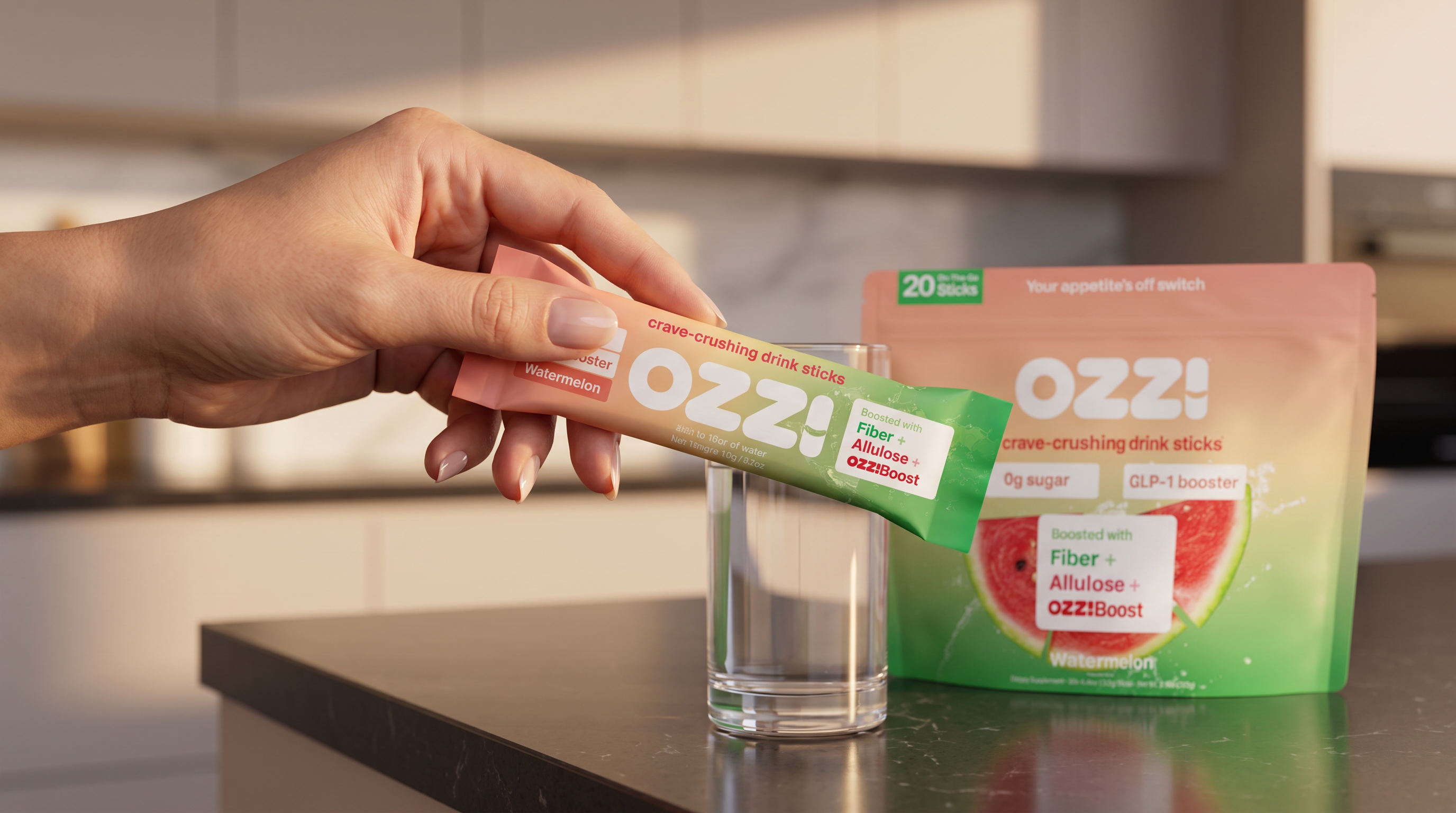
That's the thinking behind Ozzi Crave Crusher. It's a caffeine-free drink stick with allulose, glucomannan fiber, L-Lysine Butyrate, inulin, African mango, and chromium. The butyrate and inulin support your natural GLP-1 pathway, the glucomannan expands in your stomach for physical fullness, and the allulose satisfies a sweet craving without spiking blood sugar. If you want the deeper mechanism, here's how butyrate and GLP-1 work together and more on how to increase GLP-1 naturally.
To be clear: a drink stick is not a stress-management plan. It can make the urge smaller. The rest of this list makes the moment easier to handle.
What's a simple plan to stop emotional eating?
Here's the 5-step version I actually use. It's boring on purpose. Boring is what works.
1. Pause and name it. When the urge hits, stop and ask: am I hungry, or am I feeling something? Name the emotion out loud if you can. Stressed. Bored. Lonely. Naming a feeling takes some of its power, and it interrupts the automatic reach.
2. Wait 10 minutes. Emotional urges spike and fade. Set a timer. Most of the time the wave passes, and you find out the cookie was never really the point.
3. Address the actual feeling. If you're stressed, breathe or walk. If you're lonely, text someone. If you're tired, start winding down. Feed the real need, not the stand-in.
4. Make the environment do the work. Keep trigger foods out of easy reach. Keep a non-food ritual ready. Your willpower is exhausted; let your kitchen layout carry the load.
5. Soften the biology. Eat enough during the day, prioritize protein and fiber, protect your sleep, and steady your blood sugar so the urge starts smaller. This is the piece most 'just stop snacking' advice skips.
When is emotional eating a bigger problem?
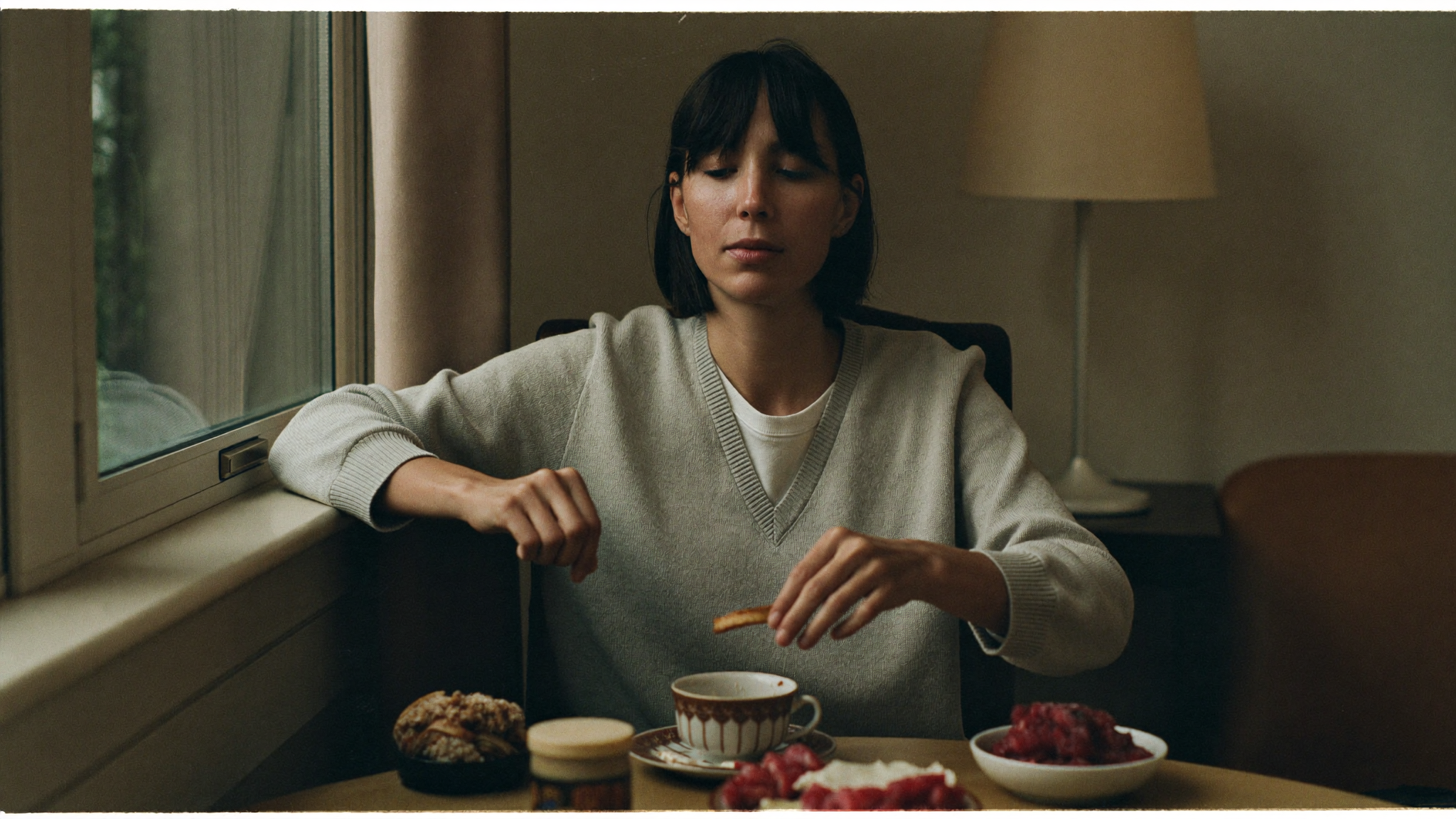
Most emotional eating is normal and manageable. Sometimes it's a sign of something that deserves real support.
If you're eating to the point of feeling out of control, eating in secret, feeling deep shame afterward, or if eating has become your main way of coping with hard emotions, please talk to a doctor or a therapist. Binge eating disorder is the most common eating disorder, and it's very treatable.
For some people, hormonal shifts make all of this harder. If your cravings ramped up around menopause, that's a real physiological change, not a sudden loss of discipline.
This is a sensitive topic. If any of this feels heavier than everyday snacking, reaching out for help is a strong move, not a weak one.
The holidays stack several of these triggers at once. For the seasonal playbook, see how to eat less junk food during the holidays.
Frequently asked questions
How do I know if I'm emotionally eating or actually hungry?
Real hunger builds slowly, sits in your stomach, and is open to any food. Emotional hunger comes on fast, points at specific comfort foods, and lingers after you're full. The speed and the specificity are the giveaways.
Why do I emotionally eat at night and not during the day?
By night your willpower is drained, your stress has accumulated, and ghrelin is high. The day's structure also drops away, so there's nothing keeping the habit in check. It's the perfect storm, not a nighttime personality flaw.
Does stress really make you eat more?
Yes. Stress raises cortisol and ghrelin, both of which increase appetite and push you toward sweet, fatty foods. Studies show people with stronger cortisol responses tend to eat more after stress.
Is emotional eating the same as binge eating disorder?
No. Emotional eating is a common behavior. Binge eating disorder is a clinical condition with larger, more distressing, out-of-control episodes. If your eating feels compulsive or shameful, talk to a professional.
Can drinking water stop emotional eating?
Sometimes, partly. Thirst can masquerade as hunger, and a warm drink gives your hands and mouth something to do during the urge. It won't fix the underlying feeling, but it's a useful pause tool.
What foods help with emotional eating?
Protein and fiber keep you fuller and steady your blood sugar, which lowers the baseline urge. Eating enough earlier in the day matters more than any single 'magic' food.
Can a GLP-1 supplement help me stop emotional eating?
It can make the urge smaller by supporting fullness signals and steadier blood sugar, which means less to resist. It works best paired with the behavior steps here, not as a replacement for them.
How long does it take to break the emotional eating habit?
Most people feel a difference in the urge within a couple of weeks of consistent pausing and environment changes. Rewiring the deeper habit takes longer, so aim for progress, not perfection.
Make the 9pm urge smaller
Ozzi Crave Crusher is a caffeine-free drink stick that supports your natural GLP-1, fills you up with fiber, and satisfies a sweet craving without the sugar spike. Try it for 14 straight days. If it doesn't work for you, we'll refund your first bag.
This article is for educational purposes and is not medical advice. Emotional eating and disordered eating can be sensitive and serious. If you're struggling, please reach out to a qualified healthcare professional. Ozzi is a dietary supplement and is not intended to diagnose, treat, cure, or prevent any disease.
- Chew HSJ, et al. The global prevalence of emotional eating in overweight and obese populations: a systematic review and meta-analysis. British Journal of Psychology. 2025. https://pmc.ncbi.nlm.nih.gov/articles/PMC11984340/
- Smith, et al. Hunger Games: A Modern Battle Between Stress and Appetite. Journal of Neurochemistry. 2025. https://onlinelibrary.wiley.com/doi/10.1111/jnc.70006
- Newman E, et al. Cortisol reactivity and distress-induced emotional eating. Psychoneuroendocrinology. https://pubmed.ncbi.nlm.nih.gov/22999262/
- Geiker NRW, et al. High/low cortisol reactivity and food intake in people with obesity and healthy weight. Translational Psychiatry. 2020. https://pmc.ncbi.nlm.nih.gov/articles/PMC7026436/
- Daily stress and eating behaviors in adolescents and young adults: the role of cortisol reactivity and eating styles. Appetite. 2023. https://www.sciencedirect.com/science/article/pii/S0306453023000835
- Emotional Eating and Obesity: An Update and New Insights. 2025. https://pmc.ncbi.nlm.nih.gov/articles/PMC12479663/
- Impact of GLP-1 Receptor Agonists on Perceived Eating Behaviors in Response to Stimuli. 2025. https://pmc.ncbi.nlm.nih.gov/articles/PMC12056664/
- GLP-1 receptor agonist semaglutide reduces appetite while increasing dopamine reward signaling. https://pmc.ncbi.nlm.nih.gov/articles/PMC12244221/
- Tolhurst G, et al. Short-chain fatty acids stimulate glucagon-like peptide-1 secretion via the G-protein-coupled receptor FFAR2. Diabetes. 2012. https://pubmed.ncbi.nlm.nih.gov/22190648/
- Yadav H, et al. Beneficial metabolic effects of a probiotic via butyrate-induced GLP-1 hormone secretion. Journal of Biological Chemistry. 2013. https://pmc.ncbi.nlm.nih.gov/articles/PMC3757173/
- Feeding the feelings: gender differences in emotional eating. Frontiers in Nutrition. 2025. https://www.frontiersin.org/journals/nutrition/articles/10.3389/fnut.2025.1680872/full
- Quieting 'Food Noise': How GLP-1s and Mindfulness Rewire the Default Mode Network and Reward Circuits. 2025. https://pmc.ncbi.nlm.nih.gov/articles/PMC12770913/
