

The Insulin Resistance Craving Cycle: Why Hunger Comes Back Two Hours Later (2026)
You ate a real lunch. Two and a half hours later you're rummaging for something sweet and you can't explain why.
The insulin resistance craving cycle is a loop where cells respond poorly to insulin, the body compensates with more insulin, blood glucose dips below baseline 2 to 3 hours after eating, and that dip triggers early hunger and sugar cravings. Eating fast carbs to fix the dip restarts the loop.
That loop is measurable. It's not a character flaw, and it's not a matter of trying harder. Your cravings aren't really a willpower problem, they're a hormone problem.
Key takeaways
- The glucose dip predicts hunger better than the peak.
- Dippers ate more at the next meal and over 24 hours.
- Higher insulin resistance tracked with stronger brain food-cue response.
- Most brain-insulin evidence comes from small human studies.
- Slowing the glucose curve is the practical lever you control.
What is the insulin resistance craving cycle?
Insulin's job is to move glucose out of your blood and into cells. Insulin resistance means those cells have gotten less responsive to the signal, so the pancreas sends more insulin to get the same work done.
That extra insulin doesn't switch off cleanly. It keeps pulling glucose down past where it needed to stop.
Roughly 2 to 3 hours after a meal, blood glucose lands below where it started. Your brain reads that dip as a fuel problem and asks for food. Fast carbs fix the dip in minutes, which is exactly why you reach for them, and which is exactly what sets up the next one.
That's the whole cycle. Meal, spike, overshoot, dip, craving, repeat. If you've read our piece on hormonal hunger vs real hunger, this is the mechanical version of the same story.
Why do cravings hit 2 to 3 hours after eating?
The clearest human data on this comes from a 2021 study in Nature Metabolism. Researchers tracked 1,070 people wearing continuous glucose monitors across 8,624 standardized meals and 71,715 meals they chose themselves.
They compared three things against hunger: the glucose peak in the first 2 hours, the area under the glucose curve, and the dip at 2 to 3 hours.
The dip won. People with bigger dips reported more hunger at 2 to 3 hours, went a shorter time before their next meal, ate more at 3 to 4 hours, and ate more across the full 24 hours. The 24-hour correlation was the strongest of the set.
Everyone watches the spike. The dip is the part that makes you hungry.
Worth being precise about what that study is and isn't. It's observational, in healthy adults, and the correlations are modest (r values from 0.14 to 0.27). It shows a real, repeatable pattern across a large group. It doesn't prove the dip causes the eating.

Does insulin resistance change how your brain sees food?
There's a second layer to this, and it's the one that explains why the same doughnut looks different on different days.
In a 2019 study in the American Journal of Clinical Nutrition, researchers scanned 39 adults who were overweight or obese and had impaired fasting glucose, impaired glucose tolerance, or both. Participants viewed food and non-food images inside an MRI scanner.
Higher insulin resistance (measured by HOMA-IR) tracked with stronger activation in the nucleus accumbens, both sides of the insula, and the right cingulate gyrus when food images appeared. Those are reward and salience regions. Emotional eating scores tracked the same direction. Habitual leisure-time physical activity tracked the opposite way.
Note the population there. These were adults already sitting in the pre-diabetes range, recruited into a clinical study. It's a small sample and it's cross-sectional, so it can't tell you which came first. We wrote more about that population in pre-diabetes and GLP-1.
The broader concept researchers use for this is brain insulin resistance: the idea that insulin signaling inside the central nervous system gets blunted, and that blunting shows up in appetite and cognition. A 2021 review in the Journal of Neuroendocrinology lays out two decades of intranasal insulin work supporting the concept, and is honest that longer-term trials in people with obesity produced negative outcomes. The mechanism is well described. The interventions built on it have mostly not delivered yet.
What has the research actually studied?
This section is here so you can see the evidence sorted by strength instead of taking a mechanism story on faith. Several of these studies enrolled participants who were under medical care or already had a metabolic diagnosis.
| Finding | Evidence type | Who was studied |
|---|---|---|
| Glucose dip at 2-3h predicts hunger and next-meal intake | Human, observational, n=1,070 | Healthy adults, UK and US cohorts |
| Insulin resistance tracks with food-cue brain activation | Human, cross-sectional fMRI, n=39 | Overweight adults with impaired glucose regulation |
| Insulin acts on midbrain reward circuitry | Human, randomized, intranasal insulin | Adults, small crossover sample |
| Brain insulin resistance as a treatable target | Review; long-term trials were negative | Mixed, includes clinical populations |
| Slowed colonic fermentation reduced energy intake | Human RCT, n=60 (24-week arm) | Overweight adults |
| Exercise improves brain insulin sensitivity | Review of animal and human work | Mixed |
Nothing in that table is a cure for anything. It's a map of a loop, with the honest labels attached.

How do you know if this is what's happening to you?
There's no self-test that diagnoses insulin resistance. That's a conversation with your doctor and a blood panel. But the pattern has a shape, and people recognize it fast.
Signs that fit the cycle:
- Hunger returns 2 to 3 hours after a full meal, reliably.
- The craving is specific and sweet, not general.
- You get shaky, foggy, or irritable before you get hungry.
- Eating something sweet fixes it within 10 minutes.
- Evenings are worse than mornings.
- Skipping breakfast makes the afternoon louder, not quieter.
The last one surprises people. A bigger morning glucose swing sets up a bigger afternoon dip in a lot of people, which is why the 3pm thing shows up after a sweet breakfast more than a savory one.
If the food thoughts run all day and not just at the dips, that's a different (and overlapping) thing. We covered it in what is food noise.
Why does this get louder in your late 30s and 40s?
Because two things move at once, and they move in the same direction.
Muscle mass declines from the mid-30s onward if nothing is done to defend it, and skeletal muscle is the single largest place your body parks glucose. Less muscle means the same meal has fewer places to go, which means a bigger swing.
Then estrogen enters the picture. Estrogen influences insulin sensitivity, and as it becomes erratic through perimenopause, glucose handling gets less predictable meal to meal. Women describe this as the same food suddenly behaving differently, which is an accurate description of what's happening. We wrote it up in detail in perimenopause and insulin resistance.
PCOS runs a version of this earlier in life, and often more sharply. Insulin resistance is a core feature rather than a complication, which is why the craving pattern shows up in women in their 20s with PCOS who are doing everything right. That's covered in PCOS cravings and insulin resistance.
Sleep is the quiet one. A few nights of short sleep measurably reduces insulin sensitivity in healthy adults, and it raises appetite the following day. If you're fighting the 3pm dip on 5 hours of sleep, the sleep is doing more damage than the lunch.
What actually breaks the cycle?
The lever you control is the shape of the curve. Flatten the rise and you shrink the overshoot, and the dip gets smaller.
Protein and fat first. Eating the protein and vegetable portion of a meal before the starch slows gastric emptying and blunts the peak. Free, works immediately.
Viscous fiber with the meal. Soluble fibers that gel in the stomach slow carbohydrate absorption. Glucomannan from konjac root is the most studied of these for satiety.
Fermentable fiber for the longer game. Here the evidence gets interesting. In a randomized trial published in Gut, overweight adults took an inulin-propionate ester designed to release propionate directly in the colon. Over 24 weeks, the group receiving the ester gained less weight and had less body fat gain than the inulin-only control, and in the acute arm they ate less at a test meal with higher post-meal PYY and GLP-1. That's propionate, a different short-chain fatty acid from butyrate, and it's one trial. But it's a human trial with a real endpoint.
Walking after meals. Muscle contraction pulls glucose out of the blood without needing insulin. Ten minutes does measurable work.
Chromium. An essential trace mineral with a long-established role in insulin receptor signaling. We went through the evidence, including where it's thinner than the marketing suggests, in chromium for cravings and blood sugar.
You can't argue a glucose dip out of existence. You can change the meal that caused it.
Where does Ozzi fit in this?
Ozzi is a drink stick you mix into 16oz of water. It was built around this exact loop, so here's the honest version of what's in it and why.
8g allulose. A rare sugar that tastes sweet without raising blood glucose the way sucrose does. It's there so the sweet craving gets something to land on that doesn't start another spike. More on that in does allulose spike blood sugar.
500mg glucomannan. The viscous konjac fiber above. Its lane is stomach fullness and slower carbohydrate absorption.
500mg chicory root inulin. A prebiotic fiber that feeds butyrate-producing bacteria in the colon.
500mg L-Lysine Butyrate (BIOMEnd). Butyrate is a postbiotic, and it's the primary fuel for the cells lining your colon. The link between butyrate and GLP-1-secreting L-cells comes from mouse and cell studies. Human confirmation is still pending, so we frame it as support for a normal process, not a promise.
11mg chromium polyursolate. For insulin signaling support.
What Ozzi doesn't do: it doesn't treat insulin resistance, and it isn't a substitute for medical care if your labs say something. It supports blood sugar control and gives the 9pm cravings somewhere to go.
Frequently asked questions
Can you have insulin resistance at a normal weight?
Yes. Insulin resistance correlates with body fat but isn't determined by it. Plenty of people at a normal BMI have it, often tied to visceral fat, sleep debt, or genetics.
Does the glucose dip mean my blood sugar is low?
Usually not clinically low. In the Nature Metabolism cohort, these were healthy people whose glucose dropped below their own baseline. The brain seems to respond to the drop itself, not to an absolute number.
Will a continuous glucose monitor help me?
It can show you which meals produce your biggest dips, which is useful information. It's also easy to over-interpret single readings and get anxious about normal variation.
Is this the same thing as reactive hypoglycemia?
Related but not identical. Reactive hypoglycemia is a clinical diagnosis with defined glucose thresholds. What's described here is a milder, much more common version of the same shape.
Why do the cravings get worse in the evening?
Insulin sensitivity follows a daily rhythm and drops later in the day, so the same food produces a bigger swing at night. Accumulated glucose swings from earlier meals add to it.
Does eating more often fix it?
Sometimes, temporarily. Grazing on fast carbs keeps you in the loop. Fewer, better-composed meals tends to work better than more frequent ones.
How long before eating differently changes the pattern?
The curve changes at the very next meal. How you feel usually takes a week or two of consistency, because you're also unlearning a habit that got reinforced every afternoon.
Can Ozzi replace medication for insulin resistance?
No. It's a supplement that supports blood sugar control and appetite. If you've been prescribed something, keep taking it and talk to your doctor before changing anything.
Give the 3pm dip somewhere to go
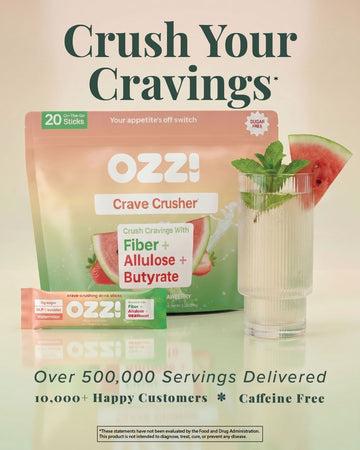
Crave Crusher is one stick in 16oz of water. Allulose, viscous fiber, prebiotic inulin, butyrate, and chromium, dosed at what's actually on the label.
Try it for 14 days straight. If it doesn't work, we'll refund your first bag.
Six actives, no stimulants
Ozzi Crave Crusher
Konjac fiber for physical fullness, 8g of allulose for the sweet craving, plus butyrate, chromium, ursolic acid and African mango. No caffeine and no stimulants, so there is no cutoff time on when you can drink it.
See what's in it →References
- Wyatt P, Berry SE, Finlayson G, et al. Postprandial glycaemic dips predict appetite and energy intake in healthy individuals. Nature Metabolism. 2021;3(4):523-529. https://doi.org/10.1038/s42255-021-00383-x
- Drummen M, Dorenbos E, Vreugdenhil ACE, et al. Insulin resistance, weight, and behavioral variables as determinants of brain reactivity to food cues. American Journal of Clinical Nutrition. 2019;109(2):315-321. https://doi.org/10.1093/ajcn/nqy252
- Hallschmid M. Intranasal insulin. Journal of Neuroendocrinology. 2021;33(4):e12934. https://doi.org/10.1111/jne.12934
- Kullmann S, Blum D, Jaghutriz BA, et al. Modulation of midbrain neurocircuitry by intranasal insulin. NeuroImage. 2019;194:120-127. https://doi.org/10.1016/j.neuroimage.2019.03.050
- Malin SK, Stewart NR, Ude AA, Alderman BL. Brain insulin resistance and cognitive function: influence of exercise. Journal of Applied Physiology. 2022;133(6):1368-1380. https://doi.org/10.1152/japplphysiol.00375.2022
- Chambers ES, Viardot A, Psichas A, et al. Effects of targeted delivery of propionate to the human colon on appetite regulation, body weight maintenance and adiposity in overweight adults. Gut. 2015;64(11):1744-1754. https://doi.org/10.1136/gutjnl-2014-307913
- Kroemer NB, Krebs L, Kobiella A, et al. Resting-state functional connectivity of brain regions involved in cognitive control, motivation, and reward is enhanced in obese females. American Journal of Clinical Nutrition. 2014;100(2):524-534. https://doi.org/10.3945/ajcn.113.080671
- Freeman CR, Zehra A, Ramirez V, et al. Impact of sugar on the body, brain, and behavior. Frontiers in Bioscience (Landmark Edition). 2018;23(12):2255-2266. https://doi.org/10.2741/4704
Citations retrieved via PubMed. This article is for education only and isn't medical advice. These statements have not been evaluated by the Food and Drug Administration. This product is not intended to diagnose, treat, cure, or prevent any disease.
