

PMS Cravings: How to Manage Them Naturally (2026 Guide)
To manage PMS cravings, steady your blood sugar with protein and fiber at every meal, keep magnesium and chromium adequate, prioritize sleep, and give yourself planned sweet options instead of white-knuckling it. Cravings peak in the luteal phase because falling serotonin and rising progesterone push your brain toward sugar and carbs. Support the biology and the urge softens.
Key takeaways
- PMS cravings are hormone-driven, not a discipline problem.
- Serotonin drops before your period, so carbs feel like relief.
- Insulin sensitivity dips in the luteal phase, worsening sugar swings.
- Protein, fiber, magnesium, and chromium all help steady the urge.
- Nighttime is the hardest window, so plan for it.
You eat well all month. Then about a week before your period, something flips.
Suddenly you want chocolate at 9pm. Bread. Anything sweet. You're not even hungry, and you know it, but the pull is real.
If that sounds familiar, you're not weak and you're not broken. Your hormones are doing exactly what they're wired to do. And once you understand the mechanism, you can work with it instead of fighting yourself every month.
I'm Brandon, founder of Ozzi. I've spent the last two years reading the research on cravings and hearing from thousands of customers, and PMS cravings come up constantly. Here's what's actually happening and what helps.
Why do I get intense food cravings before my period?
Because your brain chemistry shifts in the days before menstruation, and food is the fastest way it knows to feel better.
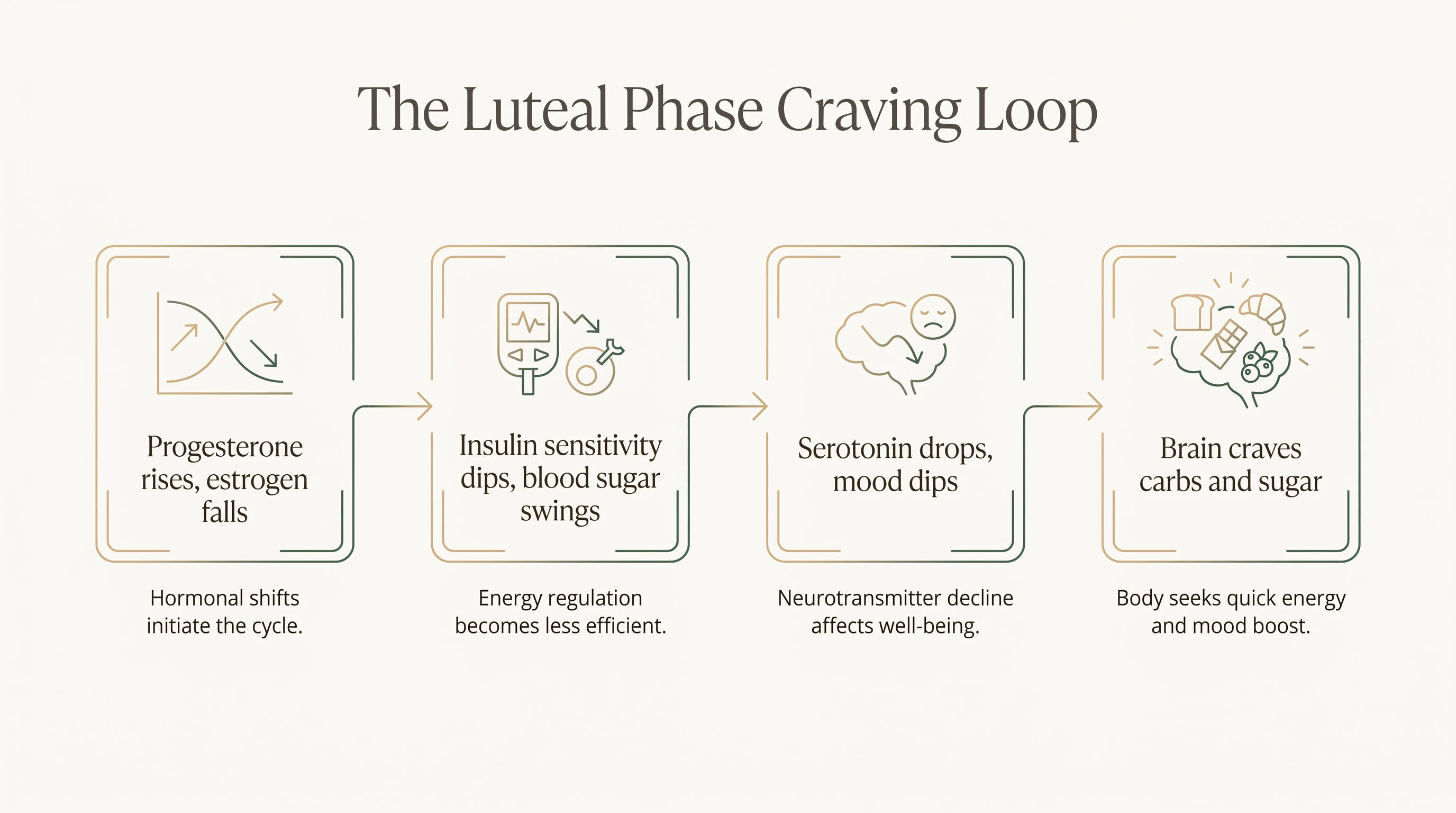
The week or so before your period is called the luteal phase. During it, progesterone climbs, estrogen falls, and serotonin (your feel-good, mood-steadying neurotransmitter) drops along with estrogen.
Low serotonin feels bad. Anxious, irritable, flat. Your brain wants to fix that fast, and it has learned a shortcut: carbohydrates.
Eating carbs raises the availability of tryptophan in the brain, and tryptophan is the raw material your brain uses to make serotonin. So a carb-heavy snack gives you a short serotonin lift. A 2025 review in Food Science & Nutrition found that women with PMS ate more carbohydrates and more energy from ultra-processed foods in the premenstrual window than women without PMS.1
So the craving isn't random. It's your brain self-medicating a serotonin dip with sugar.
The craving isn't a character flaw. It's your brain chasing serotonin the fastest way it knows how.
What's actually happening to my hormones in the luteal phase?
Two hormones drive most of it: estrogen and progesterone.
Estrogen tends to suppress appetite. When estrogen drops in the luteal phase, that appetite brake comes off. Progesterone does the opposite. It's linked to increased hunger and a small bump in how many calories you burn at rest.
Studies tracking women across the cycle have measured total daily energy intake rising by roughly 200 to 600 calories in the luteal phase compared to the follicular phase.2 That's not a small number. That's a genuine hunger signal, not just a want.
Here's the loop that ties it together.
Progesterone also nudges your body toward burning more fat and protein for fuel, which is part of why cravings often skew toward quick carbs. Your body is looking for easy energy, and sugar is the easiest energy there is.
Are PMS cravings actually a blood sugar problem?
Partly, yes. And this is the piece most people miss.
Progesterone reduces insulin sensitivity. In plain terms, your cells respond a little less efficiently to insulin during the luteal phase, so your blood sugar swings more than usual.
A comparative study found higher insulin resistance in the luteal phase than the follicular phase in healthy women, and the effect was more pronounced in women with PMS.3 A 2025 brain-imaging study went further and showed insulin sensitivity in the brain itself measurably dropped in the luteal phase, right when cravings tend to spike.4
When blood sugar spikes and then crashes, you get shaky, foggy, and hungry. Your brain reads that crash as an emergency and screams for sugar. You eat sugar, spike again, crash again. That's the loop that keeps you snacking all evening.
So steadying blood sugar isn't a side quest. It's one of the main levers you have.
Why do PMS cravings hit hardest at night?
This is the number one thing Ozzi customers tell me, period or not: they're fine all day, then the night monster shows up.
PMS stacks right on top of that. By evening your willpower is depleted, your serotonin is already low, and the day's blood sugar swings have caught up with you. Add the luteal-phase hunger bump and you get the classic 9pm scene: standing at the pantry, not hungry, eating anyway.
One customer put it perfectly: "I can be stellar all day long but the monster comes out at night."
If nighttime is your hardest window, that's worth its own plan. I wrote a full breakdown on how to stop night eating and another on why you crave sugar at night that go deeper than I can here.
Stellar all day, then the monster comes out at night. Add PMS and that monster gets louder.
How do I actually manage PMS cravings?
You don't beat biology with willpower. You support the biology so the urge gets quieter. Here's what actually helps.
Front-load protein and fiber. Both slow digestion and blunt blood sugar swings. Aim for 25 to 30 grams of protein at breakfast so you're not starting the day on a sugar rollercoaster.
Don't skip meals in the luteal week. Under-eating during the day almost guarantees a nighttime binge. Your body will collect what you owe it.
Plan your sweet, don't ban it. Total restriction backfires. A planned square of dark chocolate or a piece of fruit after dinner satisfies the serotonin pull without opening the whole pantry.
Protect your sleep. One bad night raises hunger hormones the next day. During PMS week, sleep is a craving tool.
Move, gently. A walk after dinner steadies blood sugar and gives you a natural serotonin nudge without a snack.

Here's how the main levers stack up.
| Strategy | What it targets | Evidence strength |
|---|---|---|
| Protein + fiber at meals | Blood sugar swings | Strong |
| Consistent sleep | Hunger hormones | Strong |
| Magnesium | Fluid retention, mood | Modest, mixed |
| Chromium | Carb cravings, insulin signaling | Modest, preliminary |
| Viscous fiber (glucomannan) | Fullness, slower carb absorption | Moderate |
Which nutrients and supplements help PMS cravings?
A few have real, if modest, support behind them.
Magnesium. A double-blind trial found 200mg of magnesium a day eased premenstrual fluid retention (bloating, breast tenderness, swelling) by the second cycle.5 The craving evidence is thinner, and a broad systematic review found only limited support for magnesium on psychological PMS symptoms.6 Still, low magnesium is common and linked to sugar cravings, so covering the gap is reasonable.
Chromium. Chromium plays a role in insulin signaling. A placebo-controlled trial in people with atypical depression found chromium picolinate reduced carbohydrate cravings.7 A small pilot in binge eating disorder pointed the same direction.8 The effect sizes are modest and the research is early, but for a mineral tied to blood sugar, the logic holds.
Viscous fiber. Soluble fibers like glucomannan absorb water and expand in your stomach, which promotes fullness and slows how fast carbs hit your bloodstream. That directly counters the luteal-phase blood sugar swing.
Allulose. This is a rare sugar that tastes like sugar but barely raises blood glucose. It lets you answer the sweet craving without the spike-and-crash that keeps the loop going.
None of these are magic. But stacked on top of protein, sleep, and steady meals, they take the edge off.
Can a GLP-1 booster help with PMS cravings?
This is why I built Ozzi, so I'll be straight with you about what it can and can't do.
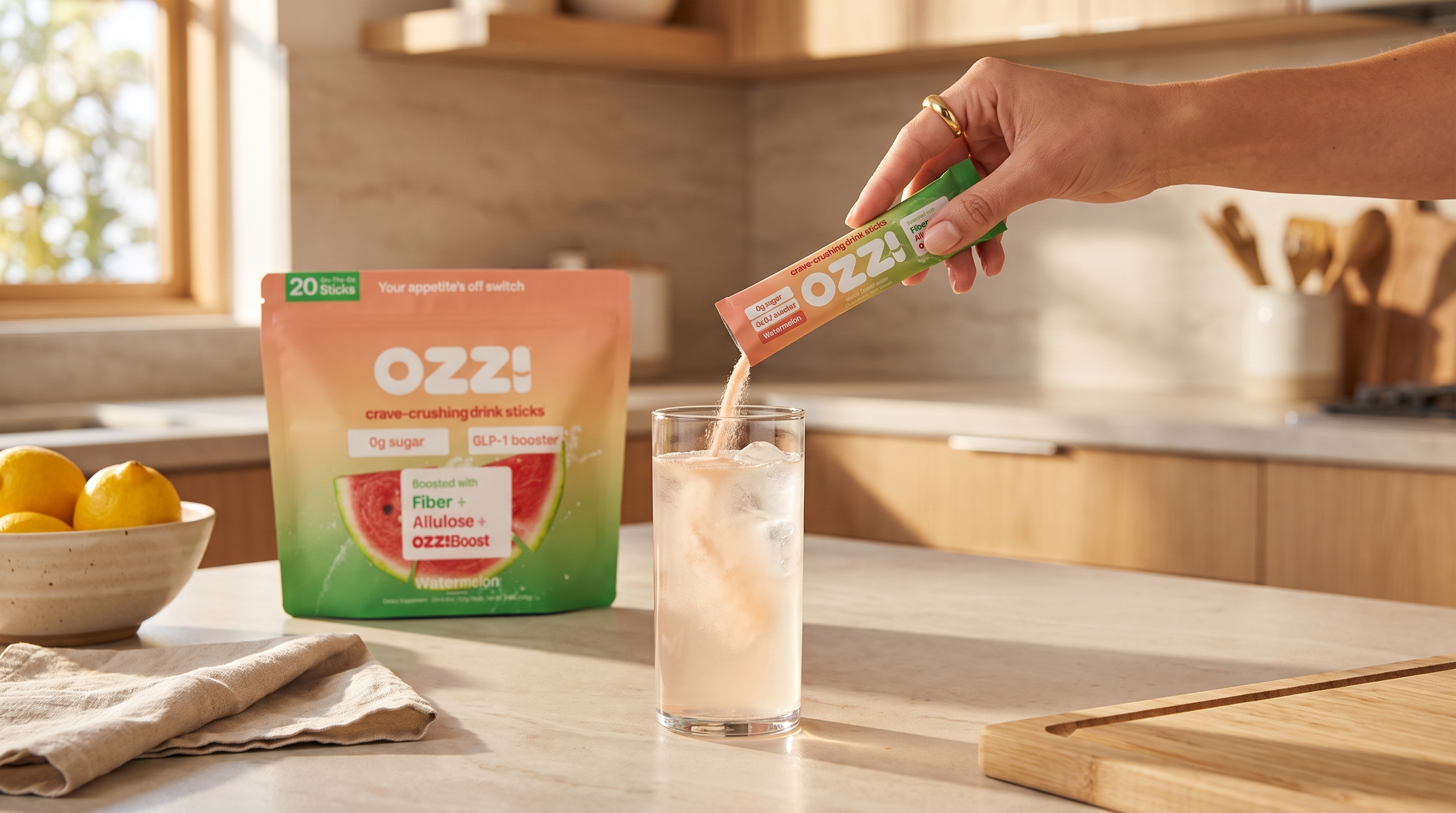
Ozzi Crave Crusher is a drink stick you mix into cold water. It brings together several of the levers above in one place: allulose for the sweet craving without the spike, glucomannan fiber for fullness, chromium for insulin signaling, and butyrate plus inulin to support your gut's natural GLP-1 response.
GLP-1 is the satiety hormone the Ozempic-class drugs mimic. It tells your brain you're full. Ozzi is built to nudge your body's own GLP-1 gently and naturally, no needles, no caffeine, no prescription. You can read the full mechanism in my guide on how to increase GLP-1 naturally.
It won't override your hormones. Nothing will. But steadier blood sugar and more fullness are exactly what your luteal-phase body is missing, and that's the gap Ozzi is designed to fill. Many customers reach for it specifically in that pre-period week and before the 9pm pantry run.
If your cravings tie into perimenopause or menopause on top of your cycle, I covered those separately in perimenopause appetite changes and menopause weight gain and cravings.
Quiet the pre-period pantry run
Ozzi Crave Crusher steadies your sweet cravings with allulose, fiber, and a natural GLP-1 nudge. Zero caffeine, so you can drink it at night.
Try it for 14 days straight. If it doesn't work for you, we'll refund your first bag.
When are PMS cravings a sign of something more?
Most PMS cravings are normal. But if your symptoms are severe enough to wreck your relationships, work, or mood every single month, that can be PMDD (premenstrual dysphoric disorder), and it's worth talking to a doctor.
Same goes if cravings come with binge episodes that feel completely out of control, or if you're managing diabetes and your blood sugar is swinging hard. Those deserve real medical support, not just a supplement.
This article is general education, not medical advice. If something feels off, see a professional who can look at your full picture.
Frequently asked questions
How many days before my period do cravings start?
Usually 7 to 10 days before, during the luteal phase. They often peak in the last few days as serotonin drops and progesterone stays high.
Why do I specifically crave chocolate before my period?
Chocolate hits several buttons at once: sugar for a serotonin lift, fat for reward, and a little magnesium. Your brain learns it works, so it asks for it again.
Do PMS cravings mean I'm eating too little?
Sometimes. Under-eating during the day makes luteal-phase cravings much worse at night. Eating enough protein and fiber earlier usually calms the evening urge.
Does sugar make PMS worse?
It can. Big sugar spikes lead to crashes that trigger more cravings and can worsen mood swings. Steadier blood sugar tends to mean a smoother week.
Will magnesium stop my PMS cravings?
Maybe partly. Magnesium has better evidence for bloating and mood than for cravings specifically, but correcting a deficiency is still worth doing.
Is it normal to gain weight before my period?
Yes. Most of it is water from fluid retention, plus the temporary increase in appetite. It usually resolves once your period starts.
Can I drink Ozzi during PMS week?
Yes. It's caffeine-free and made to steady cravings and fullness, which is exactly what the luteal phase disrupts. Many customers use it most in that window.
How do I stop the 9pm pantry raid on my period week?
Eat enough protein during the day, plan one sweet after dinner, take a short walk, and have a low-sugar option ready so you're not deciding while depleted.
Are PMS cravings a willpower problem?
No. They're driven by real shifts in serotonin, estrogen, progesterone, and insulin sensitivity. Support the biology and the urge softens.
- Bodur M, et al. Premenstrual Syndrome, Ultra-Processed Food Intake, and Food Cravings: A New Perspective. Food Science & Nutrition. 2025. https://onlinelibrary.wiley.com/doi/full/10.1002/fsn3.70520
- The role of premenstrual syndrome in hedonic hunger and food craving during the menstrual cycle. PMC. 2025. https://pmc.ncbi.nlm.nih.gov/articles/PMC12451237/
- Insulin Sensitivity, Food Intake, and Cravings with Premenstrual Syndrome: A Pilot Study. PMC. https://pmc.ncbi.nlm.nih.gov/articles/PMC3319142/
- The interplay of central insulin and menstrual cycle on functional brain networks and neural food cue reactivity in women. Communications Biology. 2025. https://www.nature.com/articles/s42003-025-09341-9
- Walker AF, et al. Magnesium supplementation alleviates premenstrual symptoms of fluid retention. J Womens Health. https://pubmed.ncbi.nlm.nih.gov/9861593/
- Effect of nutritional interventions on the psychological symptoms of premenstrual syndrome: a systematic review of RCTs. PMC. https://pmc.ncbi.nlm.nih.gov/articles/PMC11723155/
- Docherty JP, et al. A double-blind, placebo-controlled trial of chromium picolinate in atypical depression: effect on carbohydrate craving. J Psychiatr Pract. https://pubmed.ncbi.nlm.nih.gov/16184071/
- Brownley KA, et al. A double-blind, randomized pilot trial of chromium picolinate for binge eating disorder (BEACh Study). PMC. https://pmc.ncbi.nlm.nih.gov/articles/PMC4358897/
- Effects of chromium picolinate on food intake and satiety. PubMed. https://pubmed.ncbi.nlm.nih.gov/18715218/
- Blood glucose levels, insulin concentrations, and insulin resistance in healthy women and women with premenstrual syndrome. PMC. https://pmc.ncbi.nlm.nih.gov/articles/PMC3714432/
- Hedonic hunger and food cravings in premenstrual syndrome among nursing students. Frontiers in Public Health. 2025. https://pmc.ncbi.nlm.nih.gov/articles/PMC12370526/
- Zinc, copper, and magnesium in premenstrual disorders: a narrative review. PMC. https://pmc.ncbi.nlm.nih.gov/articles/PMC12647176/
