

Supplements for Period Cravings: What Actually Works (2026)
By Brandon, founder of Ozzi
TL;DR: The supplements with human evidence for cravings, hunger and food intake are allulose, konjac glucomannan, chromium and calcium. Calcium is the only one tested on period cravings directly. The rest work on the same hunger and fullness signals that every craving runs on, which is why they matter the week before your period.
Key takeaways
- You eat about 240 more calories a day before your period. That hunger is real.
- Calcium at 1,200 mg a day cut premenstrual food cravings in a 466-woman trial.
- Allulose triggered GLP-1, PYY and CCK, three fullness hormones, in a human trial.
- Chromium lowered food intake, hunger and fat cravings in women who craved carbs.
- A sweet drink with fiber answers a craving better than fighting it does.
Most articles about period supplements are really about cramps and mood. This one is about the cravings: why they show up, which ingredients have human studies on cravings, hunger and how much you eat, and how to use them the week you need them.
Which supplements help with period cravings? Calcium is the only supplement tested on premenstrual food cravings directly, and it worked. For hunger, fullness and the pull toward something sweet, the best-studied ingredients are allulose, konjac glucomannan and chromium. Magnesium, vitamin B6 and chasteberry help other PMS symptoms more than cravings.
Why do you get cravings before your period?
Because your body is asking for more food, and it is not subtle about it.
Food intake rises in the luteal phase, the two weeks before your period. A pooled analysis of 19 studies put the average increase at about 240 calories a day (Buffenstein 1995). Carbohydrate cravings are the kind women report most, especially women with PMS (Dye and Blundell 1997).
There is a gut side to it too. In a small study of healthy women, the stomach emptied faster in the luteal phase than earlier in the cycle, and hunger and the amount eaten at a buffet meal were both higher (Brennan 2009). Food leaves sooner, so the full feeling fades sooner.
Put those together and the week before your period looks like this: you are hungrier, a meal holds you for less time, and what you want is sweet and starchy. None of that is a character flaw. It is a hormone week.
Are period cravings different from any other craving?
The trigger is different. The machinery is the same.
A craving at 9pm on day 24 of your cycle runs on the same signals as a craving at 9pm on any other night:
- Blood sugar. A fast rise and a fast drop feels like "I need something sweet now."
- Fullness hormones. GLP-1, PYY and CCK are released by your gut after you eat and tell your brain you have had enough.
- Stomach stretch. Volume and thick, slow-moving food keep you full longer.
- Taste. Sometimes you just want sweet, and nothing else will count.
That is good news, because the research on cravings, appetite and food intake is much deeper than the research on period cravings alone. An ingredient that helps with hunger and fullness in general is working on the exact signals your cycle is turning up.
So this guide covers both: the handful of supplements tested in women with PMS, and the ingredients with human evidence for cravings, hunger and food intake in general. We tell you which is which every time.
Which supplements have evidence for cravings, hunger and appetite?
Here is the short version. The detail on each one follows.
| Supplement | What the human research measured | Tested on period cravings? | In Ozzi? |
|---|---|---|---|
| Allulose | Release of GLP-1, PYY and CCK; lower blood sugar rise after carbs; body fat over 12 weeks | No | Yes, 8g |
| Konjac glucomannan | Body weight and fasting blood sugar across 14 trials; mixed results on hunger | No | Yes, 500mg |
| Chromium | Food intake, hunger and fat cravings in women who crave carbs | No | Yes |
| Butyrate | Fullness-hormone cells in mouse and cell studies; blood levels in humans | No | Yes, 500mg |
| African mango | Body weight, waist and leptin in overweight adults | No | Yes, 150mg |
| Calcium | Premenstrual symptoms including food cravings | Yes | No |
| Vitamin B6 | Overall premenstrual symptoms | Not separately | No |
| Magnesium | Premenstrual fluid retention | No | No |
| Chasteberry | Overall premenstrual symptoms | Not separately | No |
Allulose: something sweet that also talks to your fullness hormones
The most common period craving is for something sweet. Allulose lets you say yes to it.
Allulose is a rare sugar. It tastes like sugar and has about a tenth of the calories. Your body absorbs it and then mostly passes it without using it as fuel, so it does not hit your blood sugar the way sugar does.
What the studies found
- Fullness hormones. In a randomized, double-blind crossover trial of 18 healthy adults, 25 g of allulose delivered to the stomach caused a significant release of CCK, GLP-1 and PYY compared with water (Teysseire 2022). Those are the three gut hormones that tell your brain you are done eating.
- Blood sugar. In healthy adults, 7.5 g of allulose on its own had no effect on blood glucose or insulin, and 5 g or more taken with a carbohydrate load lowered the rise in both (Iida 2008).
- Body fat. In a 12-week placebo-controlled trial of 121 adults, allulose at 4 g or 7 g twice a day lowered body fat percentage and body fat mass, with no difference in how much the groups ate (Han 2018).
- Food intake. In mice, oral allulose released GLP-1 and reduced food intake (Iwasaki 2018). That is an animal study, and it is the mechanism researchers are now testing in people.
Why it matters before your period
You want sweet. Sugar gives you the taste and then the blood sugar drop that brings the craving back an hour later. Allulose gives you the taste without that drop, and the human hormone data says it does more than taste good.
Ozzi has 8g of allulose per stick. The fullness-hormone trial used 25 g, so read that study as how allulose works, not as a promise about one stick.

Konjac glucomannan: the fiber that makes a meal last
If your stomach empties faster before your period, a thick fiber is the obvious tool.
Glucomannan comes from konjac root. It soaks up water and turns into a gel, which adds volume and slows how fast food and sugar move through you.
What the studies found
- Weight and blood sugar. A meta-analysis of 14 randomized trials with 531 people found glucomannan lowered body weight by 0.79 kg and fasting blood glucose by 7.44 mg/dL compared with control (Sood 2008).
- Not every trial agrees. An eight-week trial of 53 adults taking 1.33 g in capsules before each meal found no difference from placebo in weight, hunger or fullness (Keithley 2013).
The difference between those results is probably how the fiber was taken. A capsule swallowed with a little water behaves differently than fiber that is already mixed into a full glass. Glucomannan needs water to do anything.
Ozzi has 500mg of konjac glucomannan per stick, mixed into 16oz of water. Most trials used gram-level doses across the day, so it is one part of the formula and not the whole story.
Chromium: the mineral studied in women who crave carbs
This is the closest research there is to a period-craving study without being one.
- Carb cravers. Researchers gave 42 overweight women who reported craving carbohydrates chromium picolinate or a placebo for eight weeks and measured what they ate at breakfast, lunch and dinner. Chromium reduced food intake, hunger levels and fat cravings compared with placebo (Anton 2008).
- Carb cravings and mood. In adults with atypical depression, 600 mcg a day of chromium improved carbohydrate craving and appetite increase compared with placebo (Docherty 2005).
Chromium helps insulin do its job, which is the likely link to cravings. Steadier blood sugar means fewer of the drops that feel like an emergency.
Ozzi uses chromium as Metabolex, a chromium polyursolate. That is a different form and a lower chromium dose than these two trials used. Neither trial was run during the premenstrual week.
Metabolex also supplies ursolic acid, a compound found in apple peel. Its research is early: in mice it increased muscle and reduced diet-induced weight gain (Kunkel 2012). There are no human craving studies on it yet.

Butyrate: the gut signal behind fullness
Butyrate is what your gut bacteria make when they ferment fiber. It is the main fuel for the cells that line your colon, and it is one of the signals your gut uses to talk to the rest of your body.
- Fullness-hormone cells. In mouse and cell studies, short-chain fatty acids like butyrate stimulated GLP-1 release from the L-cells in the gut lining (Tolhurst 2012).
- Food intake. In mice, butyrate reduced food intake and protected against diet-induced weight gain (Lin 2012).
- In people. Human confirmation is still pending. One trial in men that raised blood butyrate after a meal found no change in the metabolic measures it tracked (van Deuren 2022).
Ozzi uses 500mg of BIOMEnd L-lysine butyrate. In a 2025 crossover trial in 10 men, lysine butyrate reached its peak in the blood in 20 minutes, with a peak about five times higher than tributyrin, the form most gut supplements use. More on that in our butyrate guide.
We include it because the mechanism is strong and the delivery is measured. We do not claim it has been shown to reduce cravings in people.
African mango: early evidence on weight and leptin
African mango is the seed extract of Irvingia gabonensis, a West African food plant.
- In a 10-week double-blind trial of 102 overweight adults, 150 mg twice a day before meals improved body weight, body fat, waist size and leptin compared with placebo (Ngondi 2009). Leptin is the hormone your fat cells use to tell your brain how much energy is stored.
- A systematic review found only three trials, all with reporting flaws, and called the weight effect unproven until better studies are done (Onakpoya 2013).
Ozzi has 150mg per stick as a supporting ingredient. It is the least proven of the six, and we would rather say that than oversell it.

What about calcium, B6, magnesium and chasteberry?
These are the classic PMS supplements. One of them has real cravings data.
Calcium. This is the strongest result. In a 12-center trial, 466 women with moderate to severe premenstrual symptoms took 1,200 mg of calcium a day or a placebo for three cycles. By the third cycle total symptoms fell 48% with calcium against 30% with placebo, and all four symptom groups improved, including food cravings (Thys-Jacobs 1998).
Vitamin B6. A BMJ systematic review found women taking B6 were more likely to see overall premenstrual symptoms improve (odds ratio 2.32). The authors said the trials were mostly low quality and that doses should stay at or under 100 mg a day (Wyatt 1999). Cravings were not measured separately.
Magnesium. A trial of 200 mg a day reported less premenstrual fluid retention (Walker 1998). Good for bloating. Not a cravings result.
Chasteberry (Vitex). In a placebo-controlled trial, 52% of women responded on chasteberry extract against 24% on placebo for overall PMS symptoms (Schellenberg 2001). Again, not a cravings study.
If you want one supplement for PMS as a whole, calcium has the best trial behind it. If cravings are the main problem, calcium plus something that works on hunger and sweet taste covers more ground.
Where does Ozzi fit?
Ozzi is a cravings product, not a PMS product. It does not treat PMS, PMDD or period symptoms, and it has not been tested for them.
What it does: one sweet drink stick after dinner, when the cravings hit, with 8g of allulose, 500mg of konjac glucomannan, 500mg of BIOMEnd L-lysine butyrate, chromium, ursolic acid and 150mg of African mango. Together they support your body's natural GLP-1 and fullness. No caffeine.
We built it as full-spectrum support for the hormones that run your appetite, because one ingredient only covers one signal:
- Sweet taste: allulose gives you something sweet for 5 calories.
- Fullness hormones: allulose and butyrate support natural GLP-1.
- Stomach stretch: konjac fiber in a full glass of water.
- Blood sugar: allulose, konjac and chromium.
- Leptin: African mango.
Those are the same signals your cycle turns up the week before your period. Cravings are cravings. The formula does not need to know what day of your cycle it is.
If the cravings come with a wider shift in your 40s, read perimenopause and menopause craving control. For everything in the formula and the research behind it, see what's inside Ozzi.
Two ways to take Ozzi
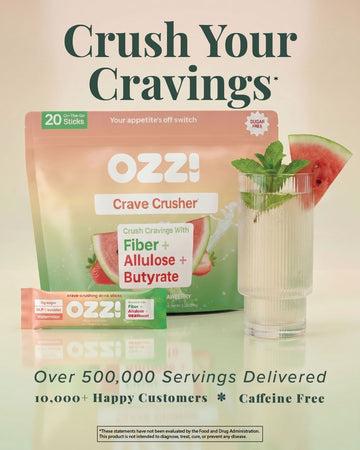
The drink
Ozzi Crave Crusher
8g allulose, 500mg konjac glucomannan, 500mg BIOMEnd L-lysine butyrate, chromium, ursolic acid and 150mg African mango in one daily stick. Sweet, caffeine-free, and made for after dinner.
See the drink →
The capsules
Ozzi Capsules
OEA, BIOMEnd butyrate and konjac fiber in a capsule. No caffeine, no flavor to choose, nothing to mix. Take with a full glass of water.
See the capsules →How do you use supplements for period cravings?
A supplement works better with a plan around it. Here is a simple one.
- Take it daily, not just on bad days. The calcium trial took three cycles to show its full effect. Appetite ingredients are also better as a routine than a rescue.
- Know your window. Cravings usually build over the 7 to 10 days before your period. If you track your cycle, you know the week before it arrives.
- Eat more on purpose. You need about 240 more calories a day that week. Add them at meals as protein and fiber, and there is less left over for 9pm.
- Put protein in the afternoon. In healthy women, a high-protein yogurt snack cut afternoon hunger and led to about 100 fewer calories at dinner compared with a chocolate snack of the same calories (Ortinau 2014).
- Have your sweet thing ready. Decide what you will have after dinner before the craving decides for you.
- Drink water with fiber. Glucomannan and other gel-forming fibers only work with a full glass.
For food ideas, see healthy snacks for period cravings. For the full day-to-day plan, read how to stop period cravings and PMS cravings. If sugar is the main one, supplements for sugar cravings goes deeper.

What can't a supplement do for period cravings?
- It can't erase the extra hunger. Your body is asking for more food that week. Feed it.
- It can't replace sleep. Short sleep raises hunger the next day, and no capsule or drink makes up for it.
- It can't treat PMDD. Severe mood symptoms need a doctor.
- It can't work if you take it twice a month. Every positive trial above used daily doses for weeks.
When should you see a doctor?
If cravings come with mood changes that disrupt your life, binge eating, or symptoms that get worse each month, talk to your doctor. Severe premenstrual symptoms can be PMDD, which needs medical care. Check with your doctor before taking supplements if you are pregnant, nursing or on medication.
More on hormones and cravings
Frequently asked questions
What is the best supplement for period cravings?
For cravings measured directly, calcium has the best trial: 1,200 mg a day cut premenstrual food cravings by the third cycle. For hunger, fullness and wanting something sweet, look at allulose, konjac glucomannan and chromium, which have human studies on appetite and food intake.
Do supplements actually stop period cravings?
They can take the edge off. They will not switch cravings off. Your body really does want more food before your period, about 240 extra calories a day on average. The realistic goal is a craving you can answer with something small instead of one that runs the evening.
Does chromium help with period cravings?
Chromium has not been tested on period cravings specifically. In overweight women who craved carbohydrates, chromium picolinate reduced food intake, hunger and fat cravings over eight weeks. Carb cravings are the most common premenstrual craving, so it is a reasonable ingredient to look for.
Does magnesium help with period cravings?
The trial evidence for magnesium is for premenstrual fluid retention, not cravings. It is worth taking if bloating is your main complaint. Do not expect it to quiet a chocolate craving on its own.
Why do I crave sugar before my period?
Appetite goes up in the two weeks before your period, your stomach empties faster after you eat, and carbohydrate cravings are the kind women report most. A sweet taste paired with fiber or protein answers the craving better than trying to ignore it.
Is allulose good for sugar cravings?
Allulose tastes like sugar with about a tenth of the calories and does not raise blood sugar the way sugar does. In a human trial it also triggered the release of the fullness hormones GLP-1, PYY and CCK. That makes it a useful way to have something sweet in the week you want it most.
When should I start taking supplements for period cravings?
Daily is better than waiting for the craving. The calcium trial ran for three full cycles before the biggest change showed up. If you only want to add something for the hard week, start about 10 days before your period is due and take it every day until it starts.
Can I take Ozzi for period cravings?
Yes. Ozzi is a cravings product built on six actives studied for appetite, fullness and blood sugar, and it is caffeine-free. It has not been tested for PMS and it does not treat PMS or period symptoms. Take one stick in water after dinner, when the cravings hit.
Can a supplement cure PMS?
No. No supplement cures PMS. Some reduce symptoms in trials. Severe symptoms that disrupt your life each month can be PMDD, which needs medical care.
References
- Buffenstein R et al. Food intake and the menstrual cycle: a retrospective analysis. Physiol Behav. 1995. PMID 8623004
- Dye L, Blundell JE. Menstrual cycle and appetite control: implications for weight regulation. Hum Reprod. 1997. PMID 9221991
- Brennan IM et al. Effects of the phases of the menstrual cycle on gastric emptying, glycemia, plasma GLP-1 and insulin, and energy intake in healthy lean women. Am J Physiol Gastrointest Liver Physiol. 2009. PMID 19556358
- Teysseire F et al. The role of D-allulose and erythritol on the activity of the gut sweet taste receptor and gastrointestinal satiation hormone release in humans. J Nutr. 2022. PMID 35135006
- Iida T et al. Acute D-psicose administration decreases the glycemic responses to an oral maltodextrin tolerance test in normal adults. J Nutr Sci Vitaminol. 2008. PMID 19155592
- Han Y et al. A preliminary study for evaluating the dose-dependent effect of d-allulose for fat mass reduction in adult humans. Nutrients. 2018. PMID 29385054
- Iwasaki Y et al. GLP-1 release and vagal afferent activation mediate the beneficial metabolic and chronotherapeutic effects of D-allulose. Nat Commun. 2018. PMID 29317623
- Sood N et al. Effect of glucomannan on plasma lipid and glucose concentrations, body weight, and blood pressure: systematic review and meta-analysis. Am J Clin Nutr. 2008. PMID 18842808
- Keithley JK et al. Safety and efficacy of glucomannan for weight loss in overweight and moderately obese adults. J Obes. 2013. PMID 24490058
- Tolhurst G et al. Short-chain fatty acids stimulate glucagon-like peptide-1 secretion via the G-protein-coupled receptor FFAR2. Diabetes. 2012. PMID 22190648
- Lin HV et al. Butyrate and propionate protect against diet-induced obesity and regulate gut hormones via free fatty acid receptor 3-independent mechanisms. PLoS One. 2012. PMID 22506074
- van Deuren T et al. Butyrate and hexanoate-enriched triglycerides increase postprandial systemic butyrate and hexanoate in men with overweight/obesity. Front Nutr. 2022. PMID 36687671
- Anton SD et al. Effects of chromium picolinate on food intake and satiety. Diabetes Technol Ther. 2008. PMID 18715218
- Docherty JP et al. A double-blind, placebo-controlled, exploratory trial of chromium picolinate in atypical depression: effect on carbohydrate craving. J Psychiatr Pract. 2005. PMID 16184071
- Ngondi JL et al. IGOB131, a novel seed extract of the West African plant Irvingia gabonensis, significantly reduces body weight and improves metabolic parameters in overweight humans. Lipids Health Dis. 2009. PMID 19254366
- Onakpoya I et al. The efficacy of Irvingia gabonensis supplementation in the management of overweight and obesity: a systematic review of randomized controlled trials. J Diet Suppl. 2013. PMID 23419021
- Kunkel SD et al. Ursolic acid increases skeletal muscle and brown fat and decreases diet-induced obesity, glucose intolerance and fatty liver disease. PLoS One. 2012. PMID 22745735
- Thys-Jacobs S et al. Calcium carbonate and the premenstrual syndrome: effects on premenstrual and menstrual symptoms. Am J Obstet Gynecol. 1998. PMID 9731851
- Wyatt KM et al. Efficacy of vitamin B-6 in the treatment of premenstrual syndrome: systematic review. BMJ. 1999. PMID 10334745
- Walker AF et al. Magnesium supplementation alleviates premenstrual symptoms of fluid retention. J Womens Health. 1998. PMID 9861593
- Schellenberg R. Treatment for the premenstrual syndrome with agnus castus fruit extract: prospective, randomised, placebo controlled study. BMJ. 2001. PMID 11159568
- Ortinau LC et al. Effects of high-protein vs. high-fat snacks on appetite control, satiety, and eating initiation in healthy women. Nutr J. 2014. PMID 25266206
