

LPS and Metabolic Endotoxemia, Explained: What the Human Evidence Actually Shows (2026)
Metabolic endotoxemia is a proposed condition where small amounts of bacterial lipopolysaccharide (LPS) cross the gut wall into the bloodstream, triggering chronic low-grade inflammation linked to obesity and insulin resistance. The mouse evidence is strong. The human evidence is weaker and complicated by unreliable blood tests.
Key takeaways
- LPS sits in the wall of gram-negative gut bacteria.
- The founding 2007 study was done in mice.
- Blood endotoxin tests are famously unreliable in humans.
- A 2025 human trial did find diet-driven endotoxin rises.
- Fiber and butyrate support the barrier, not a detox.
If you've spent any time reading about gut health, you've hit the acronym. LPS. Sometimes it's called endotoxin. It shows up in supplement marketing, podcast clips, and about nine thousand Instagram carousels, usually attached to a scary claim about toxins leaking into your blood and making you fat.
I spent a chunk of last month reading the actual papers on this. What I found was messier and more interesting than the carousels suggest.
What is LPS, and what does "metabolic endotoxemia" actually mean?
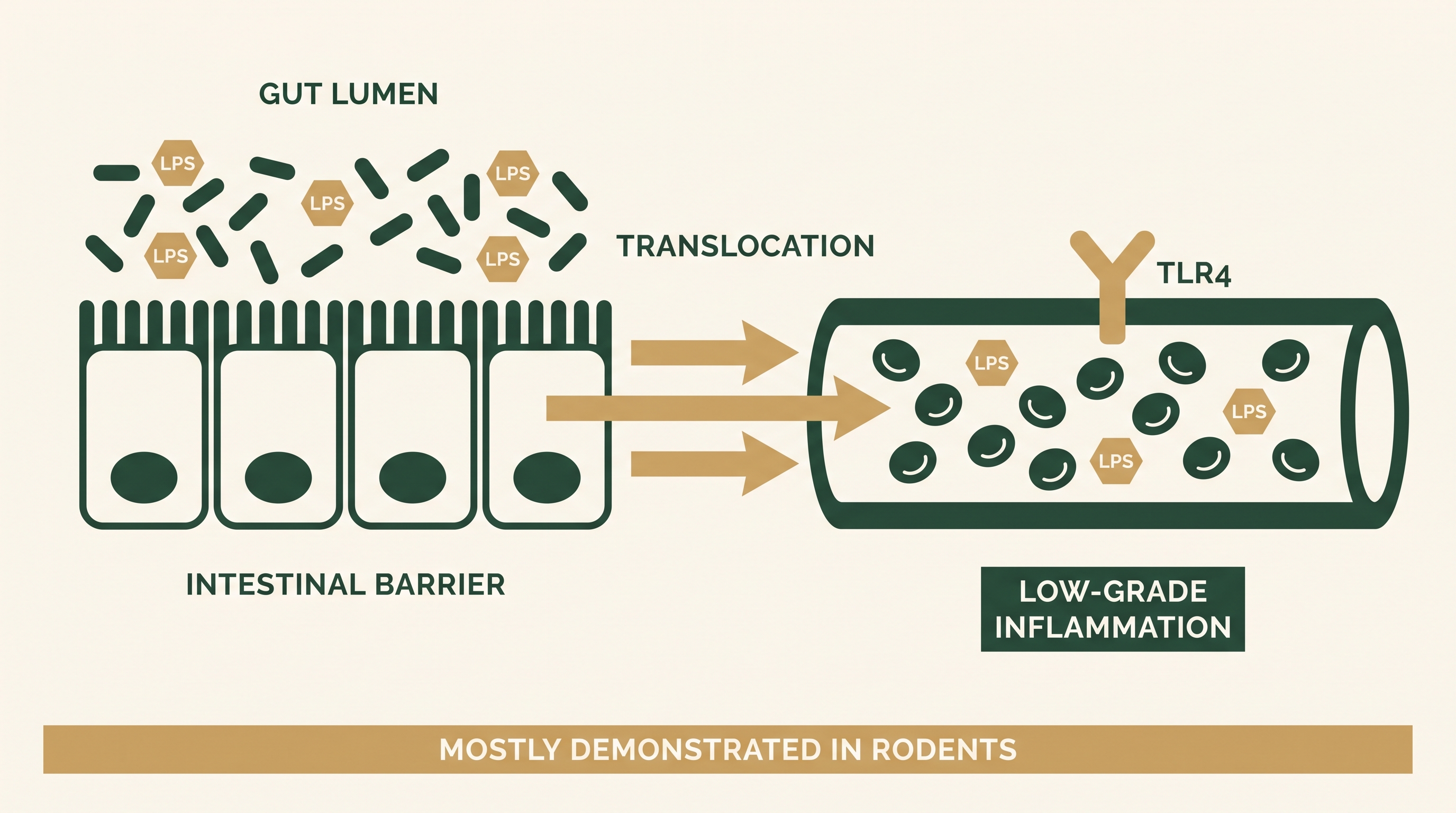
LPS stands for lipopolysaccharide. It's a large molecule that makes up the outer membrane of gram-negative bacteria, and your colon is full of gram-negative bacteria. Billions of them, right now, doing useful work.
LPS is structural. It's part of what those bacteria are built out of, and when they die and break apart, LPS fragments get released into the gut. That's normal. It happens every day of your life, and no diet stops it.
Your immune system takes LPS seriously because it's a reliable signature of bacterial presence. A receptor called TLR4 recognizes it and starts an inflammatory response. In a wound or a bloodstream infection, that reaction saves your life. Large amounts of LPS in the blood cause septic shock.
Metabolic endotoxemia is the hypothesis that a much smaller amount, roughly 2 to 3 times normal levels rather than the 1,000-fold spike of sepsis, drifts across the gut wall on a regular basis and keeps your immune system mildly annoyed forever. The proposed downstream result is chronic low-grade inflammation, insulin resistance, and weight gain.
Where did this idea come from?
One paper, mostly. In 2007, Patrice Cani and colleagues published a study in Diabetes titled "Metabolic endotoxemia initiates obesity and insulin resistance." It's been cited thousands of times and it launched the entire field.
Here's the part the carousels skip. That study was done in mice. Researchers fed mice a high-fat diet for 4 weeks and watched plasma LPS climb 2 to 3 fold. Then they pumped LPS directly under the skin of a second group of mice for 4 weeks and produced similar weight gain, fatty liver, and liver insulin resistance. Mice engineered without the CD14 receptor, which LPS needs to signal, resisted most of it.
As mouse work goes, that's a clean, well-designed experiment. It's also a mouse. A mouse given a continuous subcutaneous LPS infusion by a scientist is not a human eating pizza.
The founding study of "leaky gut makes you fat" was an infusion pump in a mouse.
Does the human evidence hold up?
Partly. And a 2025 critical review in the American Journal of Physiology argues the case is a lot shakier than the field assumes.
Bandy Chen and Laurent Gautron went through the literature and raised two problems. First, methodological: it's still unclear whether meaningful amounts of bioactive gut-derived LPS actually reach human blood. Second, theoretical: several parts of the hypothesis don't cohere well with each other.
They also point at an awkward finding. When lean and obese people are given an acute LPS challenge, they respond about the same, with cortisol as the main difference. If people with obesity were chronically marinating in low-level endotoxin, you'd expect their immune systems to look either tolerant or sensitized. Mostly they don't.
That's a real problem for the strong version of the theory. It's not a knockout blow, and the authors don't present it as one, but it's the kind of detail that never makes it into a supplement ad.
Why is blood endotoxin so hard to measure?
Because the standard test is genuinely bad at this job.
Endotoxin in blood is usually measured with the Limulus amebocyte lysate assay, which uses clotting factors from horseshoe crab blood. It was designed to check whether medical equipment is contaminated, and it's excellent at that. Human plasma is a much harder sample. Blood proteins and lipoproteins bind LPS and interfere with the reaction, results swing between labs, and the units it reports (endotoxin units per mL) don't map cleanly onto how much LPS is biologically active.
So a lot of researchers use a proxy instead: LBP, or lipopolysaccharide binding protein. Your liver makes more of it when there's more LPS around, so it's a smoother, more stable signal.
A 2025 systematic review and meta-analysis pooled 13 studies and found LBP levels significantly higher in people with metabolic syndrome than in people without it. Encouraging, until you read the authors' own caveats. Heterogeneity was extreme (I² of 99.7%), individual studies swung the pooled result around, and the Egger test flagged considerable publication bias. Their own conclusion asks readers to interpret the finding with caution.
I appreciate researchers who write that sentence about their own paper. It's rarer than it should be.

Does a high-fat meal really raise endotoxin in people?
This one has decent human data behind it.
A randomized crossover trial published in the American Journal of Clinical Nutrition in 2025 put 32 adults aged 50 to 79, half with obesity and half at normal weight, through 5 days of a 40% fat diet and 5 days of a 20% fat diet, with a washout in between.
The results, in humans, not mice:
- After a mixed meal, the rise in endotoxin was 1.8 times higher in participants with obesity than in normal-weight participants.
- Fasting endotoxin was higher after the high-fat diet than the low-fat diet in the obesity group (+0.13 EU/mL), with no significant change in the normal-weight group.
- Serum zonulin was higher after the high-fat diet and higher overall in the obesity group.
- Gram-negative bacteria in stool barely moved.
That last bullet is the interesting one. The authors concluded the endotoxin rise looked like a permeability effect rather than a change in which bacteria were present. The bugs stayed the same. What changed was how much got across.
One caveat on that zonulin result: zonulin as a barrier marker has serious credibility problems of its own, which I dug into in the zonulin test truth. The endotoxin measurements here stand on their own, though.
Is all LPS the same?
No, and this might be the most underrated finding in the whole area.
A 2021 Cell Reports paper from Jonathan Schertzer's lab at McMaster compared LPS from different bacterial species at matched endotoxin-unit doses in mice. LPS from E. coli impaired gut barrier function and worsened blood sugar control. An equal dose from Rhodobacter sphaeroides did not. It actually counteracted the damage from the E. coli LPS and improved glucose control in obese mice.
The difference comes down to lipid A acylation, a structural detail of the molecule that determines whether it turns TLR4 on or blocks it.
Which means "your endotoxin level is high" may be close to meaningless without knowing which bacteria it came from. Again, mice. But it's a strong argument that the whole one-number framing is too crude.
| Claim you'll see online | Evidence type | How solid |
|---|---|---|
| LPS infusion causes weight gain and insulin resistance | Rodent (Cani 2007) | Strong in mice, untested as an intervention in people |
| High-fat meals raise blood endotoxin | Human RCT crossover (2025) | Reasonable, effect larger in people with obesity |
| Endotoxin markers are higher in metabolic syndrome | Human meta-analysis (2025) | Associational, heavy heterogeneity and publication bias |
| All circulating LPS is harmful | Rodent (Cell Reports 2021) | Contradicted, source species changes the effect |
| Bioactive LPS routinely circulates in healthy people | Critical review (2025) | Actively disputed |
| A supplement can "flush LPS" from your blood | None | Marketing |
So what actually supports your gut barrier?
Here's where I have to be careful, because this is exactly the spot where supplement marketing goes feral.
Nothing I'm about to describe is a detox. There's no product that pulls endotoxin out of your bloodstream, and anyone selling you one is inventing a mechanism. What the research supports is much less dramatic and much more boring: the ordinary maintenance of the cells lining your colon.
Butyrate is the primary energy source for colonocytes. That's a fact of cell biology, not a claim. The cells lining your colon preferentially burn butyrate, a short-chain fatty acid produced when gut bacteria ferment fiber. Well-fed cells maintain their junctions better than starved ones.
Fiber feeds the bacteria that make it. Prebiotic fibers like chicory root inulin are fermented by Bifidobacterium and related species, and butyrate is one of the outputs. I went deeper on this in how to increase butyrate naturally and inulin and appetite.
There's some direct human evidence here too. An 8-week randomized trial in 16 endurance athletes found that 16g/day of prebiotic fiber blunted the rise in intestinal fatty acid binding protein, a marker of gut cell injury, during exercise heat stress, and lowered sCD14, a marker tied to bacterial endotoxin exposure. Small study, athletic population, specific stressor. Not proof of anything about your metabolism. But it's a human signal pointing the same direction as the mouse work.
Feed the cells that build the wall. That's the whole strategy, and it's less exciting than a detox.
For the fuller picture on barrier function, I'd start with leaky gut and inflammation and how to improve gut barrier function naturally. If you want the appetite side of the story, gut health and GLP-1 and the gut-brain axis cover how this system talks to your brain.
What does this mean for Ozzi?
Two of the ingredients in Ozzi's Crave Crusher are relevant to this topic, and I want to be precise about what I'm claiming.
500mg L-Lysine Butyrate (BIOMEnd) delivers butyrate directly. Butyrate is the primary energy source for the cells lining your colon. That's the claim, and it's a structure/function claim, not a treatment claim.
500mg chicory root inulin is a prebiotic fiber that feeds butyrate-producing bacteria. Same category of claim.
What I'm not going to tell you is that Ozzi lowers your endotoxin levels, seals anything, or reverses metabolic endotoxemia. There are zero human trials on L-Lysine Butyrate, none on Ozzi as a formula, and given how unreliable endotoxin measurement is in humans, I'd be skeptical of anyone who claims otherwise about their product either.
Ozzi is built for cravings and food noise. Butyrate is in there for gut support, and the honest version of that story is the one above. If you want the appetite mechanism instead, what is GLP-1 is the better starting point.
Fiber, butyrate, and a drink you'll actually finish
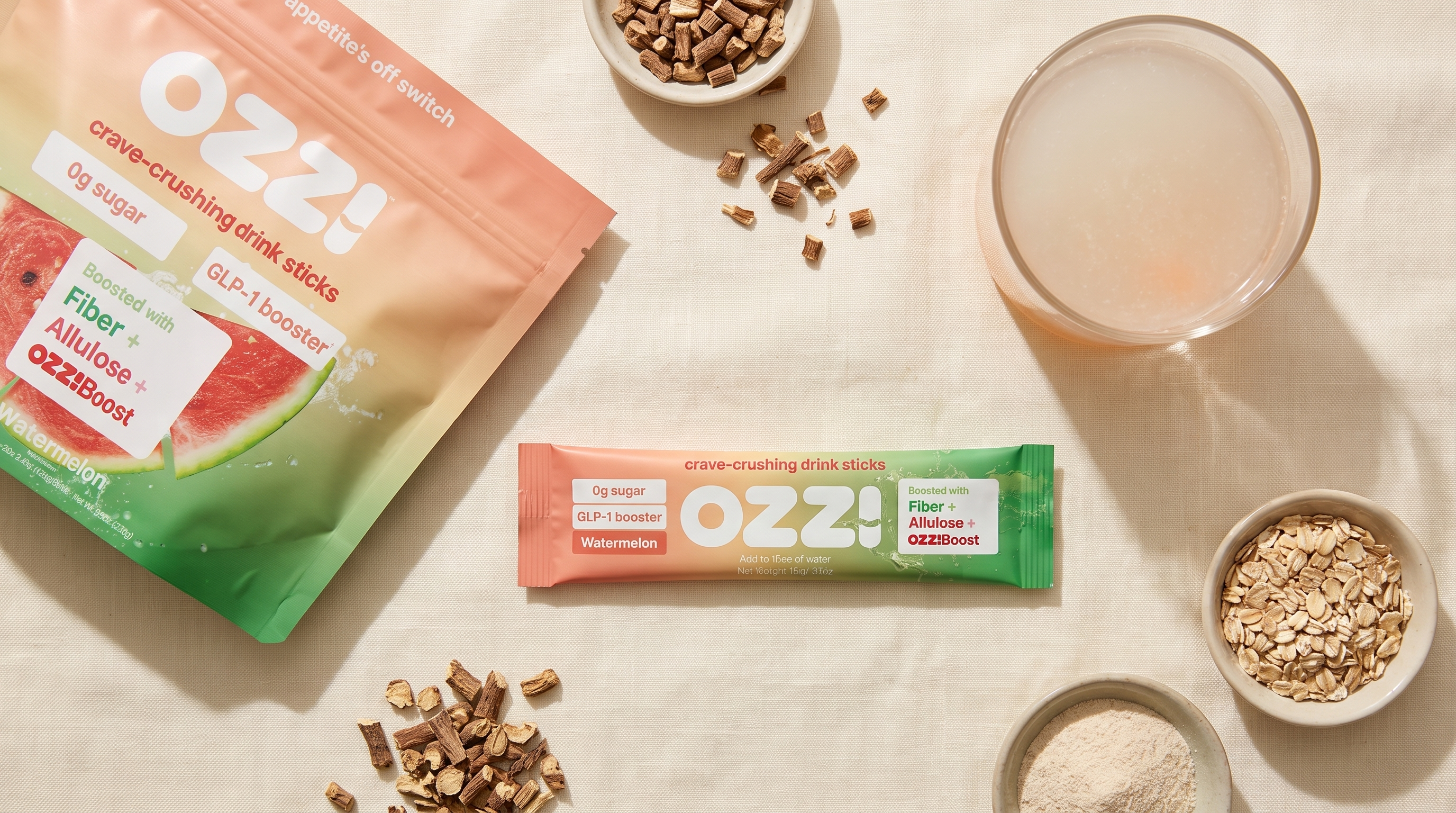
Ozzi Crave Crusher packs 8g allulose, 500mg L-Lysine Butyrate, 500mg chicory root inulin, and 500mg glucomannan into one watermelon stick. It supports natural GLP-1 production and quiets the 9pm pantry trip.
Try it for 14 days straight. If it doesn't work, we'll refund your first bag.
Frequently asked questions
What does LPS stand for?
Lipopolysaccharide. It's a molecule that forms the outer membrane of gram-negative bacteria, including many species that live in your colon. Endotoxin is another name for the same thing.
Is LPS a toxin I ate?
No. LPS is structural, part of what certain bacteria are built from. Your gut contains it constantly because your gut contains those bacteria. The question researchers debate is how much crosses into the blood and whether that amount matters.
Can I get my LPS levels tested?
Some labs offer it. I'd be cautious. The standard assay was built to test medical equipment for contamination, and human plasma interferes with it badly enough that results vary between labs. A 2025 review argued we can't say with confidence how much bioactive LPS normally circulates at all.
Is metabolic endotoxemia a real diagnosis?
No. It's a research hypothesis, not a clinical condition. No doctor will diagnose you with it, and there's no established treatment protocol.
Does a high-fat diet cause endotoxemia in humans?
A 2025 randomized crossover trial found that 5 days of a 40% fat diet raised fasting endotoxin in older adults with obesity, but not in normal-weight participants. Postprandial rises were 1.8 times larger in the obesity group. So the effect appears real, and it appears to depend on who you are.
Can a supplement lower my LPS levels?
No supplement has been shown to do that in humans in any way I'd consider convincing, and given the measurement problems, it would be hard to prove. Products marketed as "LPS detox" are selling a mechanism that hasn't been demonstrated.
Does butyrate help with LPS?
Butyrate is the primary energy source for colonocytes, the cells lining your colon, which is a well-established piece of cell biology. Most of the specific work connecting butyrate to barrier function and endotoxin comes from animal and cell studies. I wouldn't extrapolate it to a human endotoxin claim.
Does butyrate raise GLP-1?
Not in humans, as far as the evidence shows. The GLP-1 connection comes from mouse and cell studies. A human trial that successfully raised circulating butyrate measured GLP-1 and found no change. Anyone telling you butyrate raises human GLP-1 is ahead of the data.
Is inflammation from LPS why I have cravings?
There's no good human evidence for that specific chain. Cravings and food noise are driven by appetite hormones, blood sugar swings, sleep, stress, and habit. The gut is involved, but "LPS causes your cravings" is a leap nobody has earned.
What should I actually do?
Eat more fiber from real food, don't build your diet around repeated very-high-fat meals if you're managing metabolic risk, and treat any product that promises to detox endotoxin from your blood as a red flag.
The honest summary
Metabolic endotoxemia is a plausible, actively contested hypothesis with excellent rodent support, uneven human support, and a measurement problem sitting underneath all of it. It's not a scam. It's also not the settled fact that supplement marketing treats it as.
The practical advice that falls out of it is unglamorous. Feed your gut bacteria fiber. Give your colon cells the fuel they run on. Skip anything sold as a detox.
I'd rather tell you that than sell you a story the papers don't support.
Butyrate you can actually drink
Ozzi Crave Crusher
500mg of BIOMEnd L-lysine butyrate per stick, the form rated most palatable of three in a 2025 human trial, alongside allulose, konjac fiber, chromium and African mango. No capsules, no caffeine, and no butyric acid smell.
See what's in it →References
- Cani PD, Amar J, Iglesias MA, et al. Metabolic endotoxemia initiates obesity and insulin resistance. Diabetes. 2007;56(7):1761-72. Rodent study. https://doi.org/10.2337/db06-1491
- Chen B, Gautron L. Gut-derived lipopolysaccharides and metabolic endotoxemia: a critical review. Am J Physiol Endocrinol Metab. 2025;329(5):E746-E754. Critical review. https://doi.org/10.1152/ajpendo.00355.2025
- Ogilvie AR, Onishi JC, Schlussel Y, et al. Short-term high fat diet-induced metabolic endotoxemia in older individuals with obesity: a randomized crossover study. Am J Clin Nutr. 2025;122(2):601-611. Human randomized crossover trial. https://doi.org/10.1016/j.ajcnut.2025.06.001
- Mazaheri-Tehrani S, Rezaei F, Heidari-Hasanabadi S, et al. Serum lipopolysaccharide binding protein (LBP) and metabolic syndrome: a systematic review and meta-analysis. Diabetol Metab Syndr. 2025;17(1):268. Human meta-analysis. https://doi.org/10.1186/s13098-025-01847-w
- Anhê FF, Barra NG, Cavallari JF, Henriksbo BD, Schertzer JD. Metabolic endotoxemia is dictated by the type of lipopolysaccharide. Cell Rep. 2021;36(11):109691. Rodent study. https://doi.org/10.1016/j.celrep.2021.109691
- Rauch CE, Henningsen K, Martinez I, et al. The effects of prebiotic supplementation on markers of exercise-induced gastrointestinal syndrome in response to exertional heat stress. Int J Sport Nutr Exerc Metab. 2025;35(4):273-290. Human randomized trial. https://doi.org/10.1123/ijsnem.2024-0127
- Shahamati D, Akhavan NS, Rosenkranz SK. Postprandial inflammation in obesity: dietary determinants, adipose tissue dysfunction and the gut microbiome. Biomolecules. 2025;15(11):1516. Narrative review. https://doi.org/10.3390/biom15111516
- Aziz A, Adil MZ, Altaf M, Wang M, Cheong KL. Gastrointestinal tract remodeling by dietary polysaccharides: mechanistic insights in colitis. Foods. 2026;15(13):2267. Review, mechanistic and preclinical. https://doi.org/10.3390/foods15132267
This article is for general information and isn't medical advice. Ozzi is a dietary supplement and isn't intended to diagnose, treat, cure, or prevent any disease. Talk to your doctor before changing your diet or starting a supplement, especially if you manage a metabolic or digestive condition.
