

The Zonulin Test Truth: What Your "Leaky Gut" Result Actually Measures (2026)
Somebody in a Facebook group tells you to get your zonulin checked. You order a $150 panel, spit or bleed into a tube, and three weeks later a PDF arrives with a number and a red bar next to it.
High zonulin. Leaky gut confirmed. Time to buy the protocol.
Here's the problem with that chain of reasoning: the assay in the middle of it has been failing independent validation for eight years, and almost nobody selling the test mentions it.
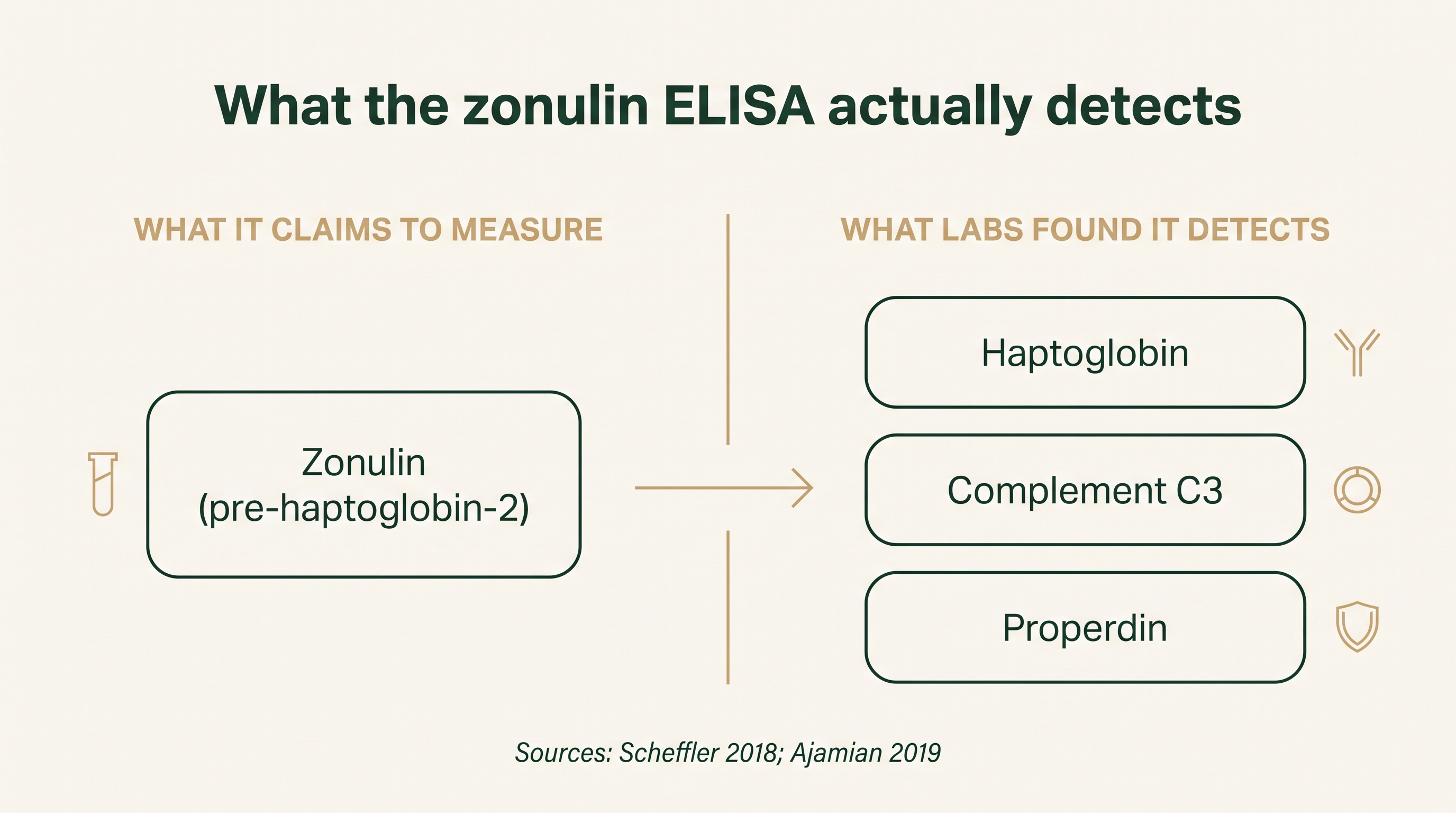
Commercial zonulin ELISA kits do not reliably detect zonulin. Independent labs using mass spectrometry found the kits detect haptoglobin, complement C3, and properdin instead. A high zonulin result tells you a mixed group of blood proteins was elevated, not that your intestinal barrier is measurably leaking.
Key takeaways
- Zonulin was identified in 2009 as pre-haptoglobin-2, a tight junction regulator.
- A 2018 study found commercial kits failed to detect pre-haptoglobin-2 entirely.
- Mass spectrometry showed the kits detect haptoglobin, complement C3, and properdin.
- Zonulin's discoverer now calls the measured proteins "zonulin family peptides."
- Lactulose-mannitol testing remains the established research method for permeability.

What is zonulin supposed to measure?
Zonulin has a real scientific origin story, and it's a good one.
In 2009, Alessio Fasano's group at the University of Maryland published a paper in PNAS identifying human zonulin as pre-haptoglobin-2, the uncleaved precursor of a common blood protein. They showed it could loosen the tight junctions between intestinal cells, which is the physical seam that decides what crosses from your gut into your bloodstream.1
That was a genuinely important finding. Up to that point, "leaky gut" was a concept without a measurable protein attached to it. Fasano gave the field a molecule.
The logic that followed was simple. If zonulin opens tight junctions, and you can measure zonulin in blood, then blood zonulin should tell you how open your gut is. Diagnostic companies built ELISA kits on that premise and started selling them to functional medicine clinics.
The kits sold well. Then other labs tried to check the work.
Why do researchers say the zonulin test is broken?
In 2018, a German group published a study in Frontiers in Endocrinology that should have ended the conversation.
They measured serum zonulin in 376 people from the Sorbs cohort, a well-characterized German population, and genotyped every participant's haptoglobin gene. Here's the part that matters: roughly 15% of people carry the HP1-1 genotype, which means they cannot produce pre-haptoglobin-2 at all. No pre-HP2, no zonulin.
Those people still got zonulin readings. Zonulin concentrations showed no relationship to haptoglobin genotype whatsoever.2
So the researchers ran the obvious control. They fed the ELISA kit increasing concentrations of recombinant pre-haptoglobin-2, the exact protein it claims to detect. The kit didn't detect it. Then they used mass spectrometry and Western blot with the kit's own antibodies to figure out what it was binding to, and landed on properdin, a complement system protein.2
People genetically incapable of making zonulin were still getting zonulin results.
A separate Australian team at Monash reached the same destination by a different road. Publishing in PLoS One in 2019, Ajamian and colleagues ran two commercial kits through mass spectrometry and found the CUSABIO assay's top antigen matches were haptoglobin and complement C3, while the Immundiagnostik assay was picking up complement C3.3
Their title said the quiet part: "May not be what it seems."
What did the kits actually detect?
Here's the side-by-side, with the species and method labeled so you can judge the strength of each finding yourself.
| Study | Method | What the assay detected | Evidence type |
|---|---|---|---|
| Tripathi 2009 (PNAS) | Protein purification, tissue assays | Identified zonulin as pre-haptoglobin-2 | Human tissue plus rodent |
| Scheffler 2018 (Front Endocrinol) | ELISA vs. genotype, mass spec, Western blot | Properdin. Did not detect recombinant pre-HP2 | Human, 376 participants |
| Ajamian 2019 (PLoS One) | Mass spectrometry on two commercial kits | Haptoglobin and complement C3 | Human serum |
| Massier 2021 (Gut, letter) | Review of assay literature | Concluded the shortcomings mislead the field | Commentary |
What does zonulin's discoverer say about all this?
Fasano responded in Gut in 2021, and his answer is more interesting than a flat denial.
He argued that the commercial ELISAs are picking up proteins that are structurally and functionally related to the zonulin he originally described, and proposed calling the whole group "zonulin family peptides," or ZFPs.5 The German group's reply, published in the same journal, was that renaming the problem doesn't solve it.4
Both positions can be partly right. Maybe the kits are detecting a family of related proteins that do something meaningful. Maybe they're detecting acute-phase reactants that go up whenever you're inflamed, which would explain a lot of the published correlations without requiring a gut barrier explanation at all.
What you can't do is take a single number off a consumer panel and read it as a measurement of your intestinal permeability. The assay hasn't earned that.
Renaming what the test detects doesn't tell you what the number means for your gut.
Is fecal zonulin any better than the blood test?
Fecal zonulin shows up on a lot of stool panels now, marketed as the more direct version. The data is thinner than the marketing.
A 2025 prospective cohort in Medicina evaluated fecal zonulin in 52 participants and found its diagnostic performance fell short of what you'd want from a standalone biomarker. At the threshold that maximized accuracy, 57.0 ng/mL, sensitivity was 68.2% and specificity was 63.3%.6
Put plainly: roughly a third of people with the condition tested negative, and roughly a third without it tested positive. The authors were appropriately careful, suggesting it might contribute something inside a larger panel. That's a long way from "your zonulin is high, here's your protocol."
How do researchers actually measure intestinal permeability?
The method that's held up since the 1970s is the lactulose-mannitol test.
You fast, drink a solution containing both sugars, then collect urine for several hours. Mannitol is small and crosses through the cells. Lactulose is larger and only gets through if the junctions between cells are loose. Neither sugar is metabolized, so whatever shows up in your urine got there by crossing your gut wall. The ratio between them is the readout.7
It's slow, it's inconvenient, and it mostly lives in research settings rather than consumer testing. Which is precisely why zonulin ELISAs got popular. A single blood draw is easier to sell than a six-hour urine collection.
Easier to sell and easier to interpret are different things.
So what should you do instead of buying a zonulin test?
Three honest suggestions.
Skip the standalone consumer zonulin panel. Whatever the number says, you won't be able to act on it with any confidence. If a practitioner has ordered it as one input among many and can explain the caveats, that's a different situation.
Take symptoms seriously even without a biomarker. Bloating, urgency, food reactions, and fatigue are real whether or not a test confirms them. The absence of a validated blood marker doesn't mean the absence of a problem. Talk to a gastroenterologist, especially if symptoms are new or worsening.
Feed the parts of the system we understand better. The gut barrier's energy economy is far better characterized than any single blood marker of it. Roediger showed back in 1980, using isolated human colonocytes, that butyrate is the primary respiratory fuel for the cells lining the colon.8 That finding has held up for over four decades.
Fiber that reaches your colon feeds the bacteria that make butyrate. More on the practical routes in our guide to increasing butyrate naturally, and the broader context in leaky gut and inflammation.
Where does Ozzi fit into this?
I'll be direct, because being vague here would make me part of the problem I just spent 1,500 words describing.
Ozzi Crave Crusher contains 500mg of L-Lysine Butyrate and 500mg of chicory root inulin per stick. Butyrate is the primary energy source for the cells lining your colon. Chicory root inulin is a prebiotic fiber that feeds butyrate-producing bacteria. Those are structure/function statements, and they're the honest limit of what I'll claim.
What I won't tell you: that Ozzi seals a leaky gut, lowers your zonulin, or fixes your intestinal barrier. There are zero human randomized trials on L-Lysine Butyrate. The GLP-1 mechanism people cite for butyrate comes from mouse and cell studies, and a human trial that successfully raised circulating butyrate measured GLP-1 as a secondary outcome and found no change. We cover that honestly in butyrate and GLP-1 and our butyrate supplement picks.
Most people buy Ozzi for a much more concrete reason: the 9pm kitchen loop. Night cravings, food noise, the monster that comes out after a day of eating well. That's what the 8g of allulose and 500mg of glucomannan are doing, and it has nothing to do with your gut barrier.
If you want the fuller picture of how the microbiome connects to appetite, start with gut health and GLP-1 and the gut-brain axis. And if you enjoyed watching a popular gut claim get taken apart, we did the same thing to the "95% of serotonin is in your gut" stat and to inulin's appetite claims.
Skip the test. Try the thing.
500mg butyrate, 500mg chicory root inulin, 8g allulose, and no claims we can't back up. Try it for 14 days straight. If it doesn't work, we'll refund your first bag.
Frequently asked questions
Is the zonulin test accurate?
Independent validation studies say no. A 2018 study found the widely used commercial ELISA failed to detect recombinant pre-haptoglobin-2, the protein zonulin was identified as, and detected properdin instead. A 2019 mass spectrometry study found two other kits detecting haptoglobin and complement C3.
Should I get my zonulin tested?
For a standalone consumer panel, probably not. The result won't give you an actionable measurement of gut permeability. If a clinician is using it as one input among several and can explain the limitations, that's a reasonable use.
What does a high zonulin result mean?
It means a group of blood proteins the assay binds to was elevated. Some of those, like complement C3 and haptoglobin, rise with general inflammation. It does not confirm that your intestinal barrier is leaking.
Is leaky gut real?
Increased intestinal permeability is a real, measurable phenomenon documented in celiac disease, Crohn's, and several other conditions. The disagreement is about whether one commercial blood test can measure it, and whether "leaky gut syndrome" as sold online is a coherent diagnosis.
What test do researchers use instead?
The lactulose-mannitol urine test, which has been the reference method since the 1970s. You drink both sugars and measure their ratio in urine over several hours.
Is fecal zonulin more reliable than serum zonulin?
The evidence is thin. A 2025 cohort of 52 participants reported sensitivity of 68.2% and specificity of 63.3% at its best-performing threshold, which the authors noted fell short of standalone biomarker performance.
Does butyrate lower zonulin?
We wouldn't make that claim, and neither should anyone selling you butyrate. Since the assay's validity is disputed, a change in the number wouldn't clearly mean anything anyway. Butyrate's best-established role is as the primary energy source for colon cells.
Does Ozzi help with gut barrier function?
Ozzi provides 500mg of L-Lysine Butyrate and 500mg of chicory root inulin per stick. Butyrate is the primary energy source for the cells lining your colon, and inulin is a prebiotic fiber that feeds butyrate-producing bacteria. There are no human randomized trials on L-Lysine Butyrate specifically.
Why do so many published studies use zonulin if the test is questionable?
Momentum and convenience. The kits were commercially available and easy to run, and many papers were published before the validation problems were widely known. Several reviewers have argued this contaminated a chunk of the intestinal permeability literature.
References
- Tripathi A, Lammers KM, Goldblum S, et al. Identification of human zonulin, a physiological modulator of tight junctions, as prehaptoglobin-2. Proc Natl Acad Sci U S A. 2009;106(39):16799-16804. doi:10.1073/pnas.0906773106 (PMID: 19805376)
- Scheffler L, Crane A, Heyne H, et al. Widely Used Commercial ELISA Does Not Detect Precursor of Haptoglobin2, but Recognizes Properdin as a Potential Second Member of the Zonulin Family. Front Endocrinol. 2018;9:22. doi:10.3389/fendo.2018.00022 (PMID: 29459849)
- Ajamian M, Steer D, Rosella G, Gibson PR. Serum zonulin as a marker of intestinal mucosal barrier function: May not be what it seems. PLoS One. 2019;14(1):e0210728. doi:10.1371/journal.pone.0210728 (PMID: 30640940)
- Massier L, Chakaroun R, Kovacs P, Heiker JT. Blurring the picture in leaky gut research: how shortcomings of zonulin as a biomarker mislead the field of intestinal permeability. Gut. 2021;70(9):1801-1802. doi:10.1136/gutjnl-2020-323026
- Fasano A. Zonulin measurement conundrum: add confusion to confusion does not lead to clarity. Gut. 2021;70(10):2007-2008. doi:10.1136/gutjnl-2020-323367 (PMID: 33177164)
- Fecal Zonulin as a Non-Invasive Marker of Intestinal Permeability: Findings from a Prospective Cohort Study. Medicina (Kaunas). 2025. PMC12471543
- Biomarkers for assessment of intestinal permeability in clinical practice. Am J Physiol Gastrointest Liver Physiol. 2021;321(3). doi:10.1152/ajpgi.00113.2021 (PMID: 34009040)
- Roediger WEW. Role of anaerobic bacteria in the metabolic welfare of the colonic mucosa in man. Gut. 1980;21(9):793-798. doi:10.1136/gut.21.9.793 (PMID: 7429343)
