

The '90% of Serotonin Is in Your Gut' Myth: What That Stat Actually Means (2026)
Key takeaways
- About 90 to 95 percent of body serotonin is made in the gut. That part is true.
- Gut serotonin can't cross the blood-brain barrier, so it doesn't directly set mood.
- Gut and brain use two separate enzymes: TPH1 in the gut, TPH2 in the brain.
- The gut still talks to the brain, through the vagus nerve and gut hormones.
- Gut serotonin's real jobs are digestion, gut movement, and metabolism.
Around 90 to 95 percent of the body's serotonin is produced in the gut, mostly by enterochromaffin cells lining the intestine. But that serotonin can't cross the blood-brain barrier, so it doesn't directly raise the serotonin your brain uses for mood. Gut and brain serotonin are two separate systems.
You've seen the line. "95 percent of your serotonin is made in your gut, so fix your gut to fix your mood." It's on supplement labels, wellness reels, and probably three podcasts you half-listened to this week.
The stat is real. The conclusion glued to it is where things go sideways.
I sell a gut-focused drink for a living, so trust me when I say I have every reason to want the simple version to be true. It just isn't. Here's what that number actually means, and why the honest version is more useful than the myth.

Is it true that most of your serotonin is in your gut?
Yes. This is the part the memes get right.
Most estimates put roughly 90 to 95 percent of the body's serotonin in the gut, produced mainly by enterochromaffin cells that line the intestinal wall (O'Mahony et al., 2015). The rest sits in platelets in your blood and in your brain.
So when someone says your gut is the body's biggest serotonin factory, they're correct. The factory is real and it's busy.
The problem starts with the next sentence, when "your gut makes most of your serotonin" quietly becomes "your gut controls your happiness." Those are very different claims, and only the first one has the evidence.
Why doesn't gut serotonin control your mood?
Because it can't get to your brain.
Serotonin doesn't cross the blood-brain barrier, the tight security wall around your brain (El-Merahbi et al., 2015). The serotonin your gut pumps out stays on the body side of that wall. It never reaches the neurons that use serotonin for mood.
That leaves you with two separate pools. Gut serotonin does gut and body work. Brain serotonin does brain work. They don't pour into each other.
The serotonin in your gut and the serotonin in your brain live behind different walls. The stat is true. The bridge people imagine between them mostly isn't there.
Your brain also builds its own supply from scratch. It doesn't import serotonin from the gut, it manufactures it locally, on demand.
How can there be two separate serotonin systems?
Because your body makes serotonin with two different enzymes, in two different places.
The rate-limiting step in making serotonin is an enzyme called tryptophan hydroxylase. It comes in two versions (Gao et al., 2020). One version, TPH1, works in the gut and other peripheral tissues. The other, TPH2, works in the brain and nervous system.
Same molecule at the end. Different assembly lines that never share stock.
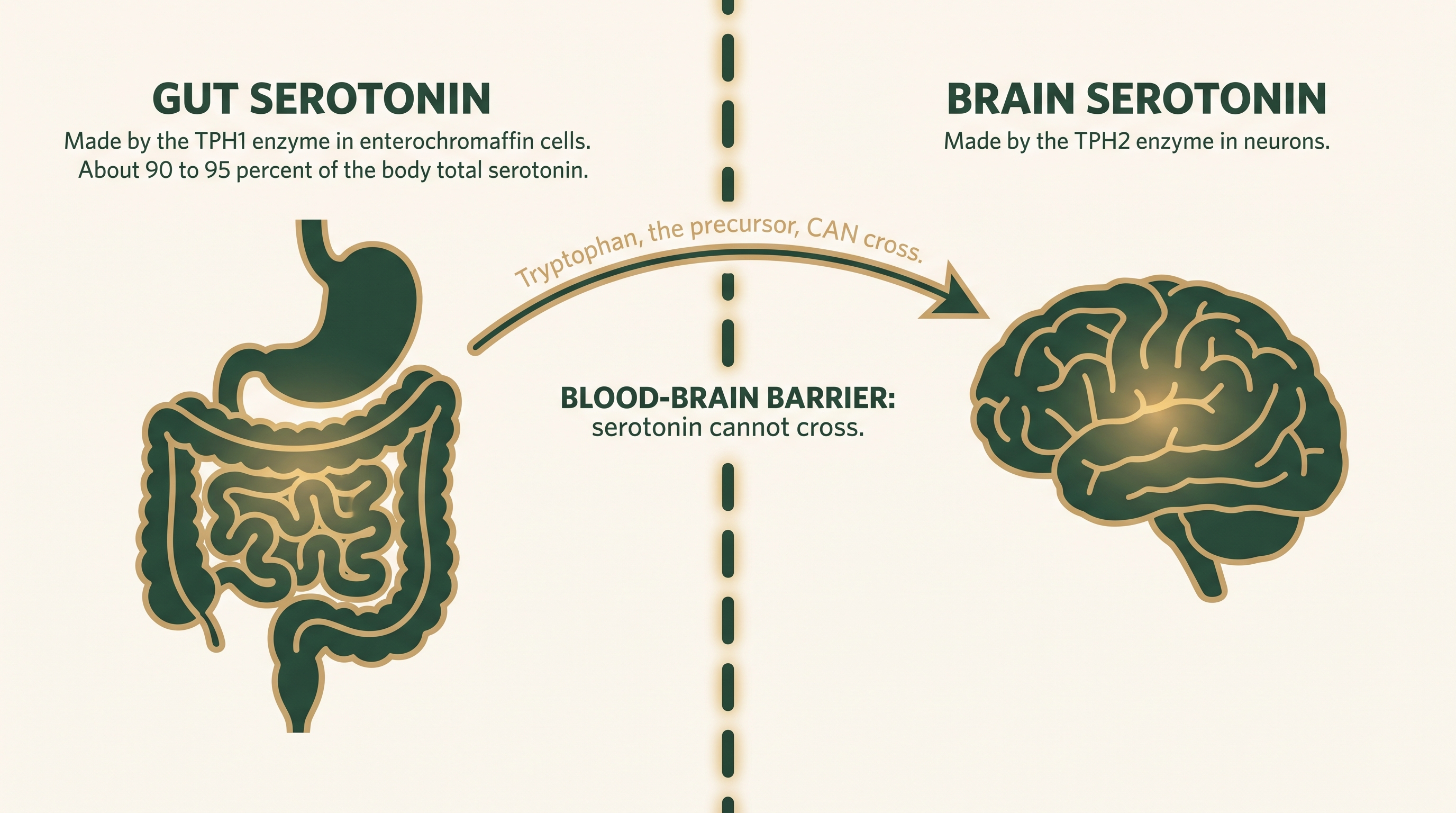
Here's the table version, because it makes the split obvious.
| Feature | Gut serotonin | Brain serotonin |
|---|---|---|
| Share of body total | About 90 to 95 percent | A tiny fraction (roughly 1 to 2 percent) |
| Made by | TPH1 enzyme, enterochromaffin cells | TPH2 enzyme, neurons |
| Crosses into the brain? | No | Already there |
| Main jobs | Gut movement, secretion, platelets, metabolism | Mood, appetite signaling, sleep, cognition |
What does gut serotonin actually do?
Plenty. It's just not moonlighting as your mood chemical.
Gut serotonin helps run digestion. It drives gut motility, the muscle contractions that move food along, and it triggers secretion in the intestine (O'Mahony et al., 2015). This is why serotonin signaling ties into nausea and bowel changes, and why some gut drugs target serotonin receptors.
It also has a metabolic side. Peripheral serotonin influences how tissues handle glucose and fat, and it plays a role in the pancreas, liver, and fat cells (El-Merahbi et al., 2015). Useful work. Body work, not brain work.
So the gut serotonin story is genuinely interesting. It just points at digestion and metabolism, not at whether you feel good on a Tuesday.
Does the gut microbiome affect serotonin at all?
It does, but read the fine print on the studies.
In mice, specific gut bacteria increase serotonin production by the enterochromaffin cells in the colon (Yano et al., 2015). Certain microbes and their metabolites, including short-chain fatty acids, nudge those cells to make more. This is real, and it's a big reason the gut-serotonin idea took off.
Two honest caveats. First, most of this is mouse research, not proof of the same effect in humans. Second, even in those studies, the serotonin that goes up is gut serotonin, on the body side of the blood-brain barrier. The mouse data does not show gut bacteria cranking up brain serotonin and lifting mood.
Gut bacteria can raise gut serotonin. In mice. That is a real finding and a much smaller claim than the labels make it sound.
So how do the gut and brain actually talk?
Through other channels, not by shipping serotonin across the border.
The gut-brain axis is a two-way line built from the vagus nerve, immune signals, and gut hormones (O'Mahony et al., 2015). Your gut senses what's happening and sends messages up. Those messages can influence appetite, fullness, and how your brain reads hunger.
There's also the precursor angle. Serotonin can't cross the blood-brain barrier, but tryptophan, the amino acid your body builds serotonin from, can (Gao et al., 2020). Gut bacteria affect how much tryptophan is available and where it gets routed, which is a plausible, indirect way the gut could touch brain chemistry. Plausible and indirect, not the one-step "boost gut serotonin, boost mood" pipeline.
If you want the fuller picture of how the gut steers hunger, that's covered in gut health and GLP-1.
Then why is the serotonin-mood story so popular?
Because it's a clean, simple story, and simple stories travel.
It also borrows credibility from antidepressants. SSRIs act on brain serotonin, so "serotonin equals mood" feels settled. It's messier than that. A 2022 umbrella review found the evidence that low serotonin causes depression is weak and inconsistent (Moncrieff et al., 2022). Serotonin matters in the brain, but the "low serotonin causes sadness" model was always thinner than the marketing suggested.
Stack a shaky brain claim on top of a real gut stat, and you get a confident sentence that sounds airtight and mostly isn't.
What should you actually do with your gut then?
Feed it well and let it do its real jobs.
A gut that runs well supports digestion, steady energy, and the appetite signaling that keeps food noise quieter. That's the lane where gut care earns its keep, and it's the honest version of "gut health matters."
Fiber and prebiotics feed the bacteria that produce short-chain fatty acids like butyrate. Butyrate is the primary energy source for the cells lining your colon and supports gut barrier function. In preclinical studies, butyrate is also part of the proposed pathway for natural GLP-1 support, your fullness signal (more on the honest state of that evidence in butyrate and GLP-1).
All of that is the boring, useful stuff: fiber, prebiotics, and the appetite signaling that actually helps you get through the evening. It won't touch your mood serotonin, and it doesn't need to. If the constant food thoughts are your main problem, how to stop food noise naturally is the more useful read.
Work with your gut, skip the myths
Ozzi Crave Crusher is a GLP-1 supporting drink stick built on fiber, prebiotics, and butyrate. It supports your natural GLP-1, your fullness signal, so the 9pm pantry run stops running you. Zero caffeine, 5 calories, watermelon.
Try it for 14 days straight. If it doesn't work, we'll refund your first bag.
Frequently asked questions
Is 90 percent of serotonin really made in the gut?
Yes. Most estimates land around 90 to 95 percent, made mainly by enterochromaffin cells in the intestinal lining. That figure is well supported.
Does gut serotonin reach the brain?
No. Serotonin can't cross the blood-brain barrier, so gut serotonin stays on the body side and never enters the brain's serotonin supply.
Can I boost my mood by boosting gut serotonin?
There's no good evidence for that. Gut serotonin and brain serotonin are separate pools made by separate enzymes. Raising one doesn't raise the other.
Why do people say gut health improves mood then?
The gut and brain do communicate, through the vagus nerve, immune signals, and gut hormones. That's real. It just isn't gut serotonin traveling to the brain.
What is gut serotonin for?
Digestion and body functions. It drives gut motility and secretion, sits in blood platelets, and plays a role in glucose and fat metabolism.
Do probiotics increase serotonin?
In mice, some gut bacteria raise gut serotonin. Most of that research is preclinical, and even there the increase is gut serotonin, not brain serotonin.
Does tryptophan cross the blood-brain barrier?
Yes. Tryptophan, the amino acid serotonin is built from, can cross into the brain, even though finished serotonin cannot. That's one indirect way the gut may touch brain chemistry.
Does Ozzi raise serotonin?
No, and we won't claim it does. Ozzi works on gut-brain appetite signaling with fiber, prebiotics, and butyrate to support your natural GLP-1. It's an appetite and cravings tool, not a serotonin product.
- O'Mahony SM, Clarke G, Borre YE, Dinan TG, Cryan JF. Serotonin, tryptophan metabolism and the brain-gut-microbiome axis. Behav Brain Res. 2015;277:32-48. https://doi.org/10.1016/j.bbr.2014.07.027 (review)
- El-Merahbi R, Loffler M, Mayer A, Sumara G. The roles of peripheral serotonin in metabolic homeostasis. FEBS Lett. 2015;589(15):1728-1734. https://doi.org/10.1016/j.febslet.2015.05.054 (review)
- Gao K, Mu CL, Farzi A, Zhu WY. Tryptophan Metabolism: A Link Between the Gut Microbiota and Brain. Adv Nutr. 2020;11(3):709-723. https://doi.org/10.1093/advances/nmz127 (review)
- Yano JM, Yu K, Donaldson GP, et al. Indigenous bacteria from the gut microbiota regulate host serotonin biosynthesis. Cell. 2015;161(2):264-276. https://doi.org/10.1016/j.cell.2015.02.047 (mouse and in-vitro)
- Moncrieff J, Cooper RE, Stockmann T, Amendola S, Hengartner MP, Horowitz MA. The serotonin theory of depression: a systematic umbrella review of the evidence. Mol Psychiatry. 2023;28(8):3243-3256. https://doi.org/10.1038/s41380-022-01661-0 (human umbrella review)
