

GLP-1 Pills vs Drinks: Which Format Actually Works Better in 2026?
Key takeaways
- Drinks deliver pre-dissolved active ingredients straight to the gut, no breakdown lag.
- Soluble fiber needs water and volume to expand and trigger satiety, capsules can't replicate that.
- Allulose stimulates GLP-1 release in the gut and works fastest in liquid form.
- Pill fatigue causes roughly 1 in 5 users to quit supplements within weeks.
- A daily ritual drink beats a 4-capsule stack for long-term adherence.
If you've stared at the supplement aisle wondering whether to grab the bottle of capsules or the box of stick packs, you're asking the right question. Format matters more than most brands want you to know.
I started Ozzi because I was tired of stacking six different capsules every morning, choking down chalky tablets, and still feeling food noise crawling up around 8 p.m. So we built a drink. But that's not the whole answer.
Here's what the science actually says about GLP-1 pills vs drinks, and how to pick the format that fits how your body and your day actually work.
GLP-1 drinks generally outperform GLP-1 pills for appetite control because liquid delivery skips digestion, soluble fiber needs water to gel and trigger fullness, and a daily ritual drink has higher adherence than a multi-capsule stack. Pills work better for single isolated compounds with proven oral bioavailability.
What's the actual difference between a GLP-1 pill and a GLP-1 drink?
Both formats are trying to do the same job: nudge your body to produce more of its own GLP-1, the hormone that tells your brain you're full. Where they split is in how the active ingredients get from your hand into your bloodstream.
A pill is a compressed or encapsulated dose of an isolated compound. Your stomach acid breaks down the shell, then the powder dissolves, then the small intestine absorbs whatever survives that gauntlet. Time to peak effect: usually 45 to 90 minutes, depending on the compound.
A properly formulated GLP-1 drink delivers pre-dissolved ingredients in 12 to 16 oz of water. Soluble fiber starts expanding in your stomach within minutes. Sugar replacers like allulose hit the gut and trigger L-cells (the cells that release GLP-1) almost immediately.
That's the structural difference. Now let's look at the data.
Do liquid supplements absorb better than pills?
Sometimes yes, sometimes it doesn't matter. The honest answer depends on the ingredient.
For fat-soluble vitamins and certain herbal compounds, liquid forms have shown faster and more complete absorption than tablets in pharmacology trials.1 A study in the Journal of Pharmacy and Pharmacology documented this for several actives, noting that pills require digestive breakdown before any nutrient becomes bioavailable.
But here's the nuance most "liquid is better" marketing skips. Berberine, a popular GLP-1 ingredient, has notoriously poor oral bioavailability regardless of format. Standard berberine capsules and unformulated berberine in water both struggle to clear first-pass liver metabolism.2 Berberine needs phytosome or liposomal delivery to absorb meaningfully, and that's true in pill or liquid.
The real win for drinks isn't a blanket "96% better absorption" claim. It's that the ingredients that do work in liquid (fiber, allulose, glycine, electrolytes) get to work faster and more reliably.
"Pre-dissolved ingredients don't wait for your stomach acid to do the work. They're already ready."
How does the format affect GLP-1 release in the gut?
GLP-1 isn't a single switch. It's a cascade that starts when your gut detects food (or compounds that mimic food signals). Volume, viscosity, and timing all matter.
Volume matters. Stomach stretch is one of the earliest satiety signals. A 16 oz drink physically expands the stomach, sending vagal signals to the brain before any nutrient gets absorbed. A 0.5 oz capsule with a sip of water does almost nothing for stretch.
Viscosity matters. Soluble fiber from sources like glucomannan or partially hydrolyzed guar gum needs water to form a gel. That gel slows gastric emptying, which prolongs GLP-1 release for up to 3 hours after a meal.3 A capsule of fiber powder sitting in a dry stomach can't gel the same way.
Timing matters. Allulose triggers L-cells to release GLP-1 within 30 to 60 minutes of consumption.4 In liquid form, that response starts in the upper intestine almost immediately. In a slow-release capsule, the trigger gets blunted.
If you're trying to flatten a craving wave that hits at 3 p.m. or 9 p.m., speed of onset is the whole game.
Which format actually wins for craving control?
Drinks. And not because of marketing. Because of mechanism.
Cravings are mostly a sensory and timing problem. Food noise tends to spike between meals and at night, when there's no actual hunger driving it. Pills don't address the sensory loop. You swallow a tablet and nothing in your mouth, throat, or stomach changes much.
A drink intervenes on the loop. You taste something, you feel cold liquid going down, your stomach fills with volume, the fiber starts to gel, the allulose triggers GLP-1. By the time you'd normally be opening the freezer, the urge is already smaller.
This is what customers describe as quieting "the night monster" or turning down the food noise. It's not a placebo. It's a multi-channel intervention that pills can't replicate.
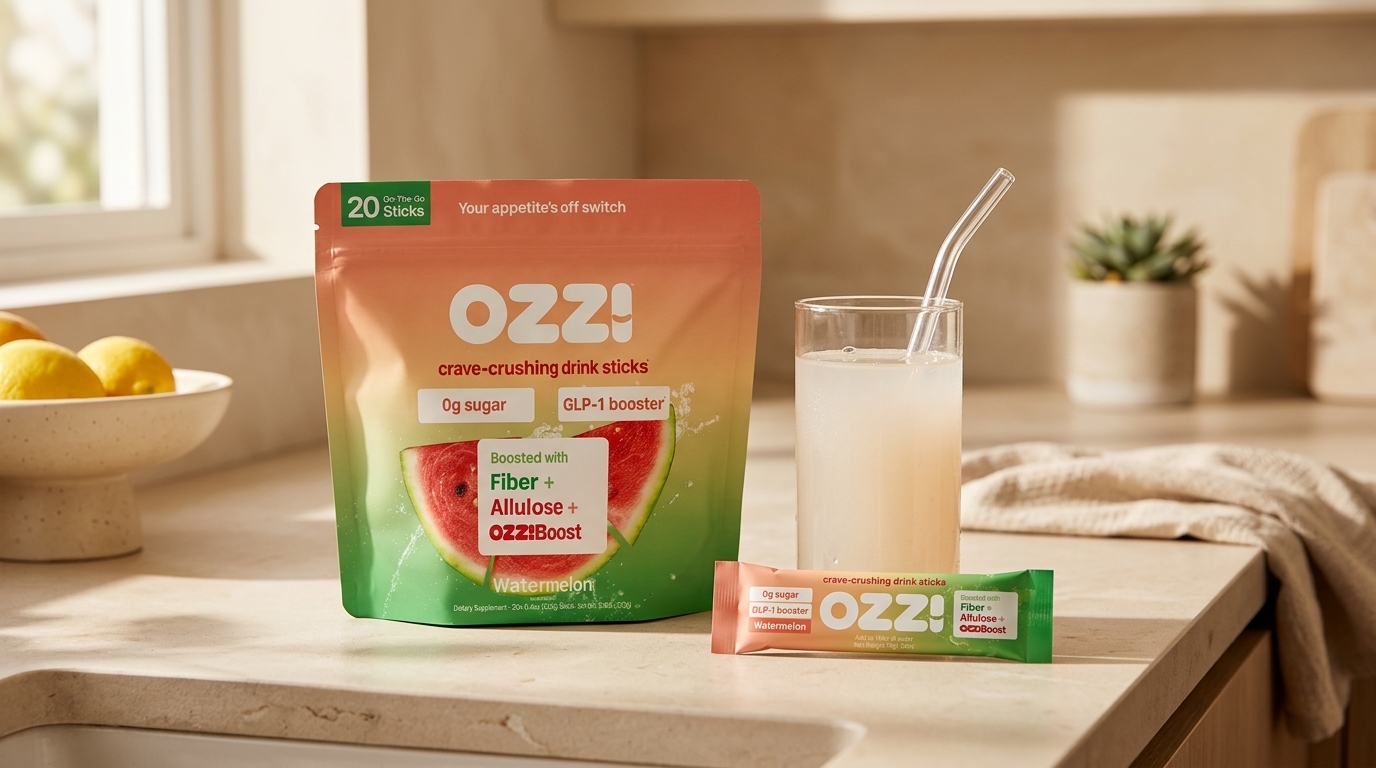
GLP-1 pills vs drinks: head-to-head comparison
Here's the side by side, based on published bioavailability data, clinical satiety trials, and adherence research.
| Factor | GLP-1 Pills | GLP-1 Drinks |
|---|---|---|
| Speed of onset | 45 to 90 minutes | 15 to 30 minutes |
| Stomach stretch signal | None | Strong (12 to 16 oz volume) |
| Fiber gel formation | Limited (no water medium) | Full gel in stomach |
| Allulose GLP-1 trigger | Possible but slower | Direct and fast |
| Daily adherence | Lower (pill fatigue) | Higher (ritual-friendly) |
| Best for | Single isolated compound, travel | Multi-ingredient stack, craving control |
| Typical serving size | 1 to 4 capsules | 15g stick in 16 oz water |
Are GLP-1 pills useless then?
No. There are real cases where a capsule format makes sense.
Berberine in liposomal or phytosome form, for example, has shown roughly a 10x improvement in bioavailability over standard berberine, and that delivery system works in a capsule.2 If your stack is built around a single advanced-delivery compound, a pill can be the right format.
Pills also win on portability for international travel where powder packets get hassled at airport security, on situations where you can't access clean water, and on cases where you genuinely dislike flavored drinks no matter how subtle.
What pills don't do well is deliver a multi-ingredient GLP-1 stack with the volume and viscosity needed to flatten cravings. Trying to get 5 grams of fiber plus 4 grams of allulose plus glycine plus electrolytes into capsules means swallowing 8 to 10 of them at a time. That's where adherence collapses.
Why does adherence matter so much for GLP-1 supplements?
Because a perfect formula you don't take doesn't work.
Research on oral nutritional supplement compliance has found that adherence drops sharply with format friction. One study tracking patients on prescribed supplements found roughly 19% stopped within the trial window due to "flavor fatigue" or volume fatigue, even with clear medical motivation.5
For GLP-1 supplements taken outside a clinical setting, the drop-off is steeper. Counting and swallowing 4 capsules at the same time every day requires conscious effort. A daily drink slots into an existing ritual (morning coffee replacement, mid-afternoon water break, evening wind-down) with almost no added friction.
Adherence research consistently shows that smaller serving counts, sensory satisfaction, and ritual integration drive long-term compliance more than ingredient potency alone.6
"The best supplement is the one you actually drink every day for six months, not the one you take for two weeks and forget in a drawer."
How should I pick between a pill and a drink?
Three questions, in this order.
1. What's the main ingredient? If it's fiber, allulose, glycine, or electrolytes, choose a drink. If it's a single isolated compound with proven advanced-delivery technology in capsule form, a pill is fine.
2. What's your craving pattern? If you fight food noise between meals or at night, you need fast-onset, volume-based intervention. That's a drink. If you're just looking for a long-acting metabolic adjuvant alongside meals, a pill can work.
3. What will you actually take in 90 days? Be honest. If a multi-capsule routine has failed you twice already, don't try a third time. A daily drink ritual has the highest real-world stick rate for non-medical GLP-1 support.
The format that fits your life is the format that works.
What we built at Ozzi (and why a drink)
When we designed Crave Crusher, we tested both pill and drink prototypes. The drink won on every metric customers cared about.
One 15g stick in 16 oz of water delivers soluble fiber, allulose, BIOMEnd L-lysine butyrate, and glycine in one motion. Stretch signal, fiber gel, GLP-1 trigger, and craving distraction all happen in the same 5 to 10 minute window. We also offer a capsule version for travel and people who genuinely won't drink flavored water, but the daily ritual format is what most customers settle into.
Drink it 20 to 30 minutes before your hardest craving window. Watermelon, no sugar, no aftertaste, no swallowing 4 horse pills.
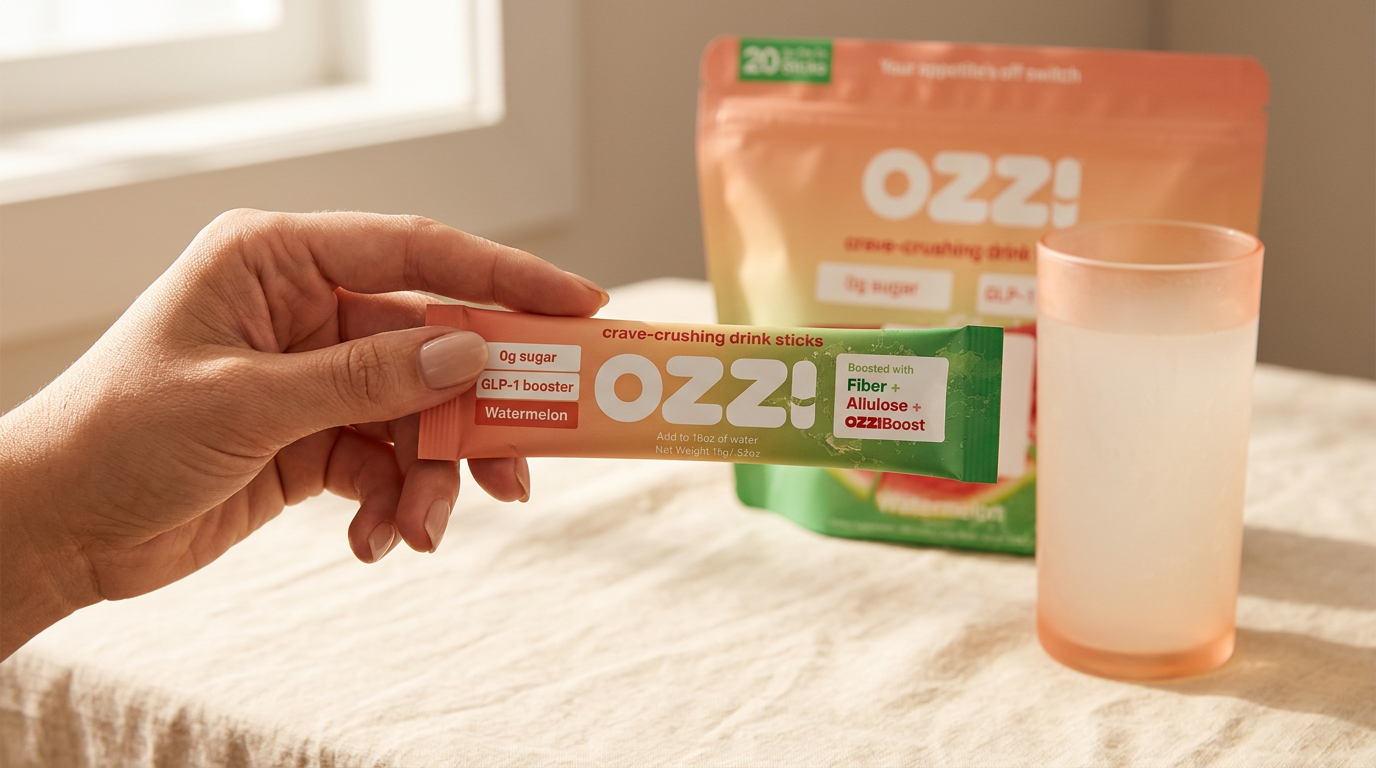
If the drink format is what you want, here is our natural GLP-1 support drink and how it is dosed.
Frequently asked questions
Do GLP-1 drinks work faster than GLP-1 pills?
Yes, in most cases. Pre-dissolved ingredients in a drink can reach the gut and start triggering GLP-1 release within 15 to 30 minutes. Capsules typically take 45 to 90 minutes to break down, dissolve, and absorb. For craving control, that speed difference matters.
Are liquid supplements really 96% absorbed and pills only 10%?
No. Those numbers are marketing oversimplifications. Real absorption varies by compound, formulation, and individual. For some ingredients liquids are clearly better, for others format makes little difference, and for a few (like advanced-delivery berberine) the capsule can actually win.
Can a GLP-1 drink replace prescription Ozempic or Wegovy?
No supplement, in any format, is equivalent to prescription GLP-1 receptor agonists. Drinks and pills support your body's natural GLP-1 production. Prescription drugs directly activate the receptor. The mechanisms are related but not interchangeable.
Do I have to take a GLP-1 drink with a meal?
You can, but it often works better 20 to 30 minutes before your hardest craving window. That gives the fiber time to gel and the allulose time to start GLP-1 release before food noise peaks.
Will pills cause stomach upset more than drinks?
Sometimes. Capsules can release a concentrated dose of fiber or botanicals in one spot in the intestine, which can cause cramping or bloating. Drinks distribute the same dose across 16 oz of water, which usually feels gentler.
Is the calorie content different between pills and drinks?
A typical 15g GLP-1 stick pack adds 15 to 25 calories. Capsules add essentially zero. If you're tracking every calorie, that's worth knowing, though the appetite suppression from a drink usually offsets the difference many times over.
Can I take both formats together?
Yes, if the ingredients don't overlap. Some people use a daily drink for craving control plus a single targeted capsule (like a specialized berberine) for metabolic support. Check ingredient totals so you don't double-dose fiber or allulose.
Which format is better for night cravings?
A drink, every time. Night cravings respond to volume, hydration, and a sensory ritual. Drinking 16 oz of a flavored beverage with active ingredients beats swallowing two capsules with a sip of water for breaking the freezer-door reflex.
Skip the pile of pills. Try the daily drink.
Crave Crusher is one stick in 16 oz of water, watermelon flavor, 0g sugar, designed to quiet food noise and the night monster. We back your first bag with a 10-day feel-the-difference guarantee. Drink it for 10 days. If it doesn't work, we refund you.
Related reading
- What is GLP-1? The complete guide to the hormone behind modern weight loss
- Natural alternatives to Ozempic: 8 science-backed options compared
- Best supplements to curb sugar cravings
- Allulose vs berberine for GLP-1: which works faster
- Ozzi vs Supergut GLP-1 Daily: honest comparison
- Ozzi vs Lemme GLP-1: which fits your routine
- Best natural GLP-1 supplements for appetite control in 2026
References
- Yu DK, Sawchuk RJ, et al. Bioavailability study of oral liquid and tablet forms of alpha-difluoromethylornithine. PubMed.
- Petrangolini G, et al. Characterization and Pharmacokinetic Assessment of a New Berberine Formulation with Enhanced Absorption In Vitro and in Human Volunteers. PMC.
- Reimer RA, et al. Consumption of the Soluble Dietary Fibre Complex PolyGlycopleX Reduces Glycaemia and Increases Satiety of a Standard Meal Postprandially. PMC.
- Iwasaki Y, et al. Allulose stimulates GLP-1 and GIP release from intestinal L-cells and K-cells: mechanisms and therapeutic implications. ScienceDirect.
- Hubbard GP, et al. Factors Affecting Adherence, Intake, and Perceived Palatability of Oral Nutritional Supplements: A Literature Review. ScienceDirect.
- Bordelon Hood K. Oral Nutritional Supplement Prescription and Adherence Perspectives. DigitalCommons.
- JMIR Research Protocols. Effects of Allulose vs Aspartame Consumption on Postprandial GLP-1 Profiles: Protocol for a Randomized Crossover Trial. Research Protocols.
- A New Dietary Fiber Can Enhance Satiety and Reduce Postprandial Blood Glucose in Healthy Adults: A Randomized Cross-Over Trial. PMC.
