

Ozzi vs Supergut GLP-1 Daily Support: 2026 Honest Comparison
Ozzi Crave Crusher and Supergut GLP-1 Daily Support both target the gut-GLP-1 pathway, but they get there differently. Supergut feeds bacteria that eventually make butyrate. Ozzi delivers butyrate directly through L-Lysine Butyrate, plus allulose, glucomannan, and inulin for layered appetite support.
Key takeaways
- Supergut uses 4 prebiotic fibers to feed butyrate-producing gut bacteria indirectly.
- Ozzi uses L-Lysine Butyrate to deliver butyrate directly, plus inulin to feed your microbiome.
- Supergut's 2023 RCT was on its meal-replacement shake, not the GLP-1 stick pack.
- Ozzi adds allulose, glucomannan, and African mango for satiety from 4 different angles.
- Both are caffeine-free. Ozzi is flavored, Supergut GLP-1 sticks are unflavored.
What is Supergut GLP-1 Daily Support?
Supergut GLP-1 Daily Support is an unflavored stick pack you mix into water, coffee, or smoothies. It contains a 4-ingredient prebiotic fiber blend: soluble vegetable fiber from maize, green banana powder resistant starch, Solnul (a resistant potato starch), and beta glucan from oats.
The idea: feed the bacteria in your colon that produce short-chain fatty acids (SCFAs), especially butyrate. Butyrate then signals L-cells in your gut to release more GLP-1, the satiety hormone behind Ozempic and Wegovy.
It's a real mechanism. It just takes a while. Your microbiome has to ferment the fiber first, and individual results vary a lot based on what bacteria you already have living down there.
What is Ozzi Crave Crusher and how is it different?
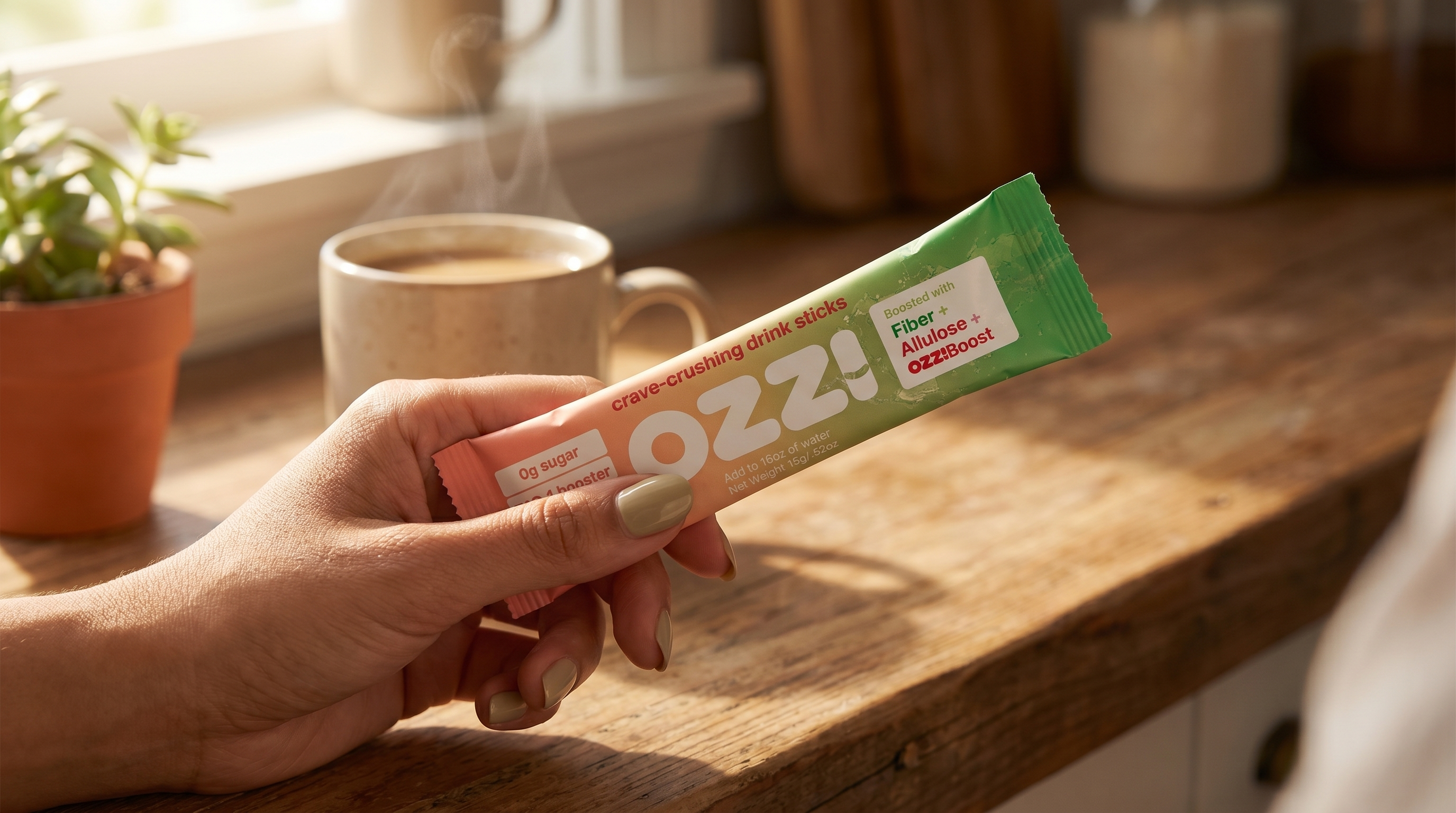
Ozzi Crave Crusher is a flavored drink stick (watermelon in the V2 line) you mix into 16oz of cold water. The formula is built around the same gut-GLP-1 pathway, but it attacks the problem from more angles.
The active ingredients per stick:
- Allulose (allSWEET) 8.35g. A rare sugar that tastes sweet but doesn't spike blood glucose or insulin.
- L-Lysine Butyrate (BIOMEnd) 537mg. A branded form of butyrate bound to L-lysine. This delivers butyrate directly instead of waiting on gut bacteria to make it.
- Glucomannan 556mg. A viscous soluble fiber from konjac root that absorbs water and expands in your stomach.
- Chicory Root Inulin 500mg. A prebiotic fiber that feeds Bifidobacterium, which produces more natural butyrate.
- African Mango Extract 150mg. Studied for effects on leptin (the satiety hormone) and waist circumference.
- Chromium Polyursolate (Metabolex) 11mg. Supports insulin sensitivity at the cellular level.
Where Supergut is a focused prebiotic blend, Ozzi is a stack. Direct butyrate, indirect butyrate via prebiotic, physical fullness from glucomannan, leptin support from African mango, and blood sugar support from chromium and allulose. If you're new to this whole category, the 2026 buyer's guide walks through the full landscape.
Supergut waits for your bacteria to make butyrate. Ozzi just hands you butyrate.
How does each product trigger GLP-1?
This is where the formulas diverge. Both end up at GLP-1, but the route matters.
Supergut's pathway (indirect): Prebiotic fiber → fermented by colon bacteria → bacteria produce SCFAs including butyrate → butyrate binds FFAR2/FFAR3 receptors on L-cells → L-cells release GLP-1.
Ozzi's pathway (direct + indirect): L-Lysine Butyrate provides butyrate immediately. Inulin also feeds bacteria for more endogenous butyrate. Both pools of butyrate hit the same L-cell receptors.
Research published in the Journal of Biological Chemistry first nailed down the butyrate-GLP-1 mechanism in 2013. Butyrate binds free fatty acid receptors FFAR2 and FFAR3 on intestinal L-cells, triggering GLP-1 release. The same mechanism shows up in newer 2026 reviews on the gut microbiome and GLP-1 crosstalk.
The catch with prebiotics: you only get the butyrate if your gut bacteria can make it. If you don't have many SCFA producers (common after antibiotics, on low-fiber diets, or with certain digestive conditions), feeding them more fiber doesn't do as much.
What does the Supergut RCT actually show?
Credit where it's due. Supergut funded a serious clinical trial.
The 2023 study published in Diabetes, Obesity and Metabolism was a 12-week, three-arm, double-blind, randomized, placebo-controlled trial with 192 participants. Stanford and the Sonnenberg Lab collaborated on the microbiome analysis. The intervention group drank Supergut meal-replacement shakes daily.
Headline results: a 0.7% reduction in HbA1c versus placebo, plus improvements in weight, blood pressure, digestion, and quality-of-life measures. Microbiome analysis confirmed an increase in bacteria that produce SCFAs, including butyrate producers.
This is good science. But there's a detail worth noting: the trial was on the Supergut shake, not the GLP-1 Daily Support stick pack. The fiber blends share some ingredients but they aren't the same product. Reading the press releases, that distinction gets fuzzy.
The mechanism (prebiotic fiber → SCFA producers → butyrate → GLP-1) is the same. The clinical proof points are specifically about the shake regimen.
How do they compare side by side?
| Feature | Ozzi Crave Crusher | Supergut GLP-1 Daily |
|---|---|---|
| GLP-1 mechanism | Direct butyrate (L-Lysine Butyrate) + prebiotic inulin | Indirect, prebiotic fiber blend only |
| Total fiber per serving | About 1.5g (glucomannan + inulin) | About 7g (4-fiber blend) |
| Satiety levers | Glucomannan, allulose, African mango, chromium | Bulking fiber only |
| Blood sugar support | Allulose, chromium, glucomannan, inulin | Fiber-driven only |
| Flavor | Watermelon, Peach, Lychee | Unflavored |
| Caffeine | None | None |
| Sugar | 0g (allulose + Reb M) | 0g |
| Published RCT on this exact product | No (ingredient-level evidence) | No, the RCT was on the shake |
| Guarantee | 10-day feel-the-difference on first bag | 30-day money-back on first order |
Supergut wins on raw fiber volume. If your goal is to flood your colon with prebiotic substrate, that's the play. Ozzi wins on mechanism diversity. You're hitting GLP-1 with direct butyrate, satiety with glucomannan and allulose, and blood sugar with chromium and a low-glycemic sweetener all in the same stick.
What about taste and the daily ritual?
Supergut's GLP-1 stick is unflavored. The brand's pitch is that you stir it into anything: coffee, water, smoothie, oatmeal. That flexibility is nice. It also means you're not getting a craving-replacement moment. There's no "this tastes good, I'm satisfied" signal built into the experience.
Ozzi takes the opposite approach. The whole point is to give your brain a sweet, cold, flavored ritual that hits when you'd otherwise be reaching for cookies. From the customer survey data we collected on 956 Ozzi buyers, the top complaint people came in with was nighttime cravings. About 45% of free-text responses mentioned after-dinner snacking, late-night eating, or the "monster" coming out at night.
For that crowd, an unflavored fiber scoop doesn't solve the actual problem. The sweet ritual does.
"The ad was about night time cravings and I was literally smashing cookies after a day of healthy eating." — Ozzi customer survey
Which one is right for you?
Both products are real. Both have real science behind their core mechanism. The choice comes down to what you're actually trying to fix.
Pick Supergut GLP-1 Daily if: you already have a healthy microbiome, you want maximum prebiotic fiber, you don't care about flavor, and your main complaint is gut health or A1C trends over months. You're patient. You like the idea of feeding your bacteria.
Pick Ozzi Crave Crusher if: you want direct butyrate (not a wait-and-see prebiotic), you want satiety from multiple ingredients hitting at once, you want a flavored ritual that replaces the urge to snack, and your main complaint is nighttime cravings, food noise, or wanting a GLP-1-style appetite quieting without a prescription. For sugar-craving specifics, the supplements for sugar cravings guide goes deeper.
If you've already tried fiber-only products and didn't feel much, the direct-butyrate plus glucomannan plus allulose stack is the next logical step. If you're comparing against another popular brand, the Ozzi vs Lemme breakdown is worth a read too.
Is there a way to use both together?
Yes, and some people do. Ozzi handles the immediate satiety and direct butyrate piece. Supergut adds prebiotic substrate. The mechanisms aren't fighting each other, they're additive.
If you go that route, watch your total daily fiber. Combining two high-fiber products can cause bloating and gas for the first week or two as your gut adjusts. Drink more water than you think you need. Start with half-doses for the first few days.
For most people, picking one and committing for 30 days is a cleaner test. You'll know what's working and what isn't.
What about side effects and tolerability?
Both products can cause GI side effects, especially in the first week. That's normal when you introduce new fibers to your gut. Common ones include gas, bloating, and changes in bowel habits.
Supergut's higher total fiber load means a bigger adjustment period for some people. Ozzi's glucomannan dose is moderate (556mg vs the 1-3g doses used in some weight-loss trials), so most people tolerate it without much issue.
Neither product contains caffeine, stimulants, or artificial sweeteners. Both are vegan-friendly. Neither is a substitute for prescription GLP-1 drugs if you actually need one. They're support tools.
If you have a serious GI condition (IBD, severe IBS, gastroparesis), talk to your doctor before adding either one. Soluble fibers can flare some conditions.
Frequently asked questions
Does Ozzi or Supergut work faster?
Ozzi tends to be faster because it delivers butyrate directly and includes glucomannan, which creates physical fullness within an hour. Supergut's effect builds over weeks as your microbiome shifts.
Can you take Ozzi and Supergut together?
Yes. The mechanisms are complementary. Start at half-doses for the first 3-5 days to let your gut adjust, and drink plenty of water.
Is Supergut's RCT proof that the GLP-1 stick works?
The RCT was on Supergut's meal-replacement shake, not the GLP-1 Daily Support stick pack. The mechanism is shared. The specific stick product hasn't been tested in a published RCT.
Does Ozzi have published clinical research on the full formula?
Not on the full V2 formula as a finished product. Every active ingredient has published research behind it, including direct butyrate, glucomannan, allulose, inulin, African mango, and chromium.
Which one tastes better?
Ozzi is flavored (watermelon V2, peach, lychee). Supergut GLP-1 Daily is unflavored on purpose so you can add it to anything. If you want a sweet drink ritual, Ozzi. If you want a stealth scoop, Supergut.
Are either of these GLP-1 drugs?
Neither one is a drug. They're supplements that support your body's own GLP-1 production through the gut. They will not match the appetite suppression of Ozempic or Wegovy.
Which one is better after stopping a GLP-1 medication?
Ozzi's stack tends to be more useful for the post-GLP-1 rebound because it works on satiety and cravings from multiple angles immediately. About 12% of Ozzi's customer survey responses cite coming off GLP-1 drugs as their reason for trying it.
How long do you have to take either one to see results?
Ozzi's 10-day feel-the-difference guarantee is built around the idea that you should notice appetite changes within 10 consecutive days. Supergut's microbiome shifts typically take 4-12 weeks to show up in measurable health markers.
Bottom line
Supergut GLP-1 Daily Support is a well-formulated prebiotic fiber blend from a brand with serious clinical research behind its broader product line. If your priorities are gut microbiome support and you're comfortable waiting for results, it's a solid option.
Ozzi Crave Crusher is built differently. The mechanism is direct butyrate plus a satiety stack designed for the person who's losing the cravings battle every night at 9pm. If that sounds like you, the formula is meant for that exact moment.
Both products are caffeine-free, sugar-free, and vegan. Both have guarantees on first orders. The right pick depends on whether you want fiber that eventually becomes butyrate, or butyrate plus a sweet drink ritual right now.
Try Ozzi Crave Crusher with a 10-day feel-the-difference guarantee
Use it for 10 days straight. If you don't feel a difference in cravings or appetite, we refund your first bag. No back-and-forth, no questions.
References
- Yadav H, et al. Beneficial metabolic effects of a probiotic via butyrate-induced GLP-1 hormone secretion. Journal of Biological Chemistry. 2013. PubMed
- Mardinoglu A, Wu H, Bjornson E, et al. Microbiome-targeting fibre-enriched nutritional formula in type 2 diabetes (Supergut RCT). Diabetes, Obesity and Metabolism. 2023. PubMed
- Iwasaki Y, et al. GLP-1 release and vagal afferent activation mediate the beneficial metabolic effects of D-allulose. Nature Communications. 2018. Nature
- Braxas H, et al. Effect of glucomannan on appetite and body weight: systematic review and meta-analysis. Obesity Medicine. 2020. ScienceDirect
- Kamath A, et al. GLP-1 agonists and the gut microbiome: a bidirectional relationship. British Journal of Clinical Pharmacology. 2026. Wiley
- Braga T, et al. Allulose for the attenuation of postprandial blood glucose: systematic review and meta-analysis. PLOS ONE. 2023. PLOS
- Onakpoya I, et al. The use of Irvingia gabonensis (African mango) in weight loss: a systematic review. Journal of Dietary Supplements. 2013. PubMed
- Anderson RA. Chromium and insulin resistance. Nutrition Research Reviews. 2003. PubMed
Educational content. Not medical advice. Talk to your doctor before starting any supplement, especially if you have a medical condition or take prescription medications. Statements about ingredients have not been evaluated by the FDA. These products are not intended to diagnose, treat, cure, or prevent any disease.
