

Best GLP-1 Companion Supplements 2026: An Honest, Evidence-Ranked Guide
The GLP-1 companion supplements with the strongest human evidence are protein (for preserving lean mass during rapid weight loss), soluble fiber (for satiety and regularity), and electrolytes (because eating less means drinking less). Gut-focused ingredients like butyrate and prebiotic fiber are mechanistically promising, but most of the appetite-hormone data comes from animal and cell studies, not people.
Key takeaways
- Protein plus resistance training has the clearest human support.
- Fiber helps satiety and regularity, not dramatic weight loss.
- Glucomannan averages about 1.3 kg across meta-analyses.
- Electrolytes are cheap, low-risk, and frequently under-considered.
- Butyrate and GLP-1 in humans remains an open question.
What is a GLP-1 companion supplement, anyway?
The category barely existed three years ago. Now roughly 1 in 5 US households includes someone on a GLP-1 medication, and every supplement brand with a spreadsheet has shipped a "GLP-1 support bundle."
Two very different products hide under the same label, and mixing them up is the single most common mistake buyers make.
Companion supplements are for people already on a prescription. They exist to patch the nutritional holes that open up when you suddenly eat 30% less food. Protein, fiber, electrolytes, a multivitamin.
GLP-1 support supplements are for people not on a medication who want to support the hormone their own body already makes. Different job, different evidence base. If you want the mechanism, we covered it in what GLP-1 actually is.
This guide covers the first category, with an honest note at the end about where a product like ours sits.
What do people on GLP-1 medications actually run short on?
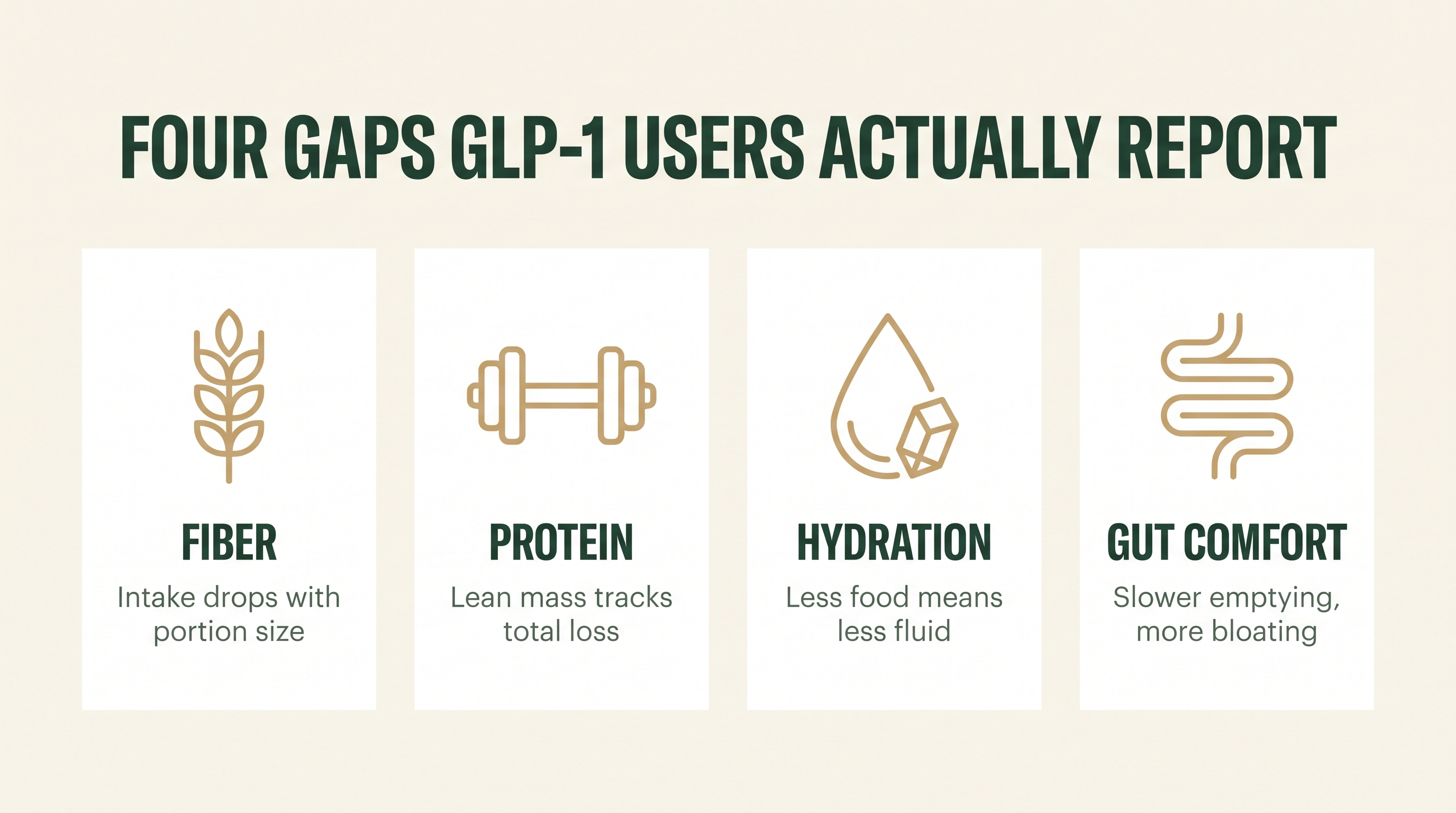
The mechanism is simple. GLP-1 medications slow gastric emptying and blunt appetite. You eat less. When total food volume drops sharply, four things tend to slip at once.
Fiber. Fiber comes bundled in food volume. Cut the volume, cut the fiber. This is a large part of why constipation shows up so often. We wrote a full guide on bloating and constipation relief.
Protein. The one with real consequences. More on this below.
Fluid and electrolytes. A surprising share of daily water intake arrives inside food. Eat less, drink less, without noticing.
Gut comfort. Slower emptying changes how the whole system feels, and a lot of people describe nausea and bloating that has nothing to do with what they ate.
Which companion supplements have real human evidence?
Here's the honest scorecard. "Human evidence" means randomized trials or meta-analyses in people. "Preclinical" means mice, rats, or cells, which is a fine reason to be curious and a bad reason to promise anything.
| Category | What it's for | Human evidence | Verdict |
|---|---|---|---|
| Protein | Lean mass during rapid loss | Strong, consistent | Start here |
| Soluble fiber | Satiety, regularity | Good for regularity, modest for weight | Worth it, oversold |
| Electrolytes | Hydration, headaches, fatigue | Indirect but well understood | Cheap insurance |
| Prebiotic fiber (inulin) | Feeds butyrate-producing bacteria | Real, but appetite-hormone results are mixed | Reasonable |
| Butyrate / postbiotics | Gut barrier function | Barrier work in humans; GLP-1 link is preclinical | Promising, unproven |
| Multivitamin | Micronutrient floor | Sensible, not exciting | Low downside |
| Collagen | Skin, hair during loss | Weak for muscle; it's an incomplete protein | Not a protein substitute |
| Digestive enzymes | Bloating, nausea | Thin outside diagnosed insufficiency | Skip unless advised |
Why is protein the one nobody argues about?
Of everything on this list, protein has the least controversy and the biggest stakes.
A 2026 narrative review of randomized trials and observational data on incretin-based therapies concluded that lean body mass does drop during treatment, though the authors were careful about how they framed it: the loss appears generally proportional to the total weight lost rather than evidence of the drug attacking muscle directly.1 That distinction matters. It reframes the problem from "the medication is doing something to me" to "rapid weight loss does this, and rapid weight loss is the point."
A separate 2026 review made the practical case plainly. Adequate protein intake plus resistance training are the two levers with the best support for preserving lean mass and function during pharmacological energy restriction.2 The same review flagged bone density as a second dimension worth protecting for the same reasons.
The strongest supplement in the GLP-1 companion category is a protein shake and two sessions in the weight room.
Here's the uncomfortable part for supplement companies, including mine. A protein powder is a commodity, and nobody needs a proprietary blend to sell one. That makes it the highest-value item on this list and the least profitable to market. We wrote more on the mechanism in GLP-1 and muscle loss.
One caveat on collagen, which shows up in a lot of GLP-1 bundles. Collagen is an incomplete protein, low in the amino acids that drive muscle protein synthesis. Good for what it's good for. A poor swap for whey, soy, or pea protein when the goal is lean mass.
Does fiber live up to the marketing?
Partly. Fiber earns its place in this category, just for smaller reasons than the ads suggest.
For weight, a 2023 network meta-analysis pooled 111 randomized trials covering 6,171 adults with overweight or obesity and ranked 18 nutraceuticals head to head. Psyllium came out best among the fibers at -3.70 kg versus placebo with moderate certainty. Glucomannan managed -1.36 kg, and the authors rated that certainty as low.3
A 2021 meta-analysis of 67 placebo-controlled trials found glucomannan at -1.27 kg and then did something most supplement marketing never does: it set a threshold for clinical meaningfulness at 2.5 kg and noted that glucomannan did not clear it.4
Older work is even more sobering. A 2014 meta-analysis of 8 randomized trials found no statistically significant weight difference at all, at -0.22 kg.5
So why include fiber? Because weight is the wrong endpoint for what it's doing here.
A 16-week trial in 200 adults with overweight or obesity tested a mixture of psyllium and glucomannan against placebo. Weight loss trended better but missed significance. What did reach significance was postprandial satiety, which increased in both fiber groups, alongside a meaningful drop in LDL cholesterol.6
That's the honest pitch for fiber during GLP-1 treatment. Fuller after meals, more regular, better lipids. Not a second weight loss drug. More detail in our guide to fiber for appetite control.
What about prebiotic fiber and the gut-hormone angle?
This is where the category gets interesting and where most brands quietly overstate.
The theory is clean. Prebiotic fiber like chicory root inulin feeds gut bacteria, those bacteria ferment it into short-chain fatty acids including butyrate, and butyrate interacts with the L-cells that release GLP-1. We laid the whole chain out in our short-chain fatty acids guide.
The human data is more complicated than the theory.
A randomized crossover trial gave 24 g of inulin to lean and overweight adults and measured what happened. Colonic short-chain fatty acids went up as predicted. GLP-1 and PYY responses did not change. Ghrelin, the hunger hormone, was lower at 6 hours, and the size of the SCFA increase tracked with the size of the ghrelin drop.7
A second randomized crossover trial gave 24 g of inulin to overweight and obese men. Fat oxidation improved, plasma glucose and insulin came down, plasma acetate rose. GLP-1 and PYY, again, no effect.8
A six-week trial of 16 g/day of inulin-type fructans found no effect on ghrelin, hunger ratings, fullness, or energy intake, and the PYY response was actually better on the control arm.9
Three well-run human trials, three failures to move GLP-1 with prebiotic fiber acutely. That's worth saying out loud, because "inulin raises your GLP-1" is a claim you'll see all over this category.
Three good human trials tried to raise GLP-1 with prebiotic fiber. Three came back empty. Everyone quotes the mouse studies instead.
The picture over longer timeframes looks slightly different. A six-month randomized, double-blinded, placebo-controlled study in 156 children and adolescents with obesity found inulin supplementation reduced emotional undereating compared with placebo, and after the intervention GLP-1 was inversely correlated with emotional overeating.10 That's a correlation inside a pediatric population, so it's a reason to keep studying inulin rather than a reason to claim anything for adults.
Our read: inulin belongs in a formula for gut and metabolic reasons that hold up. Attaching an appetite-hormone promise to it does not. More in inulin, prebiotic fiber, and appetite.
Are postbiotics and butyrate worth the hype?
Butyrate is the ingredient we've bet on, so treat what follows as an interested party being careful.
What's defensible: butyrate is the primary energy source for the cells lining your colon, and it supports gut barrier function. That's textbook physiology, not a marketing claim.
What is not defensible, and what you will see claimed constantly: that butyrate raises GLP-1 in humans. No human study shows it. A human trial that successfully raised circulating butyrate measured GLP-1 as a named secondary outcome and found no change. Every butyrate-to-GLP-1 mechanism you read is running on mouse and cell-culture work.
We say it that way on our own product pages, and we'd rather lose a sale than pretend the mice were people. Our full breakdown lives in postbiotics explained and, for the competitive comparison, Akkermansia vs butyrate.
Same discipline applies to Akkermansia muciniphila, the other gut ingredient having a moment in 2026. The human abundance findings are correlational. One pasteurized-Akkermansia human trial exists, it was small, and it ran in a metabolic-syndrome population. Interesting. Not a promise.
Should you bother with electrolytes and hydration?
Probably, and this is the least glamorous recommendation in the guide.
There's no dedicated randomized trial of electrolyte powder in GLP-1 users, and anyone who tells you otherwise is selling something. The case is mechanistic and it's solid: a meaningful share of daily fluid comes from food, appetite suppression cuts food volume, and headaches, lightheadedness, and fatigue are common complaints in the first weeks of treatment.
Sodium, potassium, and magnesium in a glass of water cost very little and carry very little risk for most healthy adults. If you have kidney disease, heart failure, or blood pressure medication in the mix, that's a conversation for your doctor rather than a supplement aisle decision.
What the research has actually studied
A note on the studies cited throughout this piece, because the population matters as much as the result.
Several of the trials above ran in patients under medical care, not in general consumers. The six-week inulin-type fructans trial enrolled 35 men and women with type 2 diabetes.9 The inulin eating-behaviour study enrolled 156 children aged 7 to 15 with obesity, all receiving monthly clinical follow-up.10 The allulose glycemic work below was conducted in healthy volunteers and, separately, in patients with type 2 diabetes.11,12
Findings in a diagnosed population do not automatically transfer to a healthy adult buying a supplement online, and they say nothing about whether any product treats a condition. They're included here because they're the best available human evidence on these ingredients, not because they establish a benefit for you specifically.
On allulose, since it's the largest ingredient in our own formula: a randomized, double-blinded crossover trial in 30 healthy Thai volunteers found that adding allulose to a 50 g sucrose beverage lowered peak postprandial glucose and insulin in a dose-dependent way.11 A separate randomized crossover pilot using continuous glucose monitoring found that a diabetic diet containing 8.5 g of allulose improved peak postprandial glucose compared with a standard energy-controlled diabetic diet.12 Both are small. Both are real. Neither is a weight loss result. Our fuller treatment is in the allulose supplement guide.

So where does Ozzi fit in all this?
Honest answer, since this is our blog and you should discount accordingly.
Ozzi is not a companion supplement for people on a medication. We built it for the people in the gap: the ones who want what GLP-1 medications do to food noise, without the prescription. Some of our customers are also weaning off a medication and want ongoing support, which we wrote about in how to keep weight off after Ozempic.
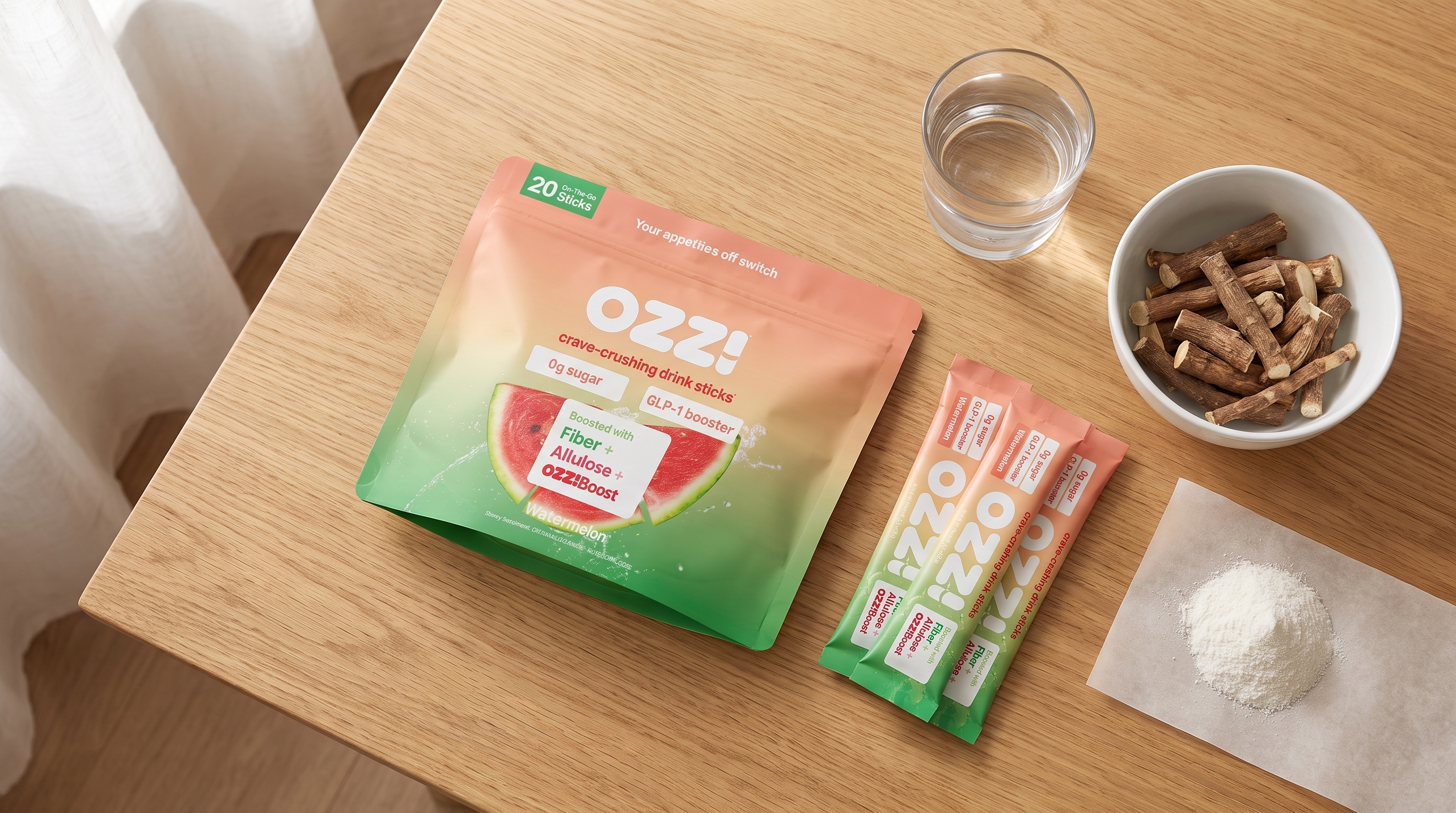
What's in a stick, at the doses we'll state publicly: 8g allulose, 500mg L-Lysine Butyrate (BIOMEnd), 500mg glucomannan, 500mg chicory root inulin, 150mg African mango, and 11mg chromium. No caffeine, no stimulants, no berberine.
Measured against this guide's own scorecard, that's four of the categories that hold up and zero protein. If you're on a medication and losing weight fast, a protein shake matters more to you than we do. We'd rather tell you that than pretend otherwise. The gut and satiety side of the guide is what we're built for. See gut health and GLP-1 for how those pieces connect.
Ozzi supports natural GLP-1 production and supports blood sugar control. It does not treat, cure, or prevent any disease, and it is not a replacement for anything your doctor prescribed.
The standalone options are compared in our comparison of natural GLP-1 supplements.
Frequently asked questions
What is the single best supplement to take while on a GLP-1 medication?
Protein, by a wide margin. Two 2026 reviews converge on adequate protein plus resistance training as the best-supported strategy for preserving lean mass during rapid weight loss.1,2 Everything else on the list is secondary.
Do GLP-1 companion bundles with 20-plus ingredients work better?
There's no evidence that more ingredients means better outcomes, and the ones with real human support (protein, fiber, electrolytes, a basic multivitamin) can be bought separately for less. Long ingredient lists usually mean small doses of each.
Does fiber actually cause weight loss?
Modestly at best. Glucomannan lands between -0.22 kg and -1.36 kg across meta-analyses, and one review explicitly noted it failed to clear a 2.5 kg clinical-significance threshold.3,4,5 Fiber's stronger case is satiety and regularity.6
Can prebiotic fiber raise my GLP-1?
Not acutely, based on the human trials that have tested it. Three randomized studies using 16 to 24 g of inulin found no increase in GLP-1 or PYY, though one saw lower ghrelin.7,8,9 Prebiotic fiber has other reasons to be in a formula.
Is butyrate proven to increase GLP-1 in humans?
No. The GLP-1 mechanism for butyrate rests on rodent and cell studies. A human trial that raised circulating butyrate measured GLP-1 as a secondary outcome and found no change. Butyrate's defensible role is as the primary energy source for colon cells and in supporting gut barrier function.
Is collagen a good protein source during GLP-1 treatment?
Not for muscle. Collagen is an incomplete protein and low in the amino acids that drive muscle protein synthesis. Use whey, soy, or pea protein if lean mass is the goal, and treat collagen as a separate purchase for separate reasons.
Do I need electrolytes if I'm not exercising much?
Possibly. Fluid intake drops alongside food intake whether or not you're sweating, and a lot of early-treatment headaches and fatigue trace back to that. Check with your doctor first if you have kidney, heart, or blood pressure considerations.
Are digestive enzymes worth adding for nausea and bloating?
The evidence is thin outside diagnosed pancreatic insufficiency. Slower gastric emptying is the more likely cause of GLP-1-related bloating, and smaller, more frequent meals plus adequate fluid tend to help more than an enzyme capsule.
Can I take a natural GLP-1 support product and a prescription at the same time?
Ask your prescriber. That's a real medical question about your specific medication and dose, and no supplement brand should be answering it for you.
If the night cravings are the problem, start there
Ozzi is a watermelon stick you mix into 16oz of cold water. 8g allulose, 500mg butyrate, 500mg glucomannan, 500mg chicory root inulin. No caffeine, no stimulants.
14-Day Ozzi Challenge: Take it for 14 straight days. If your cravings and food noise aren't quieter, we'll refund your first bag.
References
Sources retrieved from PubMed.
- Mollero ELM, et al. Beyond Weight Loss: Skeletal Muscle Health During Incretin-Based Therapy in Patients with Diabesity. Nutrients. 2026;18(16). https://doi.org/10.3390/nu18162654 (review of human trials)
- Sancho-Haro E, et al. Optimizing Weight Loss in the GLP-1 Era: Preserving Muscle Mass, Function and Metabolic Health Through Precision Nutrition and Resistance Training. Pharmaceuticals (Basel). 2026;19(6):897. https://doi.org/10.3390/ph19060897 (review of human evidence)
- Shahinfar H, et al. Comparative effects of nutraceuticals on body weight in adults with overweight or obesity: a systematic review and network meta-analysis of 111 randomized clinical trials. Pharmacol Res. 2023;196:106944. https://doi.org/10.1016/j.phrs.2023.106944 (human, 6,171 participants)
- Bessell E, et al. Efficacy of dietary supplements containing isolated organic compounds for weight loss: a systematic review and meta-analysis of randomised placebo-controlled trials. Int J Obes (Lond). 2021;45(8):1631-1643. https://doi.org/10.1038/s41366-021-00839-w (human, 67 trials)
- Onakpoya I, Posadzki P, Ernst E. The efficacy of glucomannan supplementation in overweight and obesity: a systematic review and meta-analysis of randomized clinical trials. J Am Coll Nutr. 2014;33(1):70-78. https://doi.org/10.1080/07315724.2014.870013 (human, 8 RCTs)
- Salas-Salvadó J, et al. Effect of two doses of a mixture of soluble fibres on body weight and metabolic variables in overweight or obese patients: a randomised trial. Br J Nutr. 2008;99(6):1380-1387. https://doi.org/10.1017/S0007114507868528 (human RCT, 200 participants)
- Rahat-Rozenbloom S, et al. Acute increases in serum colonic short-chain fatty acids elicited by inulin do not increase GLP-1 or PYY responses but may reduce ghrelin in lean and overweight humans. Eur J Clin Nutr. 2017;71(8):953-958. https://doi.org/10.1038/ejcn.2016.249 (human RCT)
- van der Beek CM, et al. The prebiotic inulin improves substrate metabolism and promotes short-chain fatty acid production in overweight to obese men. Metabolism. 2018;87:25-35. https://doi.org/10.1016/j.metabol.2018.06.009 (human RCT, crossover)
- Birkeland E, et al. Effect of inulin-type fructans on appetite in patients with type 2 diabetes: a randomised controlled crossover trial. J Nutr Sci. 2021;10:e72. https://doi.org/10.1017/jns.2021.70 (human RCT, type 2 diabetes population)
- Panichsillaphakit E, et al. The effects of inulin supplementation on eating behaviours in children and adolescents with obesity: a randomized double-blinded placebo-controlled study. Nutr Metab (Lond). 2025;22(1):97. https://doi.org/10.1186/s12986-025-00995-0 (human RCT, pediatric obesity population)
- Buranapin S, et al. Effects of D-Allulose with Sucrose Beverage on Glucose Tolerance and Insulin Levels among Thai Healthy Volunteers. J Nutr Sci Vitaminol (Tokyo). 2024;70(3):203-209. https://doi.org/10.3177/jnsv.70.203 (human RCT, 30 healthy volunteers)
- Fukunaga K, et al. A Pilot Study on the Efficacy of a Diabetic Diet Containing the Rare Sugar D-Allulose in Patients with Type 2 Diabetes Mellitus. Nutrients. 2023;15(12):2802. https://doi.org/10.3390/nu15122802 (human RCT, type 2 diabetes population)
These statements have not been evaluated by the Food and Drug Administration. This product is not intended to diagnose, treat, cure, or prevent any disease. This article is educational and is not medical advice. Talk to your doctor before changing anything about your medication or supplement routine.
