

Allulose and Gut Health: What the Human Evidence Actually Shows (2026)
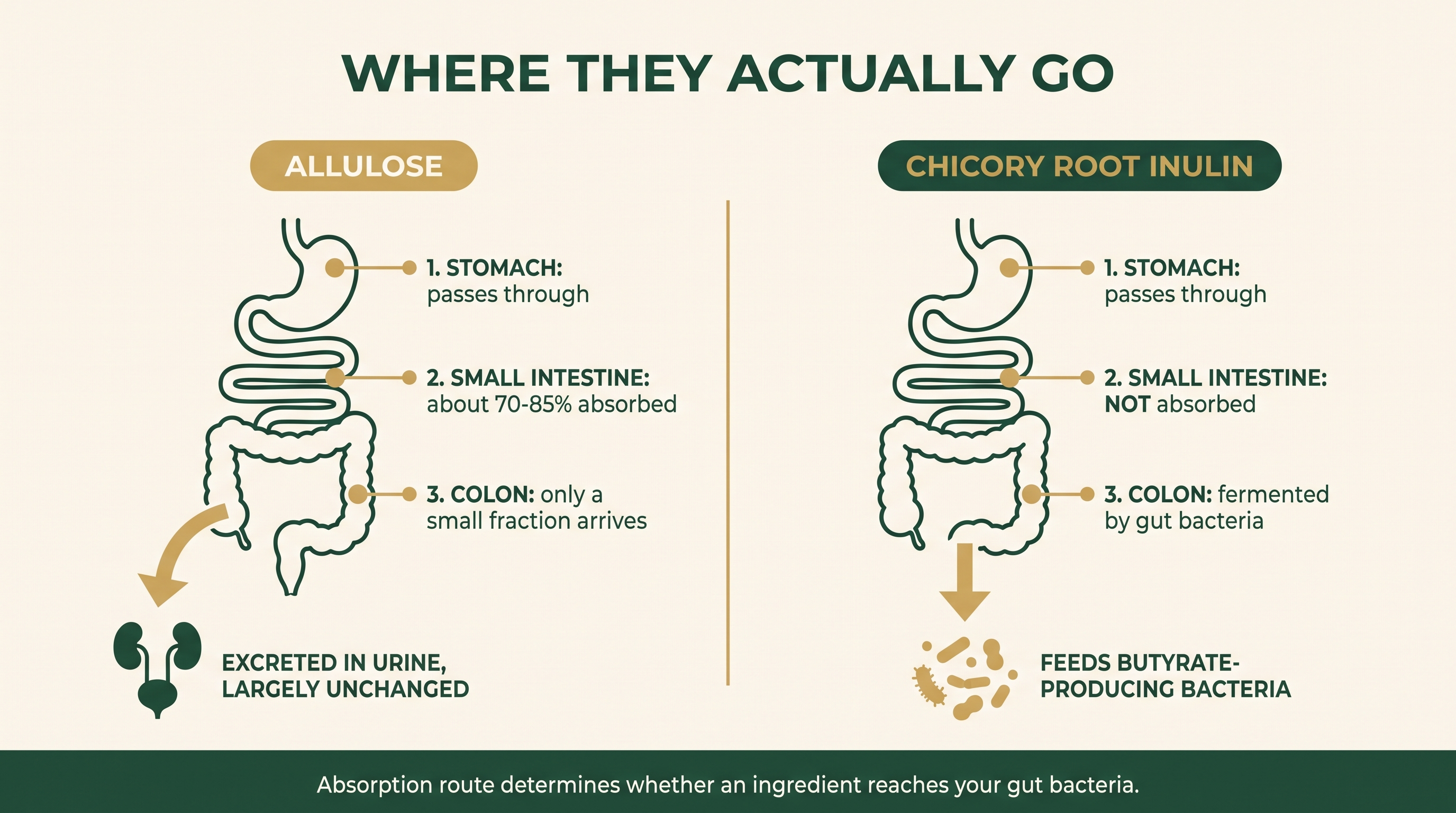
Allulose is not a prebiotic. Roughly 70% to 85% of an ingested dose is absorbed in the small intestine and excreted unchanged in urine, so only a modest fraction ever reaches the colon. In a 12-week human trial at 15 g per day, allulose produced no significant change in gut microbial diversity or short-chain fatty acid production.
Key takeaways
- Most allulose is absorbed in the small intestine, then excreted unchanged in urine.
- A 12-week human trial found no microbiome or short-chain fatty acid change.
- Only 15.8% of analyzed human gut metagenomes carry the enzyme that digests allulose.
- Butyrate findings for allulose come from ex-vivo flasks and rodents, not people.
- Chicory root inulin is the prebiotic with actual human randomized trial data.
Where does allulose actually go after you swallow it?
Allulose gets marketed as a "rare sugar" with vague gut benefits attached. The absorption data tells a much less exciting story, and it's the single most useful thing to understand about this ingredient.
In a human study measuring urinary excretion over 48 hours, roughly 70% of an ingested dose of allulose came back out in urine across three different dose levels (Iida et al., Metabolism, 2009). The same team measured breath hydrogen, which is the standard way to detect bacterial fermentation in the colon. Allulose barely registered compared to fructooligosaccharide, a known fermentable fiber used as the positive control.
That study also found allulose absorbed in the small intestine didn't get metabolized into energy. Carbohydrate energy expenditure didn't rise in the 3 hours after a dose. The authors put its energy value at under 1.6 kJ per gram, which is a rounding error compared to sugar's roughly 16 kJ per gram.
Rodent work fills in the rest of the picture. In rats given radiolabeled allulose, blood levels peaked at 1 hour and about 33% appeared in urine within 2 hours, with liver being the only organ showing meaningful accumulation (Tsukamoto et al., 2014, rat and mouse study). Rats also excrete a fraction in feces and do produce some cecal short-chain fatty acids at high dietary loads (Matsuo et al., 2003, rat study). Rats aren't people, and rat cecums ferment things human colons largely don't.
So the honest summary: allulose passes your stomach, gets absorbed across your small intestine wall, circulates briefly, and leaves through your kidneys. Your colon sees a leftover fraction. For more on the basics, see our guide to whether allulose is safe.
Does allulose feed your gut bacteria?
Here's the trial that should settle most of the marketing noise.
Researchers ran a 12-week randomized, double-blind, placebo-controlled study giving adults 15 g per day of allulose or sucralose, then sequenced stool samples with shotgun metagenomics before and after (Journal of Functional Foods, 2024). They looked at microbial diversity, the taxonomy of prevalent species, six specific pathogenic bacteria, and short-chain fatty acid production.
The result: no significant differences on any of it. No diversity shift. No pathogen bloom. No short-chain fatty acid change. That's a good safety finding and a completely flat efficacy finding.
A 2025 genomics paper explains why. Gut bacteria need an enzyme called AlsE to use allulose as a carbon source. A search across 85,202 bacterial genomes turned up AlsE homologs in only 116 species. Then the team checked 3,079 healthy adult human gut metagenomes and found the alsE gene in just 15.8% of samples (Ndjite et al., Communications Biology, 2025, bioinformatic and in-vitro work).
Most people's gut bacteria simply cannot eat allulose. That's precisely why it's gentler than sugar alcohols, and it's also precisely why it does nothing prebiotic.
The reason allulose is easy on your stomach is the same reason it doesn't feed your gut bacteria. You can't have both.
What about the allulose butyrate studies you keep seeing quoted?
There's one 2025 paper that supplement brands love to cite. It deserves an accurate description.
Researchers took stool from 6 healthy adults and 6 adults with type 2 diabetes, then ran allulose and erythritol through an ex-vivo fermentation system, meaning flasks of donated bacteria, not people eating anything. Allulose increased butyrate production at 24 to 48 hours and raised the abundance of Anaerostipes hadrus (Adolphus et al., Beneficial Microbes, 2025). The study was run by researchers at an allulose ingredient manufacturer, and the authors themselves called it "prebiotic potential worthy of investigation in human clinical trials."
That's the correct framing. A flask of stool bacteria fed a concentrated dose of allulose behaves differently than your colon, which only ever sees the small leftover fraction described above. The 12-week human trial that actually measured short-chain fatty acids in living people found nothing.
Same caution applies to the mechanism chatter about butyrate and appetite hormones. Butyrate is the primary energy source for the cells lining your colon, and the butyrate-to-appetite-hormone pathway has been mapped in mice and cell studies. That's the proposed mechanism, not a proven human outcome. One human trial that successfully raised circulating butyrate measured GLP-1 as a named secondary outcome and found no change. We go deeper on this in our breakdown of butyrate forms and our piece on how to increase butyrate naturally.
How much allulose is too much for your gut?
This is where the human data is genuinely strong, and it's the practical question most people are asking when they search "allulose and gut health."
A dose-escalation tolerance study in healthy young adults found no severe diarrhea or GI symptoms up to a single dose of 0.4 g per kg of body weight, with severe diarrhea appearing at 0.5 g per kg. For total daily intake, symptoms including nausea, abdominal pain, and diarrhea showed up as intake climbed toward 1.0 g per kg. The authors landed on 0.4 g per kg as a maximum single dose and 0.9 g per kg as a maximum daily intake (Han et al., Nutrients, 2018).
For a 155 lb (70 kg) adult, that's roughly 28 g in one sitting and about 63 g across a day.
| Allulose dose | What the study found | Evidence type |
|---|---|---|
| 2.5 g to 4.3 g (young children) | Well tolerated; 1 child at the low dose had a loose stool | Human RCT |
| 15 g per day for 12 weeks | No microbiome disruption, no pathogen increase | Human RCT |
| 0.4 g/kg single dose (~28 g at 155 lb) | Upper limit before severe symptoms appeared | Human dose-escalation trial |
| 0.5 g/kg single dose (~35 g at 155 lb) | Severe diarrhea reported | Human dose-escalation trial |
| 1.0 g/kg per day (~70 g at 155 lb) | Nausea, abdominal pain, headache, anorexia, diarrhea | Human dose-escalation trial |
A separate randomized, double-blind, placebo-controlled crossover trial in young children tested 2.5 g and 4.3 g per 120 ml serving and found allulose well tolerated at both, with no serious adverse events (Risso et al., Food & Function, 2024). More detail on what to expect at higher intakes lives in our post on allulose side effects.
What has the research actually studied?
A lot of the exciting allulose-and-gut headlines trace back to studies in animals with induced disease, or in people already under medical care. Worth knowing before you extrapolate to yourself.
A 2025 study gave allulose to mice with chemically induced colitis and reported reduced inflammation and shifts in bile acid metabolism (Ye et al., Food Research International, 2025, mouse model). Another gave allulose to mice on a high-fat diet and reported changes in liver fat and gut bacterial composition (Tan et al., Frontiers in Nutrition, 2025, mouse model). The ex-vivo butyrate study drew half its stool donors from adults with type 2 diabetes who were under medical management.
None of these involve healthy adults eating allulose and getting a measurable gut benefit. They're hypothesis generators. Treat them that way.
There's also a registered human crossover trial in Germany with gut microbiome sequencing built in as an exploratory endpoint. Its protocol is published, and the multiomic results including microbiome data aren't out yet (Busch et al., JMIR Research Protocols, 2026). Nobody should be citing that one as a finding, because it doesn't have any.
A 2022 review in the British Journal of Nutrition put it plainly: there's a clear lack of human studies on allulose at realistic doses with defined endpoints.
What actually feeds your gut bacteria, then?
Chicory root inulin. That's where the human randomized trial evidence lives, and it's a completely different quality of data.
In a placebo-controlled crossover trial in 50 healthy adults with low fiber intake, snack bars delivering 7 g per day of chicory root inulin-type fructans raised relative Bifidobacterium abundance from 5.3% to 18.7% over 4 weeks (Reimer et al., American Journal of Clinical Nutrition, 2020). A lower 3 g dose also raised Bifidobacterium on targeted qPCR analysis.
A 2025 randomized, double-blind, placebo-controlled crossover trial gave adults with functional constipation 12 g of chicory inulin daily for 4 weeks. Stool frequency improved, abdominal symptoms improved, and relative abundances of butyrate-producing Anaerostipes and Coprococcus went up (Puhlmann et al., BMC Gastroenterology, 2025). Note that these participants had a diagnosed condition, so read the result in that context.
A separate 2-month trial in healthy adults aged 55 to 80 found chicory long-chain inulin increased microbial diversity and raised Bifidobacterium, Anaerostipes hadrus, and Parabacteroides distasonis (Kiewiet et al., 2021).
| Question | Allulose | Chicory root inulin |
|---|---|---|
| Absorbed in the small intestine? | Yes, roughly 70% to 85% | No, humans lack the enzyme to break it down |
| Reaches the colon intact? | Only a modest fraction | Essentially all of it |
| Human RCT microbiome data? | Yes, and it showed no change | Yes, multiple trials showing shifts |
| Feeds butyrate-producing bacteria? | Only shown ex vivo and in rodents | Shown in human randomized trials |
| What it's actually good at | Sweetness with a minimal glycemic footprint | Prebiotic fiber that feeds butyrate-producing bacteria |
If your goal is your microbiome, the fiber does that job. Our post on inulin as a prebiotic fiber covers the appetite angle, and the gut health and GLP-1 pillar ties the whole picture together.
So what does this mean for the allulose in your drink?
Allulose has a real job. It makes something taste sweet without the glycemic hit of sugar, and human data shows it's well tolerated at sensible amounts. That's the whole claim, and it's a good one.
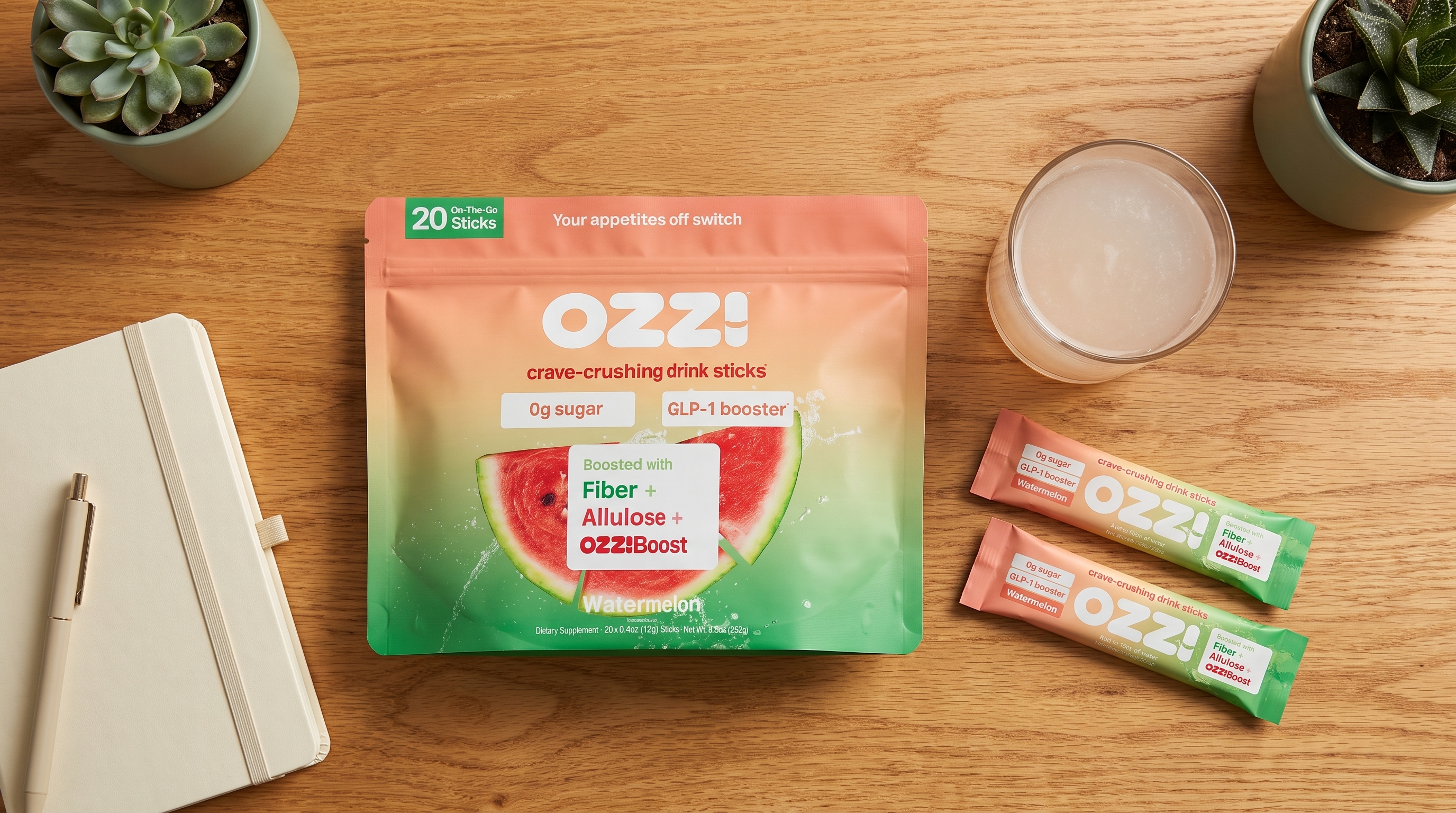
Each Ozzi stick has 8 g of allulose. That sits well under the 28 g single-dose ceiling from the human tolerance study, which is deliberate. It also sits under the 15 g daily dose that produced no microbiome disruption across 12 weeks.
The gut ingredients in the formula are separate ingredients doing separate jobs. Chicory root inulin at 500 mg is the prebiotic fiber. Glucomannan at 500 mg is a viscous fiber, and viscosity and fullness is its entire lane. We don't ask allulose to be a prebiotic, because it isn't one.
If you're chasing the microbiome-and-cravings connection or trying to sort out which fiber actually helps with appetite, start with the fiber, not the sweetener.
Ingredients that each have a job
Crave Crusher is one watermelon stick in 16 oz of water. Allulose for taste. Chicory root inulin and glucomannan for fiber. No caffeine, no stimulants, no berberine, vegan. Try it for 14 days straight. If it doesn't work, we'll refund your first bag.
Frequently asked questions about allulose and gut health
Is allulose a prebiotic?
No. Prebiotics have to reach your colon intact so bacteria can ferment them. Roughly 70% to 85% of allulose gets absorbed in the small intestine and leaves in urine, and the 12-week human trial at 15 g per day found no change in microbial diversity or short-chain fatty acid production.
Does allulose damage your gut bacteria?
The human evidence says no. The 12-week randomized trial checked 6 pathogenic species including C. difficile, Klebsiella pneumoniae, and Salmonella enterica and found no significant increases versus placebo.
Why does allulose cause bloating for some people if it's absorbed?
Because absorption is high but not complete. The leftover fraction reaching your colon draws water and can be partially fermented, which is why symptoms scale sharply with dose. Human data put severe diarrhea at around 0.5 g per kg in a single sitting.
How much allulose can I have in a day?
The human tolerance study suggested a maximum of 0.4 g per kg of body weight in one sitting and 0.9 g per kg per day. For a 155 lb adult that's about 28 g at once and about 63 g daily. Most people using it as a sweetener land far below both.
Does allulose produce butyrate?
In an ex-vivo flask system using donated human stool, yes. In living humans, the 12-week randomized trial measured short-chain fatty acids and found no significant change. Treat butyrate claims for allulose as preclinical.
Is allulose better for your gut than sugar alcohols?
For most people it's gentler, and the reason is mechanical. Only 15.8% of analyzed human gut metagenomes carry the alsE gene needed to metabolize allulose, so far fewer bacteria ferment it than ferment sorbitol or maltitol. Our allulose vs sugar comparison covers the rest.
Should I take allulose for gut health?
No. Take it because it's a sweetener with a minimal glycemic footprint. If gut bacteria are the goal, a prebiotic fiber like chicory root inulin has the human randomized trial data allulose lacks.
Does allulose affect blood sugar?
Human studies consistently show a minimal glycemic response, which is one of its better-supported properties. We break the mechanism down in does allulose spike blood sugar.
Can I take allulose while on GLP-1 medications?
Talk to your prescriber first, especially since GLP-1 medications already slow digestion and can amplify GI symptoms. Start with a smaller serving than you think you need.
How much allulose is in Ozzi?
8 g per stick, which is under both the single-dose tolerance ceiling and the daily dose used in the 12-week microbiome trial. Our allulose supplement guide has the full breakdown.
Made with 8g of allulose
Ozzi Crave Crusher
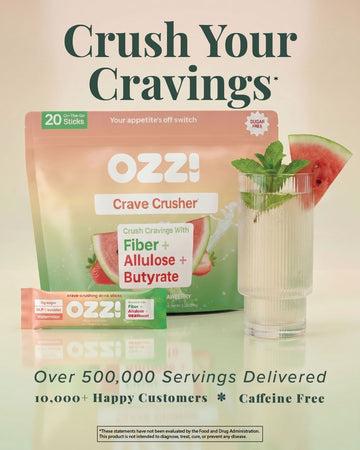
One watermelon stick a day: 8g allSWEET allulose, 500mg konjac glucomannan, 500mg BIOMEnd L-lysine butyrate, 300mcg chromium, 10mg ursolic acid and 150mg African mango. No caffeine, no stimulants, and every dose printed on the label.
See what's in it →References
- Iida T, et al. Failure of D-psicose absorbed in the small intestine to metabolize into energy and its low large intestinal fermentability in humans. Metabolism. 2010;59(2):206-14. https://doi.org/10.1016/j.metabol.2009.07.018 (human study)
- Impact of D-allulose consumption on enteric pathogens in human gut microbiota: a randomized controlled trial study. Journal of Functional Foods. 2024;122:106555. https://doi.org/10.1016/j.jff.2024.106555 (human RCT)
- Ndjite GM, et al. Gut microbial utilization of the alternative sweetener, D-allulose, via AlsE. Communications Biology. 2025;8(1):970. https://doi.org/10.1038/s42003-025-08391-3 (bioinformatic and in-vitro)
- Han Y, et al. Gastrointestinal tolerance of D-allulose in healthy and young adults: a non-randomized controlled trial. Nutrients. 2018;10(12):2010. https://doi.org/10.3390/nu10122010 (human study)
- Risso D, et al. Gastrointestinal tolerance of D-allulose in children: an acute, randomised, double-blind, placebo-controlled, cross-over study. Food & Function. 2024;15(1):411-418. https://doi.org/10.1039/d3fo04210c (human RCT)
- Daniel H, Hauner H, Hornef M, Clavel T. Allulose in human diet: the knowns and the unknowns. British Journal of Nutrition. 2022;128(2):172-178. https://doi.org/10.1017/S0007114521003172 (review)
- Adolphus K, et al. D-allulose and erythritol increase butyrate production and impact the gut microbiota in healthy adults and adults with type-2 diabetes ex vivo. Beneficial Microbes. 2025;16(5):573-591. https://doi.org/10.1163/18762891-bja00071 (ex-vivo, industry funded)
- Tsukamoto I, et al. Intestinal absorption, organ distribution, and urinary excretion of the rare sugar D-psicose. Drug Design, Development and Therapy. 2014;8:1955-64. https://doi.org/10.2147/DDDT.S60247 (rat and mouse study)
- Ye G, et al. D-allulose alleviates DSS-induced colitis via regulating gut microbiota and bile acid metabolism. Food Research International. 2025;223:117923. https://doi.org/10.1016/j.foodres.2025.117923 (mouse study)
- Reimer RA, et al. Effect of chicory inulin-type fructan-containing snack bars on the human gut microbiota in low dietary fiber consumers in a randomized crossover trial. American Journal of Clinical Nutrition. 2020;111(6):1286-1296. https://doi.org/10.1093/ajcn/nqaa074 (human RCT)
- Puhlmann ML, et al. Inulin-induced improvements on bowel habit and gut microbiota in adults with functional constipation. BMC Gastroenterology. 2025;25(1):806. https://doi.org/10.1186/s12876-025-04409-6 (human RCT, clinical population)
- Kiewiet MBG, et al. Flexibility of gut microbiota in ageing individuals during dietary fiber long-chain inulin intake. Molecular Nutrition & Food Research. 2021;65(4):e2000390. https://doi.org/10.1002/mnfr.202000390 (human RCT)
- Busch S, et al. Effects of allulose vs aspartame consumption on postprandial GLP-1 profiles and metabolic health: protocol for a randomized, crossover, double-blind, placebo-controlled trial. JMIR Research Protocols. 2026;15:e81857. https://doi.org/10.2196/81857 (published protocol, no results yet)
