

Allulose vs Sugar: What Actually Changes When You Swap (2026)
I get a version of this question every week. Someone reads the label on a bag of allulose, sees "0g added sugar" next to an ingredient that is chemically a sugar, and reasonably wonders whether the food industry is pulling something.
It isn't, exactly. But the real story is more interesting than either the marketing or the skepticism.
Allulose is a rare sugar that your body absorbs but mostly does not metabolize, so it delivers about 0.4 calories per gram versus roughly 4 for table sugar. Controlled human trials show it lowers the post-meal glucose and insulin spike, especially when eaten alongside carbohydrate. It has not been shown to change body weight or long-term blood sugar markers.
Key takeaways
- Allulose is chemically a sugar, metabolically almost not one.
- The FDA lets it sit outside "Added Sugars" on labels.
- Human trials show real post-meal glucose blunting.
- No trial shows allulose changing body composition.
- Most positive studies come from allulose manufacturers.

What is allulose, and how is it different from sugar?
Table sugar is sucrose. Your small intestine splits it into one glucose and one fructose, both of which get absorbed and used for energy. That's why sucrose runs about 4 calories per gram and why it raises blood glucose on the way through.
Allulose (also called D-psicose) is a monosaccharide that shows up in tiny amounts in figs, raisins, and maple syrup. Structurally it's a mirror-image cousin of fructose, differing at a single carbon.
That one carbon changes everything. Your body absorbs allulose in the small intestine, but the enzymes that would normally break a sugar down don't recognize it well. Most of what you absorb gets filtered out by the kidneys and leaves in urine, largely unchanged.
So you get the sweetness without most of the metabolic consequences. It reads as sweet on the tongue at about 70% the intensity of sucrose, which is why products using it need slightly more by weight.
| Table sugar (sucrose) | Allulose | |
|---|---|---|
| Sweetness | 100% (reference) | About 70% |
| Calories per gram | About 4 | About 0.4 (FDA factor) |
| Counts as "Added Sugars" | Yes | No (FDA enforcement discretion) |
| Counts as total carbohydrate | Yes | Yes |
| Post-meal glucose rise | Substantial | Minimal, and blunts other carbs |
| Bakes and browns | Yes | Yes, browns faster |
| Common side effect at high doses | Blood sugar swings | Bloating, loose stools |
Why does the label say "0g added sugar" when allulose is a sugar?
Because the FDA changed its mind, and said so in writing.
Under the 2016 Nutrition Facts rule, allulose had to be counted in total carbohydrate, total sugars, and added sugars, at 4 calories per gram. In October 2020 the agency issued final guidance saying it would exercise enforcement discretion: manufacturers can leave allulose out of Total Sugars and Added Sugars, and can use a general factor of 0.4 calories per gram.
It still has to appear in total carbohydrate. So a product sweetened with allulose can honestly show grams of carbs with zero added sugar on the same panel. That's not a loophole so much as the label catching up to the metabolism.
Chemically a sugar. Metabolically, mostly a passenger.
Does allulose actually lower blood sugar in humans?
This is the part with the best evidence, and it's genuinely good.
The most useful summary is a 2026 systematic review and meta-analysis in the American Journal of Clinical Nutrition, pooling 20 controlled human trials across 1,033 adults. For allulose specifically, post-meal glucose fell meaningfully (standardized mean difference -0.66, 95% CI -0.92 to -0.39) and post-meal insulin fell too. The authors graded both at moderate certainty, which in evidence terms is a real result, not a whisper.1
Underneath that pooled number sit some clean individual trials. A randomized crossover study at the University of Florida gave 30 adults without diabetes a standard 50g sucrose load plus escalating doses of allulose. Glucose at the 30-minute mark dropped in a dose-dependent way, reaching significance at 7.5g and 10g. Insulin excursion fell significantly at 10g.2
A separate randomized crossover in 30 Thai adults ran effectively the same design and found the same dose-dependent pattern in both peak glucose and peak insulin.3
An earlier meta-analysis restricted to healthy people found significantly smaller post-meal glucose area under the curve at both 5g and 10g.4
Four independent research groups, same direction. That's about as consistent as nutrition science gets.

What does allulose fail to do?
Here's where I want to be careful, because the supplement industry is very bad at this part.
That same 2026 meta-analysis, the strongest evidence we have, reported no significant effect of allulose on HbA1c, fasting glucose, fasting insulin, blood lipids, uric acid, or body composition.1 Not a small effect. No detectable effect at all, across every one of those outcomes.
So the honest framing is narrow: allulose reliably changes what happens in the two hours after you eat. It has not been shown to change what the scale says in three months.
There's also a null result worth naming. A double-blind randomized equivalence trial from the University of Toronto tested whether small "catalytic" doses of allulose or fructose (5g and 10g) would improve the response to a 75g glucose load in healthy people. They failed to confirm any effect, and were upfront that individual variation was larger than they'd expected.5
And in a Swiss randomized crossover, 25g of allulose lowered glucose against water, but when the researchers reanalyzed insulin using Bayesian models the difference didn't hold up. The same study found allulose did not reduce ghrelin, the hunger hormone, though erythritol did.6
If someone tells you allulose kills your appetite, that Swiss ghrelin finding is the one they haven't read.
Who funded these studies?
A fair amount of the allulose literature traces back to Matsutani Chemical Industry, a Japanese company that manufactures allulose, and to Kagawa University, where much of the foundational rare-sugar work was done.
Author lists on several of the studies above include Matsutani employees. That doesn't make the findings wrong. Industry funding is normal in ingredient research, and someone has to pay for the trials. But it does mean the independent replications carry extra weight, and it's part of why the 2026 meta-analysis from Brigham Young University and UC Irvine matters more than any single positive trial.
I'd rather tell you that than have you find it yourself and wonder what else I skipped.
What has the research actually studied in people with diabetes?
A small pilot in Japan put people with type 2 diabetes on a standard energy-controlled diabetic diet versus the same diet containing 8.5g of allulose, tracking them with continuous glucose monitors. Peak post-meal glucose improved on the allulose version.7
Worth stating plainly: those participants were patients under medical supervision, on managed diets, in a pilot-sized study. That result belongs to that context. It is not a claim about what allulose does for a healthy person buying a bag of sweetener, and Ozzi is a supplement, not a treatment for any condition.
Is there a gut angle to allulose?
There are early signals, and they are early.
A 2025 study using an ex vivo fermentation system (human stool samples in a lab vessel, not people) found that allulose increased butyrate production and shifted certain bacterial families over 24 to 48 hours.8 Interesting, and worth a real trial. But an ex vivo result is a hypothesis, not a benefit.
Separately, work in rats and mice has looked at allulose and intestinal signaling.9 Rodent findings in gut research have a long history of not surviving contact with human trials, so I file those under "watch this space."
Ozzi doesn't make gut barrier claims for allulose, and neither should anyone else yet. If you want the butyrate story, the evidence lives with butyrate itself and with gut health and GLP-1, not with the sweetener.
A test tube is not a person, and a mouse is not you.
Should you swap sugar for allulose?
If you're using sweetener anyway, allulose is one of the better available trades. It behaves like sugar in the kitchen, it browns and caramelizes (faster than sugar, so watch your oven), and it doesn't carry the post-meal spike.
Two practical caveats.
First, dose. Most people tolerate moderate amounts fine, but push past roughly 0.5g per kilogram of body weight in one sitting and bloating or loose stools become common. If you're new to it, start small. We covered the specifics in allulose side effects.
Second, expectations. Swapping sugar for allulose removes calories and blunts spikes. It does not, on the evidence, make you eat less at the next meal. If the actual problem is that you're eating cookies at 10:30 at night, a different sweetener in your coffee isn't the lever.
That's the honest reason Ozzi uses allulose as a base rather than a headline. 8g of allulose makes a stick that tastes like something you'd want to drink and doesn't spike you. The appetite side of the formula comes from fiber and butyrate working on different mechanisms entirely.

Frequently asked questions
Is allulose a natural sugar or an artificial sweetener?
Natural in origin. It occurs in figs, raisins, jackfruit, and maple syrup, though in amounts too small to harvest. Commercial allulose is made enzymatically from corn-derived fructose.
How many calories are in allulose?
The FDA permits a general factor of 0.4 calories per gram, roughly a tenth of sugar's 4 calories per gram.
Does allulose raise blood sugar?
On its own, minimally. Eaten with carbohydrate, human trials show it lowers the resulting glucose spike in a dose-dependent way. More detail in does allulose spike blood sugar.
Will allulose help me lose weight?
Not by itself, on current evidence. The 2026 meta-analysis found no effect on body composition. Replacing sugar calories with near-zero-calorie ones can reduce total intake, but that's arithmetic, not a special property of allulose.
Does allulose cause digestive issues?
It can at higher single doses. Bloating and loose stools are the usual complaints. Tolerance varies a lot between people and tends to improve with gradual introduction.
Is allulose safe?
It holds GRAS status in the US and has a reassuring safety record in trials to date. We went through the evidence in detail in is allulose safe.
Does allulose trigger GLP-1?
Some early human work suggests a modest gut hormone response, but the human GLP-1 data on allulose specifically is thin and inconsistent. Treat confident claims either way with suspicion. Background on the hormone is in what is GLP-1.
Can I bake with allulose?
Yes. It dissolves well, holds moisture, and browns noticeably faster than sugar, so lower your oven temperature or shorten the bake. It doesn't crystallize the way sugar does, which makes hard candy difficult.
Allulose or monk fruit?
Different jobs. Monk fruit is intensely sweet in tiny amounts and adds no bulk. Allulose provides bulk and browning. Many products blend them. Comparison here: allulose vs monk fruit vs stevia.
Does allulose break a fast?
Depends whose definition you're using. It contains negligible calories and produces a minimal insulin response, but it isn't literally zero on either count.
Sweet without the spike, plus the part that handles cravings
Ozzi Crave Crusher uses 8g of allulose as the base, then adds fiber and butyrate to support natural GLP-1 production. Try it for 14 days straight. If it doesn't work, we'll refund your first bag.
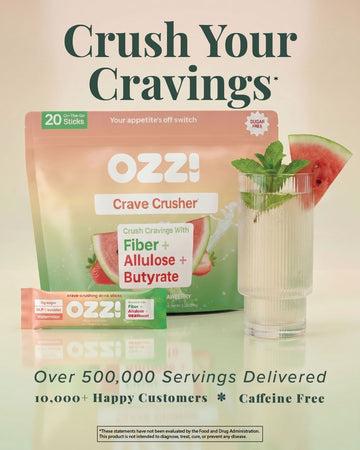
Made with 8g of allulose
Ozzi Crave Crusher
One watermelon stick a day: 8g allSWEET allulose, 500mg konjac glucomannan, 500mg BIOMEnd L-lysine butyrate, 300mcg chromium, 10mg ursolic acid and 150mg African mango. No caffeine, no stimulants, and every dose printed on the label.
See what's in it →References
- Osborn L, DuPuis K, Liu S, et al. Glycemic and cardiometabolic effects of rare sugars allulose and tagatose: a systematic review and meta-analysis of controlled human intervention trials. Am J Clin Nutr. 2026;123(6):101314. https://doi.org/10.1016/j.ajcnut.2026.101314
- Franchi F, Yaranov DM, Rollini F, et al. Effects of D-allulose on glucose tolerance and insulin response to a standard oral sucrose load: results of a prospective, randomized, crossover study. BMJ Open Diabetes Res Care. 2021;9(1):e001939. https://doi.org/10.1136/bmjdrc-2020-001939
- Buranapin S, Kosachunhanan N, Waisayanand N, et al. Effects of D-Allulose with Sucrose Beverage on Glucose Tolerance and Insulin Levels among Thai Healthy Volunteers. J Nutr Sci Vitaminol. 2024;70(3):203-209. https://doi.org/10.3177/jnsv.70.203
- Tani Y, Tokuda M, Nishimoto N, et al. Allulose for the attenuation of postprandial blood glucose levels in healthy humans: A systematic review and meta-analysis. PLoS One. 2023;18(4):e0281150. https://doi.org/10.1371/journal.pone.0281150
- Braunstein CR, Noronha JC, Glenn AJ, et al. A Double-Blind, Randomized Controlled, Acute Feeding Equivalence Trial of Small, Catalytic Doses of Fructose and Allulose on Postprandial Blood Glucose Metabolism in Healthy Participants (FACE Trial). Nutrients. 2018;10(6):750. https://doi.org/10.3390/nu10060750
- Teysseire F, Bordier V, Budzinska A, et al. Metabolic Effects and Safety Aspects of Acute D-allulose and Erythritol Administration in Healthy Subjects. Nutrients. 2023;15(2):458. https://doi.org/10.3390/nu15020458
- Fukunaga K, Yoshimura T, Imachi H, et al. A Pilot Study on the Efficacy of a Diabetic Diet Containing the Rare Sugar D-Allulose in Patients with Type 2 Diabetes Mellitus. Nutrients. 2023;15(12):2802. https://doi.org/10.3390/nu15122802
- Adolphus K, Van den Abbeele P, Poppe J, et al. D-Allulose and erythritol increase butyrate production and impact the gut microbiota in healthy adults and adults with type-2 diabetes ex vivo. Benef Microbes. 2025;16(5):573-591. https://doi.org/10.1163/18762891-bja00071
- Suzuki T, Sato Y, Kadoya S, et al. Comparative Effects of Allulose, Fructose, and Glucose on the Small Intestine. Nutrients. 2022;14(15):3230. https://doi.org/10.3390/nu14153230
- Teysseire F, Bordier V, Beglinger C, et al. Metabolic Effects of Selected Conventional and Alternative Sweeteners: A Narrative Review. Nutrients. 2024;16(5):622. https://doi.org/10.3390/nu16050622
- US Food and Drug Administration. The Declaration of Allulose and Calories from Allulose on Nutrition and Supplement Facts Labels: Guidance for Industry. October 2020. FDA guidance
These statements have not been evaluated by the Food and Drug Administration. This product is not intended to diagnose, treat, cure, or prevent any disease. Nothing here is medical advice. Talk to your doctor before changing your diet, especially if you manage blood sugar with medication.
