

Is Allulose Safe? An Honest Look at the Evidence (2026)
Allulose is considered safe at normal food-use amounts. The FDA has accepted it as generally recognized as safe and permits a 0.4 calories per gram value. The main documented downside is gastrointestinal: a human tolerance study put the ceiling at about 0.4g per kg of body weight in a single serving, or roughly 27g for a 150-pound adult.
Key takeaways
- US regulators treat allulose as safe at food-use levels.
- Side effects are digestive, not toxic, and dose-dependent.
- Human ceiling: about 0.4g per kg body weight per serving.
- EFSA's 2025 "cannot be established" was a paperwork gap.
- Long-term human data remain genuinely thin.
If you've started reading supplement labels, allulose shows up everywhere now. Protein bars, keto ice cream, GLP-1 drinks, sugar-free syrups. And because it's newish, the internet has decided it's either a miracle or a scandal.
It's neither. I've spent a lot of time in this literature because allulose is the largest ingredient by weight in what we make, and I'd rather tell you the boring accurate version than the exciting one.
Is allulose safe to eat?
At the amounts you'd actually get from food and drinks, yes, based on what regulators and published human testing show.
The US Food and Drug Administration has accepted allulose as generally recognized as safe for use in food. In 2019 it went further and issued guidance allowing manufacturers to exclude allulose from both the Total Sugars and Added Sugars declarations on the Nutrition Facts panel, and to count it at 0.4 calories per gram instead of 4. The FDA's stated reasoning was that allulose isn't metabolized like table sugar, contributes almost no calories, produces only negligible changes in blood glucose and insulin, and doesn't feed the bacteria that cause tooth decay.
That's a meaningful signal. Regulators don't hand out label carve-outs casually.
But "safe" and "unlimited" aren't the same word, and that's where most of the confusion lives.

What actually happens to allulose in your body?
Allulose is a rare sugar. Chemically it's a mirror-image cousin of fructose, which is why it tastes like sugar and behaves like sugar on your tongue.
Then the similarity stops. A 2021 review in the British Journal of Nutrition laid out the mechanism plainly: because allulose looks so much like fructose, it uses the same transport routes into the body. But the human genome doesn't encode any enzyme capable of breaking it down. So most of what gets absorbed is excreted through the kidneys, largely intact, delivering close to zero usable energy.
That's the whole trick. It isn't a filter or a blocker or anything clever. Your body simply has no tool for taking it apart, so it passes through.
Your body doesn't neutralize allulose. It just never learned how to digest it.
The same review noted why that mechanism matters for tolerance. Whatever stays unabsorbed keeps traveling, and once a sugar reaches the large intestine in quantity, it pulls water with it. That's the origin of every allulose side effect people report.
How much allulose is too much?
This is the only allulose safety question with a real number attached, and it's the one almost nobody quotes correctly.
A 2018 study in Nutrients ran a stepwise gastrointestinal tolerance test in healthy young adults, raising the dose 0.1g per kg of body weight at a time. No severe diarrhea or serious symptoms appeared up through 0.4g per kg of body weight in a single dose. At 0.5g per kg, severe diarrhea showed up. When the researchers pushed total daily intake gradually to 1.0g per kg, participants reported severe nausea, abdominal pain, headache, loss of appetite and diarrhea.
Their conclusion: a maximum single dose of 0.4g per kg body weight, and a maximum total daily intake of 0.9g per kg.
Those are per-kilogram numbers, so they scale with you. Here's what they translate to:
| Body weight | Max single serving | Max per day |
|---|---|---|
| 120 lb (54 kg) | ~22g | ~49g |
| 150 lb (68 kg) | ~27g | ~61g |
| 180 lb (82 kg) | ~33g | ~73g |
| 200 lb (91 kg) | ~36g | ~82g |
| 250 lb (113 kg) | ~45g | ~102g |
Put that next to real products. A serving of allulose-sweetened ice cream might run 15g to 20g. A cup of allulose-sweetened syrup on pancakes could clear 30g fast. Two of those in an afternoon and a 130-pound person is well past the single-serving ceiling.
Most people who say allulose "wrecked" them ate a lot of it at once. That's a portion problem wearing a safety costume.
Why did Europe say allulose safety "cannot be established"?
Here's the part that generates scary screenshots, and here's what actually happened.
In June 2025, the European Food Safety Authority published its opinion on allulose as a novel food. The conclusion was that the safety of allulose "cannot be established." Which sounds damning until you read the reason.
EFSA's panel identified data gaps in the application covering identity, production process, proposed use levels, genotoxicity and human data. They sent a request for additional information to the company that filed the application. Then, in EFSA's own words, "despite being contacted several times, the applicant did not reply to EFSA's requests for additional data."
So the panel ruled on an incomplete file. That's a very different finding from "we tested this and found harm."
An unanswered email is not a toxicology result.
I want to be fair in both directions here, though. EFSA flagging missing genotoxicity and human data is a legitimate observation about how thin parts of the evidence base still are. It just isn't evidence of danger, and anyone presenting it as "banned in Europe because it's unsafe" is skipping the sentence that explains it.
| Region | Status | What it means |
|---|---|---|
| United States | GRAS; excluded from Total and Added Sugars | Cleared for food use, counted at 0.4 cal/g |
| European Union | Not authorized; 2025 opinion inconclusive | Application incomplete, applicant stopped responding |

What are the real side effects of allulose?
Every documented complaint traces back to digestion. In the 2018 tolerance study, allulose produced significantly more diarrhea, abdominal distension and abdominal pain than regular sugar did in the same participants.
The usual list, roughly in order of how often people report it:
- Loose stools or diarrhea
- Bloating and abdominal distension
- Gas
- Cramping or abdominal pain
- Nausea, mostly at high daily totals
Two things soften this in practice. First, it's dose-dependent, so cutting the serving usually solves it. Second, tolerance tends to improve when you introduce it gradually rather than starting at a big serving on day one.
If you're already dealing with digestive sensitivity, the same caution applies here as with any fermentable carbohydrate. Our guide to GLP-1 bloating and constipation covers how to ease into this category without a rough first week.
Does allulose raise blood sugar?
Not meaningfully, which is the finding the FDA leaned on.
A double-blind randomized crossover trial published in Nutrients in 2018 tested small doses of allulose and fructose against a 75g oral glucose tolerance test in healthy adults. Adding 5g or 10g of allulose produced no significant change in plasma glucose area under the curve. Worth noting honestly: the authors reported the trial was underpowered because of high variability between individuals, so read it as "no signal detected here," not as proof of a specific effect size.
A separate human study in Nutrition found allulose increased postprandial fat oxidation in healthy people after a meal, which is a real human finding rather than a rodent one.
We went deeper on this in does allulose spike blood sugar, and compared it head to head with other sweeteners in allulose vs monk fruit vs stevia.
What don't we know about allulose yet?
This section exists because a supplement company writing a safety article and finding zero open questions would be a little suspicious.
Long-term human data are thin. Most human allulose studies are acute or short. Nobody has published a large multi-year human trial. EFSA specifically called out insufficient long-term human consumption data.
There's no combined chronic toxicity and carcinogenicity study on the record in the EU application, which is a standard box that hasn't been ticked in that filing.
The gut bacteria question is open. That 2021 British Journal of Nutrition review raised a specific hypothesis: certain bacteria, including Klebsiella, appear able to use allulose as a food source, and Klebsiella can act as an opportunistic pathogen. The authors were careful to frame this as a research need, not a demonstrated harm. It hasn't been resolved either way in humans.
Animal work looks reassuring where it exists. A rat prenatal developmental toxicity study run to OECD guidelines found no teratogenic effects and set a no-observed-adverse-effect level of 5,000mg per kg per day. That's a rodent finding, and I'm labeling it as one rather than letting it stand in for human pregnancy safety.
Same discipline applies to the mechanism research people cite most. The well-known work showing allulose triggering GLP-1 release through vagal activation was done in rodents, and a 2025 study tying allulose's anti-obesity effects to the GLP-1 receptor used high-fat-diet mice and knockout mice. Interesting, biologically plausible, and not the same thing as a human result.

How much allulose is in Ozzi, and is that a problem?
One stick of Crave Crusher contains 8g of allulose. It's the largest ingredient by weight in the formula.
For a 150-pound adult, that's roughly 29% of the single-serving ceiling from the tolerance study, and about 13% of the daily ceiling. For a 120-pound adult it's around 36% of a single serving. There's real headroom in both cases, which is deliberate.
We use allulose because it does two jobs at once: it makes the drink taste like something you'll actually finish, and it supports natural GLP-1 production without the blood sugar consequences of sugar. If you want the full breakdown of dosing and how it fits the rest of the formula, that's in our allulose supplement guide, and the comparison against the other popular option is in allulose vs berberine.
Where it fits the bigger mechanism is covered in what is GLP-1 and gut health and GLP-1. If the reason you're here is the 9pm thing rather than the chemistry, start with how to stop food noise naturally.
Who should be careful with allulose?
A few groups have a reason to go slower or check with a clinician first.
People with IBS or existing digestive sensitivity, because the fermentation and water-drawing effects hit harder on an already reactive gut. People who are pregnant or breastfeeding, because the reassuring reproductive data are from rats and human data are absent. Anyone with kidney concerns, since allulose leaves largely through the kidneys and that's a reasonable thing to ask your doctor about.
And anyone who just doesn't like the feeling. Tolerance varies a lot between individuals, and "this doesn't agree with me" is a complete reason on its own.
Frequently asked questions
Is allulose FDA approved?
Allulose is generally recognized as safe for food use in the US, which is the relevant status for an ingredient rather than a drug. The FDA also issued guidance permitting its exclusion from Total and Added Sugars on the Nutrition Facts label and a 0.4 calories per gram value.
Is allulose banned in Europe?
It isn't authorized for sale as a novel food in the EU, which is not the same as being banned after a safety finding. EFSA's 2025 opinion concluded safety could not be established because the applicant did not respond to requests for additional data.
How much allulose can I have in a day?
Published human tolerance testing suggests a maximum of about 0.9g per kg of body weight per day, and about 0.4g per kg in any single serving. For a 150-pound adult that's roughly 61g daily and 27g at once.
Why does allulose give some people diarrhea?
Whatever isn't absorbed in the small intestine continues into the large intestine, where it draws in water and gets fermented by gut bacteria. Past a certain dose that produces loose stools, gas and bloating. Smaller servings usually resolve it.
Is allulose safe during pregnancy?
There's no human pregnancy data to answer that properly. A rat study found no teratogenic effects with a no-observed-adverse-effect level of 5,000mg per kg per day, but rodent findings don't transfer to humans. Ask your doctor.
Is allulose safe for diabetics?
Allulose produces only negligible changes in blood glucose and insulin, which is part of why the FDA allows the label exclusion. That said, blood sugar management is medical territory, so anyone managing diabetes should talk to their care team before changing sweeteners.
Does allulose cause weight gain?
At 0.4 calories per gram it contributes almost nothing energetically. Studies pointing to anti-obesity effects have mostly been done in mice, so the honest framing is that it's a very low-calorie sugar substitute, not a proven weight loss agent.
Is allulose a natural sugar?
It occurs naturally in small quantities in figs, raisins, jackfruit and maple syrup. The commercial supply is made enzymatically from fructose, which is also how most food-grade allulose reaches the market.
Does allulose break a fast?
It contributes almost no calories and produces negligible insulin response, so by most practical definitions it doesn't. Strict interpretations of fasting exclude anything with flavor, so this comes down to which rules you're following.
Is allulose safe long term?
The honest answer is that long-term human data are limited. Short-term human studies and animal toxicology look reassuring, and EFSA specifically flagged the absence of long-term human consumption data as a gap. Nobody has published a multi-year human trial yet.
8g of allulose, and no guessing about the rest
Crave Crusher pairs 8g of allulose with 500mg of butyrate, 500mg of glucomannan and 500mg of chicory root inulin. Try it for 14 days straight. If it doesn't work, we'll refund your first bag.
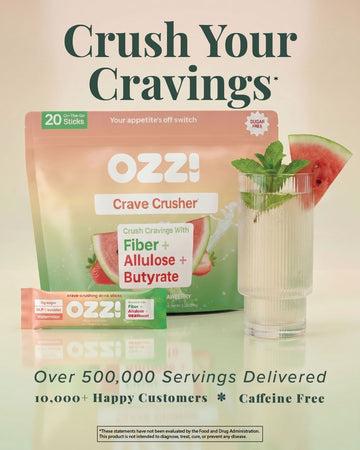
Made with 8g of allulose
Ozzi Crave Crusher
One watermelon stick a day: 8g allSWEET allulose, 500mg konjac glucomannan, 500mg BIOMEnd L-lysine butyrate, 300mcg chromium, 10mg ursolic acid and 150mg African mango. No caffeine, no stimulants, and every dose printed on the label.
See what's in it →References
- Han Y, et al. Gastrointestinal Tolerance of D-Allulose in Healthy and Young Adults. A Non-Randomized Controlled Trial. Nutrients. 2018;10(12):2010. https://doi.org/10.3390/nu10122010
- EFSA Panel on Nutrition, Novel Foods and Food Allergens. Safety of D-allulose as a novel food pursuant to Regulation (EU) 2015/2283. EFSA Journal. 2025;23(6):e9468. https://doi.org/10.2903/j.efsa.2025.9468
- Daniel H, Hauner H, Hornef M, Clavel T. Allulose in human diet: the knowns and the unknowns. British Journal of Nutrition. 2022;128(2):172-178. https://doi.org/10.1017/S0007114521003172
- Braunstein CR, et al. A Double-Blind, Randomized Controlled, Acute Feeding Equivalence Trial of Small, Catalytic Doses of Fructose and Allulose on Postprandial Blood Glucose Metabolism in Healthy Participants (FACE Trial). Nutrients. 2018;10(6):750. https://doi.org/10.3390/nu10060750
- Sa S, et al. Teratogenicity of D-allulose. Toxicology Reports. 2022;9:821-824. (Rat study) https://doi.org/10.1016/j.toxrep.2022.03.028
- Iwasaki Y, et al. GLP-1 release and vagal afferent activation mediate the beneficial metabolic and chronotherapeutic effects of D-allulose. Nature Communications. 2018;9:113. (Rodent study) https://doi.org/10.1038/s41467-017-02488-y
- Kimura T, et al. d-Allulose enhances postprandial fat oxidation in healthy humans. Nutrition. 2017;43-44:16-20. https://doi.org/10.1016/j.nut.2017.06.007
- Lee GH, et al. D-Allulose Regulates Obesity via Endoplasmic Reticulum Stress-Mediated Glucagon-Like Peptide-1 Receptor Pathway. Antioxidants & Redox Signaling. 2025;43(16-18):819-832. (Mouse study) https://doi.org/10.1177/15230864251399183
- Ruiz-Ojeda FJ, et al. Metabolic Effects of Selected Conventional and Alternative Sweeteners: A Narrative Review. Nutrients. 2024;16(5):622. https://doi.org/10.3390/nu16050622
- US Food and Drug Administration. The Declaration of Allulose and Calories from Allulose on Nutrition and Supplement Facts Labels: Guidance for Industry. FDA Brief
Peer-reviewed sources located via PubMed.
