

Why Is Allulose Banned in Europe? It Isn't, and Here Is What Is Actually Going On
Allulose is not banned in Europe. Under the EU Novel Food Regulation, any food not widely eaten in Europe before May 1997 cannot be sold until it is authorised, and allulose has not yet been authorised. Four applications are pending. In 2025 EFSA said it could not establish safety for one applicant's file because that applicant never supplied the data EFSA requested, which is a paperwork failure, not a finding of harm. Allulose is approved in the United States, Japan, South Korea, Mexico, Australia and New Zealand.
Key takeaways
- "Not yet authorised" and "banned" are different things. Europe has the first, not the second.
- The EU novel food rule is a queue. Chia seeds and stevia sat in the same queue before they were approved.
- EFSA's 2025 opinion said the safety of one applicant's file "cannot be established" because the applicant went silent, not because anything was found.
- Six major regulators have already approved allulose, including the FDA, Japan and Australia.
- The human tolerance data has a real ceiling, about 0.4 g per kg of body weight in one sitting. That is 28 g for a 70 kg adult. A stick of Ozzi has 8 g.
The short answer: not banned, not approved, in the queue
I get this question a few times a week now, usually phrased as a gotcha. "If allulose is so safe, why did Europe ban it?"
Europe didn't. There is no ban. There has never been a ban. What Europe has is a law called the Novel Food Regulation, and allulose is sitting in the line that law creates. That's it. That's the whole scandal.
I understand why the word "banned" spread. It's a better headline than "pending regulatory authorisation under Regulation (EU) 2015/2283," and a lot of sites that write about sweeteners are chasing the search term, not the truth. But it's wrong, and if you've been avoiding allulose because of it, you've been avoiding it for a reason that doesn't exist.
What "novel food" actually means
Here's the rule, in plain words. The EU decided that any food not eaten to a significant degree in Europe before 15 May 1997 counts as "novel," and a novel food can't be sold until a company applies, submits a full safety dossier, and the European Food Safety Authority signs off.1
Read that again, because it's the part everyone skips. The default state of a novel food is "not authorised yet." It isn't a judgment. It's a starting position. Every new ingredient begins there, and the only way out is a company paying for the studies and filing the paperwork.
Chia seeds were a novel food. You couldn't legally sell them as food in the EU until 2009, and the approval only covered bread until it was widened in 2013.2 Nobody wrote "Why is chia banned in Europe" articles. Stevia's sweetening compounds went through the same wait before EU approval in 2011.3 Same law, same queue, same outcome: they got through once someone finished the file.
Allulose is a rare sugar. It exists naturally in figs, raisins, jackfruit and maple syrup, but only in trace amounts, and commercial allulose only became a thing in the 2010s.4 So of course it wasn't being eaten in Europe in 1996. Of course it's novel. That's a calendar fact, not a safety fact.
What EFSA actually said in 2025
This is the part the fear-mongering leans on, so let's read the actual document instead of the headline about it.
In May 2025, EFSA's nutrition panel published an opinion on one allulose application, from a company called Petiva Europe. The conclusion was: "Based on the available data, the Panel concludes that the safety of the NF D-allulose cannot be established."5
Sounds bad, until you read why. The applicant submitted data in February 2020 and then, in EFSA's own words, "did not reply to any subsequent request from EFSA for additional data." EFSA asked for batch analyses, production process details, genotoxicity studies run to OECD standards, and longer human data. The company went quiet. So EFSA did the only thing it can do with an incomplete file: it said it couldn't reach a conclusion.5
"Cannot be established" is a regulator saying "you didn't give me enough to work with." It is not "we found a problem." Those are different sentences, and the people quoting the first one as if it were the second know that.
Three other applications are still in the queue, from CJ CheilJedang with Tereos, from Samyang, and from Tate & Lyle.6 Those are three of the largest sweetener manufacturers on earth, and they have the money and the data to finish the job. My honest expectation is that allulose gets authorised in the EU the same way chia and stevia did: later than it should have, after a lot of paperwork, with nobody apologising for the years of "banned" headlines.

Where allulose stands, country by country
| Region | Status | What that means |
|---|---|---|
| United States | Approved (GRAS) | Multiple FDA GRAS notices. Since 2020 the FDA lets it be excluded from Total and Added Sugars on the label at 0.4 calories per gram.7 |
| Japan | Approved | In commercial products for over a decade. Japanese researchers did much of the early human work. |
| South Korea | Approved | Home of two of the biggest producers. Sold in mainstream groceries. |
| Mexico | Approved | Permitted as a food ingredient. |
| Australia and New Zealand | Approved (2024) | FSANZ authorised it as a novel food in 2024 after a three-year review. Same "novel food" label as Europe, opposite outcome.8 |
| European Union | Pending, not banned | Not on the Union list of authorised novel foods. Four applications pending. One 2025 opinion inconclusive for lack of data.5,6 |
| United Kingdom | Pending, not banned | The UK runs its own process since Brexit. Application RP-1130 is in the Food Standards Agency's risk assessment stage.9 |
| Canada | Not yet on the approved list | Treated as a novel food. It does not appear on Health Canada's published list of approved novel foods as of this writing. Widely bought online anyway. |
Look at that table and ask yourself which is more likely. That the FDA, Japan, Korea, Mexico, Australia and New Zealand all missed a danger that Europe caught? Or that Europe's paperwork is slower and one applicant dropped the ball?
Why people keep saying it's banned
Three reasons, and none of them are science.
Products disappear and people fill in the blank. A US brand launches in Europe, has to reformulate without allulose, and a customer notices the ingredient is gone. "Not permitted for sale" turns into "banned" by the second retelling.
Content farms need a headline. "Why is allulose banned in Europe" is a search term with volume, so sites write an article with that exact title and answer the question as if the premise were true. I've read several. Most of them get the novel food rule right in paragraph four and keep the wrong headline anyway, because the headline is what ranks.
Competing sweeteners benefit. If you sell erythritol, stevia or monk fruit, a rumour that the new rare sugar is "banned in Europe" is free marketing. Nobody has to say it directly. They just don't correct it.
I'll be blunt about where I stand. Allulose is the sweetener in our product, so I have a bias, and you should weigh it. But I also read the EFSA opinion, the FDA guidance, and the tolerance trials before I put 8 g of it in a stick, and I'd rather you argue with me about the actual documents than about a headline.
Is allulose safe? What the human data actually says
"Not banned" isn't the same as "eat as much as you like," so here's the honest version.
Allulose is absorbed in the small intestine but your body has no enzyme to burn it, so most of it leaves in your urine unchanged. That's why it delivers about a tenth of the calories of sugar and produces a negligible glucose and insulin response.4,7 We covered that data in does allulose spike blood sugar.
The limit is your gut. A 2018 Korean tolerance trial stepped the dose up in healthy adults and found no severe symptoms until 0.4 g per kg of body weight in one sitting, with diarrhea appearing at 0.5 g per kg. The authors set a practical ceiling of 0.4 g per kg per dose and 0.9 g per kg per day.10 For a 70 kg person that's about 28 g at once, so a product carrying 10 g to 30 g in a single serving can genuinely bother some people. The full list of what to expect is in allulose side effects.
Newer data points the same way. A 30-day randomized, double-blind trial published in 2026 gave 49 healthy adults either 24 g or 36 g of allulose a day. Gut symptoms were mild, showed up mostly in the first three days, and then settled; every systemic safety marker stayed normal. The authors proposed 0.4 g per kg per day as a provisional daily limit and, to their credit, said longer studies are still needed.11
Note what's missing from EFSA's concerns: nothing about toxicity, nothing about cancer, nothing about organ effects. The gaps were about manufacturing documentation, standard genotoxicity paperwork, and wanting longer human studies. Those are the questions a regulator asks about every new ingredient, and the ones the remaining applicants are answering.
One more thing worth knowing: allulose is not a sugar alcohol, so the erythritol and xylitol gut-fermentation problem doesn't apply. It's a different molecule with a different exit route. We wrote that up in is allulose a sugar alcohol.
What this means if you're in Europe or the UK
You can't buy allulose in a European supermarket today, and a product made with it can't be legally sold to you as food by an EU-based seller. That's the practical reality of "pending." Plenty of Europeans buy it online from outside the bloc, and customs generally doesn't care about a bag of sweetener, but that's a personal decision, not something I'm recommending.
If you're in the UK, watch the Food Standards Agency application. The UK has been faster than the EU on several novel foods since it started running its own list, and the allulose file is already in risk assessment.9
And if someone tells you it's banned, ask them for the regulation number. There isn't one.
Why we put 8 g of it in every stick
Allulose is the base of Ozzi for a reason that has nothing to do with sweetness. It reaches sweet-taste receptors in the gut that trigger GLP-1 release, the hormone that tells your brain you're full, and it does that without the blood sugar spike that starts the next craving. That's why we use 8 g, which is the range the research used, rather than a pinch for the label. The allulose and GLP-1 research is laid out study by study if you want to check it.
8 g is also well under the tolerance ceiling for any adult, which is the other reason we stopped there.
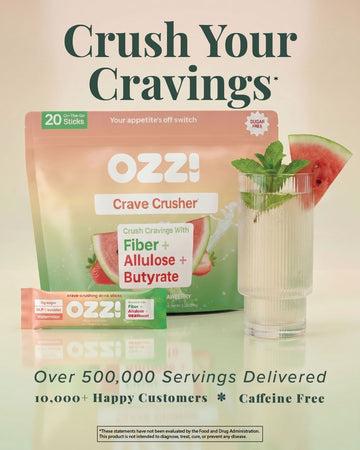
Made with 8g of allulose
Ozzi Crave Crusher
One watermelon stick a day: 8g allSWEET allulose, 500mg konjac glucomannan, 500mg BIOMEnd L-lysine butyrate, 300mcg chromium, 10mg ursolic acid and 150mg African mango. No caffeine, no stimulants, and every dose printed on the label.
See what's in it →Frequently asked questions
Is allulose banned in Europe?
No. It has not been authorised yet under the EU Novel Food Regulation, which is a different thing. Four applications are pending. There is no regulation, decision or ruling that bans it.
Did EFSA say allulose is unsafe?
No. In 2025 EFSA said the safety of one applicant's file "cannot be established" because that applicant stopped supplying the data EFSA asked for. That is an incomplete dossier, not a safety finding.5
Is allulose legal in the UK?
Not yet authorised as a novel food. An application is in the Food Standards Agency's risk assessment stage. The UK process is separate from the EU's.9
Where is allulose approved?
The United States, Japan, South Korea, Mexico, and Australia and New Zealand, among others. The FDA has issued multiple GRAS notices and a labelling guidance for it.7,8
Why is allulose a novel food if it occurs in figs?
Because the rule is about consumption history, not origin. Allulose was not eaten to any significant degree in Europe before 1997, and commercial production is recent, so it counts as novel regardless of the fact that figs contain traces of it.
Is allulose safe to eat every day?
Human tolerance trials put the practical ceiling at about 0.4 g per kg of body weight in a single dose and 0.9 g per kg per day. Below that, the main effect people notice is nothing. Above it, some get bloating or loose stools.10 Talk to your clinician if you manage a medical condition.
Will Europe approve allulose?
Nobody can promise a regulator's timeline. Three well-funded applications remain in the queue, Australia approved it in 2024 under an equivalent novel food system, and chia and stevia both went through the same wait before EU approval. I'd bet on yes, and on it taking longer than it should.
References
- Regulation (EU) 2015/2283 of the European Parliament and of the Council of 25 November 2015 on novel foods. Official Journal of the European Union. L 327, 11.12.2015. https://eur-lex.europa.eu/eli/reg/2015/2283/oj
- Commission Decision 2009/827/EC of 13 October 2009 authorising the placing on the market of Chia seed (Salvia hispanica) as novel food ingredient. Official Journal of the European Union. L 294, 11.11.2009. https://eur-lex.europa.eu/eli/dec/2009/827/oj
- Commission Regulation (EU) No 1131/2011 of 11 November 2011 amending Annex II to Regulation (EC) No 1333/2008 with regard to steviol glycosides. Official Journal of the European Union. L 295, 12.11.2011. https://eur-lex.europa.eu/eli/reg/2011/1131/oj
- Daniel H, Hauner H, Hornef M, Clavel T. Allulose in human diet: the knowns and the unknowns. Br J Nutr. 2022;128(2):172-178. Review. https://doi.org/10.1017/S0007114521003172
- EFSA Panel on Nutrition, Novel Foods and Food Allergens (NDA). Safety of D-allulose as a novel food pursuant to Regulation (EU) 2015/2283. EFSA Journal. 2025;23(6):e9468. Adopted 6 May 2025. https://doi.org/10.2903/j.efsa.2025.9468
- European Commission. Novel food status catalogue and summary of applications and notifications under Regulation (EU) 2015/2283. Pending applications for D-allulose from CJ CheilJedang/Tereos, Petiva Europe, Samyang and Tate & Lyle. https://food.ec.europa.eu/food-safety/novel-food/authorisations/summary-applications-and-notifications_en
- U.S. Food and Drug Administration. The Declaration of Allulose and Calories from Allulose on Nutrition and Supplement Facts Labels: Guidance for Industry. October 2020. https://www.fda.gov/regulatory-information/search-fda-guidance-documents/guidance-industry-declaration-allulose-and-calories-allulose-nutrition-and-supplement-facts-labels
- Food Standards Australia New Zealand. Approval of D-allulose as a novel food, 2024; announced by applicant Samyang Corporation, November 2024. https://www.prnewswire.com/apac/news-releases/samyang-corporation-achieves-first-novel-food-approval-for-allulose-in-australia-and-new-zealand-302301980.html
- UK Food Standards Agency. Regulated product application RP-1130: Allulose (novel food). Status: risk assessment in progress. https://data.food.gov.uk/regulated-product-applications/products-list/RP-1130
- Han Y, Choi BR, Kim SY, et al. Gastrointestinal Tolerance of D-Allulose in Healthy and Young Adults. A Non-Randomized Controlled Trial. Nutrients. 2018;10(12):2010. Human clinical trial. https://doi.org/10.3390/nu10122010
- Qi L, et al. D-Allulose as a Low-Calorie Sweetener: A 30-Day Randomized, Double-Blind Study on Gastrointestinal Tolerance and Systemic Safety to Support Its Application in Healthy Diets. Food Sci Nutr. 2026. Human RCT, n=49. https://doi.org/10.1002/fsn3.72042
Regulatory status checked against the primary EFSA, FDA, FSA and EU sources listed above on September 6, 2026; regulations change, so check the source for the current position. This article is for general education and is not medical or legal advice. These statements have not been evaluated by the Food and Drug Administration. This product is not intended to diagnose, treat, cure, or prevent any disease.
