

Allulose and GLP-1: A Close Read of the Actual Research (2026)
Key takeaways
- Only one human trial has shown allulose raising GLP-1 acutely.
- That trial used 25g, gave it by tube, and enrolled 18 people.
- The sweet taste receptor theory failed in humans and in rats.
- Vagus nerve and appetite-neuron findings are entirely rodent work so far.
- A 2026 meta-analysis of 20 trials found no body composition change.
Does allulose raise GLP-1 in humans? One randomized controlled crossover trial in 18 healthy adults found that 25g of D-allulose significantly raised GLP-1, CCK and PYY compared with water. That's a single acute measurement in a small group. No human trial has yet linked that hormone response to long term appetite or weight change.
If you've spent any time reading about allulose, you've seen the headline. Allulose raises GLP-1. It shows up in product copy, in podcast summaries, in a hundred blog posts that all cite each other.
Some of that is true. A lot of it is a mouse study wearing a human study's clothes.
This piece walks the actual literature, one study at a time. Sample sizes. Doses. Which hormone was measured and how. Who was in the room and who paid for it, where that's knowable. If you want the beginner version, start with the allulose supplement guide or our post on whether allulose spikes blood sugar. This one assumes you already know what allulose is and want to see the receipts.
What did the human GLP-1 trials actually measure?
There is one. Not one dozen. One.
In 2022, a research group working across the University of Basel, KU Leuven and the University of Copenhagen ran a randomized, controlled, double-blind crossover trial in 18 healthy normal-weight adults (mean BMI 21.9, mean age 24). Each person did six separate sessions. They received 25g of D-allulose, 50g of erythritol, or tap water, delivered directly into the stomach through a tube, each with or without lactisole, a compound that blocks the sweet taste receptor (Teysseire et al., Journal of Nutrition, 2022).
Both allulose and erythritol significantly raised CCK, GLP-1 and PYY versus water, all at P < 0.0001 with large effect sizes. That is a genuinely strong signal for a study this size.
Three caveats matter, and most write-ups skip all three.
First, n = 18. That's a mechanistic study, not a population finding.
Second, the dose was 25g, given intragastrically. That is roughly triple what most people would put in a drink, and it bypassed the mouth entirely.
Third, the published abstract reports "GLP-1" without specifying active versus total. This distinction is not pedantic. Total GLP-1 includes the fragment your body has already broken down with DPP-4. Active GLP-1 is the part still capable of hitting the receptor. Plenty of interventions move total without moving active much. We can't tell from the abstract which one moved here.
One trial in 18 people is a starting point. It is not a body of evidence.
The other human data point on incretins runs the other direction. We'll get to that in a moment, because it belongs in its own clearly labeled section.
Which studies say what? The full evidence table
Here is every study worth knowing about, with what it actually was. Read the species column before you read the result column.
| Study | Species / population | n | Dose | What was measured | Result |
|---|---|---|---|---|---|
| Teysseire 2022, J Nutr | Human, healthy, normal weight | 18 | 25g, intragastric, single dose | GLP-1, CCK, PYY (active vs total not specified); gastric emptying | All three hormones rose vs water, P < 0.0001. Blocking sweet taste receptors changed nothing. Allulose did not slow gastric emptying |
| Sitticharoon 2023, Eur J Nutr | Human, type 2 diabetes, under medical care | 16 | 7g twice daily (14g/day) for 12 weeks | Incretin levels, glucose homeostasis, body composition, lipids | No significant change in incretins, glucose control or body composition. HDL-C fell from 51 to 41 mg/dL, MCP-1 rose |
| Osborn 2026, Am J Clin Nutr (meta-analysis) | Human, pooled across 20 trials | 1,033 total (12 allulose trials) | Varied | Postprandial glucose and insulin, HbA1c, lipids, body composition. GLP-1 was not pooled | Postprandial glucose down (SMD -0.66) and insulin down (SMD -1.27), both moderate certainty. No effect on HbA1c, fasting glucose, lipids or body fat |
| Iida 2008, J Nutr Sci Vitaminol | Human, healthy adults 20-39 | 20 | 2.5g, 5g or 7.5g with 75g maltodextrin | Blood glucose and insulin. No GLP-1 measured | Dose-dependent suppression at 5g and above. 7.5g alone with no carb did nothing to glucose. Authors from Matsutani Chemical Industry |
| Hayashi 2010, Biosci Biotechnol Biochem | Human, adults incl. borderline diabetes | 26 acute, 17 long-term | 5g single; 5g three times daily for 12 weeks | Postprandial glucose, safety labs. No GLP-1 measured | Glucose lower at 30 and 60 min, AUC lower. No safety problems over 12 weeks. Authors from Matsutani Chemical Industry |
| Kimura 2017, Nutrition | Human, healthy, lean | 13 | 5g before a standard meal | Fat and carbohydrate oxidation by breath analysis. No GLP-1 measured | Fat oxidation AUC higher (10.5 vs 9.6 kJ), carb oxidation lower. Authors from Matsutani Chemical Industry |
| Hayakawa 2018, BBRC | Rat | Not stated in abstract | 0.5 to 2.0 g/kg body weight, oral | Total AND active GLP-1 in portal vein, plus GIP | Both total and active GLP-1 rose dose-dependently for over 2 hours. GIP unchanged. Blocked by a glucose/fructose transport inhibitor, not by SGLT1 or sweet taste receptor blockers. Matsutani co-authors |
| Iwasaki 2018, Nat Commun | Mouse and rat | Not stated in abstract | Oral, varied | Food intake, glucose tolerance, vagal signaling | Effects blunted by vagotomy, by GLP-1 receptor blockade, and by knocking out GLP-1 receptors in vagal nerve fibers specifically |
| Hira 2025, Endocrinology | Rat, male | Not stated in abstract | Luminal, varied volumes | GLP-1 secretion vs intestinal content volume and diameter | GLP-1 tracked the absolute amount of allulose, independent of concentration, and correlated with physical intestinal distension |
| Yada group 2022, BBRC | Mouse, isolated brain neurons (ex vivo) | Single cells | 5.6, 16.7, 56 mM in bath solution | Calcium signaling in hypothalamic appetite neurons | Concentration-dependent activation. 33% of POMC (appetite-suppressing) neurons responded. 40% of responders also responded to GLP-1 |
| Park 2025, Antioxid Redox Signal | Mouse + cell culture | Not stated in abstract | 12 weeks, high-fat diet model | GLP-1 receptor turnover, adipocyte differentiation, body weight | Weight effects absent in GLP-1 receptor knockout mice. Two authors affiliated with Samyang Corp., a commercial allulose producer |
| LisA trial 2026, JMIR Res Protoc | Human, healthy adults | 10 completed | 3 sweetened beverages daily, 4 weeks | Postprandial GLP-1 profile (primary outcome) | Protocol only. No results published. Analysis was expected mid-2026. Do not treat this as a finding |
Notice the pattern. The trials that measured GLP-1 in humans number exactly two, one of which found nothing. The trials that found the impressive mechanism ran in rats and mice.
Why did the sweet taste receptor theory fall apart?
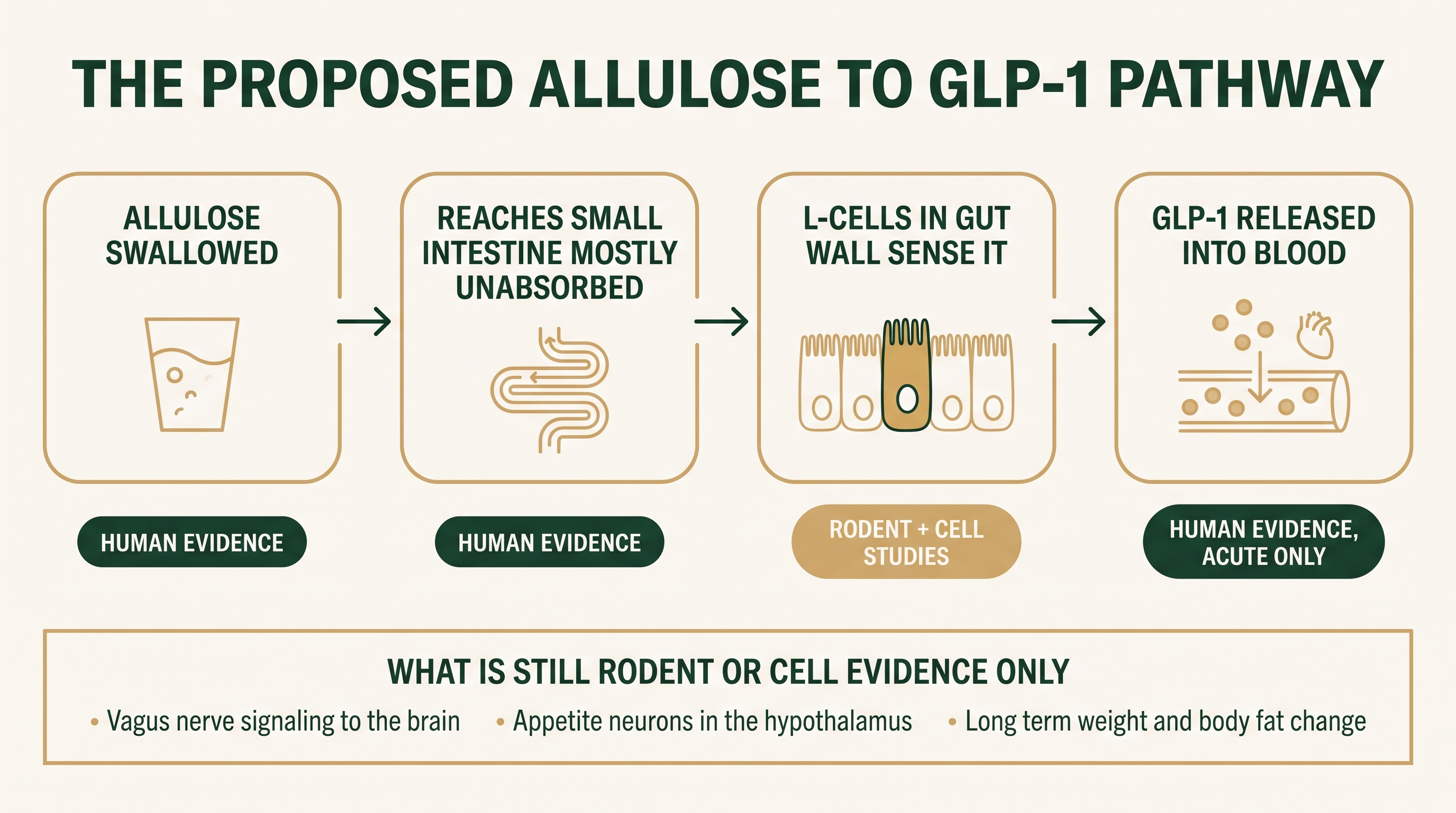
For years the tidy story went like this. Your gut has sweet taste receptors (T1R2/T1R3), the same family that sits on your tongue. Allulose tastes sweet. Allulose therefore trips those gut receptors, and the L-cells that line your small intestine release GLP-1.
Two separate experiments killed that story.
In the human trial, researchers co-administered lactisole at 450 ppm, a sweet taste receptor antagonist. If the receptor were the route, blocking it should flatten the hormone response. It didn't. All three hormones still rose, and lactisole had no measurable effect (all P > 0.1). The authors state it plainly: the response "is not mediated via T1R2/T1R3 in the gut."
In rats, the same test was run with different tools and got the same answer. A 2018 study found allulose-induced GLP-1 secretion was abolished by xanthohumol, a glucose and fructose transport inhibitor, but was not blocked by an SGLT1 inhibitor or by a sweet taste receptor inhibitor. Same conclusion, different species, different chemistry.
That same rat study is the only one in this literature that explicitly separates the two GLP-1 forms. It reported that oral allulose raised both total and active GLP-1 in the portal vein for more than two hours, while GIP stayed flat. That's a clean result. It is also a result in rats.
The most-repeated explanation for how allulose works has been tested twice and failed twice.
So what mechanism does the animal work actually support?
Three candidates, all preclinical.
Transport-mediated sensing (rodent). The xanthohumol result points at GLUT-family sugar transporters rather than taste receptors. Allulose is absorbed poorly and metabolized barely at all, so a meaningful amount reaches the stretch of small intestine where L-cells live.
Physical distension (rodent). This one is almost funny in how unglamorous it is. A 2025 rat study in Endocrinology found GLP-1 release tracked the absolute amount of allulose rather than its concentration, and correlated with intestinal content volume and diameter. Poorly absorbed but water-soluble compounds like PEG 1000 and mannitol did the same thing. Insoluble cellulose did not. Carbonated water made the allulose response bigger. Intraileal air alone stimulated GLP-1. In rats, part of the signal appears to be the gut noticing it is full of something.
Vagus nerve relay (rodent). A 2018 Nature Communications paper showed that allulose's effects on food intake and glucose tolerance were blunted by cutting the vagus nerve, by blocking GLP-1 receptors pharmacologically, and by genetically knocking out GLP-1 receptors specifically in vagal afferent neurons. A 2026 follow-up in Diabetes narrowed it further to left-sided vagal afferents and showed the effect worked by improving insulin action rather than insulin secretion.
These are elegant experiments. Every one of them is a mouse or a rat. None has a human counterpart. When you see "allulose talks to your brain through the vagus nerve" in marketing copy, that sentence is describing rodent neuroscience.
There's also central work: isolated mouse hypothalamic neurons respond to allulose directly, with 33% of POMC appetite-suppressing neurons activated and 28-30% of ghrelin-responsive and glucose-sensing neurons inhibited. Those are single cells in a dish from a mouse brain. Useful for understanding biology. Not a claim about your evening.
What has the research actually studied in clinical populations?
This section covers trials run in people with diagnosed metabolic conditions. Those participants were patients under medical supervision, enrolled in registered clinical trials. Nothing here describes what a supplement does for a healthy person, and none of it is a reason to change how you manage a diagnosed condition. Talk to your doctor about that.
The most important of these is a 2023 double-blind randomized crossover trial in 16 patients with type 2 diabetes at Siriraj Hospital in Bangkok. Participants took 7g of allulose twice daily, 14g a day, for 12 weeks, then crossed over to aspartame after a 2-week washout.
The result: no significant effect on glucose homeostasis, incretin levels, or body composition. Two secondary findings went the wrong way. HDL cholesterol dropped from 51 mg/dL to 41 mg/dL (P < 0.001) and MCP-1, an inflammatory marker, rose from 259 to 297 pg/mL (P = 0.002).
That is the only chronic human trial that looked at incretins, and it was null. It's also small, it was registered retrospectively, and the lipid finding hasn't been replicated. But it exists, and any honest read of this literature has to include it.
The broadest human picture comes from a 2026 systematic review and meta-analysis in the American Journal of Clinical Nutrition, covering 20 controlled trials and 1,033 participants, 12 of them allulose trials. Allulose significantly reduced postprandial glucose (SMD -0.66) and postprandial insulin (SMD -1.27), both graded moderate certainty. It showed no significant effect on HbA1c, fasting glucose, fasting insulin, blood lipids, uric acid, or any measure of body composition.
Read that last sentence twice. The pooled human evidence supports a real acute glycemic effect and does not currently support a body composition effect. The review also did not pool GLP-1 as an outcome, because there wasn't enough human GLP-1 data to pool.
Does an acute GLP-1 rise mean anything for appetite?
Here's the gap the marketing skips over.
An acute postprandial GLP-1 measurement tells you a hormone moved in the two hours after a dose. A claim about appetite tells you something about behavior over weeks. Those are different questions, answered by different study designs, and the second one has not been answered for allulose in humans.
The one human trial that measured both hormones and appetite ratings is instructive. Allulose raised GLP-1, CCK and PYY. But in that same trial, erythritol, not allulose, was the compound that slowed gastric emptying, increased fullness ratings, and reduced prospective food consumption. Allulose moved the hormones without moving the subjective appetite measures.
That's an inconvenient detail for a tidy story, which is exactly why it belongs here.
The rodent work does show reduced food intake and reduced weight gain. Those animals were fed allulose at 0.5 to 2.0 g/kg, which scales to doses far above anything a person consumes in a drink. If you want the wider view on raising GLP-1 without a prescription, we cover the whole category in how to increase GLP-1 naturally and compare ingredients head to head in allulose vs berberine.
How does 8g compare to the doses in the studies?
Ozzi's Crave Crusher uses 8g of allulose per stick. Being straight about where that sits:
- The human trial that found a GLP-1 rise used 25g, delivered by tube. Ozzi is well under that.
- The human glucose trials that found dose-dependent effects used 2.5g to 7.5g alongside a carbohydrate load. Ozzi is at or slightly above that range.
- The 12-week diabetes trial that found nothing on incretins used 14g a day, split into two doses.
- Rodent mechanism studies used 0.5 to 2.0 g/kg, which for a 70kg person would be 35g to 140g. Nobody is consuming that.
So: 8g is a real dose that overlaps the low end of the human glycemic literature. It is not a replication of the trial that measured GLP-1, and we're not going to pretend it is. Higher is also not automatically better. Allulose is well tolerated at moderate intakes and less so at large ones, which we cover in allulose side effects and is allulose safe.
The rest of the formula does separate work. Glucomannan is in there for viscosity, the property that makes a drink thicker in the stomach and contributes to a fuller feeling. Inulin rounds out the fiber profile. If you want the full ingredient walkthrough, the GLP-1 booster drink guide covers it.
Where does the evidence get thin, and who funded it?
Four honest limitations.
1. The human GLP-1 base is one positive trial with 18 people. Everything downstream of that inherits its uncertainty.
2. Much of the mechanism work traces to one research network. One Japanese investigator appears as an author on six of the studies in this review, spanning the vagal, hypothalamic and metabolic findings. That's not misconduct. It does mean the mechanism story has not been independently reproduced as widely as the citation count suggests.
3. Industry affiliations are present and worth naming. Several foundational human glucose trials list authors from Matsutani Chemical Industry, the company that commercialized allulose. The 2025 GLP-1 receptor paper lists two authors from Samyang Corp., another allulose producer. These are author affiliations pulled from the published records rather than formal funding statements. Industry-affiliated research can still be good research. You should simply know about it before you weigh the result.
4. One trial we can't cite yet. A German trial called LisA was designed with postprandial GLP-1 as its primary outcome. 10 participants completed it, sample collection finished in November 2023, and analysis was expected around mid-2026. Only the protocol has been published. A protocol is a plan, not a result. Nobody should be citing it as evidence, and we're not.
For the bigger picture on what GLP-1 does and why anyone cares, start with our pillar on what GLP-1 is.
Frequently asked questions
Has allulose been proven to raise GLP-1 in humans?
One randomized controlled trial in 18 healthy adults found a significant rise after 25g given intragastrically. A separate 12-week trial in 16 people with type 2 diabetes found no change in incretins at 14g a day. Two human trials, one positive, one null.
How much allulose was used in the trial that raised GLP-1?
25g, delivered directly to the stomach by tube. That's a research dose, notably higher than typical supplement servings, and the delivery route bypassed the mouth entirely.
Did that study measure active or total GLP-1?
The published abstract says "GLP-1" without specifying. Only one study in this literature separates the two clearly, and it's a rat study: it reported both total and active GLP-1 rose after oral allulose, while GIP stayed unchanged.
Does allulose slow gastric emptying?
In the one human trial that measured it, no. Erythritol slowed gastric emptying in that trial (P = 0.0002). Allulose did not.
Does allulose work through gut sweet taste receptors?
The evidence says no. Blocking sweet taste receptors with lactisole in humans did not reduce the hormone response, and a sweet taste receptor inhibitor did not block it in rats either.
Does allulose reduce body fat in humans?
The 2026 meta-analysis of 20 trials and 1,033 participants found no significant effect on any measure of body composition. It did find a consistent acute reduction in postprandial glucose and insulin.
Why do so many articles claim allulose reduces appetite?
Because the rodent studies are dramatic and the human studies are sparse. Mice and rats given allulose eat less and gain less weight. Those findings get repeated without the species label attached.
Is 8g of allulose enough to do anything?
8g sits at the upper end of the doses used in the human glycemic trials (2.5g to 7.5g alongside carbohydrate) and well below the 25g used in the single GLP-1 trial. It's a real dose within the studied range. It is not a replication of any specific trial.
Are the allulose studies funded by allulose companies?
Some carry industry author affiliations. Several early human glucose trials list authors from Matsutani Chemical Industry, and a 2025 mechanism paper lists two authors from Samyang Corp. The 2022 human GLP-1 trial and the 2026 meta-analysis do not carry commercial affiliations in their published records.
What would actually settle this question?
A properly powered human trial, at a realistic dose, measuring active GLP-1 with a validated assay, alongside real food intake over weeks rather than hours. The LisA trial is the closest thing in progress, and its results haven't been published.
The bottom line on allulose and GLP-1
Allulose has a genuine, replicated, meta-analyzed effect on postprandial glucose and insulin in humans. That part is solid.
Its GLP-1 story rests on one small acute human trial plus a large and genuinely interesting body of rodent work. The mechanism most often quoted in marketing, the sweet taste receptor, has been tested and rejected in both humans and rats. The mechanisms that survived testing (transporter sensing, physical distension, vagal signaling) are rodent findings awaiting human confirmation.
That's the honest state of it as of August 2026. We'd rather tell you that than sell you a mouse study.
Made with 8g of allulose
Ozzi Crave Crusher
One watermelon stick a day: 8g allSWEET allulose, 500mg konjac glucomannan, 500mg BIOMEnd L-lysine butyrate, 300mcg chromium, 10mg ursolic acid and 150mg African mango. No caffeine, no stimulants, and every dose printed on the label.
See what's in it →References
- Teysseire F, et al. The Role of D-allulose and Erythritol on the Activity of the Gut Sweet Taste Receptor and Gastrointestinal Satiation Hormone Release in Humans: A Randomized, Controlled Trial. J Nutr. 2022;152(5):1228-1238. doi:10.1093/jn/nxac026 (human, n=18)
- Sitticharoon C, et al. Short-term effects of allulose consumption on glucose homeostasis, metabolic parameters, incretin levels, and inflammatory markers in patients with type 2 diabetes: a double-blind, randomized, controlled crossover clinical trial. Eur J Nutr. 2023;62(7):2939-2948. doi:10.1007/s00394-023-03205-w (human, n=16, type 2 diabetes)
- Osborn L, et al. Glycemic and cardiometabolic effects of rare sugars allulose and tagatose: a systematic review and meta-analysis of controlled human intervention trials. Am J Clin Nutr. 2026;123(6):101314. doi:10.1016/j.ajcnut.2026.101314 (human, 20 trials, 1,033 participants)
- Iida T, et al. Acute D-psicose administration decreases the glycemic responses to an oral maltodextrin tolerance test in normal adults. J Nutr Sci Vitaminol. 2008;54(6):511-4. doi:10.3177/jnsv.54.511 (human, n=20)
- Hayashi N, et al. Study on the postprandial blood glucose suppression effect of D-psicose in borderline diabetes and the safety of long-term ingestion by normal human subjects. Biosci Biotechnol Biochem. 2010;74(3):510-9. doi:10.1271/bbb.90707 (human, n=26 and n=17)
- Kimura T, et al. d-Allulose enhances postprandial fat oxidation in healthy humans. Nutrition. 2017;43-44:16-20. doi:10.1016/j.nut.2017.06.007 (human, n=13)
- Hayakawa M, et al. Secretion of GLP-1 but not GIP is potently stimulated by luminal d-Allulose (d-Psicose) in rats. Biochem Biophys Res Commun. 2018;496(3):898-903. doi:10.1016/j.bbrc.2018.01.128 (rat)
- Iwasaki Y, et al. GLP-1 release and vagal afferent activation mediate the beneficial metabolic and chronotherapeutic effects of D-allulose. Nat Commun. 2018;9(1):113. doi:10.1038/s41467-017-02488-y (mouse and rat)
- Hira T, et al. Intestinal Distension Induced by Luminal D-allulose Promotes GLP-1 Secretion in Male Rats. Endocrinology. 2025;166(2). doi:10.1210/endocr/bqaf002 (rat)
- Kohno D, et al. D-Allulose cooperates with glucagon-like peptide-1 and activates proopiomelanocortin neurons in the arcuate nucleus and central injection inhibits feeding in mice. Biochem Biophys Res Commun. 2022;613:159-165. doi:10.1016/j.bbrc.2022.04.027 (mouse, ex vivo neurons)
- Park SY, et al. D-Allulose Regulates Obesity via Endoplasmic Reticulum Stress-Mediated Glucagon-Like Peptide-1 Receptor Pathway. Antioxid Redox Signal. 2025;43(16-18):819-832. doi:10.1177/15230864251399183 (mouse and cell culture; two authors affiliated with Samyang Corp.)
- Iwasaki Y, et al. Gut-Derived GLP-1 Released by Rare Sugar d-Allulose Cooperates With Insulin to Activate Left-Sided Vagal Afferents and Enhance Insulin Sensitivity. Diabetes. 2026;75(7):1086-1100. doi:10.2337/db25-1134 (mouse)
- Storcksdieck genannt Bonsmann S, et al. Effects of Allulose vs Aspartame Consumption on Postprandial Glucagon-Like Peptide-1 Profiles and Metabolic Health: Protocol for a Randomized, Crossover, Double-Blind, Placebo-Controlled Trial. JMIR Res Protoc. 2026;15:e81857. doi:10.2196/81857 (human protocol only, no results published)
Study records retrieved from PubMed. Every citation above was checked for retraction status before inclusion.
Built on what the research actually shows
Crave Crusher is a watermelon drink stick with 8g of allulose, plus glucomannan and inulin. No caffeine, no stimulants, no berberine, vegan. One stick in 16oz of water. $65.00 a bag, or Subscribe & Save 15%.
Try it for 14 days straight. If it doesn't work, we'll refund your first bag.
These statements have not been evaluated by the Food and Drug Administration. This product is not intended to diagnose, treat, cure, or prevent any disease. This article is educational and is not medical advice. Talk to your healthcare provider before starting any supplement, especially if you manage a diagnosed condition or take prescription medication.
