

PCOS and GLP-1: What the Research Actually Shows About Appetite (2026)
GLP-1 is a gut hormone released after meals that signals fullness to the brain. Human research has repeatedly found lower fasting and post-meal GLP-1 in women with PCOS compared to matched controls, which may help explain why hunger and food cravings often feel louder and harder to override.
If you have PCOS, you've probably been told to eat less and move more, and you've probably noticed that advice lands differently for you than it does for your friends.
Here's the part that's actually measurable: your cravings aren't really a willpower problem, they're a hormone problem. And in PCOS, more than one hormone is involved.
This post walks through what the human research says about GLP-1 in PCOS, what the drug trials actually tested, and what the honest evidence looks like for the non-drug options. I'll flag every claim as human, rodent, or lab study, because the PCOS literature is full of mouse findings that get repeated online as settled fact.
Key takeaways
- PCOS affects roughly 5% to 20% of reproductive-age women
- Human studies report lower GLP-1 in PCOS groups
- Food craving scores measured higher in PCOS participants
- GLP-1 drug trials studied patients under medical supervision
- Fiber and low-glycemic eating have the broadest safety record

What does GLP-1 actually do, and why does it matter in PCOS?
GLP-1 stands for glucagon-like peptide-1. It's made by L-cells in your intestine and released when food arrives.
Three things happen. It slows how fast your stomach empties. It supports insulin release in response to a meal. And it signals to appetite centers in the brain that you've had enough.
That last one is the part people feel. When GLP-1 signaling is working, the meal ends and the thought of food quietly recedes. When it isn't, dinner ends and the thinking doesn't. If you want the full mechanism, we broke it down in what GLP-1 is and how it works.
PCOS complicates this because it's increasingly framed as a metabolic condition, not only a reproductive one. A 2025 review in Cell Metabolism argued for exactly that reframe, pointing to insulin resistance, obesity, hyperglycemia, and dyslipidemia as core drivers rather than side effects.
Dinner ends. The thinking about food doesn't.
Do women with PCOS actually have lower GLP-1?
This is the question that matters most, and there's real human data on it.
A 2025 cross-sectional study in the European Journal of Endocrinology ran mixed meal tests on 36 women with PCOS and 36 age- and BMI-matched healthy controls. Blood was drawn at 0, 30, 60, and 120 minutes. Participants also completed a validated Food Craving Questionnaire.
Both baseline and area-under-the-curve values for GLP-1 were significantly lower in the PCOS group. GIP, the other major incretin hormone, was lower too. And Food Craving Questionnaire scores were significantly higher in the PCOS group.
Two things worth noting about that study design. The groups were BMI-matched, so this isn't just a weight effect. And it's cross-sectional, which means it shows an association at one point in time, not that low GLP-1 causes the cravings.
Earlier work points the same direction. A review of neuroendocrine appetite regulation in PCOS described impaired appetite regulation and blunted measures of satiety as a recurring finding across studies, alongside a tendency toward higher-glycemic, higher-saturated-fat food choices.
Leptin and ghrelin, the two other big appetite hormones, show a related pattern. A 2020 human study of 39 women with PCOS and 34 controls found that in the PCOS group, insulin resistance scores tracked positively with leptin and negatively with ghrelin. Same signals, different calibration.
| Finding | Evidence type | How confident should you be |
|---|---|---|
| Lower fasting and post-meal GLP-1 in PCOS | Human, cross-sectional, BMI-matched | Reasonably confident it's real; cause unclear |
| Higher measured food craving scores in PCOS | Human, questionnaire-based | Consistent across studies; self-reported |
| GLP-1 drugs reduce weight and testosterone in PCOS | Human RCTs and meta-analysis | Strong, but studied in supervised patients |
| Weight loss improves insulin and androgen markers | Human systematic review of 29 comparisons | Strong for some markers, weak for others |
| Butyrate improves PCOS features | Mostly rodent and cell studies | Preclinical only; do not treat as human fact |
Why does insulin resistance make cravings louder?
Roughly half of women with PCOS have measurable insulin resistance, and it shows up in lean women with PCOS too, not only those carrying extra weight.
The loop works like this. Cells respond less efficiently to insulin, so the pancreas produces more of it. Higher circulating insulin drives ovarian androgen production, which is why testosterone and free androgen index climb. Higher insulin also blunts the fullness signaling you'd normally get after a meal.

So you eat, your blood sugar rises and falls faster than it should, and the hunger comes back before it has any business coming back. We covered the mechanics of that in more depth in PCOS cravings and insulin resistance.
A systematic review of androgen excess in PCOS traced this further, describing how excess androgens affect adipose tissue, liver, pancreas, muscle, and the brain. Important caveat: much of the tissue-level mechanism in that review comes from rodent models, and the authors say plainly that the human picture remains incomplete.

Customers describe the downstream experience in almost identical language. "Food noise is the worst. Trying to solve my always hungry problem." "I binge eat in the evenings all the way up to bedtime. I'm not hungry, I know this."
If that sounds familiar, what food noise actually is covers the phenomenon in detail.
What has the research actually studied?
This section is about prescription GLP-1 receptor agonists in PCOS. Every study below enrolled patients under medical care and supervision, most of them with obesity or overweight, and most were diagnosed by Rotterdam or NIH criteria. None of it transfers to supplements, and none of it should be read as a comparison.
A phase 3 randomized, double-blind, placebo-controlled trial published in Fertility and Sterility gave 55 women liraglutide 3 mg and 27 women placebo for 32 weeks alongside lifestyle intervention. Body weight change was -5.7% on liraglutide versus -1.4% on placebo. Free androgen index dropped in the drug group and slightly rose in placebo. Gastrointestinal side effects were reported by 58.2% of the liraglutide group versus 18.5% on placebo.
A 2024 meta-analysis pooled 4 RCTs and 176 participants. GLP-1 receptor agonist use was associated with reduced waist circumference, reduced BMI, reduced triglycerides, and reduced total testosterone. Notably, there was no significant difference in HOMA-IR or total cholesterol, which is a useful reminder that these drugs are not doing everything the internet says they do.
A 2025 open-label RCT of 100 women compared metformin alone against metformin plus weekly semaglutide for 16 weeks. The combination group lost an average of 6.09 kg versus 2.25 kg, with greater improvements in testosterone and C-reactive protein, and higher rates of menstrual cycle recovery.
Zooming out, a 2024 systematic review in Annals of Internal Medicine looked at 29 comparisons and 1,529 participants across behavioral interventions, GLP-1 agonists, and other weight loss medications. Weight loss interventions improved HOMA-IR, free androgen index, and menstrual frequency. They did not produce clinically meaningful improvements in hirsutism, quality of life, or other sex hormones.
That last finding is the honest one. Weight loss helps some things measurably and other things not at all.
Weight loss helped some markers and did nothing for others. That's what the data says, and pretending otherwise helps nobody.
Can you support GLP-1 naturally if you have PCOS?
The realistic answer is that food and fiber move GLP-1 in humans, and the effect size is smaller than a drug.
Protein, fat, and fermentable fiber all trigger GLP-1 release when they reach the gut. That's basic human physiology, not a supplement claim. The practical version is eating in a way that keeps that signal firing and keeps blood sugar from spiking and crashing.
A 2025 systematic review of lifestyle interventions in PCOS found that low-glycemic-index eating, caloric restriction, high-fiber patterns, omega-3-rich diets, Mediterranean patterns, and anti-inflammatory diets all improved insulin sensitivity and hormonal balance. A 2025 review reached a similar conclusion: low-glycemic-index foods combined with high fiber intake should generally be preferred in hyperinsulinemic patients.
No single diet won. That's actually good news, because it means the version you'll stick with is a legitimate choice.
For a broader list of the mechanisms with human backing, see how to increase GLP-1 naturally and the best fiber types for appetite control.
What about fiber, the microbiome, and butyrate?
Here's where I have to be careful, because this is the area where marketing runs furthest ahead of evidence.
Start with what's solid. A 2024 systematic review of randomized trials found that probiotic and synbiotic supplementation in women with PCOS produced significant improvements in HOMA-IR, fasting glucose, insulin, lipid profiles, and sex hormone binding globulin. Real human RCTs. But the authors flagged serious limits: all 11 studies came from Iran, sample sizes were small, populations were homogeneous, and durations were short.
Now the part that gets overstated. Butyrate is a short-chain fatty acid your gut bacteria produce when they ferment fiber. It's the primary energy source for the cells lining your colon. A 2024 review examined butyrate across gynecological conditions including PCOS and described effects on hormonal balance, insulin sensitivity, and inflammation.
Almost all of that PCOS-specific butyrate work is rodent and cell-culture research. There is no human randomized trial showing that butyrate supplementation improves PCOS outcomes, and no human study showing that butyrate raises GLP-1. When you see a supplement page claiming otherwise, it's extrapolating from mice.
What's fair to say: fermentable fiber feeds butyrate-producing bacteria, butyrate supports gut barrier function, and higher-fiber diets show consistent human benefit in PCOS. That's a chain with a solid start and a solid end and a preclinical middle. Gut health and GLP-1 and inulin and appetite go deeper on the fiber side.
What does a realistic daily routine look like?
Nothing here is a treatment for PCOS. It's a set of habits that line up with what the human research supports, aimed at the specific problem of hunger that won't quit.
Front-load protein and fiber at breakfast. Both trigger GLP-1 release. A high-carb, low-fiber breakfast sets up a blood sugar swing that you'll feel by 11am.
Add fermentable fiber gradually. Inulin, glucomannan, and resistant starch all feed butyrate-producing bacteria. Ramp slowly or you'll be uncomfortable for a week.
Swap the sweetener, not the sweetness. Allulose tastes like sugar and doesn't raise blood glucose the way sucrose does, which matters when you're insulin resistant. We covered the human data in does allulose spike blood sugar.
Move after meals. A 10 minute walk after dinner blunts the post-meal glucose curve. Cheap, unglamorous, works.
Attack the evening specifically. Most women with PCOS describe the problem as a nighttime problem. Stopping food noise naturally has the tactical version, and menopause weight gain and cravings covers the hormonal-shift version if you're past 40.
Talk to your doctor about the medical options. The 2023 International Evidence-based Guideline recognizes GLP-1 receptor agonists as a pharmacological option for weight management in PCOS. If that's the right path for you, it's a conversation with a clinician, not a supplement decision.
Frequently asked questions
Does PCOS cause low GLP-1, or does low GLP-1 cause PCOS?
Neither has been established. The human studies showing lower GLP-1 in PCOS groups are cross-sectional, which means they capture an association at one moment. The direction of causation is still an open research question.
Can a supplement replace a GLP-1 medication for PCOS?
No. The prescription trials produced weight and androgen changes under medical supervision, and no supplement has been tested against them. Supplements that support natural GLP-1 production are working on a different scale entirely.
Does insulin resistance happen in lean women with PCOS?
Yes. Insulin resistance in PCOS is not exclusive to women with obesity, which is one reason "just lose weight" is incomplete advice for the condition.
Why do my cravings get worse at night?
Insulin sensitivity generally declines across the day, and appetite-regulating signals are weaker in the evening for most people. Layer PCOS-related insulin resistance on top and the evening becomes the hardest window.
Does metformin help with cravings?
Metformin primarily targets insulin sensitivity rather than appetite directly. In the 2025 combination trial, metformin alone produced 2.25 kg of weight loss over 16 weeks versus 6.09 kg with semaglutide added. That's a prescribing conversation for your doctor.
Is butyrate proven to help PCOS?
Not in humans. The PCOS-specific butyrate research is rodent and cell-culture work. Butyrate is the primary energy source for colon lining cells and supports gut barrier function, and those are fair statements. Claims beyond that are extrapolation.
How long before diet changes affect PCOS symptoms?
The randomized trials in this space typically ran 12 to 32 weeks. Menstrual cycle changes in particular tend to show up on a scale of months, not days.
Do probiotics help PCOS?
The randomized trial evidence is genuinely promising for insulin resistance and hormonal markers, with synbiotics outperforming probiotics or prebiotics alone. But the trials are small, short, and geographically concentrated. Treat it as encouraging, not settled.
Should I cut carbs entirely?
The lifestyle review found several successful dietary patterns, including Mediterranean and low-glycemic approaches that include carbohydrates. Fiber content and glycemic index appear to matter more than total carbohydrate elimination.
Built for the hunger that doesn't quit
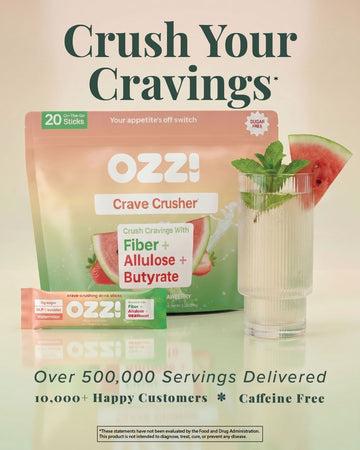
Ozzi Crave Crusher is a cold-water drink stick with 8g allulose, 500mg fiber blend, 500mg butyrate, and chromium. It supports natural GLP-1 production and blood sugar control. No caffeine, no stimulants, vegan.
Try it for 14 days straight. If it doesn't work, we'll refund your first bag.
Six actives, no stimulants
Ozzi Crave Crusher
8g allulose, 500mg konjac glucomannan, 500mg L-lysine butyrate, chromium, ursolic acid and African mango in one daily stick. Caffeine-free and stimulant-free, which matters more if sleep is already fragile.
See what's in it →References
- Gunesli I, et al. Fasting and postprandial oxytocin and incretin dynamics in women with polycystic ovary syndrome and healthy controls. European Journal of Endocrinology. 2025;193(2):255-261. https://doi.org/10.1093/ejendo/lvaf154
- Zhang Y, Chen ZJ, Zhao H. Polycystic ovary syndrome: A metabolic disorder with therapeutic opportunities. Cell Metabolism. 2025;37(10):1932-1949. https://doi.org/10.1016/j.cmet.2025.08.002
- Scragg J, et al. Effect of Weight Loss Interventions on the Symptomatic Burden and Biomarkers of Polycystic Ovary Syndrome: A Systematic Review of Randomized Controlled Trials. Annals of Internal Medicine. 2024;177(12):1664-1674. https://doi.org/10.7326/M23-3179
- Elkind-Hirsch KE, et al. Liraglutide 3 mg on weight, body composition, and hormonal and metabolic parameters in women with obesity and polycystic ovary syndrome: a randomized placebo-controlled phase 3 study. Fertility and Sterility. 2022;118(2):371-381. https://doi.org/10.1016/j.fertnstert.2022.04.027
- Austregésilo de Athayde De Hollanda Morais B, et al. The efficacy and safety of GLP-1 agonists in PCOS women living with obesity in promoting weight loss and hormonal regulation: A meta-analysis of randomized controlled trials. Journal of Diabetes and Its Complications. 2024;38(10):108834. https://doi.org/10.1016/j.jdiacomp.2024.108834
- Chen H, et al. Effects of combined metformin and semaglutide therapy on body weight, metabolic parameters, and reproductive outcomes in overweight/obese women with polycystic ovary syndrome: a prospective, randomized, controlled, open-label clinical trial. Reproductive Biology and Endocrinology. 2025;23(1):108. https://doi.org/10.1186/s12958-025-01447-3
- Romualdi D, et al. Neuroendocrine Regulation of Food Intake in Polycystic Ovary Syndrome. Reproductive Sciences. 2018;25(5):644-653. https://doi.org/10.1177/1933719117728803
- Sanchez-Garrido MA, Tena-Sempere M. Metabolic dysfunction in polycystic ovary syndrome: Pathogenic role of androgen excess and potential therapeutic strategies. Molecular Metabolism. 2020;35:100937. https://doi.org/10.1016/j.molmet.2020.01.001
- Polak AM, et al. The Association of Serum Levels of Leptin and Ghrelin with the Dietary Fat Content in Non-Obese Women with Polycystic Ovary Syndrome. Nutrients. 2020;12(9):2753. https://doi.org/10.3390/nu12092753
- Gautam R, et al. The Role of Lifestyle Interventions in PCOS Management: A Systematic Review. Nutrients. 2025;17(2):310. https://doi.org/10.3390/nu17020310
- Martinez Guevara D, et al. Effectiveness of Probiotics, Prebiotics, and Synbiotics in Managing Insulin Resistance and Hormonal Imbalance in Women with Polycystic Ovary Syndrome (PCOS): A Systematic Review of Randomized Clinical Trials. Nutrients. 2024;16(22):3916. https://doi.org/10.3390/nu16223916
- Kim N, Yang C. Butyrate as a Potential Modulator in Gynecological Disease Progression. Nutrients. 2024;16(23):4196. https://doi.org/10.3390/nu16234196
- Capozzi A, et al. Lifestyle and diet in PCOS. Minerva Obstetrics and Gynecology. 2025;77(5):341-351. https://doi.org/10.23736/S2724-606X.25.05746-X
- Cena H, Chiovato L, Nappi RE. Obesity, Polycystic Ovary Syndrome, and Infertility: A New Avenue for GLP-1 Receptor Agonists. The Journal of Clinical Endocrinology and Metabolism. 2020;105(8):e2695-709. https://doi.org/10.1210/clinem/dgaa285
