

The Gut-Brain Axis and Food Noise: Why Your Gut Won't Stop Talking About Snacks (2026)
You ate a real dinner. You're not hungry. And yet by 9pm your brain is running a slideshow of everything in the pantry.
That loop has a name now. People call it food noise, and it's one of the most common things I hear from Ozzi customers. One of them put it perfectly: "sometimes I'm not even hungry but the urge to eat is so overwhelming that I do it anyway."
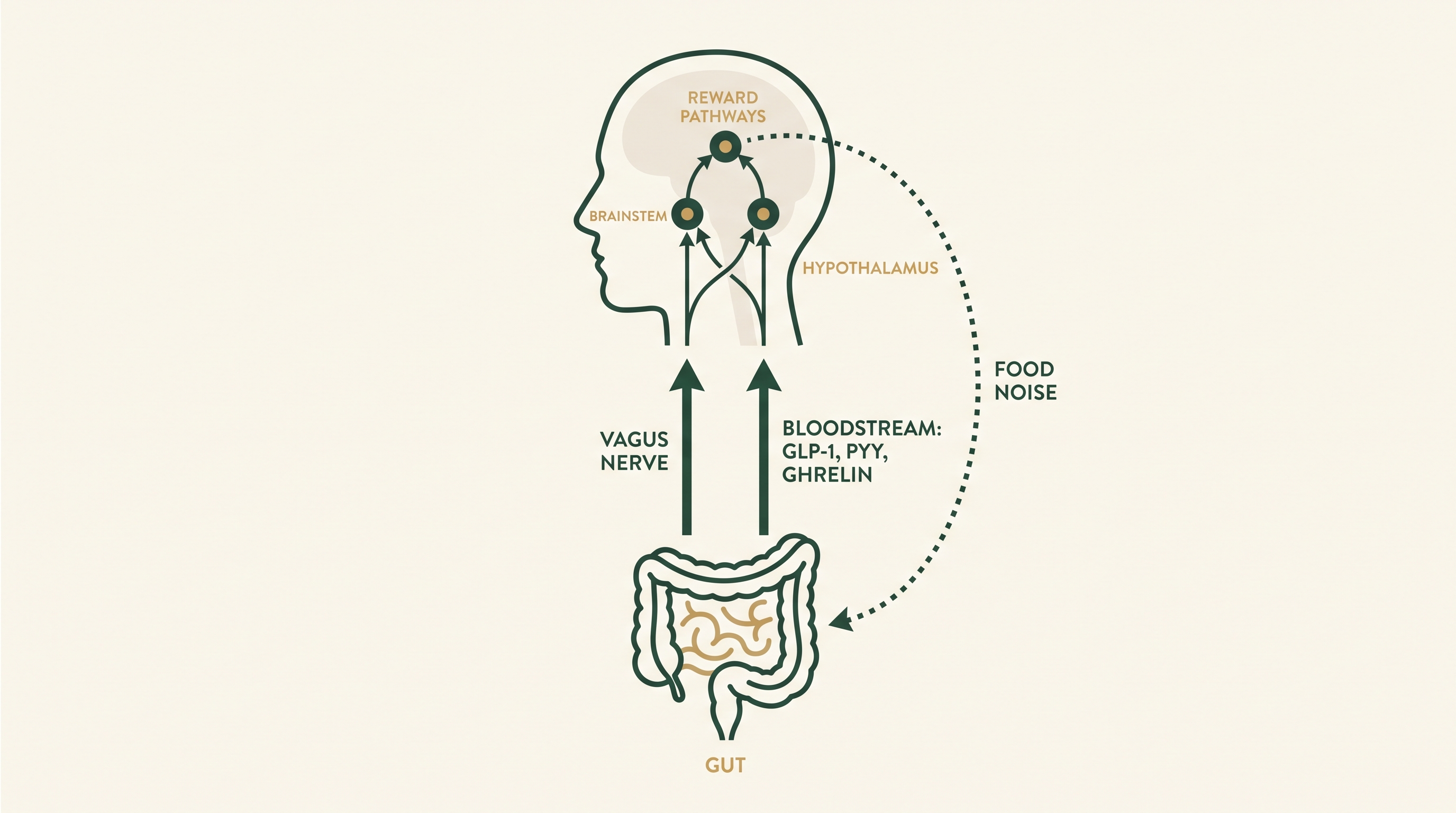
The gut-brain axis is the two-way communication line between your digestive tract and your brain. It runs on the vagus nerve, gut hormones (GLP-1, PYY, ghrelin), and signals from your gut bacteria. When those satiety signals are weak or poorly timed, your brain keeps asking for food, which many people experience as food noise.
Key takeaways
- Food noise is intrusive, unwanted thoughts about food, now measurable with a validated questionnaire.
- Your gut signals fullness to your brain via the vagus nerve and hormones.
- GLP-1 and PYY are the main "I'm full" messengers from the gut.
- Blood sugar swings and poorly timed signals make the chatter louder at night.
- Fiber, protein, sleep, and steady blood sugar are the levers with the most support.
What is the gut-brain axis, in plain English?
Think of your gut and your brain as two coworkers on a phone line that never hangs up.
Your gut is constantly sending status updates: how much you just ate, what kind of food it was, how fast it's moving through, what your bacteria are doing with it. Your brain listens and adjusts your hunger, your fullness, and how rewarding food feels.
That phone line runs on three channels. The vagus nerve carries fast electrical signals straight to your brainstem. Hormones travel slower through your bloodstream. And your gut bacteria produce their own chemical messengers that feed into both.
A 2026 review in the Journal of Clinical Investigation lays out how gut hormone signals reach the brainstem and hypothalamus to shape how much you eat [3]. This is real physiology, mapped in detail, and it's the reason the GLP-1 drugs work at all.
Is food noise a real thing, or just a buzzword?
It's real, and scientists have finally started measuring it.
A 2025 paper in Nutrition & Diabetes defined food noise as "persistent thoughts about food perceived by the individual as unwanted" that cause distress or make eating well harder [1]. Then a separate team built and validated the Food Noise Questionnaire, a 5-item tool published in the journal Obesity in 2025 [2].
In that validation work, the questionnaire held up statistically (high internal consistency, strong test-retest reliability), and higher food-noise scores tracked with a stronger tendency to overeat [2]. An Italian-language version was validated the following year, which tells you researchers are taking it seriously across countries [8].
So the thing you've been describing for years now has a definition and a measuring stick. If you want the full breakdown, I wrote a whole piece on what food noise actually is.
The thing you've been describing for years now has a definition and a measuring stick.
How does your gut create food noise?
Here's the part that surprises people. A lot of what feels like a willpower problem starts below your neck.
When you eat, cells in your gut lining (called L-cells) release GLP-1 and PYY, two hormones that tell your brain you're satisfied. GLP-1 slows how fast your stomach empties, boosts the feeling of fullness, and quiets the reward pull of food [3]. That JCI review calls these the core "stop eating" signals of the gut-brain axis [3].
Ghrelin does the opposite. It's your hunger hormone, and it rises before meals to push you to eat.
When this system is humming, you eat, you feel full, the noise fades. When the fullness signals come in weak or late, your brain keeps the "find food" program running even though your stomach is fine. That gap between a full stomach and a brain that won't quiet down is where a lot of food noise lives.
Your vagus nerve matters here too. It's the express lane carrying gut signals to the brainstem, and it helps set how strongly you register fullness.
What role do gut bacteria play?
Your gut bacteria are the third channel on that phone line, and this is where I have to be honest about what we actually know.
When bacteria ferment fiber, they produce short-chain fatty acids, including butyrate and propionate. In animal and cell studies, these fatty acids stimulate the same L-cells to release GLP-1 and PYY [6][7]. A 2024 review in Gut Microbes walks through how gut bacteria influence appetite through these pathways [4].
Now the caveat, because it's a big one. Most of the direct "short-chain fatty acids trigger fullness hormones" evidence comes from rodents and isolated human cells, not from whole people. A 2015 study showing propionate driving GLP-1 and PYY release was done in rodents [6]. A separate study showing strong PYY release was done in isolated human gut cells in a dish [7]. Those are promising mechanisms, not proof that a supplement will flip your appetite.
The human microbiome-and-appetite link is mostly correlational so far. I dug into that gap in my post on the microbiome and cravings, and the short version is: interesting, real, but oversold everywhere you look.

Why does food noise get louder at night?
Almost every customer who writes to me describes the same clock. Stellar all day, then the monster comes out after 7pm.
A few things stack up in the evening. Your blood sugar has been rising and dipping all day, and a late-afternoon crash can register in the brain as an urgent food signal even when you don't need calories. Willpower is genuinely lower when you're tired. And if dinner was low in fiber and protein, your fullness hormones may have already faded by the time you sit down to relax.
Poor sleep tips ghrelin up and satiety signaling down the next day, which sets up a rough cycle: bad night, hungrier day, more evening snacking, worse night.
None of this means you're weak. It means the biology is loudest at the exact hour you have the least defense. I put together a practical plan for this in how to stop night eating.
The biology is loudest at the exact hour you have the least defense.
Can you actually quiet food noise through your gut?
You can influence the signals. You can't flip a switch. Here's an honest map of the levers, sorted by how strong the evidence is.
| Lever | What it does to the gut-brain signal | Evidence level |
|---|---|---|
| Protein at meals | Raises PYY and GLP-1, slows stomach emptying, blunts hunger later | Strong (human) |
| Soluble/viscous fiber | Slows digestion and feeds fullness; adds physical bulk in the stomach | Moderate (human) |
| Steady blood sugar | Fewer crashes means fewer false "urgent food" alarms to the brain | Moderate (human) |
| Sleep | Keeps ghrelin and satiety signaling in a normal range | Strong (human) |
| Prebiotic fiber (feeds butyrate makers) | May increase short-chain fatty acids that stimulate fullness hormones | Early (mostly rodent/cell) |
Notice the pattern. The boring, proven stuff (protein, fiber, sleep, steady glucose) sits at the top. The exciting microbiome stuff sits at the bottom, still mostly in animals. Anyone selling you the reverse order is selling you the hype.
For the food-first version of all this, my guide on how to stop food noise naturally goes deeper on daily habits.
What has the research actually studied (and what it hasn't)?
I want to draw a clear line here, because the gut-brain space is full of mouse findings dressed up as human facts.
What's well established in humans: gut hormones like GLP-1 and PYY reduce appetite, protein and fiber raise those hormones, and GLP-1 drugs sharply cut intrusive food thoughts. Food noise itself is now measurable and tracks with overeating [1][2].
What's mostly preclinical: the idea that short-chain fatty acids from your bacteria will meaningfully raise your fullness hormones. The propionate-and-GLP-1 story ran in rodents [6]. The strong PYY effect ran in a dish of human cells [7]. Those are real signals worth studying, and they are not the same as a proven human result.
Where the disease trials sit: some of the tightest data comes from studies in people with obesity or type 2 diabetes who were under medical care. That's useful for the science, and it doesn't automatically apply to a healthy person managing evening snacking. I keep those two buckets separate on purpose.
If you want the foundational hormone explainer, start with what GLP-1 is, then come back here.
Where does Ozzi fit into the gut-brain picture?
I built Ozzi around the parts of this system that have the most support, not the flashiest headlines.
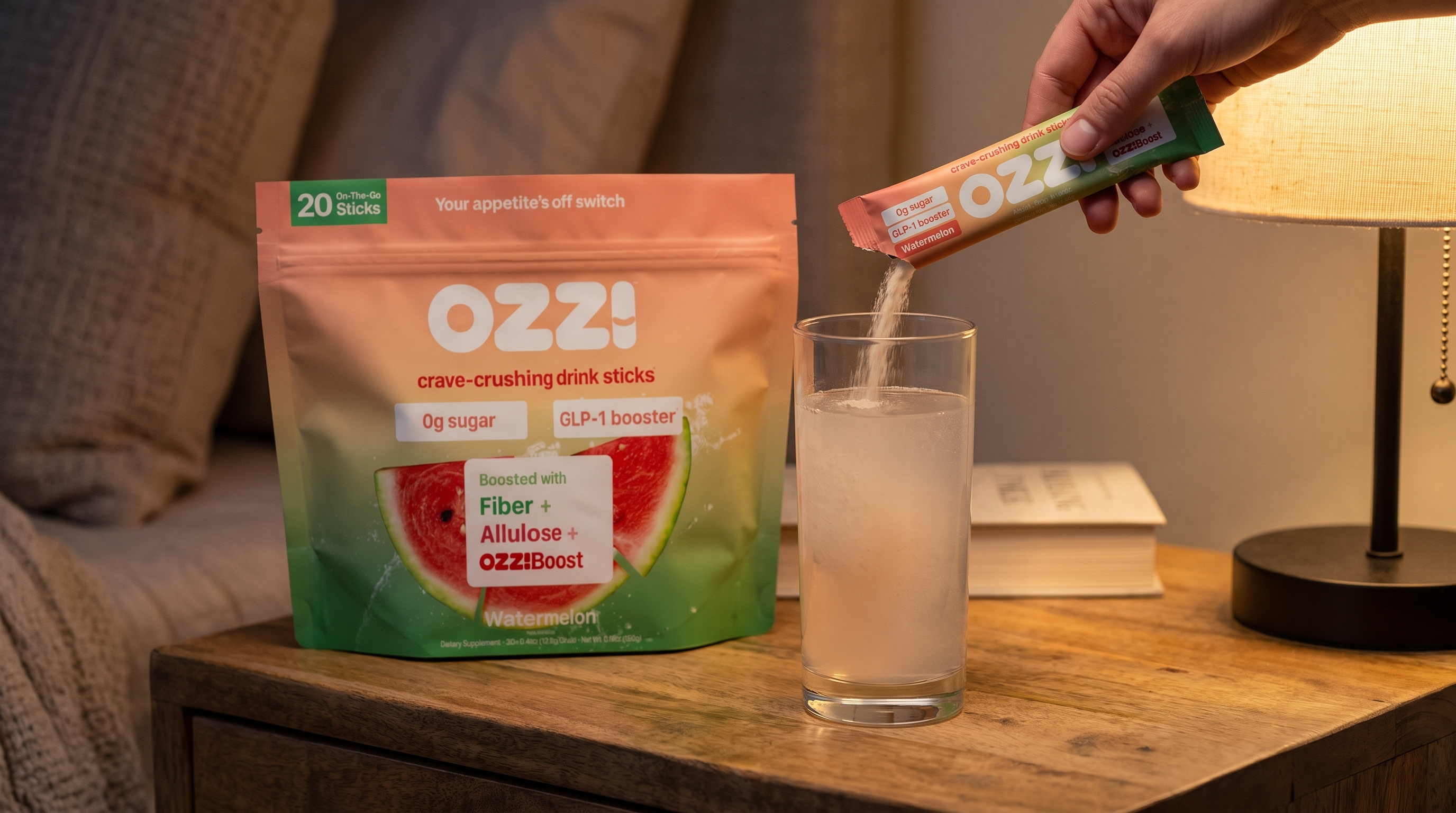
Each stick has 8g of allulose, a sweet-tasting rare sugar with about 90% fewer calories than sugar, so you can answer a sweet craving without a blood sugar spike. There's 500mg of glucomannan, a viscous fiber from konjac that absorbs water and adds fullness in the stomach. And there's prebiotic chicory root inulin, a fiber that feeds the butyrate-producing bacteria in your gut.
Ozzi also includes 500mg of L-Lysine Butyrate, a form of butyrate. Butyrate is the main energy source for the cells lining your colon and supports gut barrier function. I want to be careful here: the link between butyrate and your fullness hormones is a proposed mechanism from animal and cell research, not something proven in humans. I'd rather tell you that than oversell it.
So Ozzi supports the satiety and blood-sugar side of the gut-brain axis with ingredients that make sense. It's a tool for the 9pm moment, not a magic off switch. For the deeper science, see my post on gut health and GLP-1 and the pillar on the gut-brain axis.
Meet your 9pm cravings with something better than willpower
Ozzi Crave Crusher is a watermelon drink stick with 8g allulose, konjac fiber, and prebiotic inulin. Zero caffeine, 5 calories, no prescription. Try it for 14 days straight. If it doesn't work, we'll refund your first bag.
Frequently asked questions
Is food noise the same as hunger?
No. Hunger is a physical signal that you need fuel. Food noise is intrusive thoughts about food that show up even when you're full, which is why it feels so frustrating.
Can the gut-brain axis really affect my cravings?
Yes. Your gut sends fullness and hunger signals to your brain through the vagus nerve and hormones like GLP-1 and PYY. When those signals are weak or badly timed, cravings tend to run louder.
What gut hormones control appetite?
The big three are GLP-1 and PYY (fullness) and ghrelin (hunger). GLP-1 and PYY come from gut cells after you eat, and they tell your brain to ease off.
Do gut bacteria control food noise?
They influence the system, but the direct evidence is mostly from animal and cell studies. In humans, the microbiome-and-appetite link is real but still largely correlational. Be skeptical of anyone claiming certainty.
Why is my food noise worse at night?
Blood sugar swings, lower willpower when tired, faded fullness hormones from a light dinner, and poor sleep all stack up in the evening. The biology peaks right when your defenses are lowest.
Does fiber help with food noise?
Viscous fiber can slow digestion and add fullness, and prebiotic fiber feeds bacteria that make short-chain fatty acids. Fiber is one of the more reliable levers, though it's a support, not a cure.
Can Ozzi stop food noise?
Ozzi supports the satiety and blood-sugar side of the gut-brain axis with allulose, konjac fiber, and prebiotic inulin. It's a helpful tool for cravings, especially at night, and results vary from person to person.
Does Ozzi contain caffeine?
No. Ozzi is caffeine-free and about 5 calories per stick, so you can drink it in the evening without it messing up your sleep.
How is Ozzi different from a GLP-1 drug?
GLP-1 drugs are prescription injections that raise GLP-1 activity directly. Ozzi is a drink stick that supports your body's own satiety signals with food-based ingredients. Different tools, different intensity.
References
- Dhurandhar NV, et al. Food noise: definition, measurement, and future research directions. Nutrition & Diabetes. 2025. https://doi.org/10.1038/s41387-025-00382-x (human, conceptual)
- Diktas HE, et al. Development and validation of the Food Noise Questionnaire. Obesity. 2025. https://doi.org/10.1002/oby.24216 (human)
- Beutler LR. GLP-1 physiology and pharmacology along the gut-brain axis. Journal of Clinical Investigation. 2026. https://doi.org/10.1172/JCI194744 (review, human and rodent mechanisms)
- The effects of gut microbiota on appetite regulation and the underlying mechanisms. Gut Microbes. 2024. https://doi.org/10.1080/19490976.2024.2414796 (review)
- The interplay between gut microbiota, short-chain fatty acids, and implications for host health and disease. Gut Microbes. 2024. https://doi.org/10.1080/19490976.2024.2393270 (review)
- Psichas A, et al. The short chain fatty acid propionate stimulates GLP-1 and PYY secretion via free fatty acid receptor 2 in rodents. International Journal of Obesity. 2015. https://doi.org/10.1038/ijo.2014.153 (rodent)
- Larraufie P, et al. SCFAs strongly stimulate PYY production in human enteroendocrine cells. Scientific Reports. 2018. https://doi.org/10.1038/s41598-017-18259-0 (in-vitro, human cells)
- Psychometric Properties of the Italian Food Noise Questionnaire (FNQ). Behavioral Sciences. 2026. https://doi.org/10.3390/bs16040609 (human)
