

Allulose Baking Guide: How to Swap It for Sugar Without Wrecking the Recipe (2026)
Most sugar substitutes fall apart the second heat gets involved. Stevia goes bitter. Monk fruit adds sweetness and nothing else, so your cookies come out pale and flat. Erythritol crystallizes into something gritty and leaves a cold menthol finish on the back of your tongue.
Allulose is the exception, and the reason is chemistry rather than marketing.
Allulose can replace sugar in baking at about 1.3 cups per cup of sugar, since it's roughly 70% as sweet. It browns faster than sucrose, so lower the oven temperature by 25F and check 5 minutes early. It also holds more water, which keeps baked goods soft and makes cookie dough spread more.
I spend a lot of time with this ingredient. Allulose is the largest thing by weight in an Ozzi stick at 8g per serving, so I've read more allulose papers than any reasonable person should. Here's what actually happens when you bake with it.

What is allulose, and why does it act like sugar in the oven?
Allulose (also called D-psicose) is a rare sugar. It shows up in tiny amounts in figs, raisins, jackfruit and maple syrup. Commercially it's made by enzymatically flipping one carbon on fructose, which is why it's called the C-3 epimer of fructose.
That single flipped carbon is the whole story. Structurally it's still a monosaccharide with a free carbonyl group, so it does everything a reducing sugar does in a hot oven: it participates in Maillard browning, it caramelizes, it binds water, it lowers the freezing point of ice cream bases.
What it mostly doesn't do is get metabolized. Roughly 70% of ingested allulose is absorbed in the small intestine and then excreted in urine largely unchanged, which is why the FDA allows it to be excluded from both "Total Sugars" and "Added Sugars" on the Nutrition Facts panel and counted at 0.4 calories per gram instead of 4.
So you get the baking behavior of sugar with roughly a tenth of the calories. For more on the metabolic side, we went deep in our allulose supplement guide and our breakdown of allulose vs sugar.
How much allulose replaces a cup of sugar?
Allulose is about 70% as sweet as sucrose. That gives you two options, and which one you pick depends on the recipe.
If the recipe needs bulk and structure (cookies, cakes, quick breads), swap 1:1 by volume and accept slightly less sweetness. If sweetness is the whole point (syrups, glazes, whipped cream, ice cream base), go up to 1.3 cups of allulose per cup of sugar.
| Recipe type | Allulose per 1 cup sugar | Other adjustments |
|---|---|---|
| Drop cookies | 1 to 1.25 cups | Chill dough 30 min, oven down 25F |
| Cakes and muffins | 1.25 cups | Cut liquid by 1 to 2 Tbsp, tent with foil |
| Brownies | 1.25 cups | Expect fudgier center, bake 5 min less |
| Yeast bread | Keep some real sugar | Yeast can't ferment allulose for rise |
| Ice cream base | 1.3 cups | Stays scoopable straight from freezer |
| Caramel and syrup | 1.3 cups | Watch closely, it colors fast |
The yeast bread line is the one that trips people up. Yeast eats sucrose and maltose. It can't ferment allulose, so an all-allulose loaf won't rise the way you expect. Keep a teaspoon or two of real sugar to feed the yeast and use allulose for whatever sweetness you want on top of that.

Why does allulose brown faster, and how do you stop it burning?
Maillard browning is a reaction between a reducing sugar and an amino acid. Allulose is a ketohexose with a free reactive group, and it browns at a lower temperature than sucrose does, partly because sucrose has to break down into glucose and fructose first before it can react at all.
Practically, that means the edges of your cookies go dark while the center is still raw. Three fixes, in order of how much they help:
- Drop the oven 25F. This is the single biggest lever. 350F becomes 325F.
- Start checking 5 minutes early. Allulose bakes finish sooner than the recipe says.
- Tent with foil at the halfway mark for anything taller than an inch.
If your first allulose batch comes out dark on the outside and gummy in the middle, the recipe is fine. The oven is 25 degrees too hot.
Food scientists use this browning behavior on purpose. In a 2024 study on sugar-reduced bread, researchers combined allulose with oligosaccharides and a cellulose gum and got a 90%-sugar-reduced loaf back to a crust color close to full-sugar bread, with 50% more volume and 67% less hardness than the reduced-sugar control.
Does allulose change the texture of what you bake?
Yes, in one predictable direction: softer and moister.
Allulose is hygroscopic, meaning it pulls in and holds onto water. In that same bread study, low-field NMR showed better moisture control and slower staling, with starch retrogradation enthalpy down about 60% compared to the control loaf.
For a home baker that translates to three things:
- Cookies spread more. Extra free water in the dough means more flow before the structure sets. Chill the dough at least 30 minutes.
- Cakes stay fresh longer. Day-three allulose cake is noticeably less stale than day-three sugar cake.
- Meringue won't work. Allulose doesn't crystallize the way sucrose does, so crisp meringues and hard candies stay tacky. Use real sugar there.
The freezing-point behavior is the underrated win. Allulose depresses freezing point strongly, so homemade ice cream made with it stays scoopable straight out of a home freezer instead of setting into a brick.
What does allulose actually do to blood sugar?
This is where the evidence is strongest, and it's the reason allulose is worth the extra cost per pound.
A 2026 systematic review and meta-analysis in the American Journal of Clinical Nutrition pooled 20 controlled human trials across 1,033 adults. Allulose significantly reduced postprandial glucose and insulin at moderate certainty. It showed no effect on HbA1c, fasting glucose, fasting insulin, blood lipids, uric acid or body composition.
That last sentence matters as much as the first. Allulose is an acute, meal-level tool. Nobody has shown it changes long-term metabolic markers on its own.
| Study | Population | Finding |
|---|---|---|
| Osborn 2026 meta-analysis | 1,033 adults, human | Lower postprandial glucose and insulin; no change in HbA1c or body composition |
| Braunstein 2020 meta-analysis | 400 adults, human | Doses under 30g cut postprandial glucose response by about 10% |
| Franchi 2021 RCT | 30 adults without diabetes, human | Dose-dependent glucose drop at 30 min; significant at 7.5g and 10g |
| Buranapin 2024 RCT | 30 healthy adults, human | Peak glucose and insulin fell as allulose dose rose from 2.5g to 10g |
| Noh 2026 exploratory trial | Healthy adults, human | Allulose lowered glucose and insulin and raised plasma GLP-1 versus the reference meal |
| Han 2018 tolerance trial | Healthy young adults, human | Symptoms appear above 0.4 g/kg in one dose, 0.9 g/kg per day |
The GLP-1 line deserves a caveat. One exploratory human study reported higher plasma GLP-1 after allulose, and animal work points the same direction, but the confirmatory human trial designed specifically to test that question published its protocol in early 2026 and hasn't reported results yet. We covered the state of that evidence in detail in allulose and GLP-1 research, and the hormone itself in our what is GLP-1 guide.
How much allulose is too much in one sitting?
Here's the part most baking blogs skip, and it's the thing most likely to ruin your evening.
A dose-escalation tolerance trial in healthy young adults found no severe symptoms up to 0.4 g per kg of body weight in a single sitting. At 0.5 g/kg, severe diarrhea showed up. Pushing daily intake toward 1.0 g/kg produced nausea, abdominal pain, headache and diarrhea. The authors landed on 0.4 g/kg per dose and 0.9 g/kg per day as sensible ceilings.
Run the math on a batch of cookies. A 155 lb (70 kg) person has a single-dose ceiling around 28g. One cup of allulose weighs roughly 200g. Split across 24 cookies, that's about 8g each, so four cookies puts you at 33g and past the line.
The recipe won't hurt you. Eating half the tray in one sitting is what gets people.
Tolerance also builds with regular use, and it's very individual. If you're new to allulose, start with one serving and see how you feel before you commit to a full pan of brownies. Our full breakdown of allulose side effects covers the symptom pattern, and is allulose safe walks through the regulatory and toxicology record.
What the research has actually studied
Two of the studies people quote most often were run in patients with type 2 diabetes who were under medical care. They're useful for understanding the ingredient, and they say nothing about what a supplement does for a healthy person.
A 2023 crossover pilot in adults with type 2 diabetes found that a diabetic diet containing 8.5g of allulose improved peak postprandial glucose compared to a standard energy-controlled diabetic diet, measured with continuous glucose monitoring. A 2024 meta-analysis of six trials in 126 patients with type 2 diabetes found allulose significantly reduced glucose area under the curve and time above range, with no significant change in fasting glucose or time in range.
Those are clinical findings in a patient population. Nothing in that research is a claim about treating, preventing or reversing any disease, and no food or supplement should be sold as if it were. If you're managing blood sugar with a doctor, that conversation is the one that matters.
Where a drink stick fits when you're not baking
Baking with allulose is a way to make the dessert you were going to eat anyway do less damage. It doesn't do much for the part most people actually struggle with, which is wanting the dessert at 9pm in the first place.
That's the problem we built Ozzi around. About 45% of our post-purchase survey responses describe the same evening pattern: clean eating all day, then the food noise starts after dinner. One customer put it better than our copywriters ever have: "I can be stellar all day long but the monster comes out at night."
Each Ozzi stick carries 8g of allulose alongside 500mg of L-Lysine Butyrate, 500mg of chicory root inulin, 500mg of glucomannan, 150mg of African mango and 11mg of chromium. The allulose is there partly for taste and partly because of the postprandial research above. The fiber and butyrate are there to support natural GLP-1 production and gut health.

If you want the sweetener comparison rather than the product, start with allulose vs monk fruit vs stevia. If night cravings are the real issue, why do I crave sugar at night explains the mechanism.
Key takeaways
- Use about 1.3 cups allulose per cup of sugar.
- Drop the oven 25F and check 5 minutes early.
- Chill cookie dough 30 minutes to control spread.
- Keep real sugar in yeast bread for the rise.
- Cap single servings near 0.4 g per kg body weight.
Allulose baking FAQ
Can I substitute allulose for sugar 1:1?
By volume, yes, and the recipe will work. It'll be about 30% less sweet than the original because allulose is roughly 70% as sweet as sucrose. Use 1.25 to 1.3 cups per cup of sugar if you want matched sweetness.
Does allulose brown like sugar?
It browns more readily. Allulose is a reducing sugar that participates in Maillard browning at a lower temperature than sucrose, which has to invert first. Lower your oven 25F to compensate.
Why did my allulose cookies spread into one giant cookie?
Allulose holds more water than sugar, so the dough is effectively wetter and flows further before it sets. Chill the dough for at least 30 minutes and space cookies wider on the sheet.
Can I make meringue or hard candy with allulose?
No. Allulose doesn't crystallize the way sucrose does, so meringues stay tacky and hard candy won't set. Those two applications need real sugar.
Does allulose work in yeast bread?
Only partly. Yeast can't ferment allulose, so it contributes no rise. Keep a small amount of real sugar or honey to feed the yeast and use allulose for the rest of the sweetness.
How much allulose is safe in one sitting?
A human tolerance trial suggested a maximum single dose of about 0.4 g per kg of body weight and a daily maximum near 0.9 g/kg. For a 155 lb adult that's roughly 28g at once. Above that, digestive symptoms become common.
Does allulose count toward carbs on a keto diet?
The FDA lets manufacturers exclude allulose from Total Sugars and Added Sugars and count it at 0.4 calories per gram, but it still appears in Total Carbohydrate. Most keto trackers treat it the same way they treat fiber and subtract it.
Is allulose better than erythritol for baking?
For browning, moisture and mouthfeel, allulose is closer to sugar and doesn't produce the cooling sensation erythritol leaves behind. Erythritol is cheaper and crystallizes better, so it wins for crisp textures and frostings.
Does baking destroy allulose's effect on blood sugar?
Some allulose is consumed in Maillard browning at high heat, so a heavily browned bake contains slightly less than you added. The human trials showing reduced postprandial glucose used doses of 5g to 10g, which a typical portion of an allulose-baked dessert still delivers.
Baking with allulose is the easy part
The harder part is the 9pm food noise. Ozzi packs 8g of allulose with 500mg of L-Lysine Butyrate and 1.5g of fiber into one cold-water stick that supports natural GLP-1 production.
Try it for 14 days straight. If it doesn't work, we'll refund your first bag.
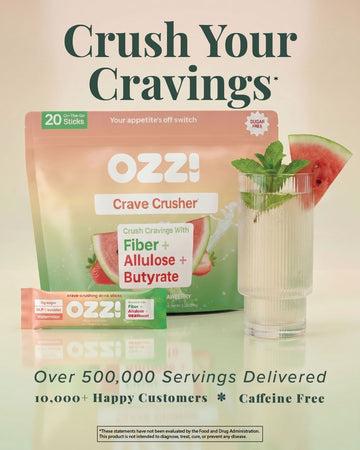
Made with 8g of allulose
Ozzi Crave Crusher
One watermelon stick a day: 8g allSWEET allulose, 500mg konjac glucomannan, 500mg BIOMEnd L-lysine butyrate, 300mcg chromium, 10mg ursolic acid and 150mg African mango. No caffeine, no stimulants, and every dose printed on the label.
See what's in it →References
- Osborn L, DuPuis K, Liu S, et al. Glycemic and cardiometabolic effects of rare sugars allulose and tagatose: a systematic review and meta-analysis of controlled human intervention trials. Am J Clin Nutr. 2026;123(6):101314. https://doi.org/10.1016/j.ajcnut.2026.101314
- Braunstein CR, Noronha JC, Khan TA, et al. Effect of fructose and its epimers on postprandial carbohydrate metabolism: a systematic review and meta-analysis. Clin Nutr. 2020;39(11):3308-3318. https://doi.org/10.1016/j.clnu.2020.03.002
- Franchi F, Yaranov DM, Rollini F, et al. Effects of D-allulose on glucose tolerance and insulin response to a standard oral sucrose load. BMJ Open Diabetes Res Care. 2021;9(1):e001939. https://doi.org/10.1136/bmjdrc-2020-001939
- Buranapin S, Kosachunhanan N, Waisayanand N, et al. Effects of D-allulose with sucrose beverage on glucose tolerance and insulin levels among Thai healthy volunteers. J Nutr Sci Vitaminol. 2024;70(3):203-209. https://doi.org/10.3177/jnsv.70.203
- Noh J, Kim HR, Han J, et al. Differential modulation of postprandial glycemic, incretin, and satiety responses by low-digestible carbohydrates in humans. Nutrients. 2026;18(11):1742. https://doi.org/10.3390/nu18111742
- Han Y, Choi BR, Kim SY, et al. Gastrointestinal tolerance of D-allulose in healthy and young adults. Nutrients. 2018;10(12):2010. https://doi.org/10.3390/nu10122010
- Xiao Z, Wu S, Liang H, Li B, Li J. Effects of oligosaccharides, sodium carboxymethyl cellulose and d-allulose as a compound improver on the quality of sugar-reduced bread. J Sci Food Agric. 2025;105(5):3024-3035. https://doi.org/10.1002/jsfa.14065
- Kimura T, Kanasaki A, Hayashi N, et al. D-allulose enhances postprandial fat oxidation in healthy humans. Nutrition. 2017;43-44:16-20. https://doi.org/10.1016/j.nut.2017.06.007
- Fukunaga K, Yoshimura T, Imachi H, et al. A pilot study on the efficacy of a diabetic diet containing the rare sugar D-allulose in patients with type 2 diabetes mellitus. Nutrients. 2023;15(12):2802. https://doi.org/10.3390/nu15122802
- Ayesh H, Suhail S, Ayesh S. Impact of allulose on blood glucose in type 2 diabetes: a meta-analysis of clinical trials. Metabol Open. 2024;24:100329. https://doi.org/10.1016/j.metop.2024.100329
- Busch S, Ferrario PG, Henk AK, et al. Effects of allulose vs aspartame consumption on postprandial GLP-1 profiles: protocol for a randomized crossover trial (results not yet reported). JMIR Res Protoc. 2026;15:e81857. https://doi.org/10.2196/81857
- US Food and Drug Administration. Guidance for Industry: The Declaration of Allulose and Calories from Allulose on Nutrition and Supplement Facts Labels. 2020. FDA.gov
Peer-reviewed sources retrieved via PubMed. This article is for general information and is not medical advice. These statements have not been evaluated by the Food and Drug Administration. This product is not intended to diagnose, treat, cure or prevent any disease.
