

Stopping Ozempic: Side Effects, Timeline, and What to Expect
Stopping Ozempic does not cause classic withdrawal. Semaglutide clears over about five weeks, and as it does, appetite and food noise return, gastric emptying speeds back up, and any blood sugar benefit fades. Most people notice hunger returning within two to four weeks of the last dose.
Key takeaways
- No true withdrawal syndrome exists for semaglutide
- The drug clears over roughly five weeks
- Appetite returns before the scale moves
- Nausea and constipation resolve as a benefit
- Nearly 65% of non-diabetic users stop within a year
Are there real withdrawal symptoms from stopping Ozempic?
Semaglutide is not a drug of dependence, and there's no withdrawal syndrome from stopping Ozempic in the sense that word usually implies. You won't get tremors, rebound headaches, or anything requiring a medical taper for safety reasons.
What people call "withdrawal" is really the removal of an effect. The medication was doing three things: slowing gastric emptying, amplifying satiety signaling, and quieting the mental loop around food. Take it away and all three revert.
Semaglutide has a half-life of about one week, so it takes roughly five weeks to substantially clear your system. That's a slow fade rather than a cliff, which is why the return of appetite feels gradual for most people rather than sudden.
What is the week-by-week timeline after your last dose?
| Timeframe | What most people notice |
|---|---|
| Week 1 | Little change. Drug levels are still near steady state. |
| Weeks 2 to 4 | Appetite returns. Food noise comes back. Meals stop feeling filling as early. Nausea and constipation start improving. |
| Week 5 | Substantially cleared. Digestion back to baseline speed. Evening cravings are usually the loudest signal at this point. |
| Months 2 to 3 | Weight regain typically becomes measurable. Blood sugar drifts up for those who had improvements. |
| Month 12 | Trial data shows about two-thirds of lost weight regained, with cardiometabolic markers near baseline. |
That last row comes from the STEP 1 trial extension in Diabetes, Obesity & Metabolism, where participants who had lost 17.3% of body weight over 68 weeks regained 11.6 percentage points in the year after stopping.
Which side effects actually go away when you stop?
The gastrointestinal side effects go away when you stop Ozempic: nausea fades, constipation improves, and reflux and early fullness resolve. This part gets buried, and it's genuinely good news.
Gastrointestinal effects are the most common reason people stop in the first place. A review of the STEP program in Postgraduate Medicine confirms GI events were the most frequently reported adverse events across STEP 1 through 5. In the real-world cohort of 125,474 US adults published in JAMA Network Open, moderate or severe GI adverse events raised the likelihood of discontinuation substantially.
When you stop, those resolve. Specifically:
- Nausea fades as gastric emptying returns to normal speed
- Constipation improves as gut motility picks back up
- Reflux and early fullness resolve
- Food aversion lifts, and food becomes enjoyable again
- Fatigue often improves as calorie intake normalizes
One of our customers described the contrast plainly: "It's so much more pleasant than the feeling I got from the GLP-1 meds. No nausea at all."
Stopping isn't only loss. The nausea goes, the constipation goes, and food gets to be enjoyable again.
Why does food noise come back so loudly?
Food noise comes back so loudly because the drug's satiety signal is gone and, because you lost weight, you're returning to a hungrier version of your old appetite. Two separate things are happening at once, and most people only account for one.
The obvious one: the drug's satiety signal is gone.
The one that catches people off guard: weight loss itself changes your appetite hormones, and those changes persist. Sumithran and colleagues published the definitive study on this in the New England Journal of Medicine. After a 10-week weight-loss program, ghrelin rose and leptin, peptide YY and cholecystokinin fell. A full year later, those hormones still had not returned to baseline, and subjective hunger was still significantly elevated.
So you're not returning to your pre-medication appetite. You're returning to a hungrier version of it, because you lost weight. Your cravings aren't really a willpower problem, they're a hormone problem.
A 2026 review covering more than 289,000 patients describes the same thing in clinical terms: reactivation of orexigenic pathways combined with adaptive thermogenesis.
Natural GLP-1 support
Ozzi Crave Crusher
A daily drink stick that supports your body's own GLP-1 production instead of replacing it. 8g allulose, 500mg BIOMEnd L-lysine butyrate, 500mg glucomannan, plus African mango and chromium. No caffeine, no stimulants, vegan.
"I cannot say enough about this product. I was on a GLP-1 for 2 years and benefited most from the food noise reduction. I chose to get off of it due to its high cost. I have tried absolutely everything on the market and nothing, absolutely nothing has had the same effect until I came across Ozzi. I am a customer for life!"Noralyn, verified customer
14-Day Ozzi Challenge: take it for 14 straight days. If your cravings and food noise aren't quieter, we'll refund your first bag.
What should you have in place before your last dose?
The single biggest predictor of how this goes is whether you set things up in advance. Appetite suppression is your window, so use it.
- Resistance training, started 4 to 8 weeks early. Incretin therapies cost around 10% of lean mass, roughly 6kg, per a review in Diabetes Care. That same review found supervised resistance training beyond 10 weeks can add about 3kg of lean mass and 25% strength, and proposes that holding lean mass blunts fat regain after stopping.
- A protein number you actually hit. Protein at every meal defends muscle and adds satiety on its own.
- A daily fiber and butyrate habit. These work on consistency. Start before you need them so it's automatic by the time appetite returns.
- An evening plan. Around 45% of Ozzi customers name after-dinner snacking as their core problem. Nights are where this shows up first.
- A check-in date with your prescriber. Put it on the calendar for 8 to 12 weeks out, before you need it.
Can you support your GLP-1 pathway naturally after stopping?
You can support your GLP-1 pathway naturally after stopping Ozempic, because the intestinal L-cells that produce GLP-1 are intact. This is where the good news lives.
Your intestinal L-cells produce GLP-1 in response to what arrives in your gut. That machinery is intact. It never went anywhere. What it responds to is fiber, fermentation, and the short-chain fatty acids your gut bacteria make.
Butyrate is the headline here. It's a postbiotic your gut bacteria produce when they ferment fiber, it's the primary fuel for the cells lining your colon, and it supports gut barrier function. In mouse and cell studies it stimulates the L-cells that secrete GLP-1, which is the proposed mechanism behind the interest in it. Human confirmation is still pending.
What's confirmed in humans is delivery. A 2025 crossover trial in healthy adults dose-matched three butyrate forms and measured serum butyrate by GC-MS. L-lysine butyrate, the BIOMEnd form, hit peak serum butyrate at 20 minutes, about 5 times tributyrin's peak.
Glucomannan works by a completely different and very physical route. It's a viscous fiber from konjac root that absorbs water and expands in your stomach. A network meta-analysis of 111 randomized trials in Pharmacological Research found a mean weight difference of 1.36kg versus control.
Allulose handles the sweet cravings without the blood sugar consequences of sugar, at about a tenth of the calories.
Your L-cells never stopped working. They just stopped being the loudest voice in the room.
When should you call your doctor?
Talk to your prescriber before you stop, not after. Beyond that, reach out if:
- You have type 2 diabetes and your glucose readings are climbing
- You regain past the line you set for yourself
- Binge eating or a return of disordered eating patterns shows up
- You're stopping over cost and haven't explored every coverage option
- Any new or unexplained symptom appears
Stopping for cost is extremely common, and worth a conversation before you assume it's your only option.
Daily support for the transition
Ozzi supports natural GLP-1 production, adds viscous fiber, and takes the edge off sweet cravings with allulose instead of sugar.
"I've been using Ozzi for just a few days now but it definitely curbs my hunger. It's so much more pleasant than the feeling I got from the GLP-1 meds. No nausea at all. And it tastes great too!"Dan, verified customer
Join 13,000+ Ozzi customers. 14-Day Ozzi Challenge: take it for 14 straight days. If your cravings and food noise aren't quieter, we'll refund your first bag.
Frequently asked questions
What are the side effects of stopping Ozempic?
There's no withdrawal syndrome. The effects are the return of appetite and food noise, faster gastric emptying, and loss of any blood sugar or blood pressure benefit over the following months. Nausea, constipation and reflux improve.
How long does it take Ozempic to leave your system?
Semaglutide's half-life is about one week, so roughly five weeks for substantial clearance. Effects fade gradually across that window rather than stopping abruptly.
Do I need to taper off Ozempic?
Not for safety. There are no validated tapering protocols for weight regain prevention either. The 2026 review in Diabetes, Obesity & Metabolism notes this gap and recommends structured transition support instead. Your prescriber should make the call.
Will my blood sugar go back up?
If you had improvements, they generally fade. Pooled data suggests glycemic, blood pressure and lipid parameters return to baseline within about 12 months, with HbA1c taking 12 to 18 months. Anyone with type 2 diabetes should be monitored through this.
How quickly will I feel hungry again?
Most people notice appetite returning between weeks 2 and 4 after the last dose. Evening cravings usually show up before daytime hunger does.
Is it normal to stop within a year?
Very. In a cohort of 125,474 US adults, 64.8% of those without type 2 diabetes had discontinued within one year, versus 46.5% of those with type 2 diabetes.
Can I restart later?
Many people do. In the same cohort, about 36% of non-diabetic patients had reinitiated within a year, and weight regain was the strongest predictor. That's a conversation for your prescriber.
Does Ozzi have side effects?
Ozzi contains fiber, and some people notice mild digestive adjustment in the first few days. Starting with half a stick helps. No caffeine, no stimulants, no artificial sweeteners.
Can I take Ozzi while still on a GLP-1 medication?
Plenty of customers do, often starting before they taper. Check with your prescriber first, particularly if you're managing gastrointestinal side effects.
Related reading
- Quitting Ozempic: how to transition off GLP-1 drugs
- The rebound effect: long term GLP-1 usage issues
- Natural GLP-1 vs GLP-1 agonists
- GLP-1 bloating and constipation relief
- How to keep weight off after Ozempic
- Best foods to increase butyrate in your gut
- What is GLP-1?
Built for daily, long-term use
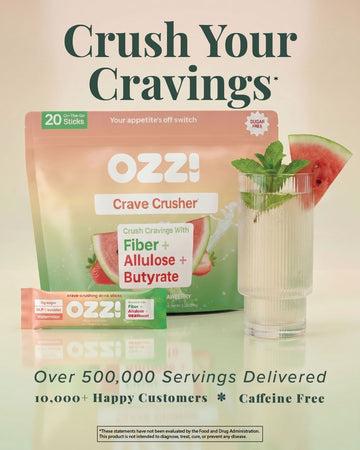
Ozzi Crave Crusher
A caffeine-free drink stick with 8g allulose, konjac fiber and L-lysine butyrate, made to be taken every day rather than cycled. Not a medication and not a replacement for one; talk to your prescriber about anything clinical.
See what's in it →References
- Wilding JPH, et al. Weight regain and cardiometabolic effects after withdrawal of semaglutide: The STEP 1 trial extension. Diabetes Obes Metab. 2022;24(8):1553-1564. https://doi.org/10.1111/dom.14725
- Sumithran P, et al. Long-term persistence of hormonal adaptations to weight loss. N Engl J Med. 2011;365(17):1597-1604. https://doi.org/10.1056/NEJMoa1105816
- Shah E, et al. Clinical management of weight regain and cardiometabolic consequences after discontinuation of GLP-1 receptor agonists. Diabetes Obes Metab. 2026;28(6):4546-4558. https://doi.org/10.1111/dom.70713
- Rodriguez PJ, et al. Discontinuation and reinitiation of dual-labeled GLP-1 receptor agonists among US adults with overweight or obesity. JAMA Netw Open. 2025;8(1):e2457349. https://doi.org/10.1001/jamanetworkopen.2024.57349
- Amaro A, et al. Efficacy and safety of semaglutide for weight management: evidence from the STEP program. Postgrad Med. 2022;134(sup1):5-17. https://doi.org/10.1080/00325481.2022.2147326
- Locatelli JC, et al. Incretin-based weight loss pharmacotherapy: can resistance exercise optimize changes in body composition? Diabetes Care. 2024;47(10):1718-1730. https://doi.org/10.2337/dci23-0100
- Shahinfar H, et al. Comparative effects of nutraceuticals on body weight in adults with overweight or obesity: a network meta-analysis of 111 randomized clinical trials. Pharmacol Res. 2023;196:106944. https://doi.org/10.1016/j.phrs.2023.106944
- La Monica MB, et al. Comparative pharmacokinetics of three butyrate supplements in healthy adults. J Exerc Nutr. 2025;8(1):4. NCT06700785.
This article is for general information and is not medical advice. Ozzi is a dietary supplement and is not intended to diagnose, treat, cure or prevent any disease. Never start, stop or change a prescription medication without talking to your healthcare provider.
