

Do Fiber Supplements Work for Weight Loss? The Honest Numbers
Fiber supplements produce modest weight loss when paired with a calorie deficit. A 2021 meta-analysis of 15 randomized trials in 1,347 people found viscous fiber supplementation alongside a calorie-restricted diet reduced body weight by 0.81 kg, about 1.8 pounds, compared with control. In an 8-week trial where participants took 4 g of glucomannan daily but ate their normal diet, there was no significant weight loss versus placebo. The mechanism is bulk and slowed stomach emptying, which makes eating less feel easier rather than burning fat directly.
Key takeaways
- Viscous fiber plus a calorie deficit: about 1.8 pounds over the trial period.
- Fiber alone, with no diet change: no significant weight loss in the best-controlled trial.
- Psyllium reliably reduces hunger between meals, which is the actual mechanism.
- Viscosity is what matters. Inulin and wheat dextrin don't gel, so they don't do this job.
- Dose is 3 g or more with a full glass of water, 30 minutes before a meal, ramped up slowly.
The honest number is 1.8 pounds
Let's start where most articles on this topic end, because the number is the whole story.
In 2021, researchers at the University of Toronto and St. Michael's Hospital pooled 15 randomized controlled trials covering 1,347 people. Everyone in these trials was on a calorie-restricted diet. Half also got a viscous fiber supplement, the gel-forming kind: psyllium, glucomannan, guar gum, beta-glucan.
The fiber group lost 0.81 kg more than the control group. That's 1.8 pounds. They also lost 1.39 percent more body fat and dropped their BMI by 0.25 points. The researchers graded the certainty of that evidence as moderate, which in this field is a respectable grade.1
So fiber supplements work. They just work at the scale of 1.8 pounds, not the scale the category markets itself at.
The trial nobody quotes
Here's the part that should shape how you buy.
In 2013, a team at Rush University ran a trial that asked a simpler question: what happens if you give people fiber and change nothing else? Fifty-three overweight adults took either 1.33 g of glucomannan or a placebo, three times a day before meals, for 8 weeks. Everyone ate their own self-selected diet.
At 8 weeks, the glucomannan group had lost 0.40 kg. The placebo group had lost 0.43 kg. The placebo group did marginally better, and the difference between them was nothing at all. Hunger and fullness ratings didn't differ either. The supplement was well tolerated and it did not work.2
Put those two studies side by side and you have the real answer. Fiber plus eating less beats eating less alone, by a little. Fiber instead of eating less beats nothing at all.
I'd rather tell you that than sell you a bag of psyllium on a promise it can't keep.

What fiber actually does to hunger
The satiety effect is real and it's been measured properly.
Researchers at Purdue and the University of Colorado ran two placebo-controlled crossover trials on psyllium at 3.4 g, 6.8 g and 10.2 g taken before breakfast and lunch. Across the doses, psyllium reduced hunger and desire to eat between meals, and increased fullness, compared with placebo.3
Now the part that surprised me when I first read it, and that almost nothing written about fiber mentions.
A 2010 study out of the University of Eastern Finland fed 16 volunteers meals enriched with 23 g of psyllium and measured their gut hormones afterward. You'd expect a big fiber load to raise GLP-1 and PYY, the fullness hormones. It did the opposite. The psyllium-enriched meal strongly attenuated the release of both.4
People still felt fuller. The fullness just wasn't coming from hormones. It was coming from physical volume in the stomach and food leaving the stomach more slowly.
That distinction matters if you're shopping. Viscous fiber is a mechanical tool. If what you want is gut hormone support, fiber is not the ingredient doing that job, and a product selling you fiber as a GLP-1 lever is stretching. We wrote up how the hormone side actually works in how to increase GLP-1 naturally.
Which fiber supplement is best for weight loss
Only the gel-forming ones do this job. Here's the field.
| Fiber | Gels? | Studied dose | Verdict for appetite |
|---|---|---|---|
| Psyllium | Yes, strongly | 3.4 to 10 g before meals | The best-evidenced pick. Cheap, boring, works. |
| Konjac glucomannan | Yes, the most | 3 g daily in the positive trials | Highest water absorption of the group. Trial results are mixed. |
| Beta-glucan (oat) | Yes | 3 g daily | Included in the viscous fiber meta-analysis. Easiest to get from food. |
| Inulin / chicory root | No | 7 to 12 g in trials | A prebiotic, not a satiety fiber. Gassy at real doses. |
| Wheat dextrin | No | Varies | Dissolves clear and does nothing for fullness. Fine for regularity. |
If a fiber supplement dissolves into clear water with no thickness, it is not doing the job described in this article. The gel is the mechanism. There's more on the individual fibers in our guide to the best fiber for appetite control and a deeper look at konjac in konjac root and weight loss.
How to take it so it actually works
Most people who say fiber did nothing for them made one of these four mistakes.
Take it before the meal, not with it. The trials that found a satiety effect dosed 30 to 60 minutes ahead. Fiber taken alongside food is just fiber in food.
Use enough water. A full 8 ounce glass, minimum. This isn't a suggestion about comfort. Expanding fiber that doesn't have enough water can lodge in the throat or esophagus, which is the one genuine safety issue in this category.
Ramp up over two weeks. Going from a low-fiber diet to 10 g of psyllium overnight produces gas and cramping, and people quit at that point. Start at a third of the target dose.
Hit the dose the studies used. A gram of fiber sprinkled into a scoop of something else is not a satiety dose. The research runs at 3 g and up.
Who should skip fiber supplements
Talk to your doctor first if you take medication on a fixed schedule, because viscous fiber can slow how some oral drugs absorb. Separating them by a couple of hours is the usual advice, but that's a conversation for your prescriber, not a blog.
Skip it entirely if you have a history of bowel obstruction, difficulty swallowing, or a narrowed esophagus. And if you have IBS, know that psyllium is generally well tolerated while the fermentable prebiotic fibers commonly are not.
Where our own fiber fits, honestly
Ozzi contains 500 mg of konjac glucomannan. That is below the 3 g the standalone glucomannan trials used, and I'm not going to pretend otherwise.
It's in there to do one specific job: add a little physical fullness in the window where cravings hit, alongside five other actives working different pathways. Allulose covers the sweet craving and the gut hormone side. Butyrate works the L-cells. Chromium supports blood sugar control. The fiber contributes body, not the whole effect.
If what you want is a fiber supplement, buy psyllium. It's cheap, it's the best studied, and a tub lasts months. That's a genuinely good purchase and it isn't ours.
Ozzi is for a different problem, which is the 9pm craving that a spoon of psyllium in the morning does nothing about. Different job, different product, and you should buy the one that matches your actual problem.
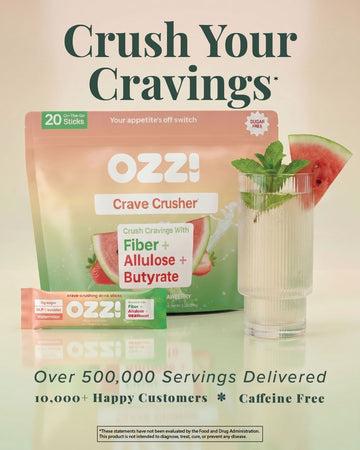
500mg of konjac fiber, plus five more actives
Ozzi Crave Crusher
Fiber alone is a small lever. Ozzi pairs 500mg of konjac glucomannan with 8g of allulose, 500mg of BIOMEnd L-lysine butyrate, chromium, ursolic acid and 150mg African mango, so fullness is one of six things working rather than the whole plan. Caffeine-free, every dose printed.
See what's in it →Frequently asked questions
Do fiber supplements really help you lose weight?
Modestly, and only alongside eating less. The pooled trial evidence puts it at about 1.8 pounds over the study period when combined with a calorie-restricted diet.1 Taken without any diet change, the best-controlled trial found no significant weight loss at all.2
What is the best fiber supplement for weight loss?
Psyllium, on the balance of evidence. It gels reliably, it has the clearest satiety data at doses between 3.4 g and 10 g, and it costs very little. Konjac glucomannan absorbs more water but its trial record is mixed.
How much fiber should I take to feel full?
3 g or more of a gel-forming fiber, taken 30 to 60 minutes before a meal with a full glass of water. Below 3 g you're under the doses the research used.
Does fiber raise GLP-1?
Not the way people assume. One study of psyllium-enriched meals found GLP-1 and PYY release was actually reduced, even though people reported feeling fuller.4 Viscous fiber works by adding bulk and slowing stomach emptying rather than by raising fullness hormones.
Is it better to take fiber before or after eating?
Before. Every trial that measured a satiety benefit dosed ahead of the meal, typically by 30 to 60 minutes, so the gel has formed by the time you start eating.
Why does fiber make me gassy?
Usually because you increased too fast, or because you're taking a fermentable fiber like inulin rather than a viscous one like psyllium. Ramp up over two weeks and switch types if the gas doesn't settle.
Can I just eat more fiber instead of supplementing?
Yes, and for most people that's the better move. Beans, oats, barley, chia and psyllium-rich foods deliver the same viscous fiber with the rest of the nutrition attached. Supplements are a convenience, not an upgrade.
References
- Jovanovski E, Mazhar N, Komishon A, et al. Effect of viscous fiber supplementation on obesity indicators in individuals consuming calorie-restricted diets: a systematic review and meta-analysis of randomized controlled trials. Eur J Nutr. 2021;60(1):101-112. Meta-analysis, 15 RCTs, n=1,347. https://pubmed.ncbi.nlm.nih.gov/32198674/
- Keithley JK, Swanson B, Mikolaitis SL, et al. Safety and efficacy of glucomannan for weight loss in overweight and moderately obese adults. J Obes. 2013;2013:610908. Randomized placebo-controlled trial, n=53, 8 weeks. https://pubmed.ncbi.nlm.nih.gov/24490058/
- Brum JM, Gibb RD, Peters JC, Mattes RD. Satiety effects of psyllium in healthy volunteers. Appetite. 2016;105:27-36. Two randomized, double-blind, placebo-controlled crossover trials. Industry-affiliated authors. https://pubmed.ncbi.nlm.nih.gov/27166077/
- Karhunen LJ, Juvonen KR, Flander SM, et al. A psyllium fiber-enriched meal strongly attenuates postprandial gastrointestinal peptide release in healthy young adults. J Nutr. 2010;140(4):737-744. Randomized crossover, n=16. https://pubmed.ncbi.nlm.nih.gov/20147463/
- Shahinfar H, Jayedi A, Torabynasab K, et al. Comparative effects of nutraceuticals on body weight in adults with overweight or obesity: a systematic review and network meta-analysis of 111 randomized clinical trials. Pharmacol Res. 2023;196:106944. https://pubmed.ncbi.nlm.nih.gov/37778464/
- Kaats GR, Bagchi D, Preuss HG. Konjac glucomannan dietary supplementation causes significant fat loss in compliant overweight adults. J Am Coll Nutr. 2015. Randomized, double-blind, placebo-controlled, n=83, 60 days. Industry-affiliated authors. https://pubmed.ncbi.nlm.nih.gov/26492494/
- Turnbull WH, Thomas HG. The effect of a Plantago ovata seed containing preparation on appetite variables, nutrient and energy intake. Int J Obes Relat Metab Disord. 1995;19(5):338-342. Human trial. https://pubmed.ncbi.nlm.nih.gov/7647826/
Peer-reviewed citations retrieved from PubMed. This article is for general education and is not medical advice. These statements have not been evaluated by the Food and Drug Administration. This product is not intended to diagnose, treat, cure, or prevent any disease.
