

Cheapest Way to Boost GLP-1 in 2026: Food, Supplements, and What to Skip
The cheapest way to boost GLP-1 is through food: soluble and fermentable fiber (beans, lentils, oats, cooled potatoes) plus 25-30g of protein per meal. These cost a few dollars a day and stimulate your gut to release GLP-1 naturally. Supplements that concentrate fiber and butyrate are the mid-tier option, and prescription GLP-1 drugs run $199 to $499 a month.
Key takeaways
- Food is the cheapest GLP-1 booster, a few dollars a day.
- Ozempic runs $349-$499/month out of pocket in 2026.
- Fermentable fiber feeds gut bacteria that make GLP-1.
- Protein at 25-30g per meal reliably raises GLP-1.
- Supplements sit between free food and pricey drugs.
What is the cheapest way to boost GLP-1?
Food. Full stop. Nothing beats it on price.
Your gut already makes GLP-1 every time you eat. Certain foods just make it release more. And those foods happen to be some of the cheapest things in the grocery store.
Fermentable fiber (oats, beans, lentils, green bananas, cooled potatoes) gets broken down by your gut bacteria into short-chain fatty acids, which trigger GLP-1 release. A bag of dried lentils costs about the same as a fancy coffee and lasts a week.
Protein does it too. Most high-protein meals stimulate GLP-1, and the general target is 25 to 30g per meal.
The cheapest GLP-1 booster on earth is a pot of lentils. It's just not very convenient at 9pm.
How much does Ozempic cost in 2026?
Let's put real numbers on the expensive end so the comparison is fair.
As of 2026, Ozempic without insurance runs about $349 per month for the lower doses and $499 per month for the 2mg dose, according to GoodRx and Novo Nordisk pricing. That's roughly $4,000 to $6,000 a year.
There have been temporary discounts. New self-pay patients could get $199 for the first two fills through a limited window that was set to end March 31, 2026. A Medicare bridge program offers some beneficiaries $50/month starting mid-2026.
But for most people paying cash, you're looking at hundreds of dollars every month, indefinitely. And if you stop, appetite often comes roaring back.
Cost comparison: free food to prescription
Here's the full range, cheapest to priciest, with the tradeoffs spelled out.
| Approach | Rough cost/month | Effort | Tradeoff |
|---|---|---|---|
| Whole foods (beans, oats, protein) | $30-$80 (groceries) | High (cook, plan) | Time and consistency |
| Bulk fiber powder (psyllium, inulin) | $10-$25 | Low | One lever only, taste |
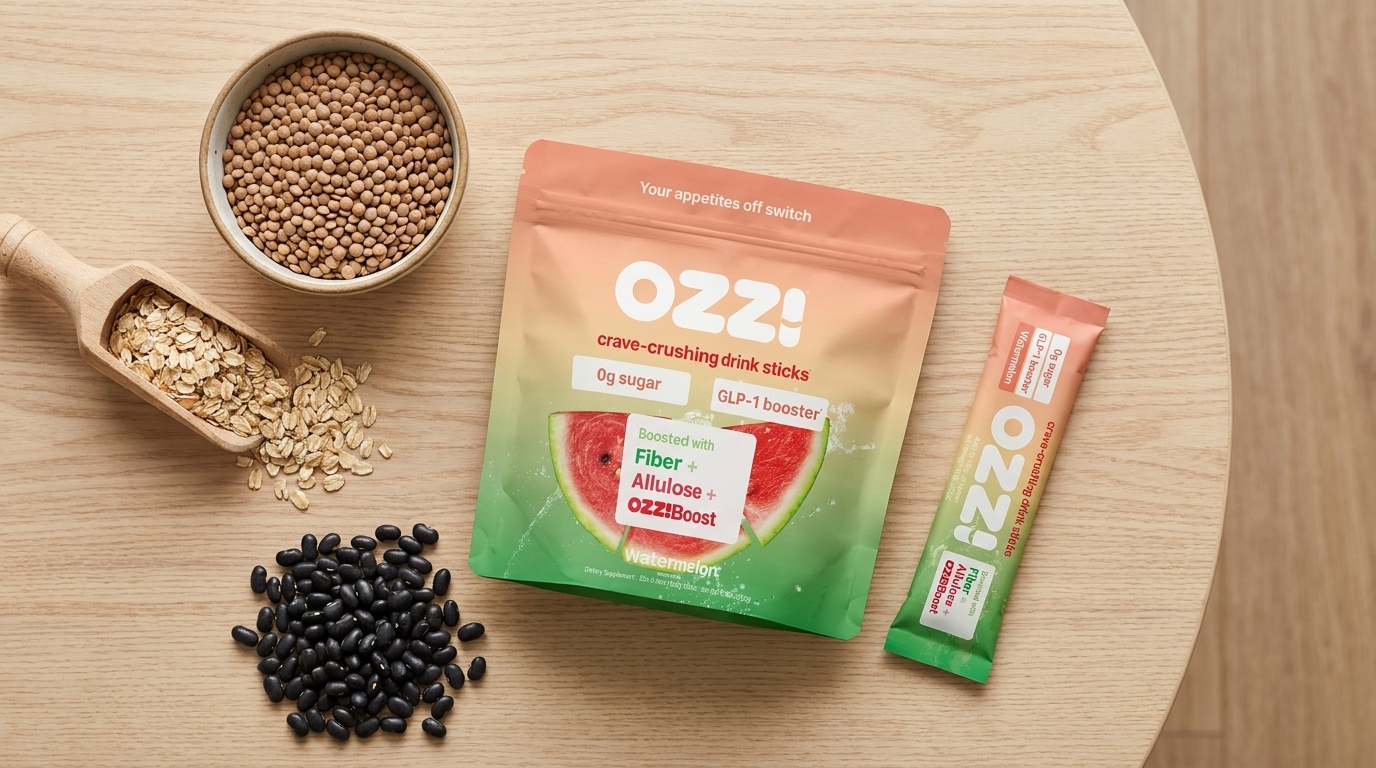
| GLP-1 drink stick (Ozzi) | ~$1-2/day | Very low | Not a drug, supports not replaces |
| Prescription GLP-1 (Ozempic) | $199-$499 | Low (injection) | Cost, side effects, rebound |
The pattern is clear. Cheaper options ask more of you (planning, cooking). More expensive options do more of the work but cost a fortune and carry side effects.
Which cheap foods raise GLP-1 the most?
If you want to do this on a budget, here's your shopping list.
Legumes. Lentils, black beans, chickpeas. Loaded with fermentable fiber and protein at the same time. Pennies per serving.
Oats and barley. Beta-glucan fiber, one of the better-studied fibers for satiety and blood sugar.
Cooled potatoes. When you cook and cool potatoes, they form resistant starch, which your gut bacteria love. Reheating is fine.
Protein. Eggs, Greek yogurt, chicken, tofu. Aim for that 25-30g per meal. Research shows protein reliably nudges GLP-1 up.
Four hours after eating just 24g of fiber, ghrelin (your hunger hormone) can be suppressed as much as if you'd eaten 500 calories of food, per satiety research. That's the power of cheap fiber.
The problem was never that beans don't work. It's that nobody wants to soak beans when the craving hits at 9pm.
Where do supplements fit on price?
Food is cheapest but takes work. Drugs are easiest but cost the most. Supplements sit in the middle, and that's their whole pitch.
A concentrated fiber powder like psyllium is dirt cheap and does one thing (bulk fiber). It works, but it's one lever and it tastes like wallpaper paste.
A formulated GLP-1 drink stick costs more than raw fiber but stacks several ingredients: viscous fiber for fullness, prebiotic fiber and butyrate for the gut GLP-1 pathway, and allulose for sweet cravings. You're paying for the combination and the convenience.
For deeper background, see how to increase GLP-1 naturally and the GLP-1 booster drink guide.

Where does Ozzi land on cost?
I'll be upfront since I make the thing.
Ozzi's Crave Crusher works out to roughly $1 to $2 a day, depending on your plan. That's a fraction of a prescription and it's caffeine-free, so you can drink it in the evening when cravings usually hit.
It won't out-muscle a prescription GLP-1 agonist on raw appetite suppression. It's a natural support, not a drug. But it's built on the same ingredients the research points to (glucomannan, butyrate, inulin, allulose), and it costs less than a coffee.
If it doesn't work for you, we refund your first bag. Try it 14 days straight, and if the cravings don't budge, you get your money back on that first bag.
GLP-1 support for about a dollar a day
Six clinically studied ingredients, zero caffeine, no prescription. Take the challenge: use it 14 days straight. If it doesn't work, we'll refund your first bag.
We priced the options against each other in our comparison of natural GLP-1 supplements, cost per serving included.
Frequently asked questions
What is the cheapest way to boost GLP-1?
Food. Fermentable fiber (beans, oats, lentils, cooled potatoes) and 25-30g of protein per meal cost a few dollars a day and stimulate natural GLP-1 release.
Can food really raise GLP-1 like a drug?
Food raises GLP-1, but not as high or as long as prescription agonists. Drugs keep levels elevated far longer. Food gives you smaller, natural bumps that still help with appetite.
How much does Ozempic cost without insurance?
Around $349/month for lower doses and $499/month for the 2mg dose in 2026, per GoodRx and Novo Nordisk. Roughly $4,000-$6,000 a year.
Is a fiber supplement enough on its own?
Bulk fiber like psyllium helps and is cheap, but it's one lever. Combining viscous fiber, prebiotics, butyrate, and protein works better.
What foods have fermentable fiber?
Legumes, oats, barley, green bananas, and cooled cooked potatoes (resistant starch). All budget-friendly.
Does protein boost GLP-1?
Yes. Most high-protein meals stimulate GLP-1. Aim for 25-30g per meal from any source, animal or plant.
Is Ozzi cheaper than a prescription?
Yes, by a wide margin. It runs about $1-2 a day versus hundreds a month for prescription GLP-1 drugs. It's a natural support, not a drug.
What free habits help?
Walking after meals, staying hydrated, prioritizing protein and fiber, and getting enough sleep all support appetite regulation at zero cost.
- How to Increase GLP-1 Naturally With Supplements and Foods. GoodRx. https://www.goodrx.com/conditions/weight-loss/how-to-increase-glp-1-naturally
- Short-Chain Fatty Acids Stimulate GLP-1 Secretion via FFAR2. Diabetes (ADA). https://diabetesjournals.org/diabetes/article/61/2/364/14608/
- SCFA propionate stimulates GLP-1 and PYY via FFAR2. PMC. https://pmc.ncbi.nlm.nih.gov/articles/PMC4356745/
- A New Dietary Fiber Can Enhance Satiety and Reduce Postprandial Blood Glucose: RCT. PMC. https://pmc.ncbi.nlm.nih.gov/articles/PMC10648557/
- Acute Effect of Resistant Starch on Food Intake, Appetite and Satiety in Overweight/Obese Males. PMC. https://www.ncbi.nlm.nih.gov/pmc/articles/PMC6316739/
- Konjac glucomannan as an emerging nutritional strategy for obesity control. Discover Food, 2025. https://link.springer.com/article/10.1007/s44187-025-00533-0
- Ozempic Cost 2026: Average Price and More. Healthline. https://www.healthline.com/health/drugs/ozempic-cost
These statements have not been evaluated by the Food and Drug Administration. This product is not intended to diagnose, treat, cure, or prevent any disease. This article is for education, not medical advice. Drug prices are approximate and change frequently.
