

What’s in Ozzi Capsules: ingredients, amounts and research
OEA, BIOMEnd® butyrate and konjac fiber, fully dosed, plus African mango, ursolic acid and chromium. Six actives at effective doses, with every amount printed on the label.
Last reviewed November 10, 2026

The capsule formula, per 3 capsules
| Ingredient | Amount and form |
|---|---|
| OEA | 125 mg oleoylethanolamide |
| Butyrate | 500 mg BIOMEnd® L-lysine butyrate |
| Konjac | 500 mg konjac glucomannan |
| African mango | 150 mg African mango seed extract |
| Ursolic acid | Supplied through 10 mg Metabolex® chromium polyursolate |
| Chromium | 300 mcg chromium, supplied through 10 mg Metabolex® chromium polyursolate |
Each serving has 10 mg Metabolex® chromium polyursolate, which supplies ursolic acid and 300 mcg chromium together.
84 capsules, 28 servings per bottle. There’s no caffeine, green tea extract or any other stimulant in the formula.
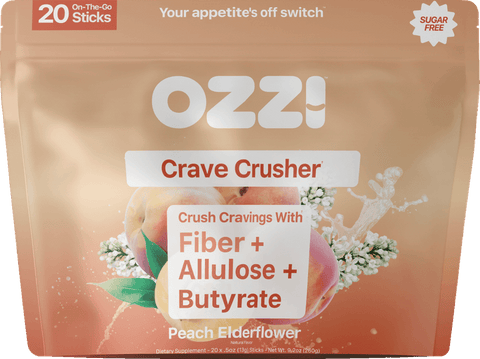
The drink is a different formula, with allulose and no OEA. See what’s in the drink.
OEA (oleoylethanolamide)
125 mg per 3-capsule serving
OEA (oleoylethanolamide) is a molecule your small intestine makes after a meal with fat in it. It’s one of the ways your gut tells your brain you’ve eaten. Each serving gives you 125 mg to support appetite control and natural GLP-1 production.†
What the research shows
In a 60-day randomized, placebo-controlled trial of 60 adults with obesity, the group taking 125 mg OEA twice a day reported less hunger, less desire to eat, fewer sweet cravings and more fullness by the end of the study. That’s the same daily amount as two servings.
How it works
In mouse and cell studies, OEA activated GPR119, a receptor on the gut’s L-cells, and triggered GLP-1 release. It also reduced food intake in rats by switching on PPAR-alpha, a fullness sensor. Two pathways, one molecule your gut already makes.
OEA is the fullness molecule your gut makes from the fat in a meal. In rodents, fat reaching the small intestine raised OEA there, while protein and carbohydrate did not. It isn’t a cannabinoid and it isn’t a stimulant.
Oleoylethanolamide increases the expression of PPAR-Α and reduces appetite and body weight in obese people: A clinical trial.
60 adults with obesity; randomized, double-blind, placebo-controlled; two 125 mg OEA capsules daily for 60 days; 56 completed.
By the end of the study, the OEA group reported less hunger, less desire to eat, fewer sweet cravings and more fullness, along with higher PPAR-alpha expression.
Read the original publicationOleylethanolamide regulates feeding and body weight through activation of the nuclear receptor PPAR-alpha.
Receptor-binding experiments, plus feeding studies in normal mice and in mice lacking PPAR-alpha.
OEA bound PPAR-alpha with high affinity and produced satiety in normal mice, but not in mice without the receptor. It does not bind cannabinoid receptors. The study identified PPAR-alpha as a main route for OEA’s fullness effect.
Read the original publicationDeorphanization of a G protein-coupled receptor for oleoylethanolamide and its use in the discovery of small-molecule hypophagic agents.
Receptor experiments identifying a receptor OEA activates, plus rat feeding studies with compounds that act on the same receptor.
OEA activated GPR119, a receptor found in the gut and pancreas. Compounds that act on GPR119 reduced food intake in rats, which points to GPR119 as one route for OEA’s effect on appetite.
Read the original publicationGPR119 is essential for oleoylethanolamide-induced glucagon-like peptide-1 secretion from the intestinal enteroendocrine L-cell.
Mouse, human and rat intestinal L-cell models, plus OEA delivered directly into the rat intestine.
OEA increased GLP-1 release from L-cells in every model, and reducing GPR119 reduced the response. Delivered into the rat intestine, OEA raised active GLP-1 about 1.5-fold.
Read the original publicationThe lipid messenger OEA links dietary fat intake to satiety.
Rodent experiments infusing fat, protein or carbohydrate into the small intestine, including mice lacking the fat transporter CD36 or PPAR-alpha.
Fat reaching the small intestine raised OEA there, while protein and carbohydrate did not. OEA was made from oleic acid in the meal, and animals without CD36 or PPAR-alpha lost the fullness response to fat.
Read the original publicationButyrate (BIOMEnd® L-lysine butyrate)
500 mg BIOMEnd® L-lysine butyrate per serving
Butyrate is the fuel your gut lining runs on. Your gut bacteria make it from fiber, and Ozzi supplies it directly as BIOMEnd® L-lysine butyrate, which pairs butyrate with the amino acid L-lysine instead of sodium.
What the research shows
Butyrate is the main fuel for the cells lining your colon and helps maintain your gut barrier. In colon-lining cells taken from people, butyrate accounted for about three quarters of the cells’ oxygen use when it was their only fuel.
In a 2025 human crossover study, BIOMEnd® L-lysine butyrate reached peak blood butyrate at 20 minutes, about 5× the peak of tributyrin.
How it works
In mouse and cell studies, butyrate stimulated the L-cells that release GLP-1 and PYY, through a short-chain fatty acid receptor called FFAR2. In a lab model of the gut lining, it helped cells assemble tight junctions, the connections that hold the barrier together.
OEA and butyrate reach the same L-cells from two directions: OEA from the fat in your meal, butyrate from fiber. Together they’re the core of the formula.
A Pharmacokinetic Comparison of Three Butyrate Products
10 healthy men; randomized crossover; lysine butyrate, sodium butyrate and tributyrin, each providing 786 mg butyric acid.
Lysine and sodium butyrate produced greater systemic exposure and earlier peak concentrations than tributyrin. The mean lysine-butyrate peak occurred at the first post-dose sample, 20 minutes.
Read the original publicationRole of anaerobic bacteria in the metabolic welfare of the colonic mucosa in man.
Colon-lining cells isolated from 14 human surgical specimens; oxygen use measured with butyrate, glucose and glutamine as fuels.
Butyrate supplied 73 to 75 percent of the cells’ oxygen use when it was the only fuel. The author concluded that butyrate made by gut bacteria is a major energy source for the colon lining, especially the lower colon.
Read the original publicationShort-chain fatty acids stimulate glucagon-like peptide-1 secretion via the G-protein-coupled receptor FFAR2.
Primary intestinal cell cultures and mice lacking the SCFA receptors FFAR2 or FFAR3.
Short-chain fatty acids stimulated GLP-1 release, and receptor disruption reduced this response. The findings support a receptor-mediated link between intestinal fermentation products and hormone secretion.
Read the original publicationButyrate enhances the intestinal barrier by facilitating tight junction assembly via activation of AMP-activated protein kinase in Caco-2 cell monolayers.
Caco-2 intestinal cell monolayers; butyrate exposure and AMPK-inhibition experiments.
Butyrate increased barrier resistance and promoted tight-junction assembly through an AMPK-linked process. Blocking AMPK prevented key barrier effects.
Read the original publicationKonjac glucomannan
500 mg konjac glucomannan
Glucomannan is a soluble fiber from the root of the konjac plant. It absorbs water and forms a thick gel in your stomach, adding volume your stomach can register.
What the research shows
A meta-analysis of 14 randomized trials found glucomannan supported healthy body weight, cholesterol and fasting blood sugar in adults, which is why it’s one of the best-known fibers for fullness.
Thickness matters too. In a crossover study of 22 healthy adults, more viscous konjac breakfasts improved hunger, fullness and desire-to-eat ratings.
How it works
As the gel forms, it takes up space and slows how food moves and mixes through your digestive tract.
Effect of glucomannan on plasma lipid and glucose concentrations, body weight, and blood pressure: systematic review and meta-analysis.
Meta-analysis of 14 randomized trials with 531 participants.
Glucomannan lowered total and LDL cholesterol, triglycerides, body weight and fasting blood sugar compared with control. HDL cholesterol and blood pressure did not change.
Read the original publicationIn vitro gastric emptying characteristics of konjac glucomannan with different viscosity and its effects on appetite regulation.
22 healthy adults; randomized single-blind crossover breakfasts with different viscosities; separate simulated gastric-emptying experiments.
Higher-viscosity breakfasts improved subjective hunger, fullness and desire-to-eat ratings and altered appetite-related hormone responses. Subsequent food intake changed only slightly.
Read the original publicationAfrican mango
150 mg African mango seed extract (Irvingia gabonensis)
African mango extract comes from the seed of Irvingia gabonensis, a West African fruit tree. It’s in the formula for appetite control and metabolic support.
What the research shows
In a 10-week randomized, placebo-controlled trial, a standardized African mango seed extract supported healthy body weight, waist size, cholesterol and blood sugar markers. That trial used 150 mg twice a day, the same daily amount as two servings.
How it works
In cell studies, the extract slowed the development of new fat cells and changed the expression of leptin, a fullness hormone, and adiponectin, which helps regulate blood sugar and fat use.
IGOB131, a novel seed extract of the West African plant Irvingia gabonensis, significantly reduces body weight and improves metabolic parameters in overweight humans in a randomized double-blind placebo controlled investigation.
102 overweight or obese adults; randomized double-blind study; IGOB131 extract 150 mg twice daily before meals for 10 weeks.
IGOB131 improved weight, waist and body-fat measures as well as several metabolic markers compared with placebo. This is an important positive study of a specific African-mango seed extract.
Read the original publicationInhibition of Irvingia gabonensis seed extract (OB131) on adipogenesis as mediated via down regulation of the PPARgamma and leptin genes and up-regulation of the adiponectin gene.
Murine 3T3-L1 adipocytes exposed to IGOB131 extract in culture.
The extract reduced fat-cell development and altered expression of PPAR-gamma, leptin and adiponectin. These findings offer a mechanistic explanation worth testing in humans.
Read the original publicationUrsolic acid
Supplied through 10 mg Metabolex® chromium polyursolate
Ursolic acid is a plant compound found in apple peel and herbs like rosemary. In Ozzi it comes bound to chromium in one ingredient, Metabolex® chromium polyursolate.
How it works
In animal and cell studies, ursolic acid activates AMPK, your cells’ switch for burning fuel instead of storing it. In rats, it increased how much fat muscle took up and burned. In mice, it increased muscle and brown fat and raised energy expenditure.
Ursolic acid increases energy expenditure through enhancing free fatty acid uptake and β-oxidation via an UCP3/AMPK-dependent pathway in skeletal muscle.
Diet-induced obese rats receiving 0.5% ursolic acid for six weeks, plus cell experiments.
Ursolic acid increased fatty-acid uptake and oxidation through an UCP3/AMPK-linked pathway. The animal experiments also showed lower weight and altered muscle lipid metabolism.
Read the original publicationUrsolic acid increases skeletal muscle and brown fat and decreases diet-induced obesity, glucose intolerance and fatty liver disease.
High-fat-fed mice receiving a diet with ursolic acid.
Ursolic acid increased muscle Akt signaling, muscle and brown-fat measures, and energy expenditure while improving obesity-related outcomes. The work provides a biological rationale for metabolic and muscle research.
Read the original publicationChromium
300 mcg chromium, supplied through 10 mg Metabolex® chromium polyursolate
Chromium is an essential mineral that helps insulin move glucose into your cells. It’s one of the most researched minerals for blood sugar support, and each serving provides 300 mcg as Metabolex®.
What the research shows
In an 8-week randomized, placebo-controlled trial of 42 overweight women with carbohydrate cravings, chromium picolinate reduced food intake, hunger and fat cravings.
Effects of chromium picolinate on food intake and satiety.
42 overweight women reporting carbohydrate cravings; 1,000 mcg elemental chromium as picolinate daily versus placebo for eight weeks; 40 analyzed.
Chromium picolinate reduced measured food intake, hunger and fat cravings compared with placebo. The difference in weight change did not reach statistical significance.
Read the original publicationThe full label
Every amount is printed on the bottle. Open the Supplement Facts panel.
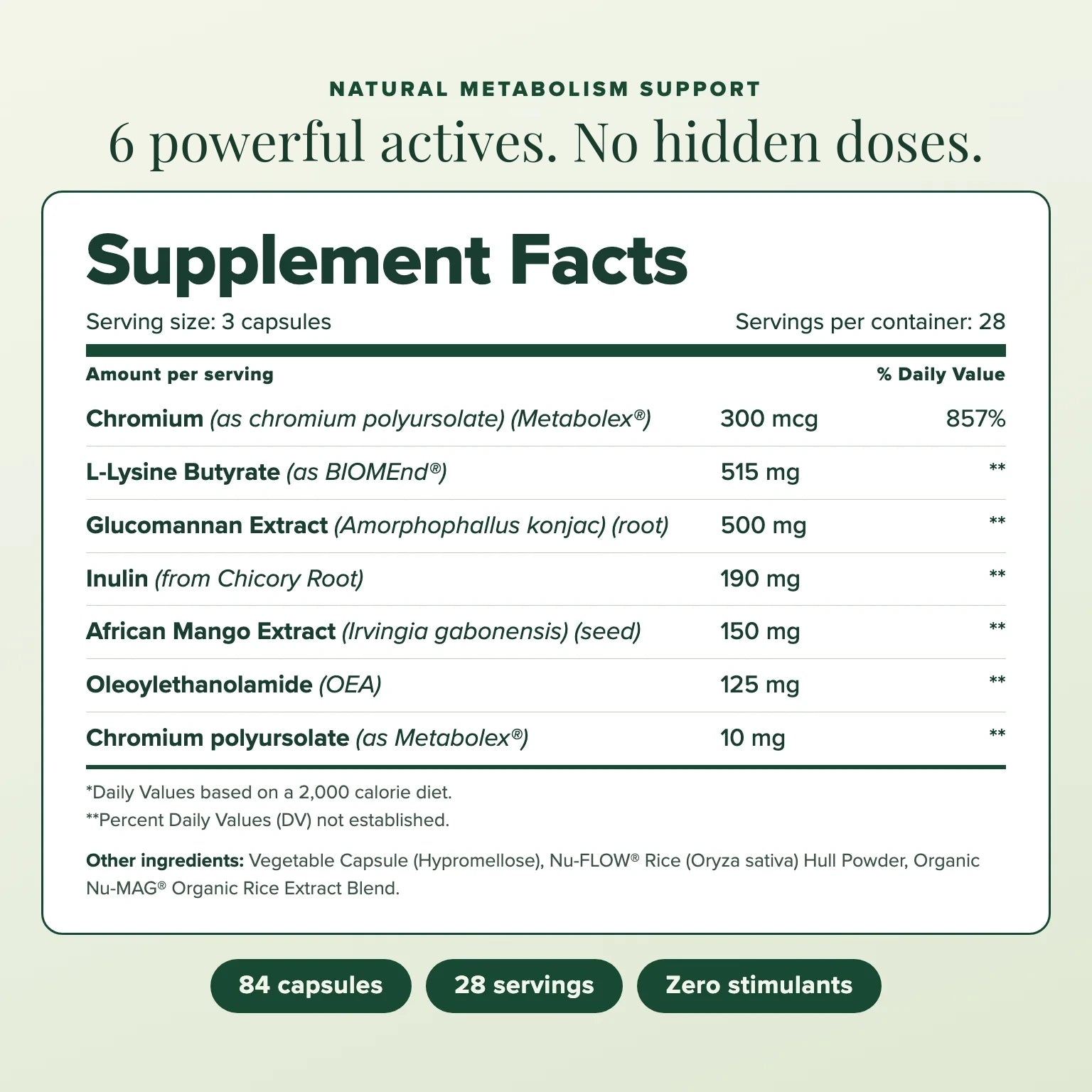
Other ingredients: Vegetable Capsule (Hypromellose), Nu-FLOW® Rice (Oryza sativa) Hull Powder, Organic Nu-MAG® Organic Rice Extract Blend.
Allergen statement: This product is manufactured in a facility that also processes other products which may contain milk, eggs, fish, shellfish, tree nuts, peanuts, soy, wheat, and sesame.
Directions
Take 3 capsules with at least 12 oz of water, 30 minutes before a meal, once or twice a day. Leave at least 4 hours between servings. Before lunch is a great place to start.
Not intended for use by persons under 18. Do not use if pregnant, nursing, or planning to become pregnant. Consult your healthcare provider before use, especially if you are taking medication or have a medical condition.
OEA, BIOMEnd® butyrate and konjac fiber, fully dosed.
Shop Ozzi Capsules†These statements have not been evaluated by the Food and Drug Administration. This product is not intended to diagnose, treat, cure, or prevent any disease. BIOMEnd® is a registered trademark of Velocity Life Sciences LLC. Metabolex® is a registered trademark of American Research Sciences, LLC.